Honeybees find their way back to the hive using three tools working together: a sun (and polarized-sky) compass that gives them a heading even when the sun is hidden behind clouds; the famous waggle dance, deciphered by ethologist Karl von Frisch (who won the 1973 Nobel Prize for it), which lets one bee tell others the direction and distance of a food source; and a detailed mental map of landmarks (hedgerows, treelines, fields) that they build up on their first orientation flights and reinforce with help from a learning gene called Egr.
Many people in the world, myself included, struggle with keeping their bearings when they’re out wandering in the world. For example, if I am running errands and try to get clever and take a shortcut, there is about a 50/50 chance that I’ll get turned around and end up having to use my smartphone to guide me back home. Many people seem to have a natural sense of direction… but we’re not all that lucky.
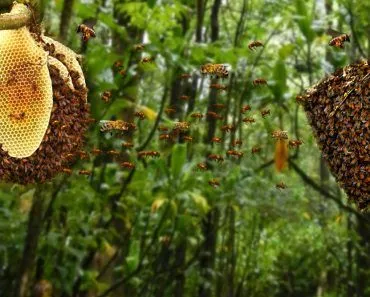
In the animal kingdom, this innate ability is seen far more often, which is why some animals can forage for miles through the wilderness, yet still manage to find their way home. One of the most notable navigators are bees, which manage to find their way back to the hive every time, even if they forage far from their honeycomb home.
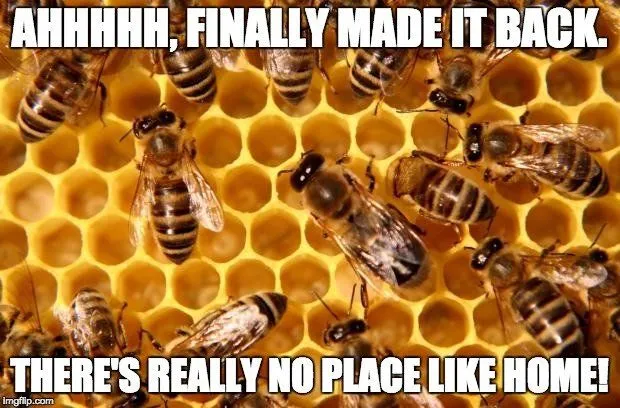
For insects with tiny brains, this raises an interesting question… how do bees find they way back?
Short Answer: Bees use a combination of sunlight and mental maps of their surrounding geography to ensure that they never get lost.
The Busy Lives Of Bees
In the complex world of honeybees, there are three main roles – queen, worker and drone. The queen is responsible for laying all the eggs that will keep the population of the hive stable or growing. Her only job is to have sex and have babies, and be well taken care of in the meantime. A queen can live for 2-3 years, and even up to 5 on the outside.
Queens produce unfertilized eggs that become drones – male honeybees. A drone’s only real purpose is to mate with the queen, and once this is accomplished, the drone will die soon after. If the drone fails to mate, it will be cast out of the hive, where it will likely die from cold or starvation.
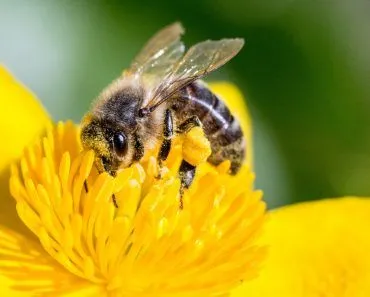
The worker bees are the ones who truly keep the hive running. These worker bees are smaller than the other two classes, but they make up the vast majority of the hive. These are also the bees that you encounter out in the world. Worker bees spend the first few weeks of their lives working inside the hive, but they eventually move up to foraging, which is when they fly out of the hive to seek out pollen and nectar. The average life span of these workers, particularly during labor-intensive pollen season, is no more than two months. That’s also why they can get a bit testy when you try to steal their honey!
With such short life spans, and so much work to do to feed a constantly growing population, it is important that bees not waste time getting lost when they’re out foraging for food. Depending on the conditions and availability of food, bees will fly up to seven miles from the hive in search of food, representing a total search area of more than 100,000 acres. For those of you who get lost in a grocery store, bees finding their way home after endless zig-zagging and hunting for pollen seems like an impossible task. And yet… here we are.
The Navigation Tricks Of Bees
This question of bee navigation is hardly a new one, and many research studies have found that bees use the particular angle of the sun to guide their flight path. Once they locate a source of nectar or pollen, they collect the bounty, turn tail, and head back the same way they came, keeping the sun at the same angle once again. If a bee maintains a strict angle between the angle of flight and the angle of the sun, it should be able to easily replicate that on the way back to the hive. (Cloudy day? No problem — bees can also pick out the sun’s position from the pattern of polarised light in even a small patch of blue sky, a trick first decoded by Karl von Frisch.)
This sun theory became even more interesting due to the bees’ apparent ability to communicate the direction of the food to other bees, through the legendary “waggle dance” — work that earned the Austrian ethologist Karl von Frisch the Nobel Prize in Physiology or Medicine in 1973. There was some speculation on this theory, because the brains of bees were so small, and it wasn’t believed that they could comprehend location and communication at this level, but repeated tests have shown that their navigation instructions to other bees are accurate, and that distinct elements of the dance relate to whether the sun is behind or in front of the foraging bee.
However, the story doesn’t stop there. It has also been found that bees possess a particular gene, called Egr, that is activated when a bee is exposed to a novel environment. The same gene has been found in other vertebrates and is activated in unfamiliar surroundings, and is believed to be linked to learning. Essentially, when worker bees leave the hive the first few times, before going on proper foraging runs, this gene becomes activated, allowing bees to “become” better navigators in a very short amount of time.
Finally, there is the mental maps theory. Certain experiments to refute or add to the theory of sun-navigation for bees has involved confusing bees and their body clocks, making it more difficult for them to understand the direction of their hive based on the movement of the sun. By drugging bees that had been out on a foraging run for six hours, it was believed that the bees would be disoriented and unable to find the hive.
On the contrary, it took approximately the same amount of time for the drugged bees to return to the hive. This made it very clear that the geographic elements of the surroundings also have an impact on bees’ ability to navigate while foraging. By creating a mental map of hedgerows, orchards, fields, and natural landmarks, bees basically have a GPS screen in front of their eyes, guiding their trips back and forth from the hive.
Now that you know, if anyone ever insults the intelligence of bees in your presence, you should step up and set them straight. And while you’re at it, kindly debunk the famous-but-fake “Einstein said humans would last only four years without bees” quote — Einstein never said it, and staple crops like wheat, rice and maize are wind-pollinated rather than insect-pollinated. What is true is that honeybees and other pollinators support roughly a third of the food we eat (especially fruits, nuts and many vegetables), so a world without them would mean less varied diets, costlier produce, and serious losses for many farmers. I guess we should be happy they’re such great navigators!
When Do Bees Return To The Hive?
If you have ever watched a hive at dusk, you have probably noticed the traffic thinning out as the light fades, and there is a good reason for that. Honeybees are creatures of the daylight, and their whole navigation toolkit depends on being able to see. A worker will not leave the hive if there is no light, no matter how warm it is, because without the sun (or that telltale patch of polarised sky) she has no compass to steer by. As the afternoon wears on and the light starts to drop, foragers head home so they are safely inside before dark, and unlike us, they do get their rest overnight rather than flying around in the black.

Temperature matters just as much as light. Honeybees need it to be roughly 12–13°C (about 54°F) before they will take to the air at all, and they are at their busiest when it is somewhere around 22–25°C (72–77°F). On a cold, wet, or blustery day you will see far fewer bees out and about, since rain grounds them entirely and strong wind (once gusts climb past roughly 24–34 km/h, or 15–21 mph) makes flying too risky. So the honest answer to “what time do bees go back to the hive?” is: whenever the light and the weather tell them to, usually tapering off through the late afternoon and finishing up around sunset.
How Do Bees Know Which Hive Is Theirs?
Finding the right patch of ground is only half the battle. In an apiary, dozens of hives can sit side by side, so how does a returning forager know which one is home, and how do the bees inside know not to let a stranger in? The answer, once again, comes down to smell. Every colony carries its own distinctive chemical signature, a blend of waxy compounds called cuticular hydrocarbons that coat each bee’s body like a shared perfume. Guard bees stationed at the entrance greet every incoming bee with a quick pat-down of the antennae, matching that scent against the colony’s own “template”. A nestmate is waved through; a bee wearing the wrong smell gets challenged, and may be turned away or attacked.

Interestingly, a bee is not simply handed this scent at birth. Research published in 2019 found that a worker’s chemical profile develops through an inbuilt, age-related program (shifting as she graduates from nurse duties to foraging) that is then fine-tuned by the smell of her particular hive and its comb. That is also why bees sometimes drift into the wrong hive by mistake, especially in a crowded apiary where neighbouring colonies smell alike and a tired forager simply lands next door.
How Can You Find A Wild Honey Bee Hive?
We have spent this whole article marvelling at how bees find their way home, but the same instinct can be flipped around and used by us to find them. The centuries-old craft of “bee lining” (also called bee hunting or bee coursing) relies on one simple fact: a worker that has filled up on nectar or sugar water flies back to her nest in a dead-straight line, which is exactly where the phrase “make a beeline” comes from.

Bee hunters exploit this with a shallow dish of sugar syrup, often scented with a drop of anise, set out where bees are already foraging. Once a worker loads up and lifts off, you note the compass bearing she flies away on. Marking a few bees with a dab of paint lets you time their round trips, and that gives a rough sense of distance: a bee back in under five minutes is nesting very close, around ten minutes suggests roughly 1.6 km (about a mile) away, and longer round trips mean a longer walk ahead. Move a short distance to one side, take a second bearing, and the point where the two lines cross on a map points you toward the tree. It is a slow, patient game, but it is a lovely reminder that a bee’s navigation is so reliable you can borrow it to go the other way.
References (click to expand)
- BBC Nature: Honeybees 'read maps' to find home (Wayback Machine).
- Bees simply turn tail to find their way back home | New Scientist. New Scientist
- Menzel, R., Brandt, R., Gumbert, A., Komischke, B., & Kunze, J. (2000, May 22). Two spatial memories for honeybee navigation. Proceedings of the Royal Society of London. Series B: Biological Sciences. The Royal Society.
- Wehner, R., & Menzel, R. (1990, March). Do Insects Have Cognitive Maps?. Annual Review of Neuroscience. Annual Reviews.
- Background: Honeybee Flight Activity Index - University of Maine Cooperative Extension.
- What is bee lining? How to find feral bee colonies - University of Arkansas Cooperative Extension Service.
- Vernier, C. L., et al. (2019). The cuticular hydrocarbon profiles of honey bee workers develop via a socially-modulated innate process. eLife.