Table of Contents (click to expand)
We can’t see clearly underwater because water and the cornea have almost the same refractive index. In air, the cornea does most of the eye’s focusing, but underwater that effect vanishes, so the image lands behind the retina and everything looks blurry. Diving masks fix this by keeping a layer of air in front of the eyes.
If you’re a swimmer, then you will relate to this problem instantly. The moment you dive underwater, your vision undergoes a dramatic change. Things start to appear dimmer and you can’t look very far into the distance. The same effect can be observed when you dunk your head into a bucket (large enough to accommodate your head) full of water. Although there’s only so far you can look while keeping your head submerged inside a bucket or a bathtub, you will still notice that your vision is quite different from what it is above the surface of water.
Why is that? Why does being underwater have such a dramatic effect on our vision?
Refraction Of Light
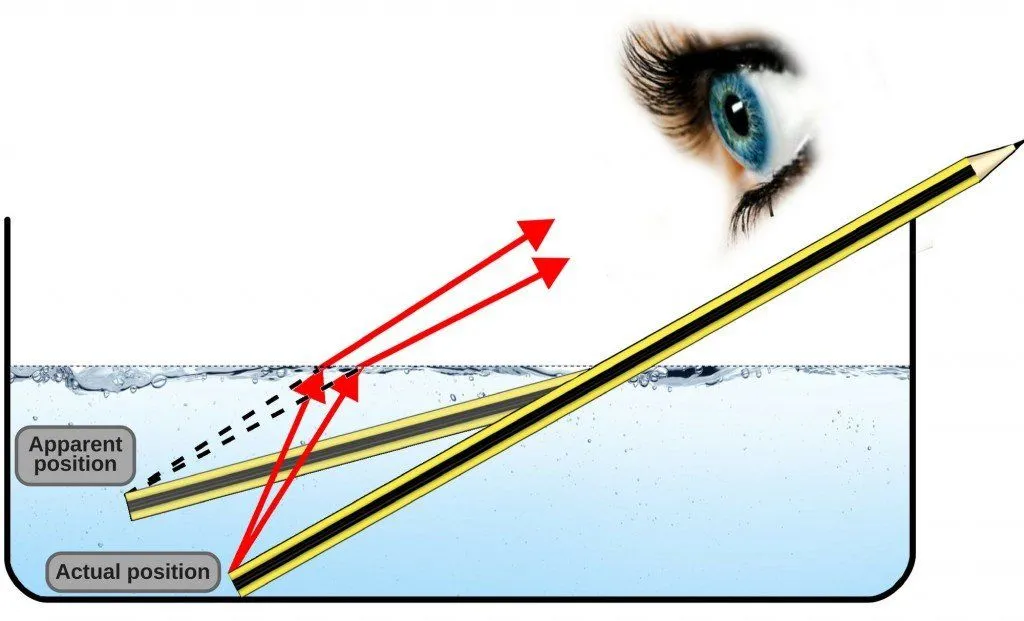
At some point in your life, you have likely studied about the ‘refraction’ of light, probably during numerous science lessons in high school. To put it simply, when light travels from one medium into another, it bends slightly. This phenomenon is called the refraction of light. This occurs because light usually has slightly different velocities in different media. For instance, the speed of light in water is reduced to three-quarters of its speed in a vacuum. Therefore, it appears to bend as it enters (or leaves) the water. The ‘bent pencil’ is a classic experiment that demonstrates the refraction of light.
So, does light bend randomly in different media, or is it more specific? Can we determine how much light bends in a given medium? Yes, we can, by using…
Refractive Index
Refractive index is an indicator of the speed of light in different media. Water, for instance, has a refractive index of 1.33. This means that the speed of light in a vacuum is 1.33 times faster than the speed of light in water. Below is a table of refractive indices for some common substances:
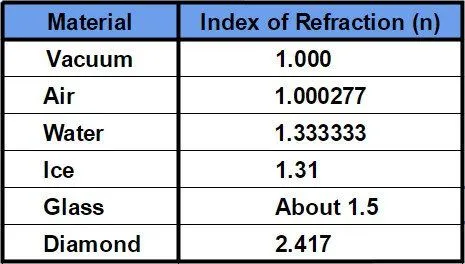
The higher the refractive index of a medium, the more the light bends when entering it from air (or from a medium with a lesser refractive index than the given medium).
How Does The Refraction Of Light Affect Our Underwater Vision?
Vision, whether in normal conditions or underwater, is entirely influenced/controlled by the way the human eye is designed. The human eye can be categorized into three parts: the outer, middle and inner eye. The interplay of these three components is what affects how we fare while keeping our eyes peeled for a distant shark underwater.
Structure Of The Human Eye
The cornea, a constituent of the outer eye, helps to focus incoming light at the back of the eyeball. The middle portion consists of a lens that is surrounded by a layer of liquid (called the aqueous humor). The most important component of the inner eye is the screen, called the retina, where everything we see is finally projected and sent to the brain for further processing via the optic nerve. (Note that there are a few other components of the eye as well, but we have only focused on those that pertain to underwater vision for the scope of this article).
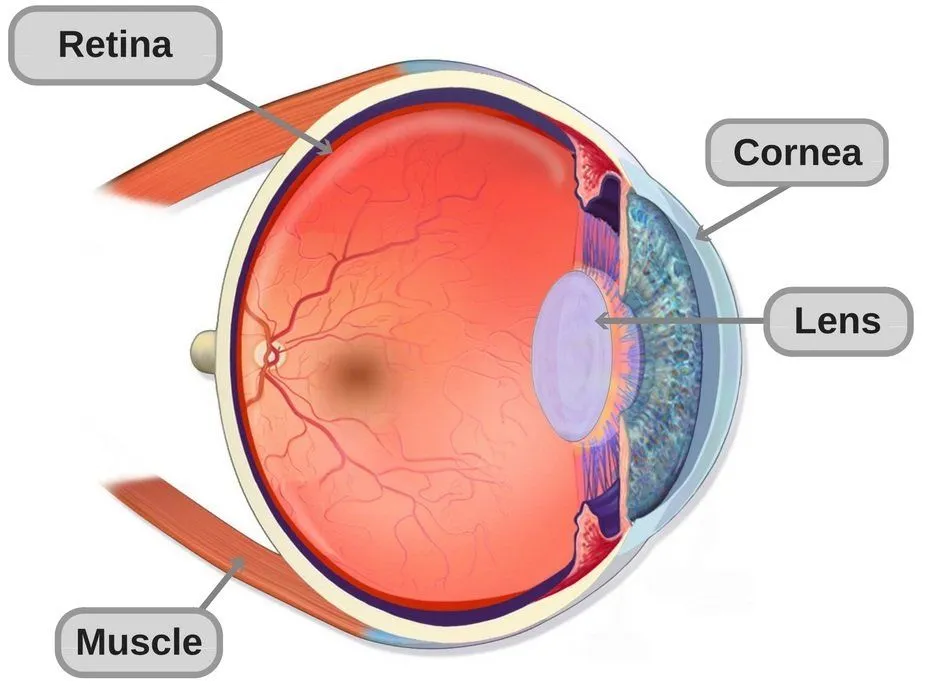
Anything we see around us reflects light. When I say ‘light’, it’s not just a ray or two (as they demonstrate in numerous optic diagrams to explain these concepts); it’s actually a cluster of thousands upon thousands of rays consisting of photons entering the eye. The cornea bends the light slightly and transmits it to the lens, which immediately springs into action and focuses the light rays onto retina. This process works like clockwork… under normal conditions. Dive underwater, however, and the whole scenario changes dramatically.
Notice how the light rays bend twice under normal conditions to form a crisp image on the retina, whereas underwater, they bend only once to form the image somewhere behind the retina.
The difference in the refractive indices of air and the cornea is significant enough to bend the incoming light before sending it to the lens. In fact, the cornea does most of the heavy lifting in the eye, accounting for roughly two-thirds of its total focusing power, precisely because there’s such a big jump in refractive index between air and the corneal surface. However, water (refractive index 1.33) and the cornea (about 1.38) have almost the same refractive indices, which means that light barely bends as it crosses the cornea and gets transmitted to the lens more or less unchanged. The lens can bend the light only so much, which is why the image is not formed on the retina, but somewhere behind it instead. In effect, slipping underwater turns your eye into an extremely farsighted one, leaving everything in front of you a blur.
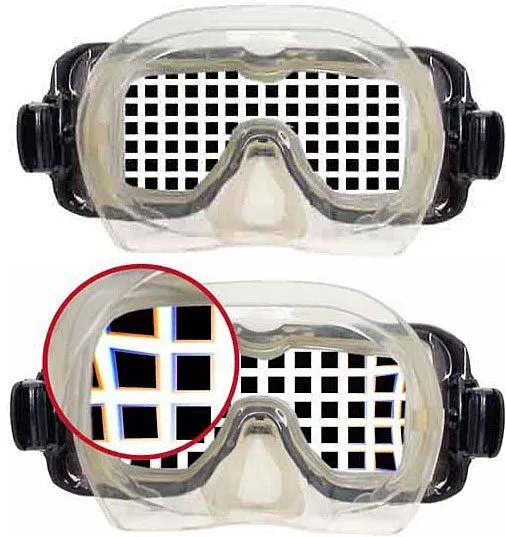
This is precisely why divers wear flat diving masks, as the mask’s window allows a layer of air to be formed between the wearer’s eye and the surrounding water, which in turn facilitates the bending of light before it enters the eye.
Can Some People See Clearly Underwater?
Here’s the surprising part: a few people genuinely can. The Moken, a community of “sea nomads” who live around the islands off Thailand and Myanmar, spend much of their childhood diving for food. In a study published in Current Biology in 2003, vision researcher Anna Gislén found that Moken children could see more than twice as sharply underwater as European children of the same age. They pull off this trick in two ways: by constricting their pupils to the very limit of what the human eye can manage (down to about 1.96 mm), and by accommodating, or squeezing the lens into a rounder shape, to the maximum of human performance (around 15-16 diopters). Both responses are routine for them and essentially absent in everyone else.
The catch is that this isn’t a genetic superpower. When Gislén later put a group of European children through about a month of underwater training, they learned to constrict their pupils and accommodate their lenses just as well, matching the Moken’s underwater acuity. So clear underwater vision is something the young, flexible eye can be coached into, at least up to a point, rather than a gift reserved for one population.
The science of the whole thing aside, the most important (to the point of saving your life) takeaway from this article is that one should never, EVER count on their own eyes to spot danger underwater. Seeking artificial help is a great idea, and will help keep you safe beneath the waves.