No, the bright lights of sea submersibles do not blind aquatic animals.
In the past twenty years, few documentary series have thrilled the world and nature enthusiasts as much as BBC’s Planet Earth and Blue Planet, narrated by David Attenborough (or Sigourney Weaver, in America). These spectacular documentary series have recharged the imagination of the world and inspired a new generation of nature lovers. The camera operators’ ability to capture such incredible shots have astounded videographers and left viewers’ jaws dropping, but is there a darker side to some of these intimate moments?
When camera crews are shooting these undersea moments, or when underwater submersibles are exploring the ocean floor, can their bright lights damage the vision of fish? Are we blinding marine life in the dark depths for the sake of our own entertainment?
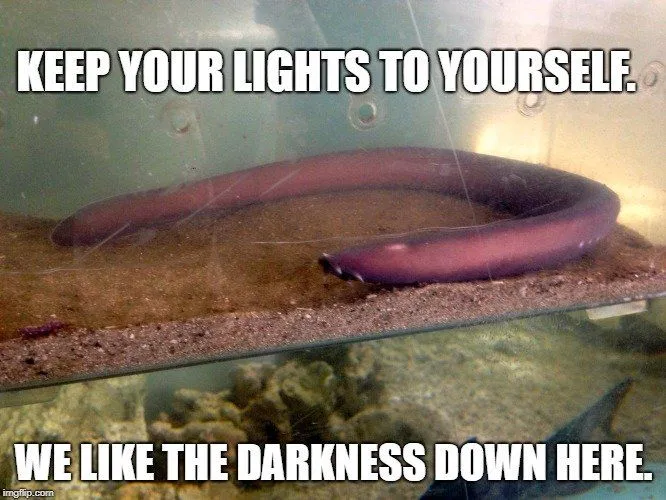
This is a complicated issue that has a number of different stakeholders and opinions, as well as nuances in terms of the degree of damage and species susceptibility. To begin with, we should differentiate between the different types of damage that can be inflicted, and why, in marine species.
Light Damage To Vision In Marine Species
As most of you likely know, marine animals in the depths of the ocean receive significantly less sunlight than we humans do here on terra firma. Over the course of millions of years of evolution and natural selection, their eyes have adapted to this reality. Most fish species have rod cells and cone cells, similar to humans, and some can also see in color—or even light in the ultraviolet spectrum. However, fish have developed different eye structures (e.g., more or less concavity, protrusion) to account for their need to see in darker waters. For example, some fish are able to see blue light wavelengths, even though they have never seen sunlight, and may lack the photoreceptors to even detect other forms of light.
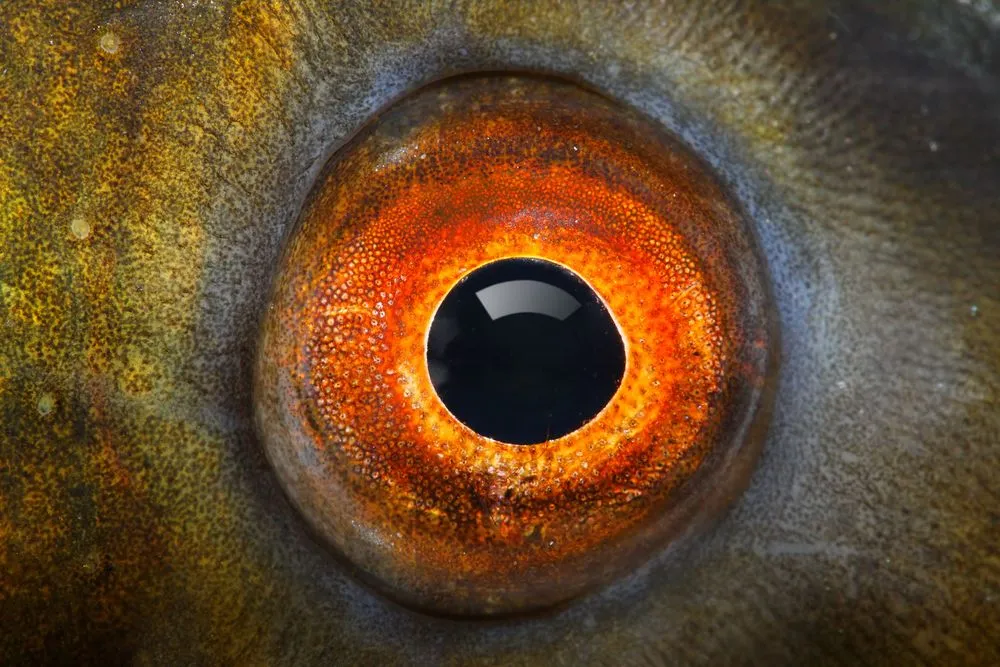
In the furthest depths of the ocean, where light rarely reaches, primitive eyespots may be the only source of vision for some creatures, while others are already completely blind. When a bright light, e.g., from a submersible or a photography flash, strikes these marine animals in their eyes, it can be incredibly intense and traumatic. Imagine going years without seeing any light, and then suddenly having your world flooded by it. Humans have trouble adjusting to sunlight when they leave a dark movie theatre, and that’s only two hours of darkness, not an entire lifetime!

When such intense light exposure occurs, a number of things can occur, including retinal bleaching, stunning/dazing, or permanent vision damage. We will explain these different impacts briefly below.
Retinal Bleaching
When a deep-sea fish eye is exposed to a bright light or flash, it can cause some of the cells of the retina to become “bleached”. Depending on the species, and the intensity of the exposure, this bleaching may be temporary, lasting only 10-15 minutes, before the rod and cone cells are once more able to absorb light properly. However, some research has shown that the bleaching and temporary blindness can last for days, making these organisms easy prey and significantly disrupting and harassing their natural life cycle.
Stunning/Dazing
This is a reaction that we as humans can certainly understand. When we have a flashlight shone in our eyes, we are oddly stunned by it, as it fills our vision in an unpleasant way, often freezing us in place for a moment as we adjust. The same thing is seen in animals who run across the road in the middle of the night; the headlights will often freeze them in place, rather than encourage them to flee and avoid harm.
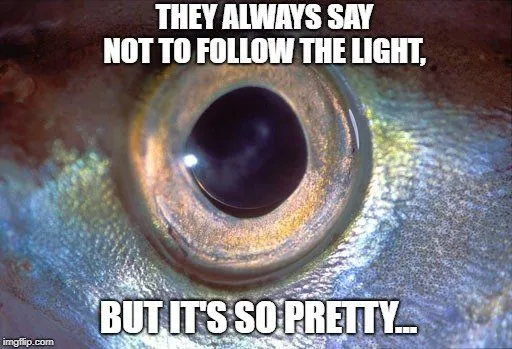
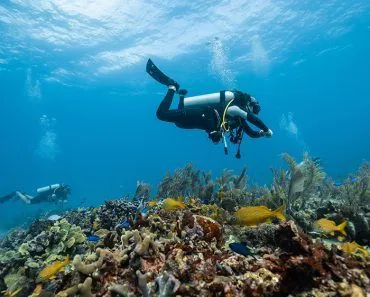
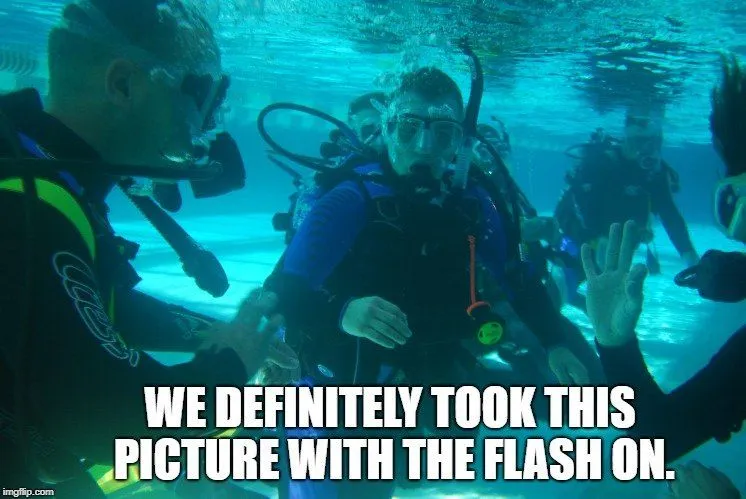
In the deep waters of Earth’s oceans, many divers and researchers have reported this type of stunned behavior when marine creatures had lights shone on them. If you have ever gone on a night dive, you have likely seen how fish will often stop directly in the beam of the light, rather than escaping back into the darkness. In situations like this, the eyes of fish so close to the surface are likely adapted to sunlight, and won’t suffer any permanent damage, but putting a spotlight on them is still a form of harassment. Not only that, highlighting the location of these animals makes them an easy target for predators, which becomes a real problem if you are shining and stunning a protected or threatened creature. There have even been reports of predatory fish following groups of night divers, knowing that they will benefit from the stunning effects of their bright lights.
Permanent Vision Damage
Numerous research studies have found that the use of white lights at great depths can permanently blind creatures exposed to such illumination. Studies on shrimp near geothermal vents shows that exposure to light left them permanently without the ability to see, and various crab species can be blinded by exposure to even small amounts of artificial light. For this reason, experts, academics and researchers take special care to avoid using bright white lights or flash photography at great depths. Unfortunately, there is no way to control the behavior of underwater photographers, amateur divers and the general population from using lights underwater in an irresponsible way.
How To Mitigate The Risk
It is important to note once more that the majority of fish species near the surface, which is where the most human-fish interaction occurs, have adapted to brighter light, since their exposure to sunlight is frequent, or even constant. In such instances, there is a smaller risk of doing permanent damage to fish vision when using a camera or bright flashlight underwater. The disruption of the normal space and Circadian rhythms of the animals should also be considered; avoiding permanent damage to the fish is a good thing, but affecting their home and delicately balanced ecosystem is also a danger.
As you descend into the depths, as either a diver or someone in a submersible, the risk of damaging the vision of fish becomes much greater. In the early days of deep sea exploring, before it was known that bright lights could do such damage, the amount of harm done to those ecosystems and organism is incalculable. Fortunately, deep-sea professionals now use red light for the vast majority of their visual exploration/observation. Red light is the first wavelength filtered out by seawater, so the majority of fish at such great depths don’t even possess photoreceptors for that color. In this way, researchers can observe creatures without endangering them or causing more of a disruption to the ecosystem than necessary. Without the proper photoreceptors, if the red light shines right in their eyes, the fish won’t even notice. The dimmer light is also less obtrusive, and is less likely to expose animals unfairly to predators

Are Deep-Sea Creatures Actually Blind?
Given how little sunlight reaches the deep ocean, you might assume the animals living down there have simply given up on eyesight altogether. It is a reasonable guess, but for most species it turns out to be wrong. Far from being blind, the majority of deep-sea fish that scientists have studied possess large, exquisitely sensitive eyes, finely tuned to the only light available to them: the faint blue-green glow of bioluminescence and the last traces of sunlight filtering down from above.

Below roughly 200 meters (about 660 feet), nearly every color except blue has been absorbed by the water, so many deep-sea animals carry a single, blue-sensitive visual pigment perfectly matched to that narrow slice of the spectrum. Rather than losing their vision, a surprising number have supercharged it. In a 2019 survey of 101 fish genomes, researchers found that the silver spinyfin (Diretmus argenteus) carries 38 different rod opsin genes, the most of any back-boned animal on Earth. That extraordinary toolkit may let it tell apart the colors of different bioluminescent flashes in water we would consider pitch black, quickly sorting a potential meal from a potential predator.
This actually reframes the whole worry about submersible lighting. When a floodlight suddenly blazes on, the risk is not that it dazzles creatures that cannot see. The risk is precisely the opposite: it floods eyes that have been engineered, over millions of years, to wring every usable photon out of near-total darkness. An animal built to detect a single faint spark is exactly the animal most likely to be overwhelmed by a sudden blast of white light.
The Deep-Sea Fish That Can See Red Light
The red-light approach described above works because, as a rule, deep-sea animals cannot see red at all. But nature loves an exception. Three genera of deep-sea stomiid dragonfish (Aristostomias, Pachystomias and Malacosteus) have broken the rule completely. Alongside the usual blue bioluminescence, they produce far-red light, at wavelengths beyond 700 nanometers, from special photophores tucked beneath their eyes.

A fish emitting light it could not see would be useless, so these dragonfish evolved a way to perceive red as well. The black loosejaw, Malacosteus niger, pairs unusually long-wavelength visual pigments with a second, stranger tool: its retina contains a photosensitizer derived from chlorophyll, the same molecule plants use to capture sunlight. The fish cannot manufacture chlorophyll itself, and the leading explanation is that it borrows the pigment from the copepods it eats, whose fluorescence closely matches the substance found in its eyes.
The payoff is a private channel of light. Because nearly every other creature in the deep is blind to far-red, these dragonfish gain a built-in searchlight to shine on prey, and a signal to flash at one another, without giving away their position. It is a useful reminder that “red light is safe” is a rule of thumb for filming the deep ocean, not an ironclad law. For a small and remarkable club of hunters, red is the one color they were built to see.
References (click to expand)
- EJDFJ WARREN. THE PHOTOSENSITIVE PIGMENTS IN THE RETINAE ... - CORE. CORE
- Ripps, H., & Weale, R. A. (1969, January 1). Flash bleaching of rhodopsin in the human retina. The Journal of Physiology. Wiley.
- Douglas, R. H., Partridge, J. C., & Marshall, N. J. (1998, October). The eyes of deep-sea fish I: Lens pigmentation, tapeta and visual pigments. Progress in Retinal and Eye Research. Elsevier BV.
- Vision in the Deep. NOAA Ocean Exploration.
- Musilova, Z., et al. (2019). Vision using multiple distinct rod opsins in deep-sea fishes. Science.
- Douglas, R. H., et al. (2000). Long-wave sensitivity in deep-sea stomiid dragonfish with far-red bioluminescence. Philosophical Transactions of the Royal Society B.