Lizards climb walls by using the tiny hairs on their feet to create Van der Waals forces. These forces are created when the electrons in the lizard’s atoms interact with the electrons in the atoms of the wall. The lizard’s feet also have tiny pads at the tips, which increase the surface area and help the lizard to grip the wall.
Have you ever noticed how lizards have the insane ability to scurry up walls and even walk upside down on the ceiling? They are fascinating creatures, although some people are not overly fond of them. I am, however, extremely fascinated by how they manage to defy gravity, and walk on walls and ceilings so successfully. It turns out that their unique ability is due to tiny hair on their feet! That, and a tiny bit of physical chemistry…
Van Der Waals Forces
For those of you who are aware of what Van der Waals forces are, you can jump to the next heading. For those who aren’t, a brief explanation will help. Matter is made up of atoms and molecules. Molecules are made up of different atoms that combine together. When we talk about a compound or any substance, we can consider two different types of forces – intramolecular and intermolecular. There are certain forces that hold the different atoms in a molecule together. These are the intramolecular forces, which include ionic bonds, covalent bonds, etc. The forces that exist between two different molecules are the intermolecular forces. The former is much stronger than the latter. In fact, intermolecular forces are sometimes not even considered, as they pale in comparison to the strength of intramolecular forces.
Van der Waals forces is a term collectively used to refer to intermolecular forces. Atoms have electrons, which are negatively charged particles. These revolve around the centre of the atom, or the nucleus. Molecules are formed by the donating and accepting or sharing of electrons. As mentioned, these electrons are not fixed in one place. Instead, they keep moving. Therefore, this leads to times when a large number of electrons collect at one end of a neutral molecule. Since electrons carry a negative charge, that end of the molecule develops a slight negative charge.
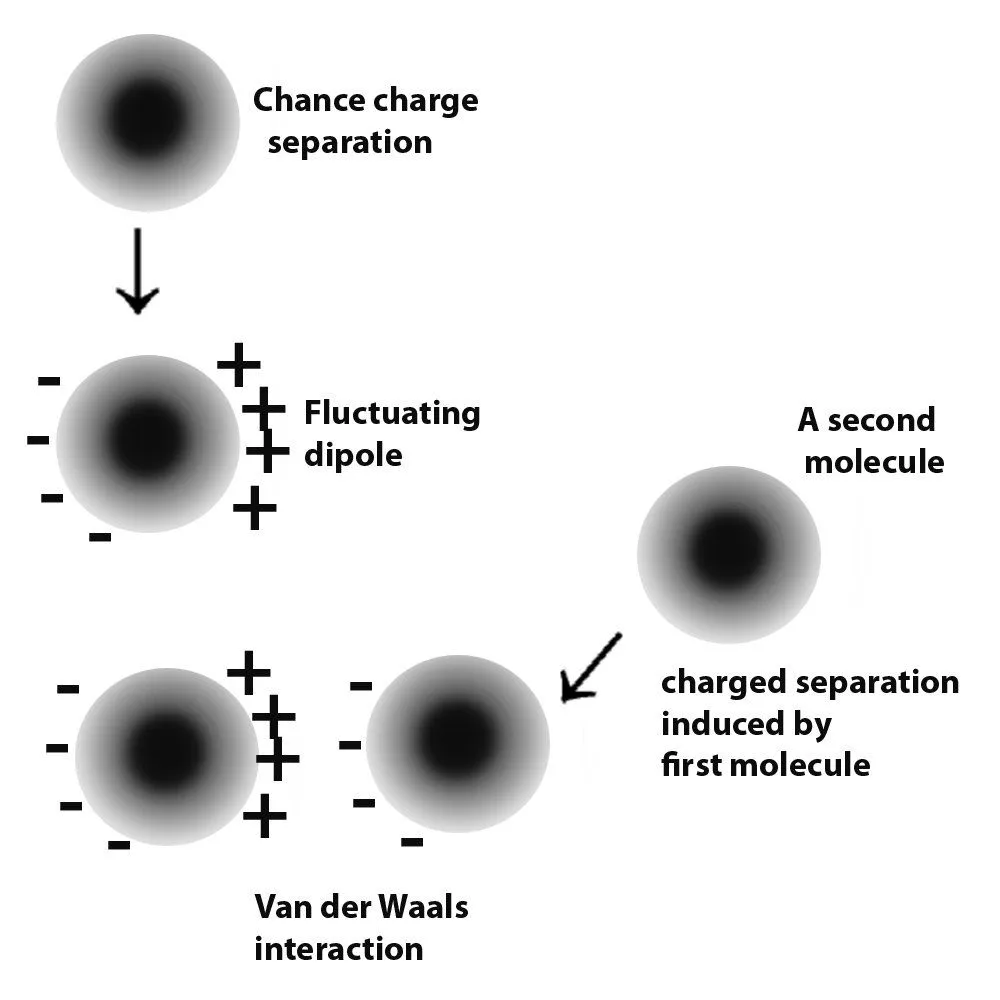
Since like repels like, this negative charge repels the electrons of the neighboring molecules, causing them to momentarily crowd at the end that is away from the negative charge. In this way, the small negative charge induces the further development of such small charges in the surrounding molecules and a small force of attraction occurs between these molecules. This is the mechanism in molecules that are neutral. In molecules that already have a permanent charge separation, i.e., they permanently have a positive and negative end, they attract other molecules in a similar fashion, except without the charge development process in themselves.
These forces are known as Van der Waals forces. Since the strength of these forces is quite small, they only come into play when two molecules come pretty close. For these forces to have a considerable effect between two different surfaces, the two must come very close to each other.
How Do Lizards Stick To Walls?
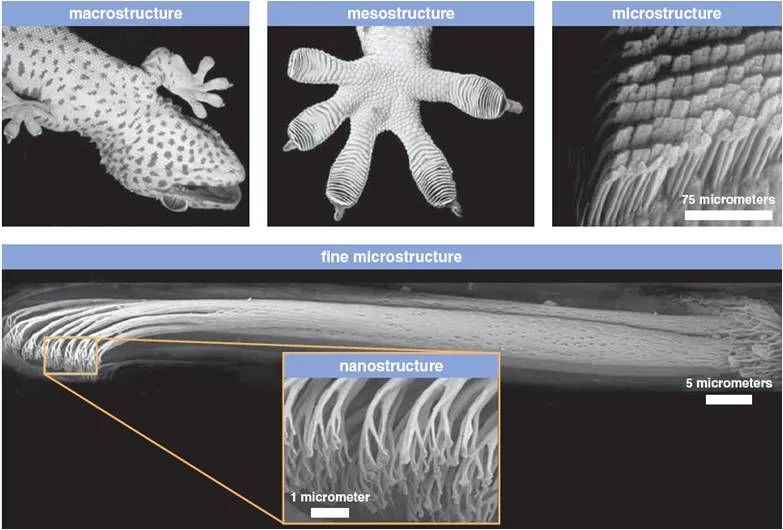
Wall-climbing lizards — most famously geckos, but also some anoles and skinks — have a vast number of very tiny hairs on the pads of their feet called setae. Each seta is roughly one-tenth the diameter of a human hair (about 5 micrometers across), and each one branches at its tip into hundreds of even smaller pads called spatulae, only about 200 nanometers wide. These billions of nano-scale spatulae drastically increase the contact area with the surface on which the lizard is crawling, so the Van der Waals forces kick in. Although normally considered negligible, in this case, the Van der Waals forces combine to form a pretty strong force. To understand how strong these forces can be, think of this – the number of hairs that cover an area the size of a single dime, which will be about one million hairs, can lift up to 45 pounds!
Geckos employ a rotating, peeling motion to attach and detach their feet from the surface, as simply placing the foot down will not engage the setae. Instead, they slide the foot into position so the spatulae lock against the wall, and then peel the toe off at a precise angle to release. The setae actually require a small shear (sliding) force to "switch on" — without this, the foot does not stick at all, which is why a dead gecko falls off the wall.
Geckos can run up vertical surfaces at speeds of more than 1 metre per second, attaching and detaching their toes in mere milliseconds. In lab experiments, they only need a fraction of their setae to support their body weight; the rest is reserve capacity. In the natural world, various substances can decrease the forces created — for example, the waxy coating on leaves — so they recruit more of their hairs to compensate. The setae even appear to be self-cleaning, shedding dirt particles with each step. Researchers are now using these insights to develop dry, reusable adhesives and "gecko tape" based on the design of lizard feet, with applications in robotics and even space-grappling devices.
Which Lizards Can Actually Climb Walls?
Here is something that surprises a lot of people: most lizards cannot climb a smooth wall at all. The sticky-footed trick we have been describing is actually rare. Adhesive toe pads have evolved independently more than a dozen separate times, yet they show up in only three branches of the lizard family tree: geckos (the undisputed champions), anoles (the small green and brown lizards common across the Americas), and a handful of skinks from Pacific islands. Even among geckos, only about 60% of species have functional toe pads; the rest have lost them over evolutionary time. Every other lizard climbs the old-fashioned way, with claws.
So a gecko can sprint straight up a pane of glass, but a bearded dragon, a green iguana, or a monitor lizard cannot. Those heavier lizards have curved claws that hook into bark, brick, and rock, which works beautifully on rough surfaces and fails completely on anything smooth. If you have ever watched a small lizard cross the inside of a windowpane at night, it was almost certainly a gecko, not just any lizard that happened to wander up.

Anoles are an interesting middle case. They carry both adhesive pads and claws, so they can press onto a glossy leaf with the pads and still dig into rough bark with the claws. Geckos, by contrast, went all in on the pads. This is why, when scientists talk about wall-climbing lizards, the conversation almost always comes back to geckos.
Can Geckos Stick To Any Surface?
For all their wall-walking talent, geckos do have a weakness. The Van der Waals trick only works if those billions of spatulae can get close enough to a surface to feel its atoms, and a few materials simply refuse to cooperate. The most famous one is probably sitting in your kitchen: Teflon, the non-stick coating (polytetrafluoroethylene, or PTFE) on a frying pan.
The reason is chemistry. Teflon is a chain of carbon atoms wrapped in fluorine, and fluorine holds onto its electrons more tightly than almost any other element. Those clamped-down electrons barely shift around, so they never form the fleeting, lopsided charges that Van der Waals attraction depends on. Teflon was practically designed to be un-stickable. When researchers placed geckos on dry PTFE, the animals could barely hold on, mustering only about a tenth of the grip they get on glass.

Water changes the picture too, though not in the way you might expect. On a water-attracting (hydrophilic) surface like glass, a thin film of water sneaks between the toe and the surface and the grip collapses: in one study, a gecko’s shear adhesion fell from roughly 17 newtons on dry glass to about 5 newtons on wet glass. (Curiously, on Teflon the opposite happens, and a wet surface actually improves the grip, but that is little comfort to a gecko trying to cross a foggy window.) The everyday takeaway is simple: a gecko is far more likely to lose its footing on a steamed-up bathroom mirror than on a clean, dry pane.
Why Do Lizards Fall From The Ceiling?
Anyone who has lived around house geckos has seen it happen. A lizard strolls confidently across the ceiling and then, with no warning, loses its grip and drops. If their feet are so spectacular, why does this happen at all? A few things can switch off the magic:
- Dirty feet. The setae are self-cleaning, but they are not invincible. A thick coat of household dust, grease, or kitchen grime can clog the spatulae and weaken their contact with the surface.
- Moisture. As we just saw, a film of water or condensation can slip between the foot and a smooth surface and break the seal, which is why falls are more common in steamy bathrooms and kitchens.
- Cold. Geckos are ectotherms (cold-blooded), so when temperatures drop their muscles turn sluggish. A cold, slow gecko struggles to make the rapid peeling and re-gripping motions that keep it attached.
- Shedding. Like all reptiles, geckos periodically molt, and a layer of old skin lifting off the toes temporarily cuts their stickiness.
- A simple startle. Remember that the setae need a small sliding (shear) force to stay switched on. A sudden lunge to escape a predator, or a scuffle with a rival, can break that tension and send a gecko tumbling.

The reassuring part, at least for the gecko, is how much grip it holds in reserve. In laboratory tests, a gecko needs only a fraction of its foot hairs to support its entire body weight, so a healthy lizard on a clean, dry ceiling almost never falls by accident. When one does drop, it is usually a sign that something (dust, water, cold, or a fright) has interfered with an otherwise near-perfect system.
References (click to expand)
- It's not glue, suction or static electricity that keep geckos from .... The University of California, Berkeley
- Geckos' Sticky Secret? They Hang by Toe Hairs | Live Science. Live Science
- Van der Waals Forces - Chemistry LibreTexts. LibreTexts
- Surface wettability plays a significant role in gecko adhesion underwater. PNAS (NCBI/PMC)
- Convergent developmental patterns underlie the repeated evolution of adhesive toe pads among lizards. Biological Journal of the Linnean Society
- Repeated Origin and Loss of Adhesive Toepads in Geckos. PLoS ONE (NCBI/PMC)