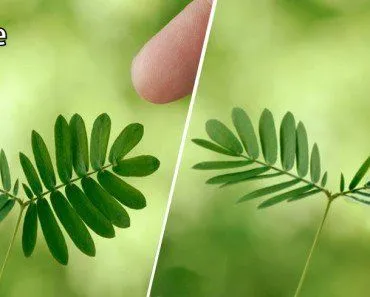
Climbing plants find supports through thigmotropism, a touch-driven growth response. Tendrils sense solid contact, then curl around it through differential growth on one side. Some vines also use chemical sensing (such as detecting oxalate on a host’s surface) to avoid coiling around plants of their own species.
In the world of botany, climbing plants quite literally “stand out”. They are tenacious acrobats that cling and twirl around any form of physical support for survival and exploration. Not to be too philosophical, but the ability of vines to grow in the most unlikely places and rise up against all odds can be a lesson for us all. Be it the grill of your balcony, the walls of an abandoned building, or a huge tree in the heart of a jungle, they will hold onto just about anything to grow.

Don’t worry, you aren’t the first person to find climbing plants fascinating. It turns out that human evolution wasn’t the only thing that tickled Charles Darwin’s curiosity. He studied these remarkable climbing plants and ended up writing an entire book about them, The Movements and Habits of Climbing Plants, published in 1875.
Climbing plants have a unique organ that makes them outrank other plants in terms of “habitat choice”. Quite simply, they are in possession of tendrils. Tendrils are slender yet robust threadlike strands that grow from the stem or leaves of a plant.
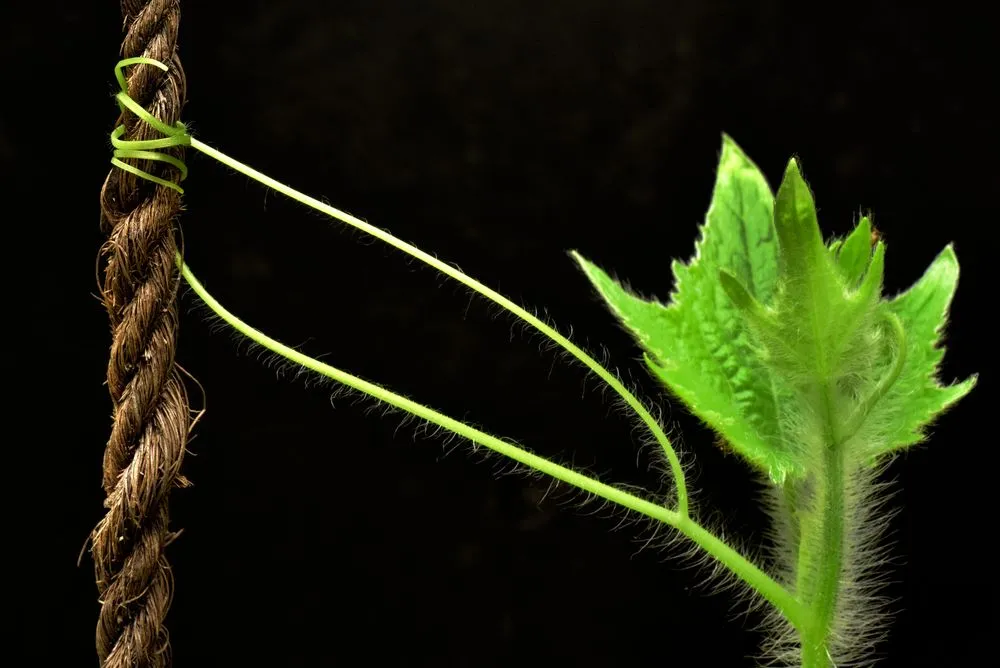
Vines or climbing plants depend on external support structures to grow. Thanks to tendrils that stretch outwards to search and cling, climbing plants are able to find support on which to survive. Now, how do they know if there is anything worth climbing on in the first place? It’s not like they have a periscope they can pop out to scan their surroundings for a pole or plant.
Why Do Plants Bother Climbing At All?
Before we get into how a vine finds a pole, it is worth asking why it bothers climbing in the first place. The answer, almost always, is sunlight. On a crowded forest floor the leafy canopy overhead can soak up most of the light long before it reaches the ground, so any plant that wants to photosynthesize well has to lift its leaves up high. A tree does this by spending decades and a great deal of energy building a thick, self-supporting trunk. A climbing plant cheats. Instead of pouring resources into heavy woody tissue of its own, it borrows the trunk of a neighbor and spends its energy growing long and fast toward the light.

This is exactly why woody climbers called lianas are so common in tropical rainforests. They sprout on the dim forest floor as modest shrubs, then haul themselves up the nearest trees toward the bright upper canopy. Botanist Ernesto Gianoli, who reviewed the behavior of climbing plants, points out that vines lucky enough to find a sturdy support grow and reproduce far better than those left sprawling on the ground. Seen that way, climbing is not a quirky habit at all. It is a high-stakes strategy for grabbing a share of the sun on the cheap.
How Do Vines And Creepers Find Support?
The cute curly strands on the plant play a critical functional role. Tendrils are pretty useless if they can’t find anything to cling on, but tendrils help them find support to cling on.
Tendrils are sensitive to touch. More formally, tendrils exhibit thigmotropism. If you break down the word, thigmo means “touch” and tropism refers to “the act of growth or movement of a plant in response to external stimuli”. Basically, thigmotropism is the change in the direction of a plant’s growth in response to the touch of a solid object.
Thigmotropism comes in two types: positive and negative thigmotropism. Roots typically show negative thigmotropism: when the root tip “feels” a solid obstacle in the soil, it bends away from it. This lets roots steer around stones and into softer, water-rich pockets of soil.
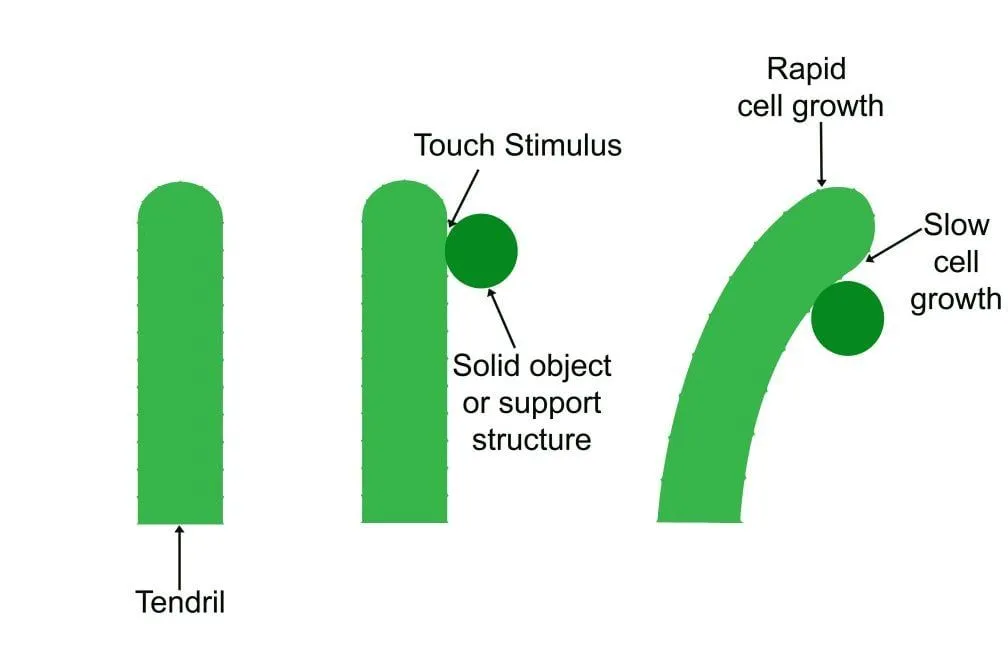
Movement in tendrils works just the opposite as it does in roots. Tendrils of climbing plants show positive thigmotropism. When the tendril feels a solid object, it moves towards the touch stimuli. It then coils itself around the said object and continues to grow on it. Through differential growth, the plant curves towards the object and wraps itself onto the source of support. To learn more about thigmotropism, click here.
What Makes A Tendril Reach Out And Search?
Here is a detail that fascinated Charles Darwin: a tendril does not simply wait around for something to bump into it. Its growing tip is in constant slow motion, sweeping through the air in lazy circles and spirals as if feeling for a handhold. Darwin gave this restless movement a name, circumnutation, and described it at length in his 1880 book The Power of Movement in Plants.

The motion is powered by growth itself. As the tip lengthens, the zone of fastest growth travels around the stem or tendril, so the bend keeps pointing in a slowly rotating direction and the tip ends up tracing a circle in the air. By sweeping a wide arc this way, the tendril greatly improves its chances of brushing against a twig, a wire, or a neighboring stem somewhere within reach. It is searching without eyes or muscles, simply by growing in a loop. The instant the touch-sensitive tip makes contact, those open sweeps tighten up: the thigmotropism we just met takes over, and the loose spiral collapses into a firm coil wound around the support. The searching sweep and the gripping curl are really two halves of the same trick.
Do They Know What They’re Climbing On?
Plants lack the sophisticated neural networks of the mammalian brain, but they are still perceptive to their surroundings. This awareness informs them of which plants are okay to climb on and which they should avoid.
It is quite common for climbing plants to come across plants of their own species. In the race to survive, coiling around a plant of the same species seems counterproductive. Plants of the same species pose a threat, as they will act as strong competitors for space and resources, as compared to plants of different species.
Additionally, given the fact that the climber plants themselves lack a strong stem to support their growth, clinging onto a plant of the same species seems pointless. It’s like using a twig as a walking stick. Thus, in view of natural selection, staying clear of a plant from the same species sounds like a smart choice.
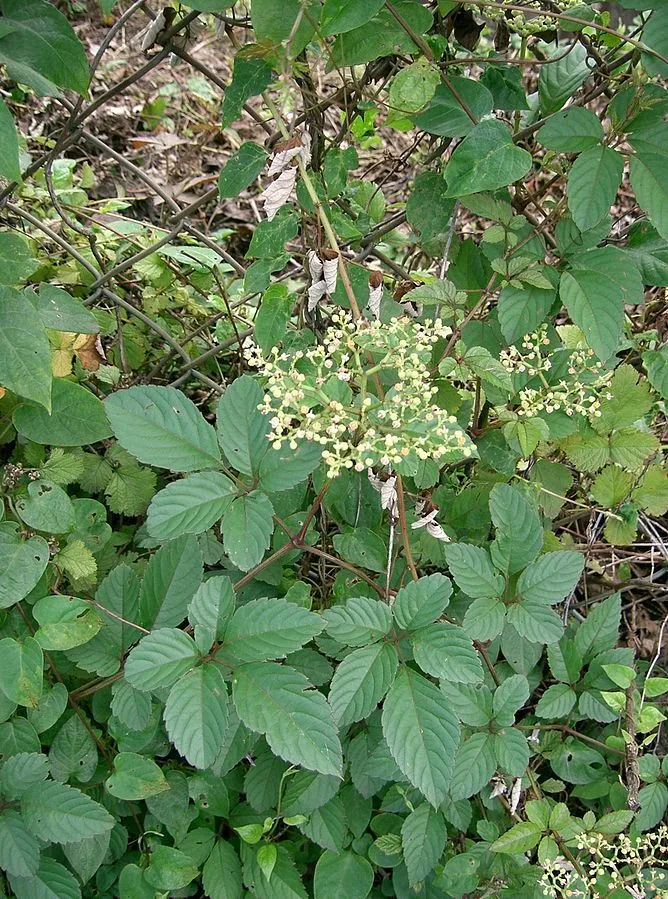
According to a study conducted at the University of Tokyo, climbers can differentiate between plants of their own species and other species. They found that the tendrils of C. japonica can taste oxalate. Oxalate is a chemical present in high quantities in the same plant. Upon tasting oxalate on the supporting structure, the plant recoils, moving away from that plant. On the other hand, the plant did not avoid coiling around sticks that were coated with chemicals like agarose or citric acid.
Scientists believe that the ability to sense chemicals may be widespread among this group of plants.
Do All Climbers Use Tendrils?
Tendrils are the stars of this article, but they are only one of several ways plants climb. Stroll past a few garden walls and you will spot the alternatives. Twining climbers such as morning glory skip tendrils altogether and wind their entire stem around a support in a slow spiral. Adhesive-pad climbers like Boston ivy and Virginia creeper tip their tendrils with tiny sticky disks that glue themselves to flat brick or stone. Root climbers such as English ivy and climbing hydrangea sprout dense mats of short clinging roots along the stem, gripping rough bark and masonry. And scramblers like climbing roses simply hook their thorns over anything close by and lean on it.

Which toolkit a plant carries decides what it can climb. A twining stem or a grasping tendril can only loop around something fairly slim, which is why Gianoli’s review notes that stem-twining vines grow rarer as tree trunks get thicker. There is a hard limit to how wide an object a coil can wrap. Adhesive pads and clinging roots face no such limit, so ivy happily scales a broad tree trunk or a sheer wall that a tendril could never grasp. According to the Smithsonian’s survey of tropical climbers, twining is actually the single most common strategy of all, with tendrils, simple scrambling, and clinging roots filling out much of the rest. So when you wonder how a particular vine grabs hold, the honest answer is that it depends entirely on which climbing gear that species happens to own.
Conclusion
As it turns out, climbing plants are more sophisticated than we originally thought. They can not only change the direction of their growth based on the touch stimuli, but can also identify if the support they plan to climb on belongs to the same species or not. Some plants make their choice of support based on the diameter of the trunk. Darwin himself observed that Wisteria sinensis shoots will not climb on a support more than about 15 cm wide, a limit that still holds up in modern reviews of climbing-plant behaviour.
References (click to expand)
- Thigmotropism in Tendrils - Biology - Kenyon College.
- Gianoli, E. (2015, January 1). The behavioural ecology of climbing plants. Aob Plants. Oxford University Press (OUP).
- Fukano, Y. (2017, March). Vine tendrils use contact chemoreception to avoid conspecific leaves. Proceedings of the Royal Society B: Biological Sciences. The Royal Society.
- Darwin, C., & Darwin, F. (1880). The Power of Movement in Plants. John Murray / Project Gutenberg.
- Climbing Mechanisms. Smithsonian National Museum of Natural History.
- Biomechanics of tendrils and adhesive pads of the climbing passion flower Passiflora discophora. Journal of Experimental Botany. NCBI/PMC.