Table of Contents (click to expand)
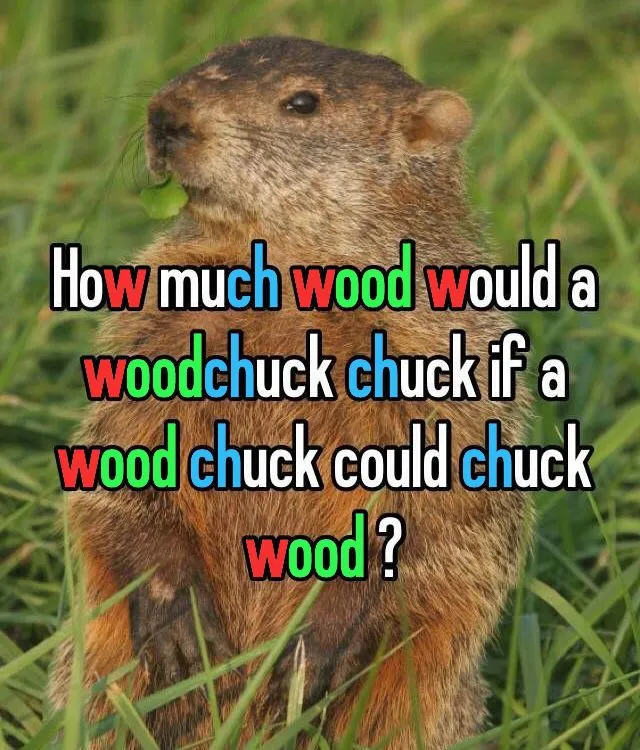
How much wood would a woodchuck chuck if a woodchuck could chuck wood? Let’s attempt to find an answer to this tricky tongue twister.
Say it with me now…. How much wood would a woodchuck chuck if a woodchuck could chuck wood?
Now, say it ten times fast…
Congratulations to any of those who did it, and for those who couldn’t, don’t worry, it tripped me up too!

My attempts to master this phrase also led me to another question: how much wood could a woodchuck chuck? Maybe you’ve wondered that before, thanks to this classic tongue twister, and as it turns out, you’re not alone!
A Simple Tongue Twister
The origin of the woodchuck tongue twister is from the 1902 song “The Woodchuck Song”, written by Robert Hobart Davis. The phrase has since made its way into several popular songs and other media. You might have heard Aronchupa’s version of it on the dance floor once or twice.
The woodchuck tongue twister is actually a fairly easy one to master. It doesn’t even come close to say, ‘the sixth sick sheik’s sixth sheep’s sick,’ or ‘pad kid poured curd pulled cod.’ The first one holds the Guinness record for the toughest tongue twister, while the second one was declared the toughest by a group of researchers from MIT.
Tongue twisters are hard to say because our brain finds it hard to switch between similar but not identical sounds. The alliteration in the phrase is what makes the woodchuck tongue twister so twisty. We have the ‘w’, the ‘ch’ and the ‘ood’ sounds that we must alternate between.
This one, and other tongue twisters like it, are great for those looking to improve their English pronunciation.
How Much Wood Could A Woodchuck Chuck?
A woodchuck, or a groundhog, is a rodent native to North America. These cute animals actually got their name from the Algonquian languages of Native Americans, who called them “wuchak,” which English settlers modified to “woodchuck.”

The word chuck can have two different meanings. It could mean throw, as in “to chuck something away”. Or it could mean eat, as in the opposite of upchucking.
Whatever meaning of “chuck” we consider, it would seem that woodchucks don’t typically chuck wood, as their name suggests. They don’t eat wood at all, though they do sometimes chew on it. In reality, their diet mainly consists of grasses, clover, alfalfa, and other vegetation.

They don’t routinely toss wood around either…. not that they can’t, but why would they?
The question is, of course, how much wood would a woodchuck chuck, if a woodchuck could chuck wood. It’s reasonable to assume that they could, at least in some sense of the word. So a more accurate question is, “how much wood would a woodchuck chuck if a woodchuck did, in fact, chuck a measurable quantity of wood, for some reason?”
How Much Wood Could A Woodchuck Eat?
One answer to the question was presented in a 1995 edition of the journal Annals of Improbable Research. The article ‘The Ability of Woodchucks to Chuck Cellulose Fiber’ by P.A. Paskevich and T.B. Shea of Harvard Medical School seems to have experimentally verified just how much wood woodchucks are capable of chucking, or consuming.
Their experiment claims to have involved depriving 12 adult male woodchucks of nourishment, and then presenting wood as their only source of food. The meaning of the word ‘chuck’ was also concluded by them to mean ‘eat,’ as that is what 100% of the animals did.
Their extremely precise conclusion is that an average woodchuck can chuck wood at a rate of 361.9237001 cubic centimeters per day. Which is about 0.7979051766784 pounds.
If you take this improbable piece of research at face value, you have your answer!
How Much Wood Could A Woodchuck Toss?
Let’s now look at the more obvious meaning of chuck, which is to toss or throw away. This perspective of the question was answered in 1988 by fish and wildlife technician Richard Thomas.
Thomas reasoned that although woodchucks don’t toss wood, they do toss dirt when they’re digging their burrows.
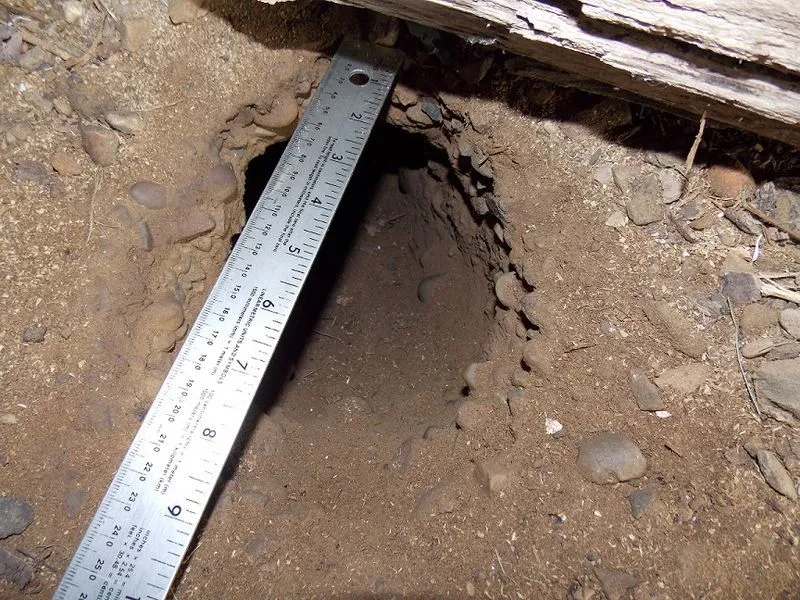
By evaluating the size of woodchuck burrows, and considering the approximate weight of soil, he came up with an answer.
According to Thomas, a woodchuck could chuck 700 pounds of wood, “on a good day, with the wind at his back.”
So What Do Woodchucks Actually Do?
If a woodchuck doesn’t toss timber or feast on logs, what is it busy with all day? Quite a lot, as it turns out. The woodchuck (Marmota monax) is the very same animal you may know as the groundhog or the whistle-pig, a chunky ground squirrel that weighs roughly 2–6 kg (about 4.5–13 lb) and ranges across much of North America. It is a strict herbivore, grazing on grasses, clover, alfalfa, and dandelions, with the odd bit of bark or leaf thrown in. So while it will gnaw on woody stems, it isn’t eating wood as a meal.

That gnawing has a purpose. Like other rodents, a woodchuck has chisel-shaped front incisors that never stop growing, and steady chewing is what keeps them in check. If the upper and lower incisors don’t grind against each other properly, they can overgrow, with results that are fatal for the animal. So a little chomping on wood is less about appetite and more about dental maintenance.
Where woodchucks truly earn their keep is underground. They are champion diggers: a single animal shifts roughly 700 pounds (about 320 kg) of soil while excavating a burrow that can stretch 25 to 35 feet (around 8 to 11 m) and include separate chambers for nesting and even a “bathroom.” That number should look familiar, because it is exactly where the famous 700-pound figure came from in the first place. It isn’t the weight of any wood a woodchuck tosses, but of the dirt it moves to dig its home. As for the “whistle-pig” nickname, it comes from the loud, shrill alarm whistle these animals let out, often while standing bolt upright like a sentry, to warn the rest of the colony of danger. And come early February, the most famous woodchuck of all gets roused from its hibernation to forecast the weather on Groundhog Day.
Satisfactory Answers
We can conclude that a woodchuck could chuck (eat) 0.7979051766784 pounds of wood per day, and that it could chuck (toss) around 700 pounds of wood per day. Those of you who are dissatisfied with the definition of chuck, the methods of those who came to these conclusions, or are simply doubtful, can certainly bring us better answers in the future!
For me, the answer seems satisfactory to the long-standing riddle… now I can go back to getting my tongue tied up in knots again.
References (click to expand)
- How much wood would a woodchuck chuck - Wikipedia
- How much wood would a woodchuck chuck - Wikipedia
- Nuzzo, R. (2013, February 20). Why tongue twisters are hard to say. Nature. Springer Science and Business Media LLC.
- Do Woodchucks Chuck Wood? | Kids Environment Kids Health. The National Institute of Environmental Health Sciences
- Woodchucks. Penn State Extension.
- On Groundhog Day: Ten Things to Know about These Surprising Creatures. The National Wildlife Federation.
- The Truth about Groundhog Day. National Wildlife magazine, The National Wildlife Federation.
- Marmota monax (woodchuck). Animal Diversity Web, University of Michigan Museum of Zoology.