Table of Contents (click to expand)
Simply put, when wood comes in contact with fire, it undergoes thermal degradation, or pyrolysis. The pyrolysis of wood leads to the release of certain volatile gases and the formation of char, which eventually undergoes flaming and glowing reactions, respectively, to release the heat energy.
If you are the adventurous kind of soul who likes camping in the jungle, then you might have also relished sitting around a campfire, enjoying the sugary goodness of s’mores. If that sounds like you, then you should be grateful for the wood that had to burn for you to savor the treat.
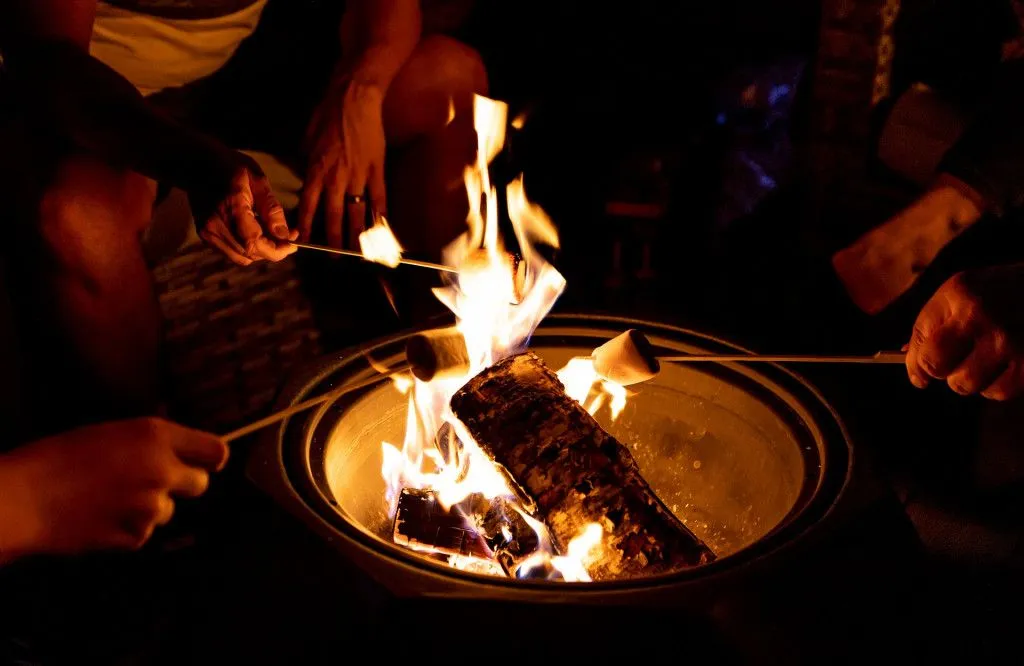
We all know what happens when wood mingles with fire. It will first produce some smoke and then blaze with hues of orange and red. The stack of glowing embers finally fizzles out to form a heap of cooled grey ashes.
All this is what we observe at the surface level, but have you given any thought to what happens at the molecular level of the wood during its fiery end?
Composition Of Wood
The chemical composition of wood varies with the part, type and location of the tree the wood comes from. However, in a general sense, wood comprises two key chemical components: lignin (18-35%) and carbohydrates (65-75%). Carbohydrates such as cellulose (40-50%) and hemicellulose (25-35%) contribute to the majority of the wood composition.
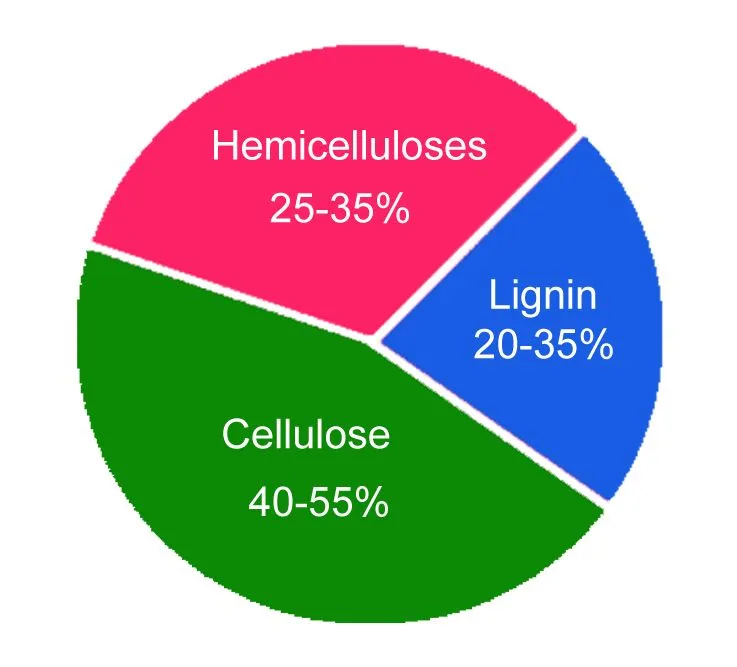
Apart from these complex molecules, the wood may also contain inorganic substances (ash) and organic extractives (phenolic compounds, fats, waxes, terpenes and terpenoids).
In a nutshell, the wood has an elementary composition of roughly 50% Carbon, 6% hydrogen, 44% oxygen and trace amounts of metal ions. Almost all species of wood have roughly the same elementary composition.
What Happens When Wood Burns?
When you light wood on fire, it doesn’t simply burn directly as a solid. Instead, it undergoes a complex series of chemical reactions. But what exactly happens at the molecular level?
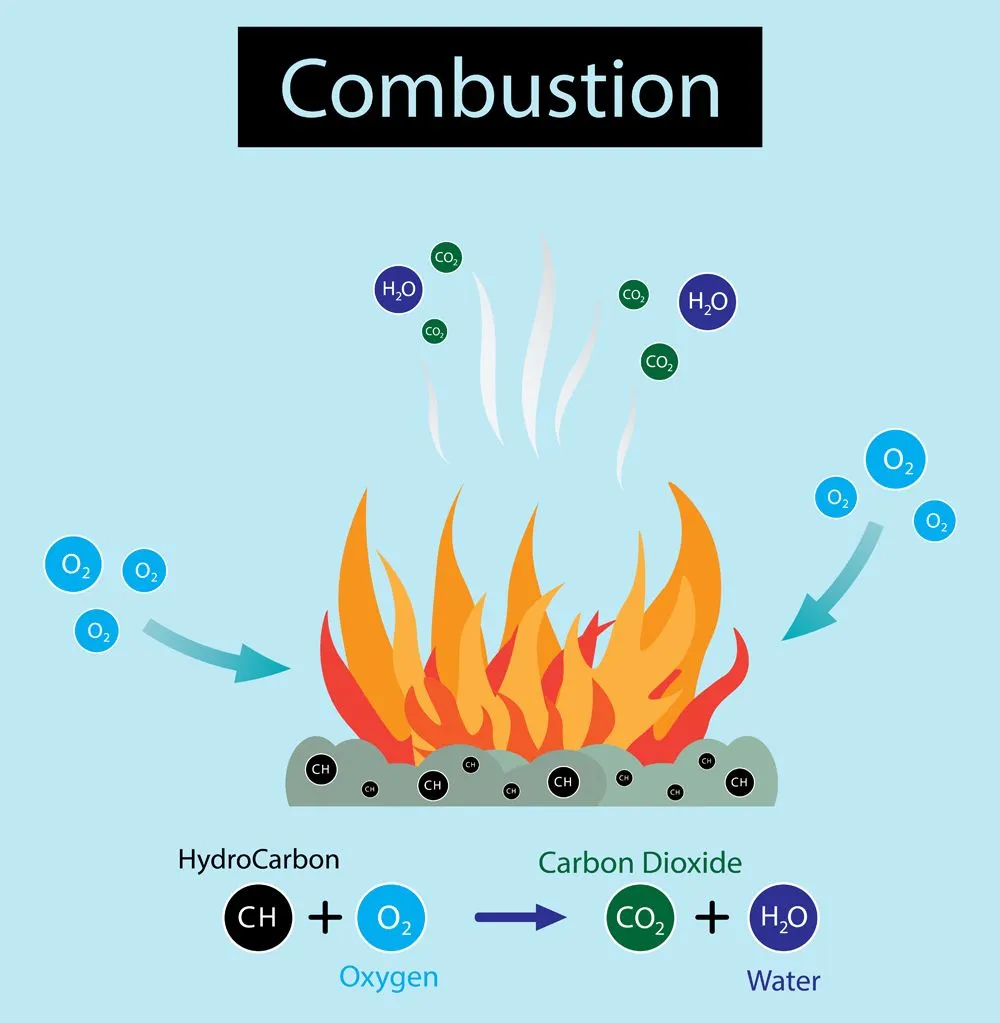
Wood burning actually involves two distinct types of combustion. First, the heat causes the wood to release volatile gases through a process called pyrolysis (thermal decomposition). These gases then undergo flaming combustion (the bright flames you see are actually these gases burning in the air, not the solid wood itself). Second, once the volatile gases have been driven off, the remaining char undergoes glowing combustion (or smoldering), which is the familiar sight of red-hot embers.
Simply put, when the wood comes in contact with fire, it undergoes thermal degradation or pyrolysis.
Pyrolysis Of Wood
Pyrolysis plays a significant part in wood combustion. It is a process of thermal decomposition of organic matter under an inert atmosphere or in the absence of oxygen. Pyrolysis of wood leads to the release of some volatile gases and the formation of char, which eventually undergoes flaming and glowing reactions, respectively, to release the heat energy. Being a complex chemical reaction, the pyrolysis of wood occurs in three major stages.
Stage 1
To initiate the combustion of wood, a source of heat is brought in contact with wood in the presence of air. This causes a rise in the temperature of an area on the wood. As the temperature of the wood reaches 100°C, the water in the wood begins to boil and evaporate. As you may know, it is difficult to burn wood with a high moisture content. Therefore, dehydration of wood is essential for combustion to begin. At around 160°C, the dehydration is complete.
The hemicellulose in the wood starts to decompose between the temperature range of 200°C to 280°C. The decomposition causes the production of gases, such as carbon dioxide, carbon monoxide, acetic and formic acid.
The gases released during the first stage, do not catch fire until the moisture evaporates completely and the temperature is hot enough.
Stage 2
The second stage of wood combustion is a heat-producing stage. It begins when the temperature of the wood is above 280°C. During this stage, a large amount of energy, along with unburnt combustible gases like methane and methanol, water vapor and carbon dioxide is released. These gases are called secondary gases, and they comprise about 60% of the potential heat in the wood. The combustion of these gases is important for efficient wood combustion.
In this stage, the cellulose starts to decompose and reaches a peak at around 350°C. The decomposition of cellulose leads to char, tar and volatile products formation.
Stage 3
Lignin actually begins decomposing gradually from as low as 160°C, but at temperatures beyond 320°C, its decomposition rate intensifies significantly. At this point of wood combustion, all the gaseous products evaporate. The gas mixes with air to either cool off and form smoke, or catch fire to burn in flames. The only solid product of wood pyrolysis is the carbon chains of cellulose and lignin molecules left behind as charcoal. Around 20-30% of the weight of the wood converts into charcoal.
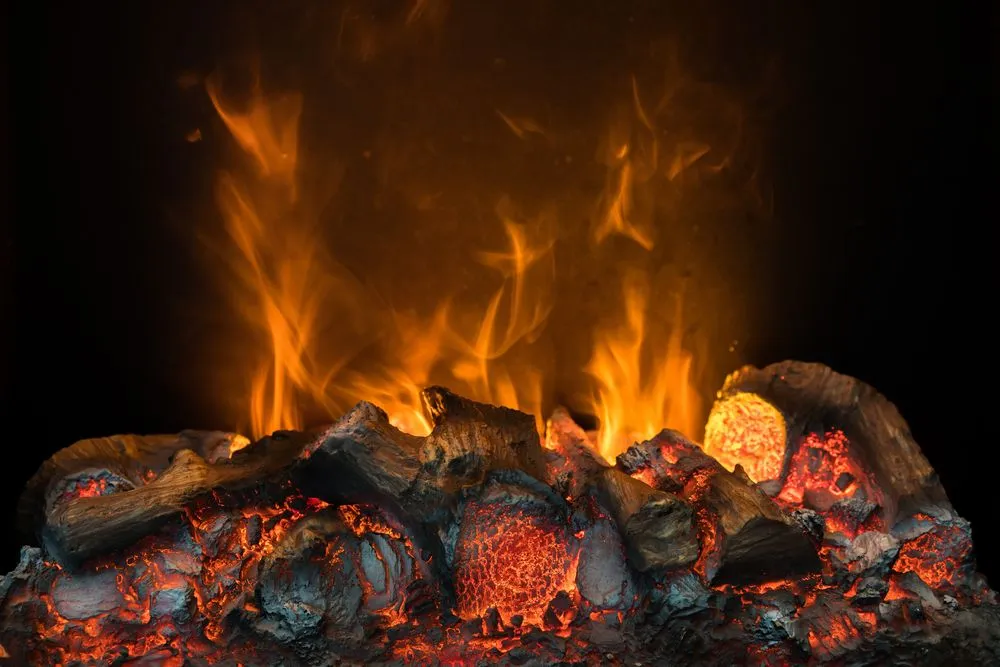
The charcoal bed continues to burn for a long time, but with low heat output. The glowing charcoal will radiate its energy away and cool off in the absence of oxygen. However, as we know, blowing air at the glowing charcoal causes it to burn brighter and spread the fire. Hence, the fire can be rekindled by supplying new oxygen to the charcoal bed and adding more wood.
A small percentage of wood that did not burn, known as ash, is left behind after all the combustible products are removed. Wood ash contains potassium carbonate, which acts as a good soil fertilizer.
Is Burning Wood A Chemical Change Or A Physical Change?
This is the question that brings most people to a campfire's chemistry, and the answer is clear: burning wood is a chemical change, not a physical one. The simplest way to tell the two apart is to ask whether brand-new substances with new properties are formed. Melting an ice cube or snapping a twig is a physical change, because you still have water, or wood, afterward. Burning is different. The molecules in the wood are torn apart and their atoms rearranged into completely new compounds.

The bulk of wood is cellulose, a carbohydrate with the repeating formula C6H10O5. When it burns, it reacts with oxygen from the air, and the balanced reaction for complete combustion of one cellulose unit is:
C6H10O5 + 6 O2 → 6 CO2 + 5 H2O
The carbon dioxide and water vapor on the right are not present in the original log. They are new substances, formed by breaking and remaking chemical bonds, which is the very definition of a chemical reaction. Two other clues seal the case. First, the change releases heat and light, the energy signature of a chemical reaction. Second, it is irreversible: you cannot gather up the smoke, ash and warmth and reassemble the log, the way you could refreeze melted ice. For the same reason, fire itself is best thought of as a chemical reaction in progress rather than a substance.
Is Burning Wood Exothermic, And Where Does The Energy Come From?
Burning wood is firmly exothermic, meaning it gives out far more energy than it takes in. A small amount of energy has to be supplied first (the match or spark) to get things going, but once the reaction is underway it pours energy into its surroundings as heat and light. That is exactly why a campfire keeps you warm.
So where was that energy hiding? It was locked up as chemical potential energy in the bonds of the cellulose and lignin molecules, which trees built using sunlight during photosynthesis. Burning unlocks it. When the carbon and hydrogen atoms in the wood bond with oxygen to form carbon dioxide and water, the new bonds in those products are more stable, and hold less energy, than the bonds that were broken. That surplus energy has to go somewhere, and it leaves the fire as heat and light. In the language of energy transformations, a wood fire converts stored chemical energy into thermal energy (heat) and radiant energy (light), the glow that determines the color of the flames. Fittingly, the U.S. National Institute of Standards and Technology defines a fire simply as “an exothermic chemical reaction that emits heat and light.”
At What Temperature Does Wood Catch Fire?
Wood does not have a single neat ignition temperature, because it depends on the wood species, its moisture content, and whether a spark or flame is present. Still, the U.S. Forest Service's Wood Handbook gives useful ranges. When a small flame or spark is present (so-called piloted ignition), the surface of the wood has typically been measured at 300 to 400 °C (about 570 to 750 °F) just before it ignites, and steady flaming needs the released volatile gases and air to reach roughly 400 to 500 °C (750 to 930 °F).

Without any flame to ignite the gases (unpiloted or spontaneous ignition), the numbers are higher and more scattered: the Wood Handbook notes spontaneous ignition reported as low as about 270 °C and as high as 470 °C for convective heating, and around 600 °C under radiant heating. There is an important safety footnote here too. Wood that is held at warm temperatures for a very long time slowly degrades and can ignite far below these figures, so the handbook recommends keeping wood surfaces below about 80 °C (176 °F) near long-term heat sources. This is also why kindling and thin twigs catch first: their large surface area reaches ignition temperature far faster than a thick log.
Where Does The Mass Go When Wood Burns?
If you weigh a log and then weigh the ash it leaves behind, the ash weighs only a fraction of the original. So has matter been destroyed? Not at all. The law of conservation of mass states that matter can be neither created nor destroyed in a chemical reaction, and burning wood obeys it perfectly.
The trick is that most of the log leaves as invisible gas. As the wood combusts, the great majority of its carbon and hydrogen combine with oxygen from the air and float away as carbon dioxide and water vapor, with only a small mineral residue (the ash) staying put. If you could capture and weigh all of that escaping gas, the smoke, and the ash together, the total would equal the mass of the original wood plus the oxygen it pulled in from the air. As Chemistry LibreTexts puts it, “when wood burns, the mass of the soot, ashes, and gases equals the original mass of the wood and the oxygen when it first reacted.” So the missing mass has not vanished; it has simply turned into substances you cannot see, which is also why a wood fire feels like it makes the log “disappear.”
Conclusion
Until now, you might have found the burning of wood to be a simple process where the fire burns every molecule that comes in its way, but I think it’s pretty evident that things are not as simple as they might appear!
When wood comes in contact with fire, it sets off a series of complex chemical reactions. The combustion of wood results in the release of carbon dioxide, water vapor and various gaseous products, as well as the formation of black solid residues like charcoal and ash.
References (click to expand)
- Emmons, H. W., & Atreya, A. (1982, December). The science of wood combustion. Proceedings of the Indian Academy of Sciences Section C: Engineering Sciences. Springer Science and Business Media LLC.
- Theories of the combustion of wood and its control. Semantic Scholar
- (PDF) Modeling of pyrolysis in wood: A review - ResearchGate. ResearchGate
- Heating with Wood: Principles or Combustion. The University of Wisconsin–Madison
- The Chemical Composition of Wood - www.fpl.fs.fed.us
- Wood Handbook, Chapter 18: Fire Safety of Wood Construction. USDA Forest Service, Forest Products Laboratory (FPL-GTR-190).
- 3.6: Conservation of Mass. Chemistry LibreTexts.
- Fire Dynamics. National Institute of Standards and Technology (NIST).