Table of Contents (click to expand)
Despite hammering wood up to about 20 times per second at roughly 6 to 7 m/s (about 14 to 16 mph), woodpeckers don’t get concussions, but not because their skulls cushion the blow. A 2022 study showed their skulls act like stiff hammers, not helmets. What protects the bird is its small, well-anchored brain, a chisel-shaped beak, a precisely aligned posture, and a long hyoid bone wrapping around the skull that keeps the brain from sloshing.
How much wood would a woodpecker peck if a woodpecker could peck wood without getting a headache?
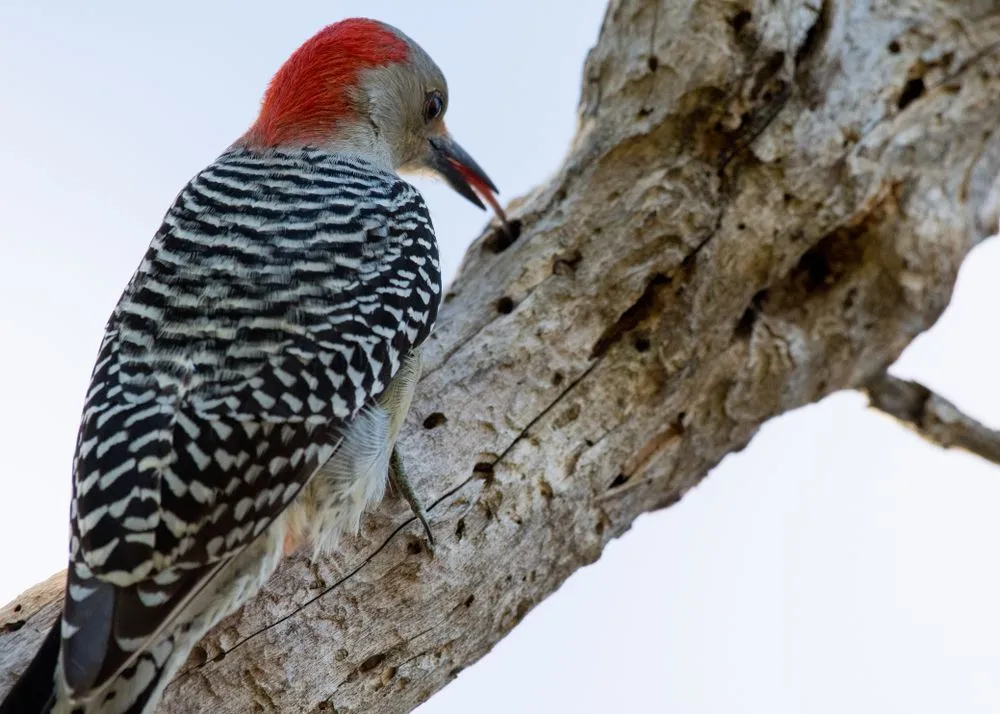
Belonging to the Picidae family, woodpeckers have aptly and simply been named after the thing they love to do most, pecking wood. If you’re a birder, you’ll catch these arboreal dwellers vertically clawed on a tree’s side, jamming their beaks into the bark at seemingly impossible speeds.
If you were to smash your face against a tree hundreds of times per minute, your brain would jiggle its way into some serious damage.
So, how are these birds managing all this high-speed pecking? Or do they simply carry on with a parade of concussions?
Why Does A Woodpecker Peck Wood?
A woodpecker’s diet consists of insects (eggs and larvae included), small worms and other types of invertebrates. Many of these wiggly creatures live inside tree trunks, so to access their meal, woodpeckers need to get through the tough outer parts of the wood.
Shelter is also a top priority for birds. Woodpeckers create cavities in trees in which they make their nests. Interestingly enough, these cavities aren’t made and then abandoned. After the woodpecker leaves its nest, other birds who can’t make their own nests, such as bluebirds, wrens and swallows, use the empty hole and fill it with life.
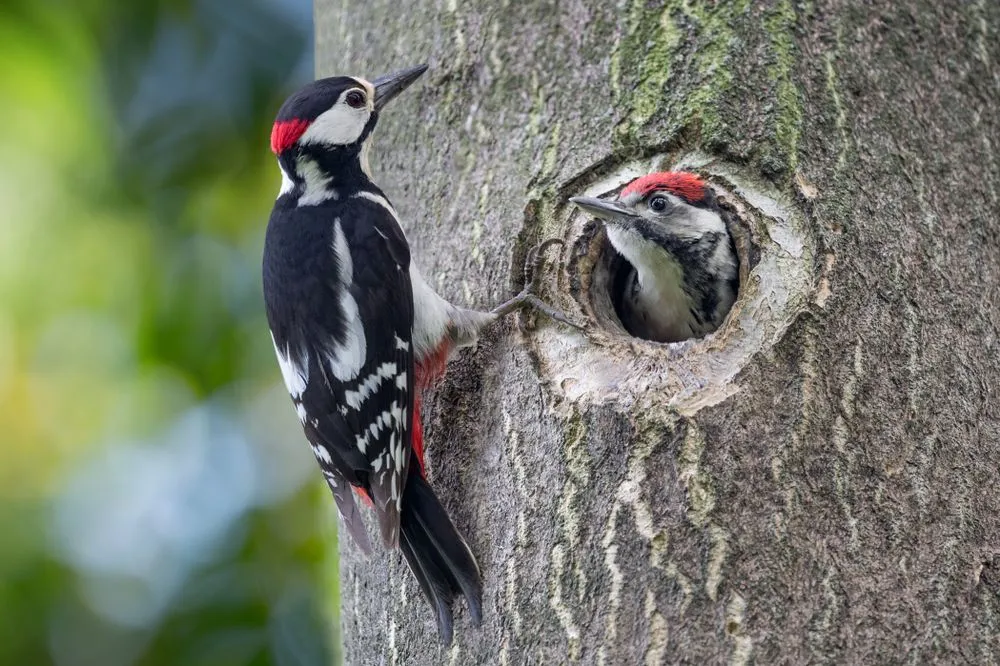
Woodpeckers occasionally hammer at something that isn’t wood, but there’s a completely logical explanation for this.
“Drumming” is when a woodpecker will pound on a resonant object (such as metal) to create noise. This might be annoying to listen to, but it is melody to the ears of a woodpecker’s mate.
High-speed Pecking, But Exactly How Fast?
Each peck decelerates the woodpecker’s head at roughly 1,000 g (a thousand times the force of gravity). For comparison, a hard punch in a boxing match peaks at about 50 g, and the threshold for a human concussion is around 60 to 100 g. That deceleration isn’t mostly absorbed by the skull (more on that in a moment); it’s simply that everything else about the bird is built to tolerate it.
A male hairy woodpecker can strike its target at an astounding 20 pecks per second, with the tip of the beak moving at roughly 6 to 7 meters per second (about 14 to 16 mph) on impact. At this rate of hammering an object, any other animal’s brain would become a soupy mess, so how do woodpeckers avoid this?
The ‘Helmet’ Protecting The Woodpecker
Scientists began by investigating the skull of woodpeckers. Was it an efficient shock absorber? Was it made of a different type of bone? In 2022, biologist Sam Van Wassenbergh and colleagues published a study in Current Biology showing, counter-intuitively, that a woodpecker’s skull is not a shock absorber. High-speed video of three species pecking revealed the head decelerates almost as fast as the beak: a cushioning skull would actually waste energy and make the bird a worse hammerer.
A human brain is large, and a large brain hits the inside of the skull harder when the head suddenly stops. A woodpecker’s brain is pea-sized (about 2 grams), so even when the head slams to a halt, the pressure it generates inside the skull stays well below the threshold that gives a primate brain a concussion. Van Wassenbergh’s simulations put it at less than 60% of the human concussion threshold even for the hardest pecks.
However, another structure in the skull provides the brain with essential stability.
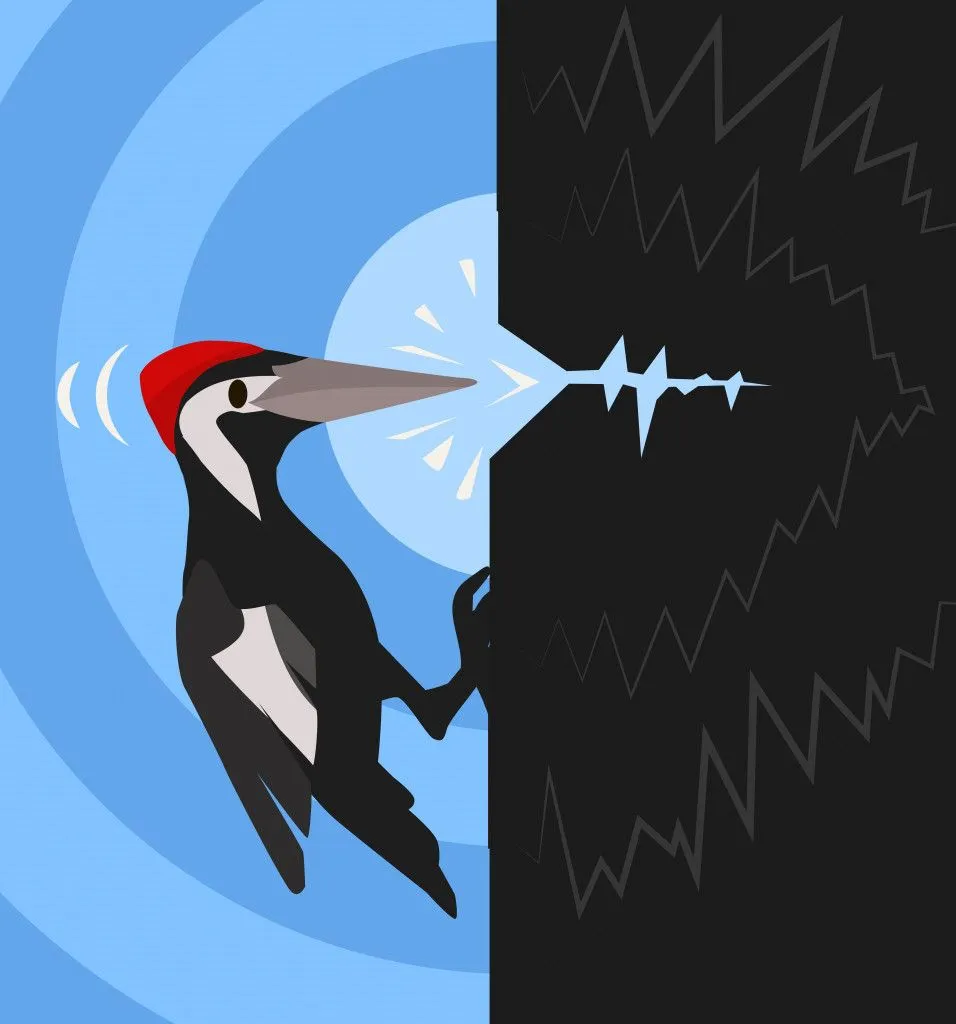
The hyoid bone is a horseshoe-shaped bone present in the floor of the mouth that keeps the tongue in place. When it comes to woodpeckers, the hyoid bone is not only present in their beak, but extends inwards until it forms a loop that encompasses the whole brain.
Like a seatbelt, it holds the brain safe and secure, even as the head goes for a wild pecking ride.
Additionally, the orientation of the brain, neck muscles that bear a good amount of strength, and a tightly packed skull with no extra space, all work to the bird’s advantage. They even have an in-built protective shield (bristled nostril feathers) to protect themselves from breathing in the tiny chips of wood flying off in their direction.
The Woodpecker’s Beak
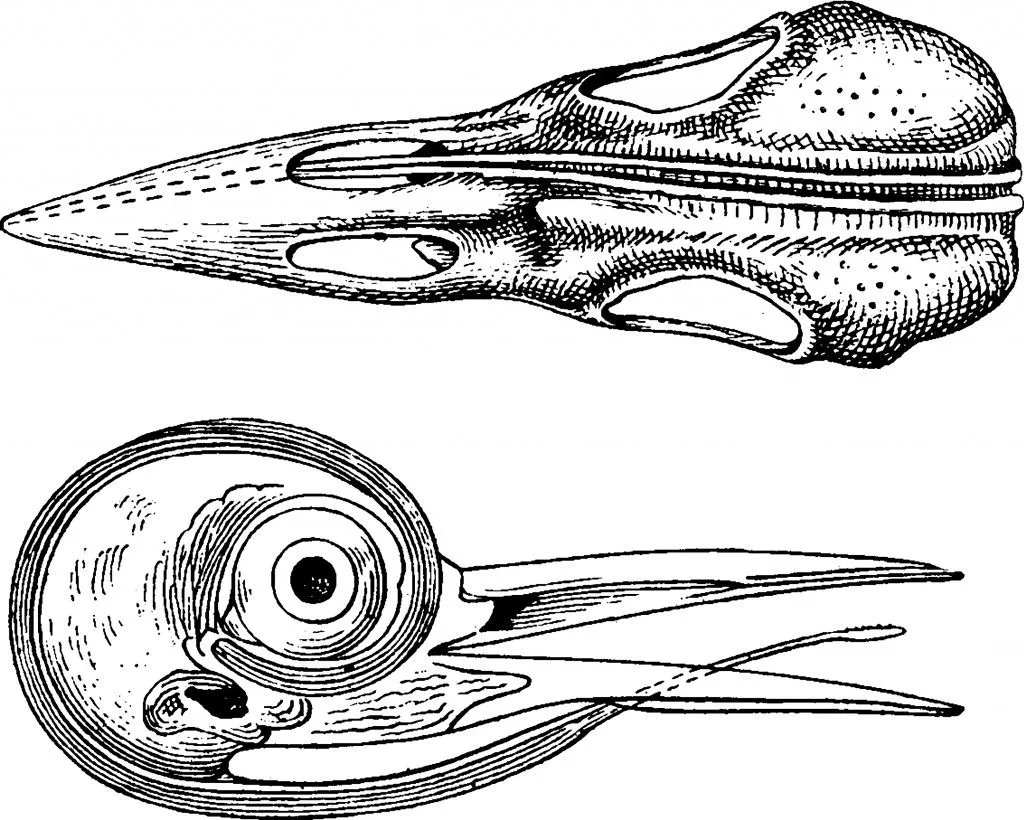
Perhaps the bird’s most prized asset is its beak. Shaped like a chisel, it cuts through the wood, rather than stopping on contact. This avoids any shock waves that would come from doing the latter.
Scientist have also found that the tissue layer covering the woodpecker’s upper beak is longer than the layer covering the lower beak, while the bony structure of the lower beak was longer than the upper. This mismatch, scientists believe, also allows energy to be directed through the lower beak and away from the brain casing.
Posture During Pecking
It’s not just the uniquely designed skull or beak that gives the woodpecker the license to hammer without a headache. Have you ever seen the position a woodpecker assumes when it’s pecking?
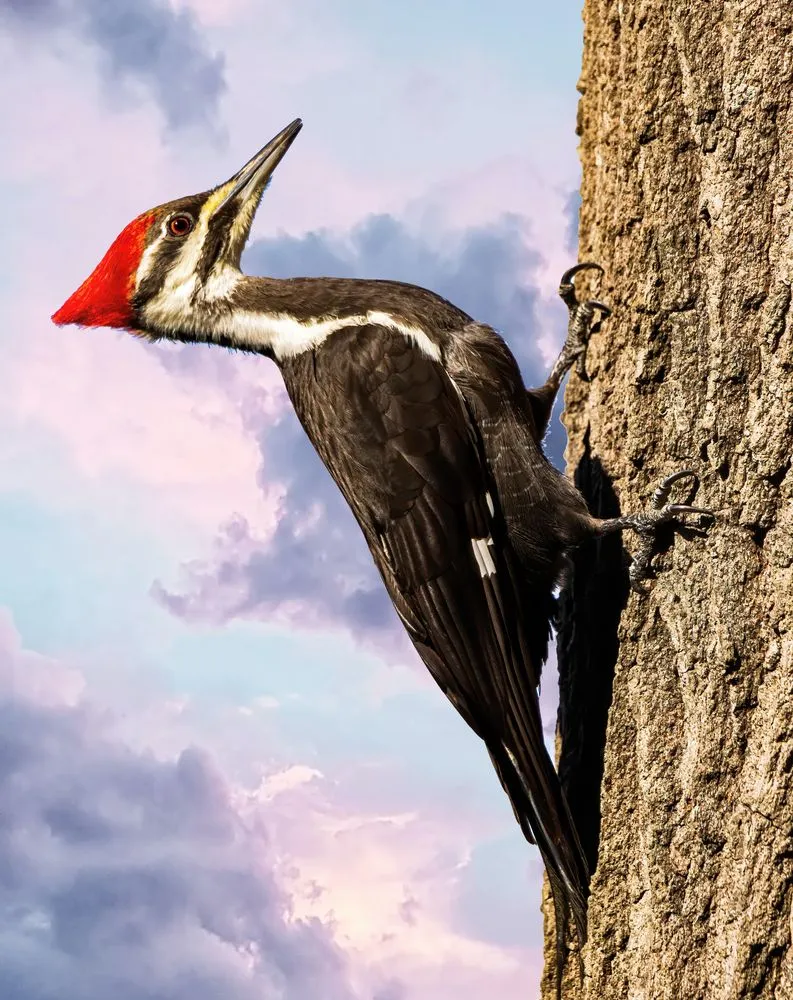
Their feet, with two toes in the front and two in the back (unlike other birds with three in the front and one in the back), allow them to remain vertical while clinging to the tree trunk. This further reduces the impact to the body as a whole.
The Unique Fine-tuned Iron Tongue
Given that all of their anatomy and morphology enable them to seamlessly drill holes, there’s nothing left for the bird to do other than stick out its tongue (one-third of its body length), and slurp up the treasured sap and insects within the tree.
But where do they store such a long tongue? Surely the beak can’t hold all of it!
The tongue is anchored in the head, wrapping around the back of their brains. Not only does this solve the storage issue, but it also gives the brain a cushion-like support.
How Many Times Does A Woodpecker Peck In A Day?
A woodpecker doesn’t hammer in one long, unbroken burst. It fires off short volleys of roughly 20 pecks per second, pauses to reposition or fish out a grub, and then goes again. Add up all those bursts across a full day of foraging, excavating and territorial signalling, and the numbers get genuinely staggering. Researchers studying woodpecker biomechanics estimate that the pecking can happen over 12,000 times a day, and on an especially busy bird the daily tally can climb to somewhere between 8,000 and 20,000 strikes, depending on how active it is.

Not every peck is the same, either. The rapid-fire drumming a woodpecker uses to stake out its territory is fast but fairly light. Excavating a nest cavity or chiseling after insects is slower, yet each blow lands with far more force. Either way, the head is taking thousands of high-speed decelerations every single day, which is exactly why the bird’s pea-sized brain, seatbelt-like hyoid bone and chisel beak matter so much. Without that toolkit, a schedule of 12,000 daily head-bangs would be a recipe for disaster rather than dinner.
Do Woodpeckers Actually Eat The Wood?
Here’s a common mix-up: despite all that drilling, woodpeckers don’t actually eat the wood. They bore through bark and trunk to reach what they’re really after (insects, larvae, ants and other invertebrates tucked inside), and the splintered wood simply flies off as debris. A woodpecker’s gut isn’t built to digest cellulose, so the tree is a pantry to be cracked open, not the meal itself.

There is one charming exception. Sapsuckers, a group of true woodpeckers in the genus Sphyrapicus, drill tidy, orderly rows of shallow holes called sap wells. Rather than chasing insects, they tap into the tree’s sugary phloem sap and lap it up with a brush-tipped tongue (despite the name, they sip and lick the sap rather than suck it). Those weeping wells double as insect traps, drawing in ants and other bugs that the sapsucker happily eats alongside its sweet drink. So while the rest of the family treats a tree like a locked lunchbox, the sapsucker has worked out how to make the tree itself flow with food.
Closing Thoughts
Just like the mountainous rams who wage rutting battles with their heads, the structure of the skull of an animal plays an important role in the protection of its brain. The anatomical features unique to the woodpecker work ingeniously to give it the liberty to head-bang on any object they choose.
This adaptation in woodpeckers could work as a model of biomimicry, wherein people learn how nature works its wonders and tries to simulate the same ability using similar techniques. Helmets engineered to mimic the intricacies of the woodpecker’s skull arrangement could potentially aid in preventing head and brain injuries of athletes playing various high-impact sports.
References (click to expand)
- Catalina-Allueva, P., & Martín, C. A. (2021, January 3). The role of woodpeckers (family: Picidae) as ecosystem engineers in urban parks: a case study in the city of Madrid (Spain). Urban Ecosystems. Springer Science and Business Media LLC.
- Baum, P. (2020). Woodpecker Drumming Analysis. Unpublished.
- (PDF) Drumming and tapping by Red-bellied Woodpeckers. ResearchGate
- Why Don't Woodpeckers Get Concussions? - MTPR. mtpublicradio.org
- September 2019 | Biomechanics in the Wild - Notre Dame Sites. The University of Notre Dame du Lac
- Woodpeckers - K-State Extension Wildlife Management. Kansas State University
- Van Wassenbergh, S., Ortlieb, E. J., Mielke, M., Böhmer, C., Shadwick, R. E., & Abourachid, A. (2022, July). Woodpeckers minimize cranial absorption of shocks. Current Biology. Elsevier BV.
- Bock, W. J. (1999, March). Functional and evolutionary morphology of woodpeckers. Ostrich. Informa UK Limited.
- Jung, J.-Y., Naleway, S. E., Yaraghi, N. A., Herrera, S., Sherman, V. R., Bushong, E. A., … McKittrick, J. (2016, June). Structural analysis of the tongue and hyoid apparatus in a woodpecker. Acta Biomaterialia. Elsevier BV.
- Five things to know about those wacky and wonderful woodpeckers. Forest Preserve District of Will County.
- And Less Well-known Sap Feeders. Smithsonian's National Zoo and Conservation Biology Institute.