Turritopsis dohrnii, often called the immortal jellyfish, is the only known animal that can reverse its entire life cycle. When injured, starved, or environmentally stressed, an adult medusa can transform back into a juvenile polyp via a process called transdifferentiation, effectively starting life over. In principle, it can repeat this cycle indefinitely, which is why it is considered biologically immortal.
Imagine this… You’re old, with a hunched back and greying hair. You know that your time is near. The clock is ticking and the seconds are passing, but then, suddenly, you revert back to being a baby, ready to live all over again. You’re…immortal!
Like Benjamin Button, you would grow from old to young, but in this case, you could do it at will.
This sounds like science fiction, but it actually happens to what is popularly called the immortal jellyfish! Scientifically, it is called Turritopsis dohrnii
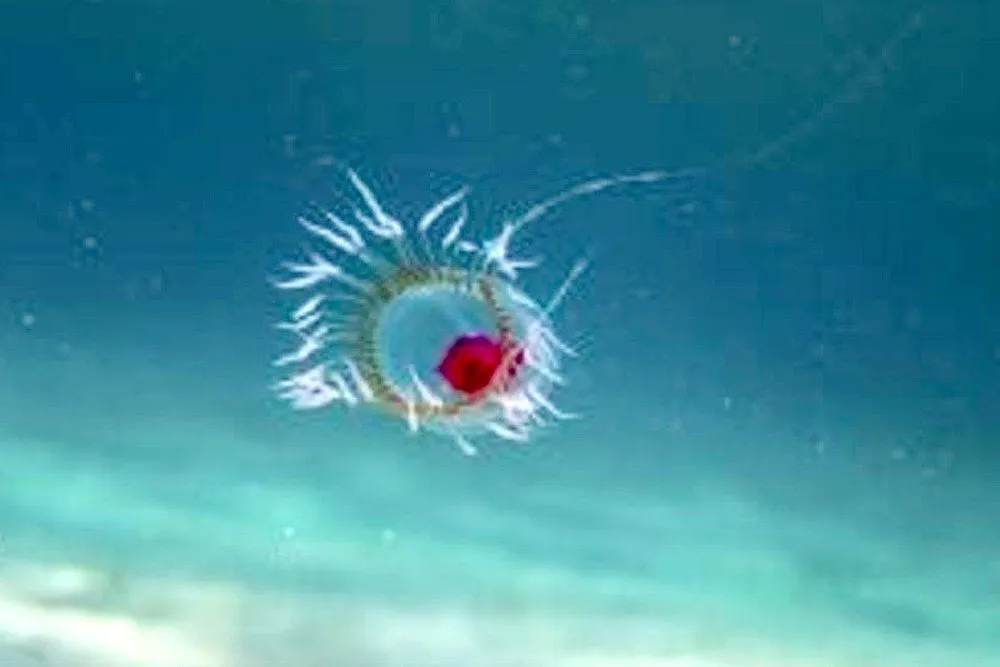
Turritopsis Dohrnii
The creature capable of such an amazing feat is a very specialized jellyfish. For years it was widely (and mistakenly) reported under the name Turritopsis nutricula. However, T. nutricula is actually a separate species native to the western Atlantic; the jellyfish famous for its immortality is Turritopsis dohrnii, a distinction untangled by taxonomic work in the 2000s.
It belongs to the Phylum Cnidaria. Jellyfish can exist in polyp form, as medusa, or can alternate between both. T. dohrnii falls under the last category. Polyps are sessile creatures that stay attached to a substratum. They have a foot with which they attach to the substratum, and their mouth faces the water, surrounded by tentacles.
On the other hand, medusae are motile creatures that can swim about. They have a bell-shaped head with tentacles that help for swimming
As is the case with all jellyfish, they have neither a heart nor a brain. They were first discovered in the Mediterranean Sea in 1883, and are now spreading all over the world, particularly because these tiny creatures are hitchhiking on ships in their ballast water and traveling across the globe. (A note for the purists: hydras and some planarians also show forms of biological immortality, but T. dohrnii is unique in being able to reverse from a sexually mature adult back to a juvenile.)
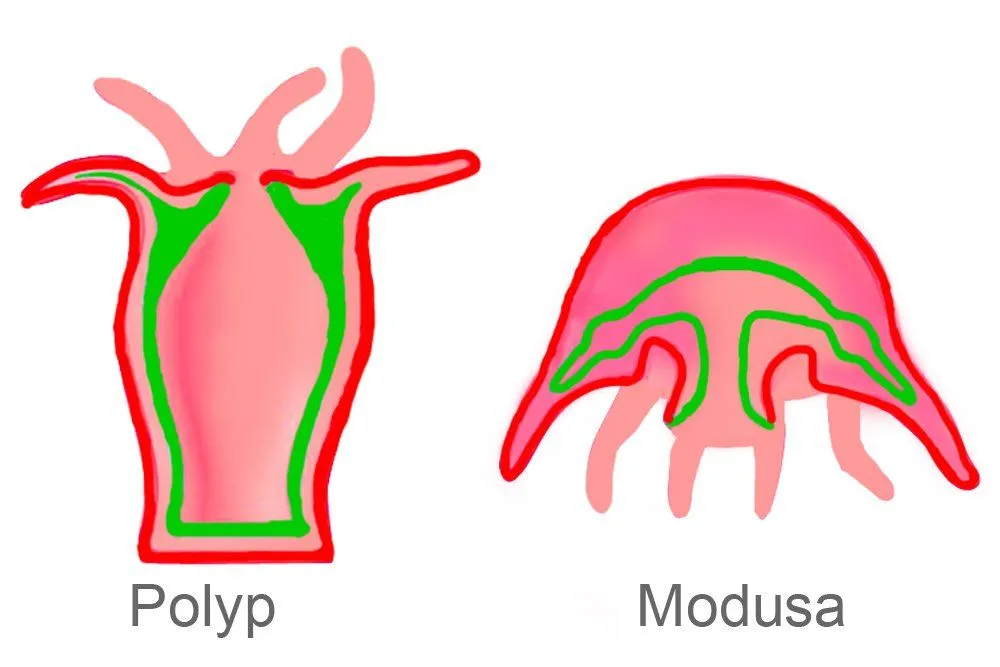
Life Cycle
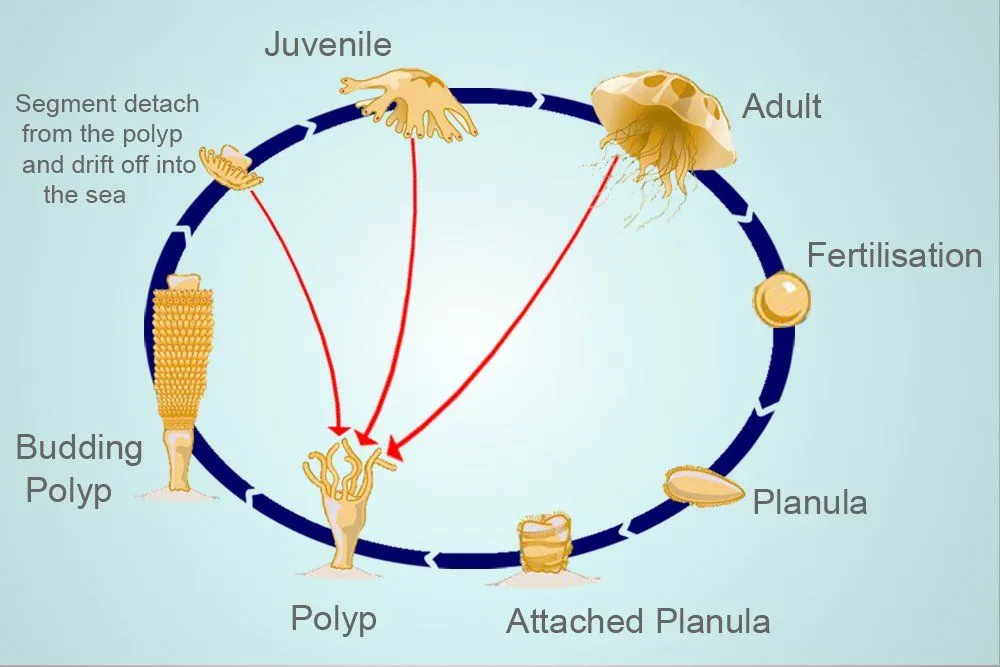
T. dohrnii reproduce sexually. The males release their sperm in the water, while the females develop the eggs in their stomach in an area called the manubrium. It is assumed that fertilization takes place in the water itself, giving rise to planula, which is the larval stage. These planula then settle down on the sea bed or other suitable substratum and form colonies called polyps. These polyps reproduce asexually to form exact replicas of themselves. Eventually, from these colonies, immature medusae develop through budding. They take a few months to attain sexual maturity, and then the cycle repeats.
Immortality Through Transdifferentiation
While the life cycle of T. dohrnii moves in a set manner, these organisms have the unique ability to stop and reverse it. That’s correct. While in their medusa stage, the jellyfish can revert back to the polyp stage. They can do this not just while they are immature medusae, but even after they have attained sexual maturity!
They achieve this through a process called transdifferentiation. This is the ability of a mature cell to transform into another type of mature cell. This process requires the cells from the bell and the cells of the circulatory canal system. Therefore, an adult medusa can simply revert back to its polyp form after going through an intermediate cyst form, leaving it ready to start life all over again! This is biological immortality
However, it’s not all that easy. This conversion comes with certain conditions too; namely, medusae cannot completely control their reversal. Whenever the medusa is injured, the external conditions are not conducive, or if it is starving, only then can it undergo this transformation. Fortunately, there is no limit as to how many times it can undergo this change.
Even so, this doesn’t mean that they can never die. They can still be eaten or die of diseases, etc.
Until recently, we knew very little about how these beings carry out such a fascinating process. Observing this transformation in a lab is easier said than done, because the conditions under which they undergo their transformation are very specific and not fully understood. However, a 2022 study published in PNAS by Pascual-Torner and colleagues sequenced and compared the genomes of T. dohrnii and its non-reverting cousin Turritopsis rubra, identifying expanded gene families linked to DNA repair, telomere maintenance, and stem-cell pluripotency that likely underpin its rejuvenation trick.
Is The Immortal Jellyfish Really Immortal?
It is worth being precise about what “immortal” means here. Biologists call T. dohrnii biologically immortal, which means it does not have to die of old age, not that it cannot die at all. The 2022 PNAS study frames the species as one that can “rejuvenate repeatedly after sexual reproduction,” hinting at biological immortality rather than declaring a creature that lives literally forever.
In the real ocean, plenty still kills it. As the Natural History Museum in London notes, immortal jellyfish are prey to other animals such as fish and turtles, while the bottom-dwelling polyps are nearly defenseless against sea slugs and crustaceans. They can also be felled by disease, and the rejuvenation trick only works under the right conditions, so most individuals are eaten or simply die long before they ever get the chance to wind the clock back.
Has any single jellyfish actually been observed living forever? No. Immortality here is a cellular property rather than a documented life span. The clearest evidence comes from Japanese scientist Shin Kubota, who has reared colonies for decades: over one two-year stretch his captive jellyfish naturally rejuvenated up to 10 times, sometimes only a month apart. That is repeated, real rejuvenation, but it is a long way from proof that a wild medusa could dodge predators and disease indefinitely.
How Big Is The Immortal Jellyfish, And Where Does It Live?
For such a celebrated animal, T. dohrnii is astonishingly tiny. A fully grown medusa is only about 4.5 mm (0.18 in) across, smaller than the nail on your little finger, with a transparent, bell-shaped body. A bright red stomach is usually visible through that see-through bell, and a fringe of fine tentacles rings the rim. The number of tentacles varies with where the jellyfish lives: animals in warm tropical waters such as off Panama may carry only about eight, while those in cooler temperate seas like the Mediterranean can sport two dozen or more.

Originally a Mediterranean species, T. dohrnii is now found in temperate and tropical seas around the world. Researchers believe it has hitched rides across the oceans in the ballast water that ships pump in and out, surviving the long crossings thanks to the very life-cycle reset that makes it famous. It is a carnivore that feeds on tiny drifting zooplankton; in Kubota’s laboratory tanks, the jellyfish are kept alive on a fiddly diet of brine shrimp eggs sliced up under a microscope.
References (click to expand)
- Turritopsis dohrnii - Wikipedia. Wikipedia
- "Immortal" Jellyfish Swarm World's Oceans. National Geographic
- Turritopsis dohrnii. The Smithsonian Institution
- Immortal jellyfish: the secret to cheating death. Natural History Museum
- Comparative genomics of mortal and immortal cnidarians unveils novel keys behind rejuvenation. PNAS (2022). NCBI PubMed
- Turritopsis nutricula McCrady, 1857. World Register of Marine Species (WoRMS)