No, jellyfish do not have brains, hearts, bones, or blood. They use a diffuse nerve net of neurons spread across the body — plus sensory clusters called rhopalia — to react to touch, light, temperature, and salinity. Oxygen and nutrients diffuse directly through their paper-thin bodies (about 95% water), so no pump is needed.
There is no shortage of strange animals on Earth, and it should come as no surprise that the vast majority of these bizarre earthlings are found underwater, given how much of the deep blue remains unexplored. This article, however, is about one particular water-dwelling creature—the Jellyfish—and its essential organs, or lack thereof.
What Is A Jellyfish?
Contrary to its name, a jellyfish is not actually a fish. These animals are a kind of zooplankton, which translates from Greek to mean animal (zoon) wanderer (planktos). Zooplankton (and the photosynthetic phytoplankton) are a diverse group of organisms that float in water and are mostly microscopic, but some are as large as our jellyfish.
Jellyfish belong to the same phylum as sea anemones and corals. These organisms on the more ancient branches of the evolutionary tree have relatively simple anatomy. In fact, jellyfish consists of about 95% water! A good way to visualize this is that if a jellyfish had washed up on the beach after a while due to evaporation, it would have basically disappeared! This simplicity has allowed their body plan to be relatively simple!
Perhaps most remarkable is that they have no brain or heart. While they do have a simple digestive cavity called the gastrovascular cavity, they lack the complex organs that most animals rely on.
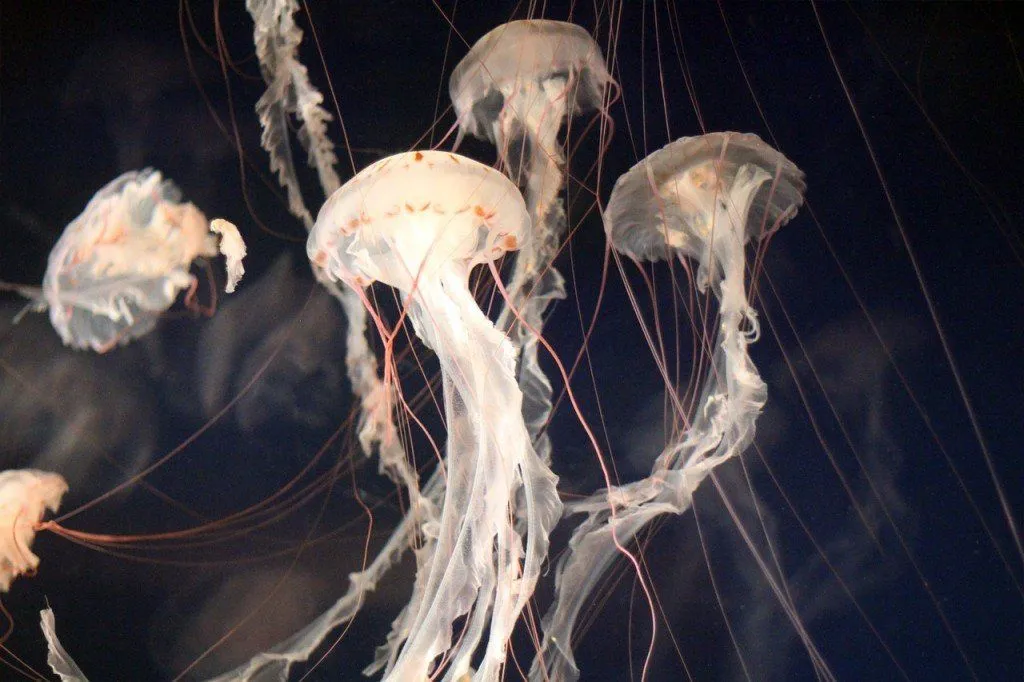
Jellyfish Have No Brain, But They Do Have A Rudimentary Nervous System!
Although jellyfish do not have a brain, they have a very basic set of nerves or a nerve net that spreads radially through the jellyfish. These nerves serve as sensory organs that detect touch, temperature, salinity, etc., and the jellyfish react reflexively to these stimuli. Their neurons are interspersed in the various body layers of the jellyfish.
However, don’t let their lack of a brain fool you into thinking that jellyfish have a simple, uncomplicated nervous system. There’s a rich diversity of nervous systems that could whet the appetite of even the most inquisitive mind. These creatures have sensory organs that recognize light, salinity, gravity, touch, and temperature.
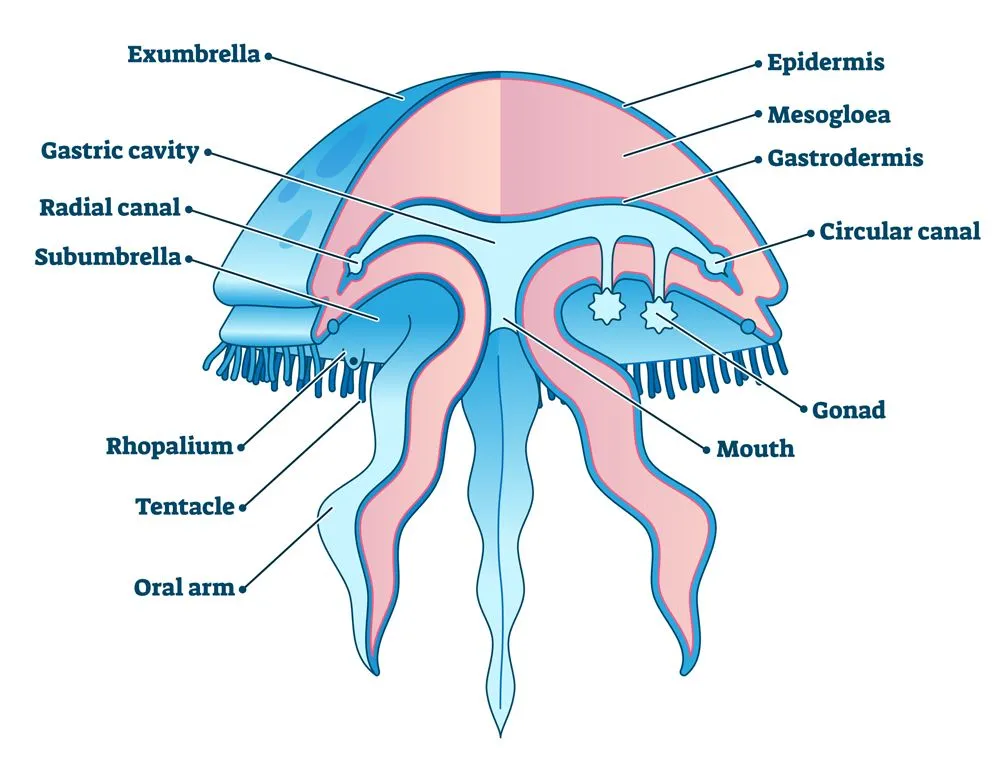
They sense light via light-sensitive cells along the ridge of their bells called rhopalia. Nerves in the rhopalia are aggregates, unlike the diffuse nerves in the rest of the jellyfish. Within the rhopalia are eyespots that detect light.
Statocysts Let The Jellyfish Balance.
Next to the eyespots within the rhopalia is the sensory machinery that enables jellyfish to maintain their balance. Statocysts, the organ of balance, is composed of sand grains within the organ. As the jellyfish moves, the minerals press against sensory neurons on the opposite side of the direction of motion due to inertial resistance. Based on this input, the jellyfish automatically corrects its course through reflexive movements.
The rhopalia are spectacularly visible in typical jellyfish (Scyphozoa), such as the moon jellyfish, and box jellyfish, such as the Tripedalia cystophora.
Some Jellyfish Have Eyes!
Box jellyfish have a remarkable 24 eyes in their 4 rhopalia, 6 in each. The eyes are not identical, and there are four different types. The upper lens eye and the lower lens eye resemble our own eyes and have a cornea, lens, pupil, and retina!
This results in some interesting behaviors. Tripedalia cystophora can look up at the water’s surface to find its favorite habitat, mangrove trees. Even more remarkably, a 2023 study demonstrated that box jellyfish are capable of associative learning — they can learn from experience to avoid obstacles, modifying their behavior based on past encounters. This challenges the assumption that a centralized brain is required for learning.
Some jellyfish are even known to court their mates, such as box jellyfish Carybdea sivickis. In such a situation, the male jellyfish grabs the female with its tentacles and mates with her.
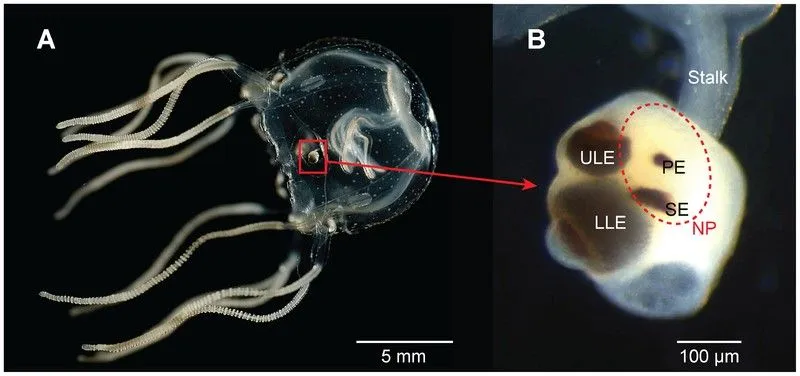
All this is not possible with a simple diffused nerve net. Some jellyfish do have a kind of central nervous system, a nerve ring, and the rhopalial nervous system. This nerve ring runs along with the bell and connects the different rhopalia and sensory neurons.
And although the layout is simple, it still holds many mysteries. For one, scientists still do not know how jellyfish coordinate information between their different rhopalia. We often associate those deliberate behaviors with “brains”, yet the jellyfish do these tasks – mating, seeking shelter, and migrating. How they do this remains a great mystery.
One of the most surprising discoveries about jellyfish is that they sleep — despite having no brain. Research has shown that upside-down jellyfish (Cassiopea) pulse their bells less often during nighttime, are less responsive to stimuli, and experience sleep rebound after deprivation — sleeping 50% longer after a bad night, just like humans. In 2025, UC Berkeley researchers identified a gene called chrnal-E that promotes wakefulness in jellyfish, and a 2026 Bar-Ilan University study found that jellyfish accumulate neuronal DNA damage during wakefulness that is repaired during sleep — suggesting that protecting neurons is one of the most ancient functions of sleep, predating the evolution of complex brains.
How Do Jellyfish Navigate Without A Brain?
If a jellyfish has no brain, how does it know which way is up, where the light is coming from, or when to swim toward food? The answer is that navigation in a brainless animal is handled by distributed sensory clusters and reflex circuits, not by centralized decision-making.
Around the rim of the bell sit small sensory structures called rhopalia. Each rhopalium packs several sense organs into one tiny bundle: light-detecting ocelli (and in some species, full lens eyes with a cornea, lens, and retina), gravity-sensing statocysts, and chemosensory cells that pick up dissolved substances in the water. Box jellyfish (Tripedalia cystophora) carry four rhopalia with 24 eyes in total, while moon jellies and most other scyphozoans get by with simpler ocelli.
Statocysts handle balance and orientation. Inside each one, a small mineralized grain rests against sensory hairs. When the jellyfish tilts, the grain shifts, the hairs bend, and the local nerve net fires asymmetric pulses to the bell muscles, automatically correcting the tilt. No "decision" is involved; it's a reflex loop wired directly into the body plan.
Light direction works in a similar way. Garm and colleagues showed in 2011 that box jellyfish can detect the dark silhouette of mangrove canopies above the water through their upward-pointing lens eyes, then steer back toward shallow habitat whenever they drift out. A 2023 study by the same group went further, demonstrating that Tripedalia can learn to avoid obstacles after only a few exposures, modifying its reflex behavior based on experience. Associative learning, it turns out, doesn't strictly require a brain.
The nerve net stitches all of this together. Sensory input from the rhopalia spreads radially, and the bell pulses asymmetrically to turn the animal in the appropriate direction. It isn't navigation in the deliberate, map-and-compass sense, but it's enough to find food, avoid obstacles, stay in suitable habitat, and migrate up and down the water column with the day-night cycle.
Do Jellyfish Have A Heart?
No, jellyfish have no heart at all. They have no arteries, no veins, no capillaries, and no pump of any kind. The cardiovascular hardware most animals rely on (an atrium, a ventricle, the steady drumbeat of a heartbeat) simply isn't part of cnidarian anatomy.
What jellyfish do have is a single muscular bell. The subumbrellar musculature running along the underside of the bell contracts in coordinated pulses, squeezing water out and propelling the animal forward through a kind of biological jet propulsion. These contractions move the jellyfish through the water, but they don't push fluid through any internal vessel system. There is no internal "blood loop" that would need pumping in the first place.
In place of a circulatory system, jellyfish rely on a gastrovascular cavity, a single chamber that handles both digestion and the distribution of dissolved nutrients. Seawater itself flows in and out of this cavity, carrying oxygen and food in, and carrying waste out. Because the body wall is only a few cells thick, every cell ends up close enough to either the surrounding seawater or the gastrovascular cavity that simple diffusion does the rest.
A heart, in other words, is an evolutionary answer to a problem jellyfish never had: thick, complex tissues with cells buried far from any oxygen source. Solve that problem differently (stay thin, stay watery, let physics do the work) and you don't need one.
Do Jellyfish Have Blood?
No, jellyfish have no blood. There is no red, blue, or any other circulating fluid, and no respiratory pigment like the hemoglobin or hemocyanin that ferries oxygen around in most animals. They also have no lungs, no gills, and no dedicated respiratory organ.
This sounds impossible until you remember how thin a jellyfish actually is. Strip away the water (and a jellyfish is roughly 95% water) and what remains are two cellular layers separated by a jelly-like substance called mesoglea. The outer layer, the ectoderm, and the inner layer lining the gut, the endoderm, are each only a handful of cells thick. At that scale, oxygen and carbon dioxide can move directly across the cell membranes by simple diffusion. No pump, no carrier molecule, no plumbing required.
Nutrients work the same way. Once prey is digested inside the gastrovascular cavity, the breakdown products diffuse from the inner lining out into the surrounding tissues. The same cavity also serves as the waste exit; undigested material and metabolic byproducts are flushed back out through the mouth (jellyfish don't have a separate anus either).
It's a striking lesson in scaling. Complex circulatory and respiratory systems exist because larger, denser animals can't rely on diffusion alone. Jellyfish, by staying thin and watery, sidestep the entire engineering problem.
Why Jellyfish Still Surprise Biologists
Nature’s first draft of a nervous system might be simple, but it still works. Considered among the first even to have a nervous system, the cnidarian’s nerve nets reveal the evolutionary origins that led to later, more complicated nervous systems like ours!
Perhaps the most extraordinary jellyfish ability belongs to Turritopsis dohrnii, the so-called "immortal jellyfish." When stressed, sick, or aging, this tiny species can revert from its adult medusa form back to a juvenile polyp through a process called transdifferentiation — essentially resetting its life cycle. This makes it the only known animal capable of biological immortality (though individuals can still die from predation or disease). Recent research has identified genetic networks involved in this reversal, including genes with significant implications for understanding human aging.
Jellyfish are truly fascinating creatures that manage to survive without many of the organs we now consider vital, and their bodies are well suited to survive the conditions of the endless blue, drifting across the vast oceans, displaying their beauty for all to see—at a safe distance!
References (click to expand)
- Katsuki, T., & Greenspan, R. J. (2013, July). Jellyfish nervous systems. Current Biology. Elsevier BV.
- Satterlie, R. A. (2011, April 15). Do jellyfish have central nervous systems?. Journal of Experimental Biology. The Company of Biologists.
- Schwab, I. R. (2003, May 1). Is the brain overrated?. British Journal of Ophthalmology. BMJ.
- Jellyfish and sea anemones sleep like humans. Smithsonian Magazine.
- Jellyfish sleep a lot like us. Science/AAAS.
- Immortal Jellyfish Offers Clues into Biological Aging. The Scientist (2024).
- Garm, A., Oskarsson, M., & Nilsson, D.-E. (2011). Box Jellyfish Use Terrestrial Visual Cues for Navigation. Current Biology.
- Bielecki, J., Nielsen, S.K.D., Nachman, G., & Garm, A. (2023). Associative learning in the box jellyfish Tripedalia cystophora. Current Biology.