Table of Contents (click to expand)
Some brood parasites, such as certain cuckoos and cowbirds, act like a mafia. If a host bird ejects the parasite’s egg, the parasite returns and destroys the host’s nest or kills its chicks. This “mafia hypothesis,” proposed by Amotz Zahavi in 1979, suggests hosts accept parasite eggs to avoid retaliation, though the evidence remains debated.
“I’m going to make him an offer he can’t refuse.”
Movies about gangsters and organized crime reveal the gritty underbelly of humanity. As it turns out, the Godfather syndrome also operates in the bird world. Now, don’t get ahead of yourself by imagining birds carrying around guns or peddling drugs. There is indeed an avian mafia, but it’s a lot different from what you might imagine.
What Is A Mafia? Brood Parasitism
Animals interact with each other in many ways: predator-prey enemies, mutualistic business partners, best friends, or frenemies. Out of all these, one of the most sinister is a parasitic interaction, where an organism, the parasite, lives off another organism, the host, harming it and sometimes causing its death. The parasite may use the host for food, shelter or…
…as a nanny and caretaker for its young. This particular type of parasitism is called brood parasitism. We know that birds put a lot of energy and time into making nests where they can safely lay eggs and protect their young. However, some birds are too lazy to do all this. They just casually fly over and lay eggs in the well-prepared nests of different species of birds. These birds are called brood parasites.
Who Is The Mafia In This Situation?
In the brood parasite-host relationship, there is constant conflict between both parties. The host does not want the parasite’s eggs in her nest, and the parasite wants to ensure that it remains there. They both engage in strategies to satisfy their desires. Upon detection of the eggs of the parasite, the first tendency of the host bird is to remove it from its own nest. How do parasites respond to this?
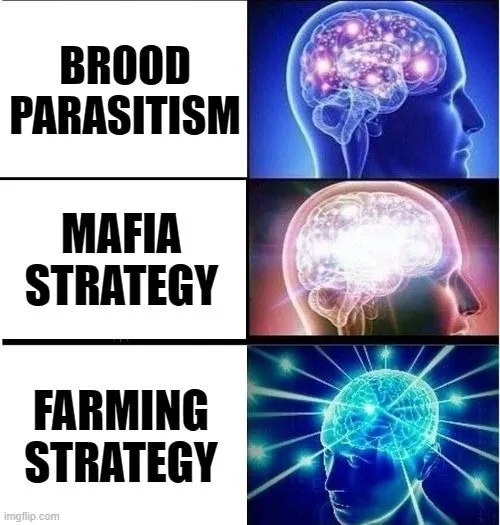
Amotz Zahavi, an Israeli evolutionary biologist, in 1979 proposed that parasites like cuckoos may regularly visit the parasitized nests and kill the host’s eggs if the host has expelled the parasite’s eggs. On the other hand, if the host has accepted the parasite’s eggs and is caring for them well, they won’t damage the other eggs. When such a “mafia” is keeping an eye on them, hosts that are unable to defend against the parasite mafia attacks might decide that accepting some parasite eggs and raising at least some of their own kids is better than losing their whole family to the organized thugs. This is called the ‘Mafia hypothesis.’
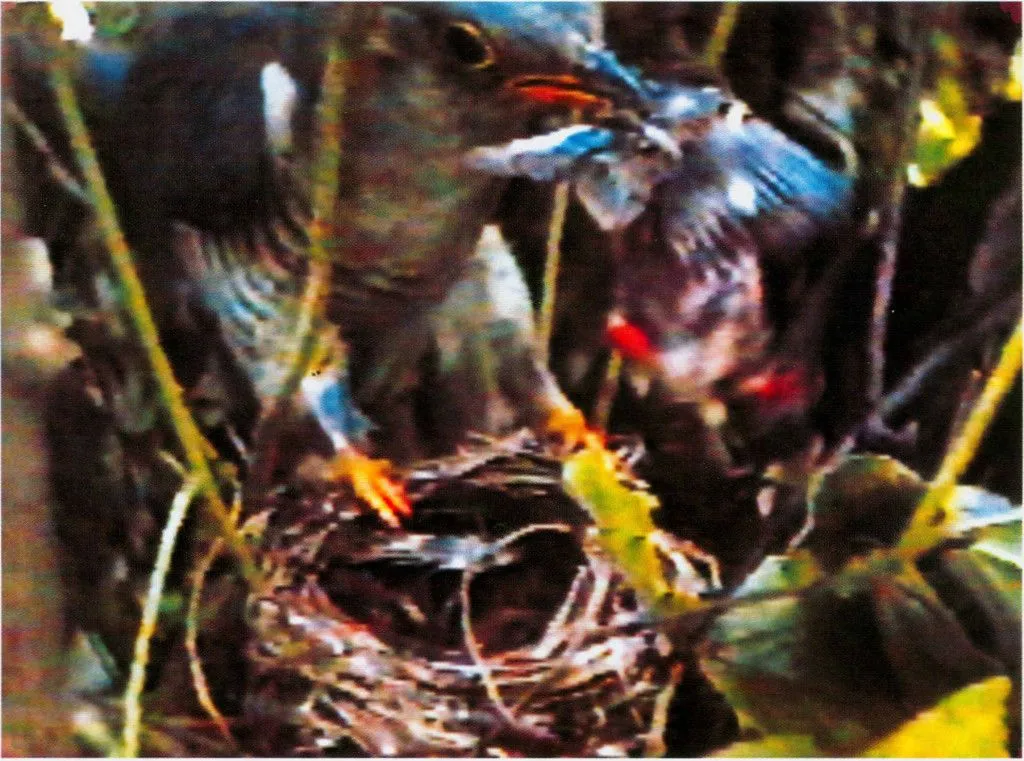
It is known that around 100 species, or roughly 1% of all bird species, are obligate brood parasites. Among these, only a few species have been noted to display mafia-like behavior so far.
Mafia Group 1: The Cuckoos
The mafia theory proposed by Zahavi was first tested by Manuel Soler and his colleagues in 1995. They found that great spotted cuckoos were using the nests of magpies to lay their eggs. When the cuckoo eggs were experimentally removed from the host nest, those nests were destroyed at a much higher rate than untouched nests, and the cuckoos were caught in the act of damaging them. Soler noted that the cuckoos performed regular check-up visits to their host nests as a part of their mafia behavior. “Making collections,” or regularly visiting your unwilling workforce, feels very much like a true human mafia, right?
Mafia Group 2: The Cowbirds
A North American brood parasite called the brown-headed cowbird also shows this kind of retaliatory behavior. In a 2007 study, Jeffrey Hoover and Scott Robinson removed cowbird eggs from the nests of prothonotary warblers. When the cowbirds could reach those nests, 56% of the “ejector” nests were destroyed, compared to just 6% of the nests that had accepted the cowbird egg. In other words, warblers that fought back paid a heavy price. Another study reported that nestlings of crow-tits were thrown out of their nests by a cuckoo.
There is even a precautionary strategy called the ‘farming strategy,’ in which the parasites clear out nests in which they have not yet laid eggs. This is because, when their nests are damaged, the hosts build new ones, giving the parasite bird more chances to lay eggs in the future. In 2024, researchers caught this on camera for the first time: a common cuckoo ejected all seven nestlings from a Daurian redstart’s nest, the pair rebuilt nearby, and the same cuckoo then laid an egg in the replacement nest.
A Final Word
What do the mafia birds gain from all this? For starters, there is always the effort of making the nest that they can avoid. Additionally, the parasite is also let off the hook from all the parental care they would need to dole out to protect, feed and take care of the young ones or eggs. This means they get more time to feed… or make a lot more babies.
It is worth noting that the mafia hypothesis is still debated among biologists. The retaliation seen in great spotted cuckoos and the prothonotary warbler experiment is striking, but it has only been documented experimentally in a handful of host species. A 22-year study of brown-headed cowbirds parasitizing dark-eyed juncos, for instance, found no sign of mafia retaliation at all. Some researchers also argue that such punitive behavior is costly and tricky to evolve in the first place. So while there is real evidence for an avian mafia, it may be a local or occasional tactic rather than a universal rule of the bird world.
Every host-parasite interaction is part of an evolutionary race. There is an adaptation expressed by one party to which the other party responds with a co-adaptation. When parasitic birds make eggs that look exactly like those of the host, the host adapts by developing mechanisms to recognize these foreign eggs. This relationship is a never-ending battle. Over time, this ends up driving more adaptations that result in diversification of both species, or it could result in the defeat or extinction of one member of this dynamic!
References (click to expand)
- Zahavi, A. (1979, January). Parasitism and Nest Predation in Parasitic Cuckoos. The American Naturalist. University of Chicago Press.
- Soler, M., Soler, J. J., Martinez, J. G., & M⊘ller, A. P. (1995, August). Magpie Host Manipulation By Great Spotted Cuckoos: Evidence For An Avian Mafia?. Evolution. Wiley.
- Hoover, J. P., & Robinson, S. K. (2007, March 13). Retaliatory mafia behavior by a parasitic cowbird favors host acceptance of parasitic eggs. Proceedings of the National Academy of Sciences. Proceedings of the National Academy of Sciences.
- Nestling Crow-Tits Paradoxornis webbiana Ejected From Their Nest By Common Cuckoo Cuculus canorus. The Raffles Bulletin of Zoology (1999).
- Soler, M., Pérez-Contreras, T., & Soler, J. J. (2017). Brood Parasites as Predators: Farming and Mafia Strategies. Avian Brood Parasitism. Springer International Publishing.
- Zhang, J., Santema, P., Li, J., Deng, W., & Kempenaers, B. (2024). Video evidence that cuckoos farm their hosts by ejecting nestlings. Ecology and Evolution.
- Twenty-two Years of Brood Parasitism Data Do Not Support the Mafia Hypothesis in an Accepter Host of the Brown-headed Cowbird. Journal of Field Ornithology (2022).