Table of Contents (click to expand)
- What Do Crow Funerals Look Like?
- Scientific Evidence For Crow Funerals
- Crow Funerals Are A Way Of Learning About Danger
- Are Crows Capable Of Feeling Empathy?
- Do Crows Actually Bury Their Dead?
- How Long Does A Crow Funeral Last?
- Do Crows Eat Their Dead?
- Do Ravens And Other Birds Hold Funerals Too?
- Conclusion
Crows do hold “funerals” when they find a dead member of their species, mobbing the corpse, cawing intensely, and ganging up on any people or predators nearby. Researchers (notably Kaeli Swift and John Marzluff) believe these gatherings are mainly about danger-learning: crows use a fallen comrade to identify and remember threats. Whether they also feel grief is still an open scientific question.
Crows are culprits of chaos, breaking the monotony of our mornings with their unpleasant cawing noises. However, these birds might not be making a fuss without good reason. That noise may actually be the heartbroken cries of a murder of crows mourning a fallen friend.
Perhaps you’ve just stumbled into a crow funeral.
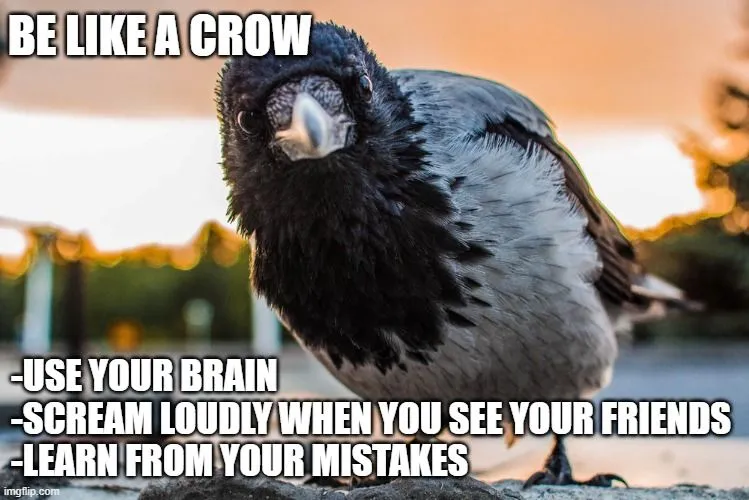
Crows are amongst the most intelligent birds in the animal kingdom. These birds possess higher cognition skills, which allow them to solve complex problems and plan their future tasks. Their response to death is another unique feature that distinguishes them from the rest of the animal kingdom. Only a few other animals, such as elephants and whales, have significant responses to death.
What Do Crow Funerals Look Like?
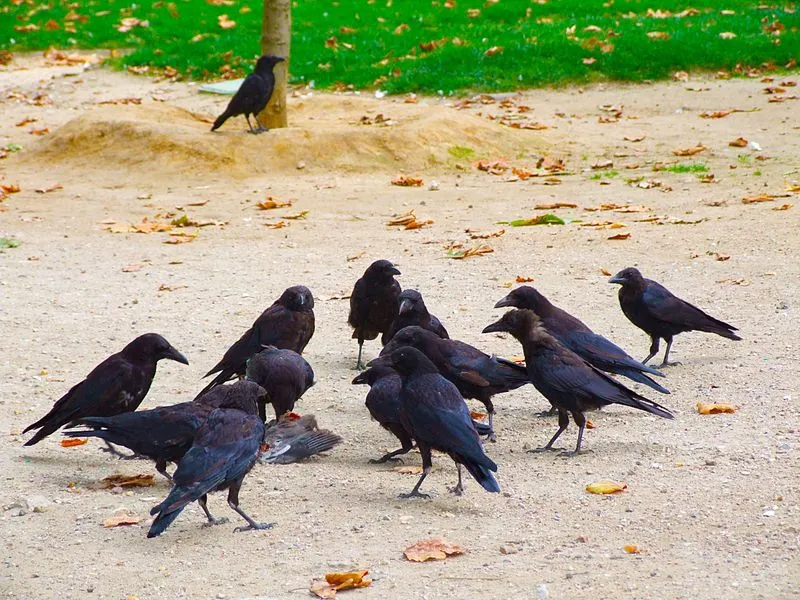
If a crow spots a fallen comrade, it raises an alarm call to alert the other members of the “murder”. A mob of crows then settles down on the branches to observe the corpse, watching and contemplating. They break into intense cawing, as if grieving the death of their fallen brother.
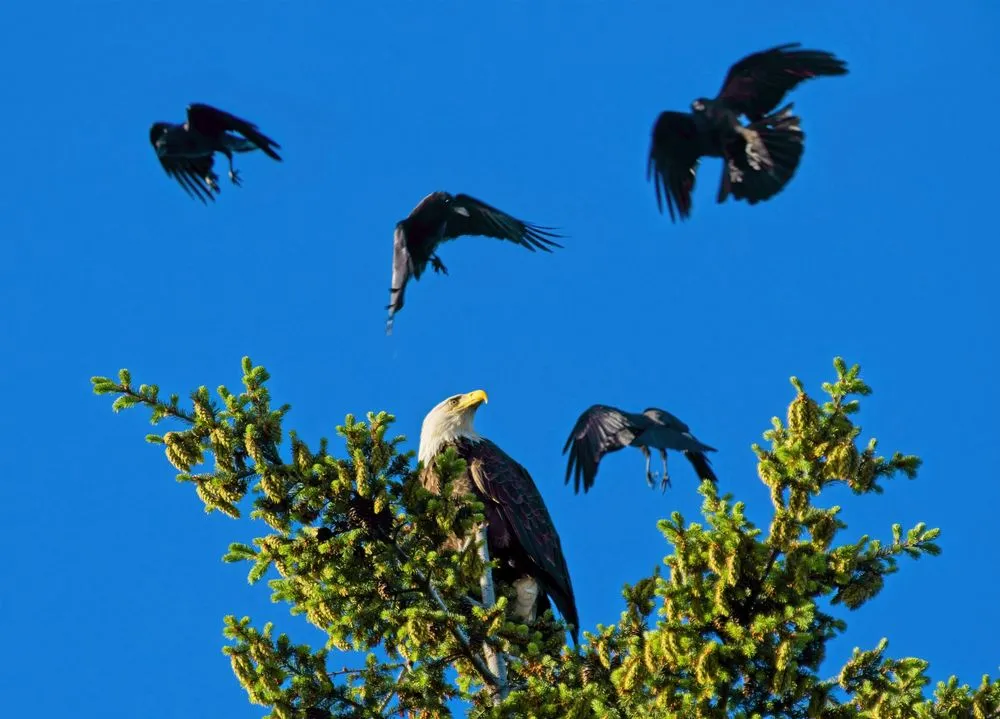
After they have choked themselves with shrill cries, they sit in silence, watching over the corpse for several minutes. If they spot a predator approaching the dead crow, the birds resort to mobbing behaviors, diving over the predator and scolding them away.
Such rituals have been frequently observed by bird watchers in parks or backyards. Farmers have witnessed them innumerable times in their fields. Scientists eventually decided to move beyond anecdotal evidence and test the occurrence of these funerals experimentally.
Scientific Evidence For Crow Funerals
Researchers conducted experiments where they tried to study the response of these birds towards taxidermy-prepared, dead-looking crows. In the taxidermy-prepared birds, the skin of a real crow was arranged over a fake body to make it look real. It was observed that crows identified the stuffed animal as a dead comrade and initiated an alarm call. The corpse was soon surrounded by a mob of crows that broke into intense cawing.
The birds did other things too. There were times when they initiated physical contact with the body of their dead companion. They nudged and pecked, making it seem as though they were feeding from the corpse. However, since crows rarely cannibalize each other, it is unlikely that they considered their fallen comrade a tasty treat.
In rare incidents, they also make attempts at initiating sexual intercourse with the corpse. Although some people find this behavior gross and revolting, necrophilia happens to be quite common in the animal kingdom. It is much less common in crows, with most incidents occurring at the peak of the breeding season. Scientists suspect that these occasional attempts at copulation possibly result from a failure of recognizing their comrade’s deceased state.
These experiments allowed scientists to conclude that when crows spot a fallen member of their species, it indeed results in the commencement of a funeral-like ritual. However, what are we to make of this behavior? Does it stem from emotions? Or is there a more rational explanation?
Crow Funerals Are A Way Of Learning About Danger
The most likely explanation of these funerals is that crows use such gatherings to learn about dangerous places, people, and even novel predators. This has actually been proven scientifically.
According to Kaeli Swift and John Marzluff, the death of a member belonging to their own species represents a salient danger very similar to the observation of a predator. Their experiments demonstrated that spotting a human holding a dead crow evoked mobbing and scolding behavior in the crows that lasted for several weeks.
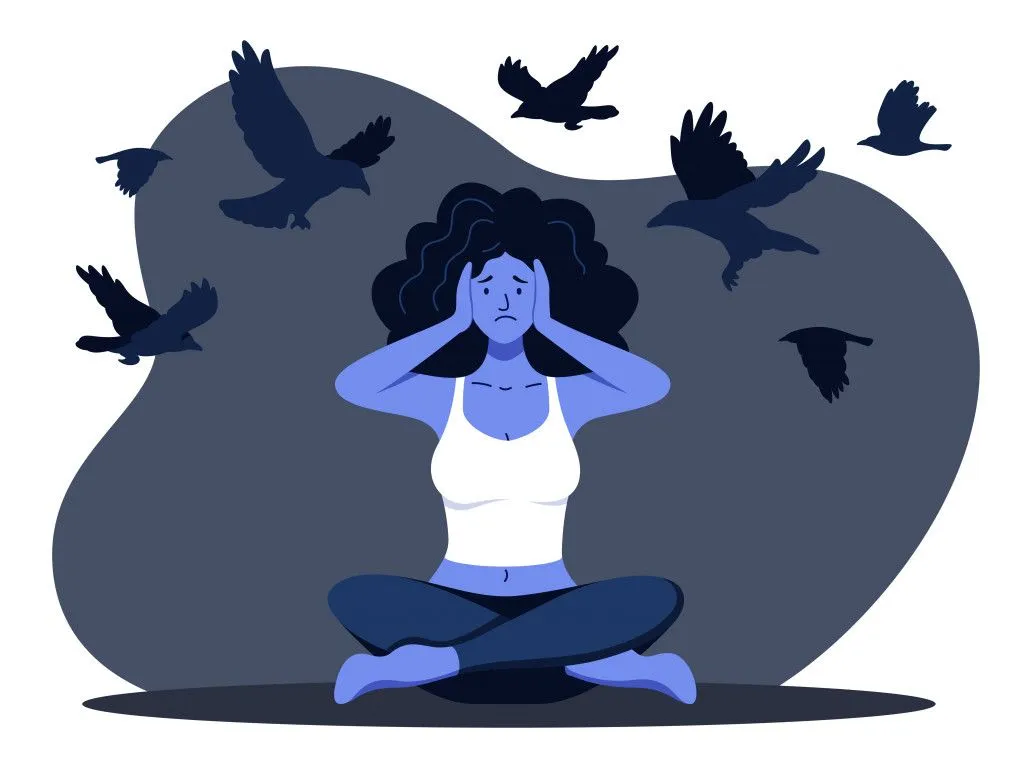
Crows are known to hold grudges and mob the people who have upset them for several years. (Photo Credit : graphicwithart/Shutterstock)
It was also observed that crows avoided eating food in the areas associated with dangerous events for several days. The mobbing behavior and reduced foraging were less commonly observed when the bird used in the experiments was a dead pigeon, rather than a crow.
Since crows don’t just ignore their dead and go on about their day like nothing happened, one could say that death holds meaning for them. But does it evoke a similar feeling of empathy and sadness in them as it does in us? Well, that’s hard to tell.
Are Crows Capable Of Feeling Empathy?
Members of the corvid family, such as crows and ravens, form long-lasting, mostly permanent bonds with their mates and other members of their group (a “murder” in the case of crows). The presence of intricate social systems in these birds points towards the existence of complex emotions, including empathy and grief.
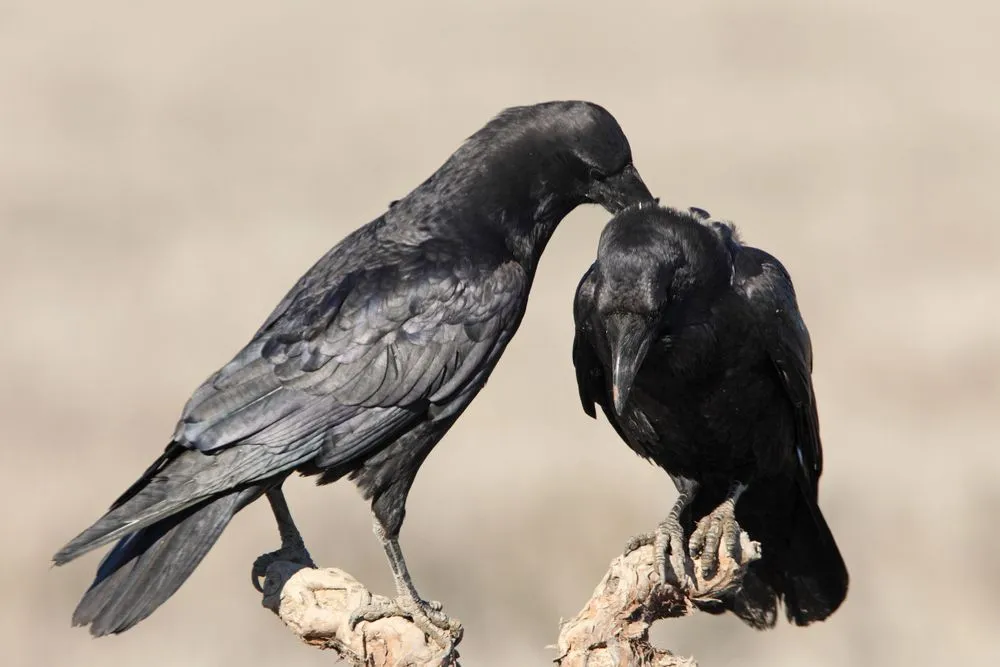
A recent study conducted on ravens found that they can read and feel the emotions of their friends. In an experiment conducted with 4 pairs of ravens, when one was denied a tasty treat during a task, the other mirrored the disappointment of their partner, even though they weren’t themselves deprived of anything. The ones who observed their partners grow excited at the sight of something tasty similarly mirrored their enthusiasm.
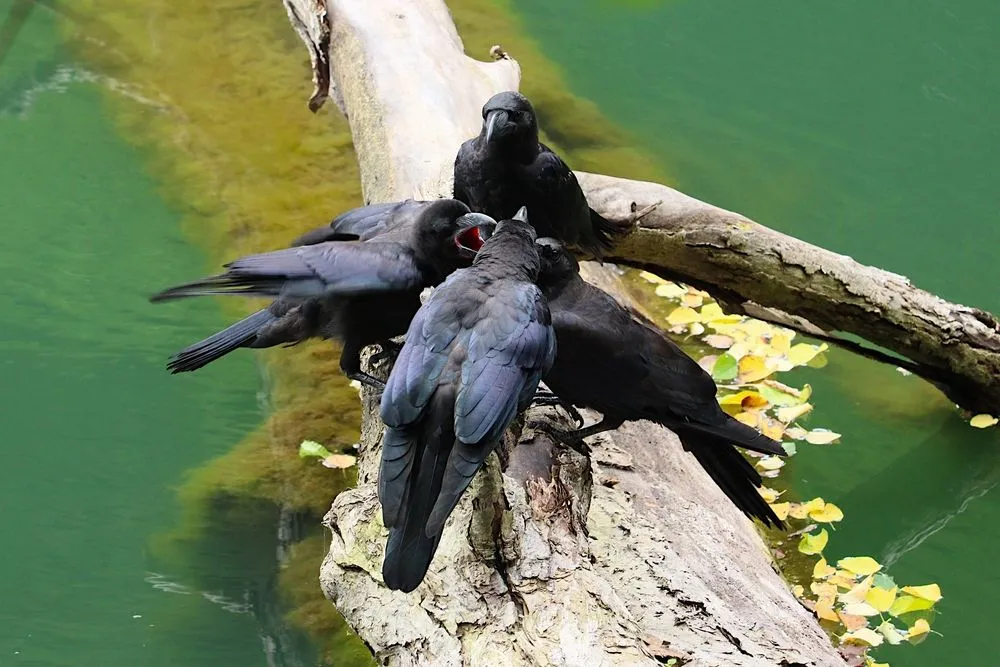
These birds also display other unusual behaviors, such as consoling their friends after they get into a fight with other un-friendly ravens. Though indicative of emotional intelligence, these behaviors alone cannot be considered inherent proof of complex emotions, such as grief. Crow communication is complex and not easy to interpret. For example, in the former experiment, the birds could simply be mirroring the behavior of their partner, instead of their emotions.
Since scientists do not have enough evidence to prove the existence of grief and empathy in birds, they currently lean towards the more rational cause, i.e., danger learning, to explain funeral rituals in crows.
Do Crows Actually Bury Their Dead?
This is one of the most common things people want to know, and the short answer is no. For all the talk of crow “funerals,” there is no burial involved. The birds gather, scold, mob any nearby threat, and then, after a few minutes, drift away and leave the body exactly where it lies. Digging a grave or carrying the corpse off is simply not part of the repertoire.

Burial is a human cultural ritual, and projecting it onto crows is where the misunderstanding starts. As Kaeli Swift and John Marzluff have shown, a crow that finds a dead member of its species is not honoring the body so much as studying it. The gathering is reconnaissance: a chance to work out what killed their flockmate and to memorize the people, places, or predators linked to the death. The corpse is information, not a loved one to be laid to rest, which is exactly why the birds investigate it intently and then abandon it. If anything sticks around after the crows leave, it is the memory of the danger, not a grave.
How Long Does A Crow Funeral Last?
The gathering at the body itself is brief. The birds typically watch over the corpse for only a few minutes before the mob breaks up. What lingers is not the ceremony but the memory of the threat tied to it, and that can stretch on for weeks.
In Swift and Marzluff's 2015 experiments, crows that saw a person holding a dead crow even once went on to scold that individual on sight for up to six weeks afterward. The birds also steered clear of food they had been offered near the dangerous spot for roughly the next three days, treating the whole area as suspect. So while the “funeral” is over in minutes, the lesson it teaches can outlast it many times over. Crows are famous for holding these associations far longer still, recognizing and dive-bombing people they consider threats for years, which is why they have earned a reputation for being able to hold a grudge.
Do Crows Eat Their Dead?
Given how often crows turn up at roadkill and rubbish bins, it is fair to wonder whether a dead crow is just another meal. By and large, it is not. When Swift and Marzluff presented wild crows with a dead member of their own species, the majority of the birds (around 70%) refused to touch it at all. A minority approached to peck, tug, or drag the corpse, but outright cannibalism was rare.
Tellingly, the crows treated a dead crow very differently from the carcass of a pigeon or a squirrel, reacting to a fallen flockmate with the alarm they reserve for danger rather than the indifference of an everyday scavenging opportunity. That distinction matters: it suggests the birds recognize one of their own and respond with alarm rather than appetite. Some of the pecking looks like feeding, but it appears to be investigative, the bird probing a threat rather than eating a meal. So while crows are unfussy scavengers in general, eating a fallen flockmate is not part of their normal behavior.
Do Ravens And Other Birds Hold Funerals Too?
Crows are not the only corvids that pay attention to their dead. The clearest experimental example actually comes from a cousin, the western scrub-jay. In a 2012 study, Teresa Iglesias and colleagues found that the sight of a dead scrub-jay set off loud alarm calls that drew in other jays, producing what the researchers called a “cacophonous aggregation.” These noisy gatherings could last up to half an hour, and afterward the jays warily avoided the spot, much as they would after seeing a predator.

Ravens and magpies, also members of the corvid family, show similar responses, calling around a fallen bird and giving its body close attention before moving on. The interpretation researchers favor is the same one offered for crows: these are not symbolic rituals but a form of social risk assessment, a way of learning where danger lurks. If you have ever wondered how alike these two black birds really are, we cover that in detail in our piece on whether crows and ravens are the same.
Conclusion
Even though “danger learning” seems to be the most probable explanation for the occurrence of crow funerals, we still cannot rule out grief. Sadly, a lack of concrete scientific evidence supporting the existence of complex emotions in animals keeps us from understanding the more holistic function of crow funerals. There is always a risk of over-interpreting or under-interpreting their behavior around death, but that doesn’t make it any less fascinating.
Nevertheless, the pain of separation is real and humans do not hold the monopoly over it. So, the next time you walk into a pack of screeching crows, take a moment to pay your respects!
References (click to expand)
- Gruber, R., Schiestl, M., Boeckle, M., Frohnwieser, A., Miller, R., Gray, R. D., … Taylor, A. H. (2019, February). New Caledonian Crows Use Mental Representations to Solve Metatool Problems. Current Biology. Elsevier BV.
- (2015) Wild American crows use funerals to learn about danger. The University of Washington
- Swift, K., & Marzluff, J. M. (2018, July 16). Occurrence and variability of tactile interactions between wild American crows and dead conspecifics. Philosophical Transactions of the Royal Society B: Biological Sciences. The Royal Society.
- Adriaense, J. E. C., Martin, J. S., Schiestl, M., Lamm, C., & Bugnyar, T. (2019, May 20). Negative emotional contagion and cognitive bias in common ravens ( Corvus corax ). Proceedings of the National Academy of Sciences. Proceedings of the National Academy of Sciences.
- de Waal, F. B. M. (2007, December). Do Animals Feel Empathy?. Scientific American Mind. Springer Science and Business Media LLC.
- Fraser, O. N., & Bugnyar, T. (2010, May 12). Do Ravens Show Consolation? Responses to Distressed Others. (S. F. Brosnan, Ed.), PLoS ONE. Public Library of Science (PLoS).
- crow funeral | - Corvid Research. corvidresearch.blog
- Swift, K. N., & Marzluff, J. M. (2015). Wild American crows gather around their dead to learn about danger. Animal Behaviour. Elsevier.
- Iglesias, T. L., McElreath, R., & Patricelli, G. L. (2012). Western scrub-jay funerals: cacophonous aggregations in response to dead conspecifics. Animal Behaviour. Elsevier.
- Think Crow Funerals Are Strange? Wait Until You See the Wake. Audubon Magazine. National Audubon Society.