Table of Contents (click to expand)
- What Kind Of Animal Is A Skunk?
- What Do Skunks Eat?
- Where Do Skunks Live?
- The Skunk Spray
- How Far Can A Skunk Spray, And Why Does It Spray At All?
- Why Does The Skunk Spray Smell So Pungent?
- What Exactly Is Skunk Spray Made Of?
- Why Does Weed Smell Like A Skunk?
- How To Get Rid Of Skunk Smell?
- Why Doesn’t Tomato Juice Work?
Skunk spray smells so bad because it consists of a mixture of chemicals containing sulfur (such as thiols), which are notorious for their pungent and nauseating odor, basically like the smell that rotten eggs have.
Many creatures of the animal kingdom are quite popular/notorious among humans for a variety of reasons: lions are known for their loud, thunderous roar, ostriches are known for burying their heads in the sand when they sense danger (which, by the way, is a myth), and skunks are known for their signature stinky spray. This spray is released from a skunk’s anus, and is notorious for its incredibly disgusting odor.
What Kind Of Animal Is A Skunk?
The skunk is a mammal primarily known for secreting a foul, noxious-smelling oily liquid from its anal glands and spraying it from its rear end when it feels threatened.
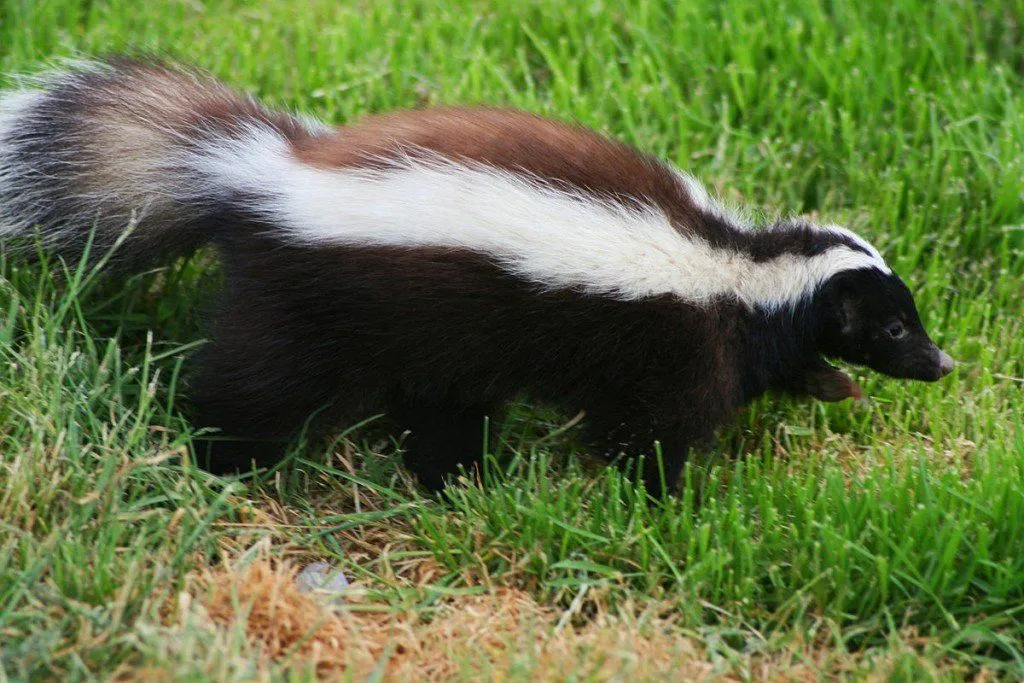
Also known as polecats, skunks are classified in the Mephitidae family (or ‘skunk family’), which is in the order Carnivora. There are 12 known species of mephitids, most of which are found in the Western hemisphere (especially in the Americas).
Skunks come in a variety of sizes; they range from 15 to 37 inches long, 15 to 28 inches tall, and weigh between 0.5 and 8.2 kilograms (1.1-18 lbs). Their bodies are moderately elongated and consist of well-muscled legs. Skunks usually have long front claws that help them to dig.
What Do Skunks Eat?
Skunks are omnivorous, which means that they eat both plant and animal material. Skunks commonly feed on roots, berries, grasses, fungi, nuts and leaves.
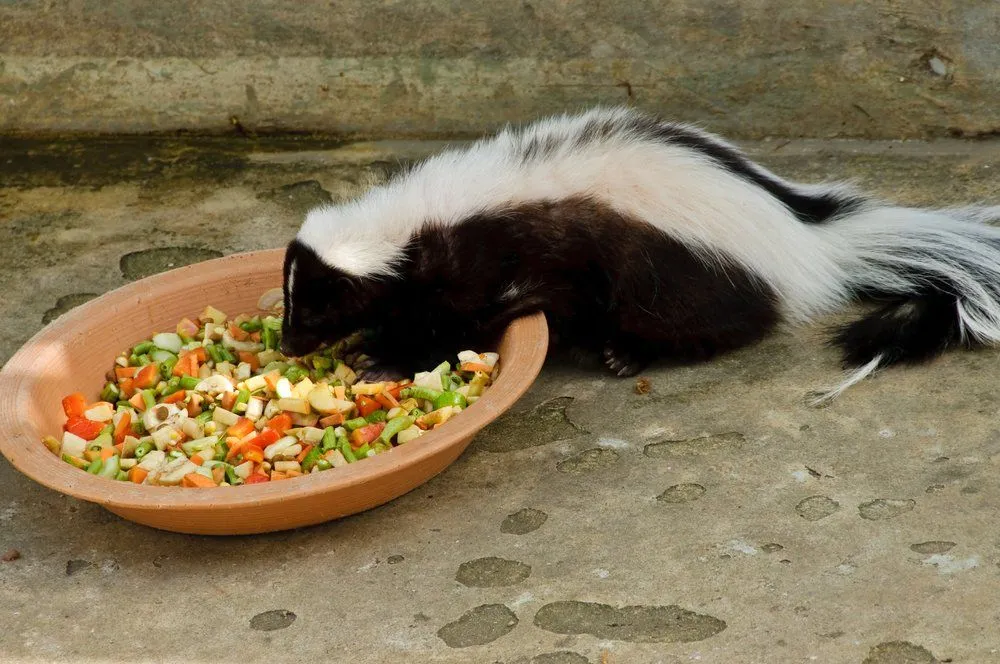
Skunks also commonly eat larvae, insects, grubs, earthworms, rodents and lizards. They are even known to feed on frogs, salamanders, snakes, moles, eggs and birds from time to time.
Where Do Skunks Live?
Skunks generally live in natural environments, such as woodlands, forest edges, grasslands and deserts, i.e., locations that have no dearth of ‘hiding spots’. However, skunks also thrive in urban areas, and can therefore be found in abandoned structures, hollow logs and beneath large rocks.
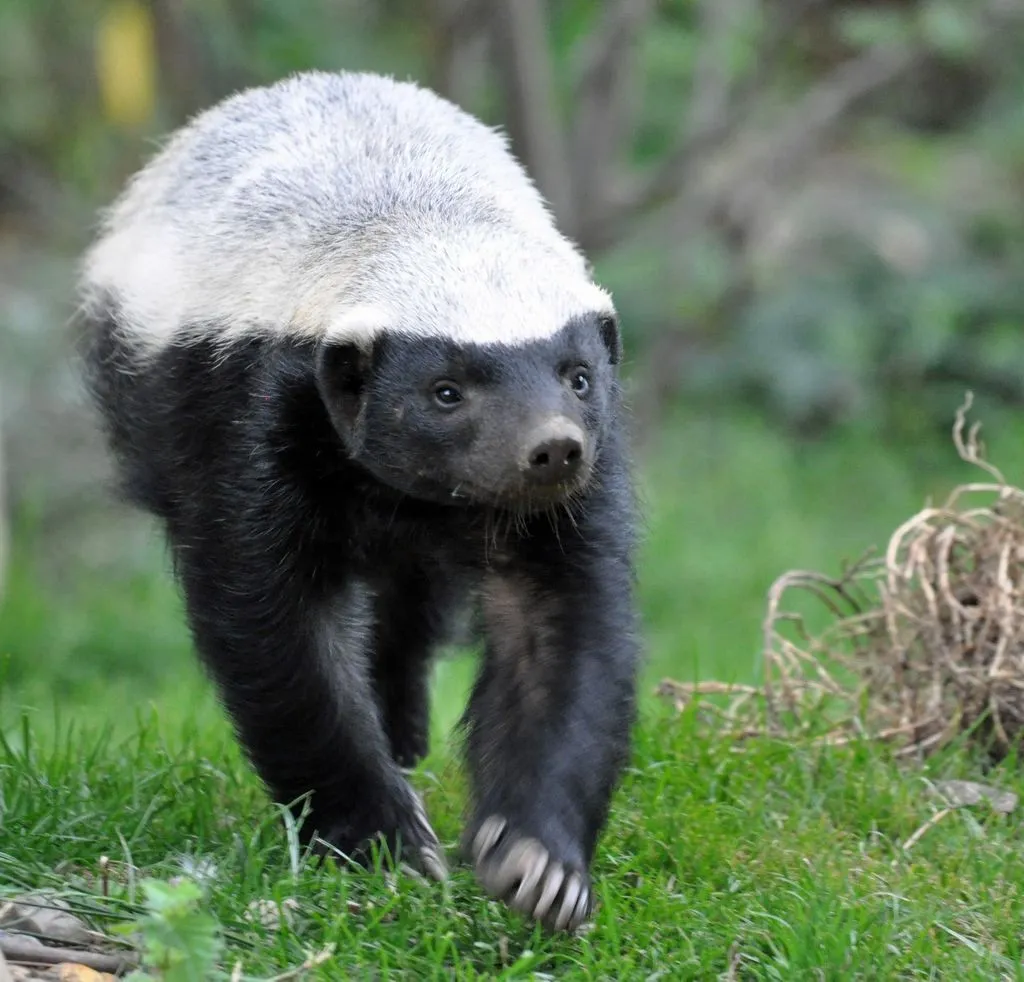
From a broader perspective, skunks are primarily found on the American continent, i.e., the United States, Canada, South America and Mexico. Another member of the skunk family, the stink badger, is mostly found in the Philippines and Indonesia.
The Skunk Spray
Skunks are most commonly known for their ‘spray’, an oily liquid they release from their rear end when they feel threatened.
There are two walnut-sized anal glands beneath a skunk’s tail. These glands secrete a foul-smelling liquid and the muscles around the glands help the skunk project the spray quickly and with incredible accuracy at its target.
How Far Can A Skunk Spray, And Why Does It Spray At All?
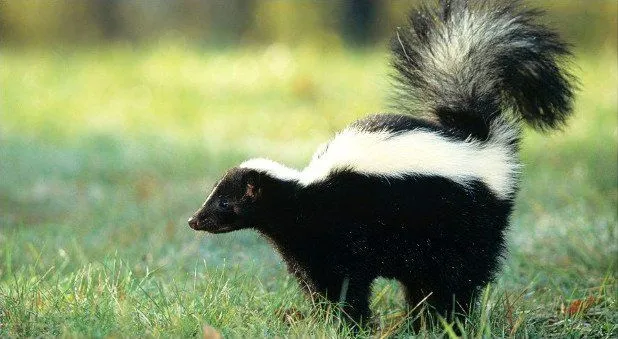
Spraying is a skunk’s last resort, not its first move. Because refilling those two anal glands takes time, a skunk would rather warn you off than waste its ammunition. When a striped skunk feels cornered, it puts on a clear display: it lowers its head, arches its back and lifts its tail (keeping the tip limp), then rapidly stamps its front feet on the ground. Ignore that warning and the tail tip goes up, and the skunk lets fly. The spotted skunk has an even more theatrical version, rearing up into a handstand on its front legs and spraying forward over its head.
The range is genuinely impressive. According to Texas Parks and Wildlife, anything within roughly 3 to 3.7 meters (10 to 12 feet) of the animal is usually within range, and the muscles around each gland let the skunk aim with surprising accuracy. Each gland holds about a tablespoon of liquid, enough for five or six shots, so an undeterred skunk can spray repeatedly before running dry. The spray itself is an oily, pale-yellow liquid, and a face-on hit causes burning, painful (but temporary) eye irritation, choking and coughing. If you have ever wondered where the spray comes out, it is from the two glands flanking the anus, not from the mouth or any scent on the fur.
Why Does The Skunk Spray Smell So Pungent?
The foul odor of the skunk spray can be attributed to the constituents of the liquid that is sprayed. The oily liquid consists of 7 major volatile organic components, which can be further divided into two groups of compounds: thiols and acetate derivatives of thiols.
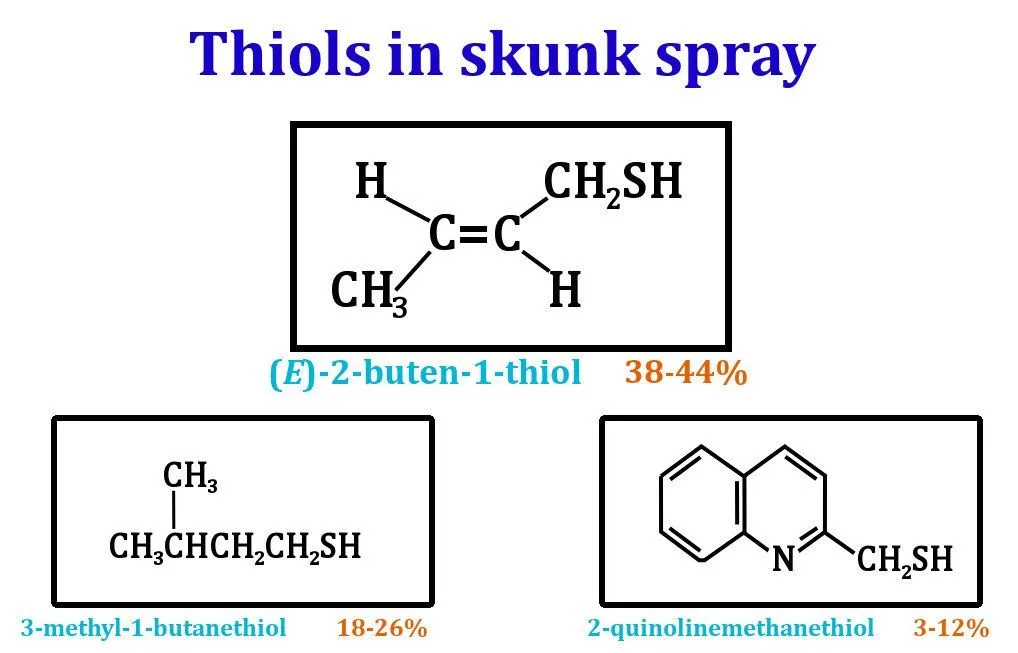
The compounds that contribute the most to the strong, pungent odor of skunk spray are (E )-2-butene-1-thiol and 3-methyl-1-butanethiol. There’s a third thiol as well, but it does not contribute towards the odor as much as the other two compounds, due to its low volatility and the fact that human olfactory receptors are not triggered by such large thiols (Source).
Is it harmful to humans? Mostly no. Skunk spray is not toxic. A direct hit can sting your eyes, briefly blur your vision, and trigger coughing, nausea or even an asthma attack in people with respiratory conditions, but the effects are short-lived and there’s no lasting harm. The smell, however, can linger on skin, clothing and pets for days if it isn’t neutralized.
What Exactly Is Skunk Spray Made Of?
This is the question most people actually type into a search bar, so let’s be precise about it. When chemist William F. Wood analyzed the anal-gland secretion of the striped skunk (Mephitis mephitis) by gas chromatography, he identified seven major volatile components, and they fall into two families: thiols and the thioacetate (acetate-thioester) derivatives of those thiols.
The three thiols are (E)-2-butene-1-thiol, 3-methyl-1-butanethiol and 2-quinolinemethanethiol. Thiols are the sulfur-and-hydrogen group (−SH), also called mercaptans, and the first two are the heavy hitters behind that instant, eye-watering reek. The other three components are their thioacetate cousins, including S-(E)-2-butenyl thioacetate and S-3-methylbutanyl thioacetate. There is no single “skunk formula”, then. The smell is a cocktail, and it is the low-molecular-weight thiols, not any one tidy molecule, that human noses find so revolting.
Here is the clever part. The thioacetates barely smell at all on their own, because the sulfur is capped by an acetyl group. But they are oily and far less volatile than the thiols, so they cling to fur, skin and fabric. When they get wet, water slowly hydrolyzes them back into the foul-smelling thiols. That is precisely why a dog you thought you had cleaned can suddenly reek again days later after a bath or a walk in the rain. The spray is, in effect, a slow-release stink bomb.
Why Does Weed Smell Like A Skunk?
It is not your imagination, and it is not just the nickname “skunk” for certain cannabis strains. The two really do share a chemical family. For decades the pungent, gassy note of cannabis was blamed on terpenes (the aromatic oils behind a plant’s scent), but in a 2021 study published in ACS Omega, analytical chemist Iain Oswald and colleagues used two-dimensional gas chromatography with a sulfur-specific detector and found that the skunky character actually comes from a previously overlooked group of volatile sulfur compounds (VSCs).

The dominant culprit is 3-methyl-2-butene-1-thiol (also known as prenylthiol), a thiol that belongs to the same broad sulfur-bearing family as the compounds in skunk spray. The researchers actually went looking for sulfur precisely because cannabis is so often described as smelling “skunky”, and skunks are famous for their potent VSCs. As with skunk spray, a little goes a long way: these thiols make up only a tiny fraction of the plant’s volatile profile yet dominate how it smells, the same way a trace of sulfur compounds gives garlic or “skunked” beer their unmistakable punch.
How To Get Rid Of Skunk Smell?
The combination of baking soda and hydrogen peroxide is a very good strategy to get rid of the skunk smell on dogs, cats or other household pets.
Just make a mixture of 1 quart of 3% hydrogen peroxide, 1/4 cup of baking soda (sodium bicarbonate) and a teaspoon of liquid detergent. Apply it on the animal and rinse it off with water after 5 minutes.
Since the ‘skunk smell’ is caused by the thiols present in the spray, it can easily be taken care of by converting those thiols into compounds that have little or no odor. Thiols can be easily oxidized to form sulfonic acids, which makes oxidizing agents, like hydrogen peroxide and baking soda, quite popular options.
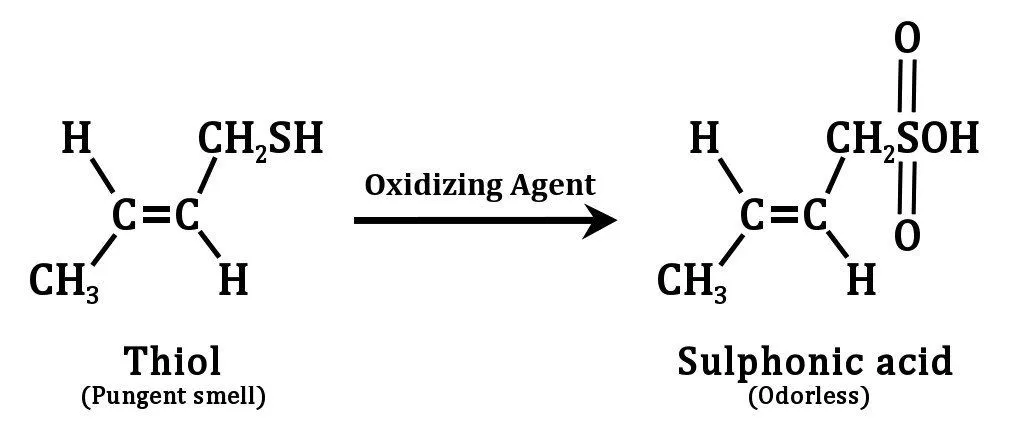
Both of the aforementioned oxidizing agents are very effective, and also mild enough to be used on pets. However, they may change the hair color of your pets!
Getting rid of the skunk smell in your house (non-living objects) is even simpler and cheaper. Sodium hypochlorite solutions (liquid laundry bleach) are quite an effective and inexpensive option. Note that using this solution may bleach the floors, so it’s advised to use it on a small area first.
Why Doesn’t Tomato Juice Work?
If you grew up watching cartoons, you “know” that a skunked dog gets dunked in a bathtub of tomato juice. It is one of the most stubborn folk remedies around, and the chemistry says it simply does not work. Tomato juice does not neutralize the thiols at all; the pigments and acids in tomatoes have no power to break those sulfur compounds down.
So why are people so sure it works? The answer is a quirk of perception called olfactory fatigue (also known as nose blindness). When your nose is exposed to a strong odor for long enough, the receptors and the brain stop responding to it, and you simply stop noticing it. Sit in a room thick with skunk and tomato juice long enough and the skunk smell seems to fade. But that is your sense of smell switching off, not the thiols disappearing. Step outside for a few minutes, come back, and the stench is right where you left it. If you want to understand the mechanism in more depth, we have a full piece on how your sense of smell works.
What actually destroys the smell is chemistry, not masking. The peroxide-and-baking-soda mixture works through oxidation: the hydrogen peroxide oxidizes the smelly thiols into sulfonic acids, which have little or no odor, while the baking soda keeps the solution alkaline and the dish soap cuts through the oily secretion so the oxidizer can reach it. The popular pet recipe (1 quart of 3% hydrogen peroxide, ¼ cup of baking soda and a teaspoon of liquid soap) traces back to chemist Paul Krebaum, who publicized it in the 1990s. Mix it fresh and use it immediately, because peroxide and baking soda react to release oxygen and the solution loses its punch as it sits. A genuine word of caution: never seal that mixture in a closed container, as the oxygen it gives off can build up pressure.
References (click to expand)
- Skunk Spray - Chemical Components - users.humboldt.edu:80
- Skunks: Damage Management - Natural Resource Stewardship. Iowa State University of Science and Technology
- What you didn't know about Skunks. Texas A&M University
- Wood, W. F. New components in defensive secretion of the striped skunk, Mephitis mephitis. Journal of Chemical Ecology. PubMed (NCBI)
- Oswald, I. W. H. et al. Identification of a New Family of Prenylated Volatile Sulfur Compounds in Cannabis. ACS Omega. PMC (NCBI)
- What happens if a skunk sprays me? National Capital Poison Center (Poison Control)
- Skunks. Introducing Mammals to Young Naturalists. Texas Parks and Wildlife Department
- Butene thiol - Molecule of the Month. School of Chemistry, University of Bristol