Table of Contents (click to expand)
A lion’s roar is so loud because its vocal folds form a square shape. This shape essentially stabilizes the vocal cords, enabling them to better respond to the passing air. That way, lions can produce loud roars without exerting too much pressure on their lungs!
A lion’s roar is one of the most terrifying sounds in the animal kingdom. If you’re in the African savannas and happen to hear that sound, you may want to start running!
Lions, as you may already know, aren’t the only animals that can roar. This threatening feat can be accomplished by three other animals – tigers, leopards and jaguars. This isn’t a coincidence, of course; all four species belong to the same genus, Panthera.
So, what makes these animals so special? What is it about them that imbues them with such a frightening roar?
The Voice Box
The science behind those majestic roars all comes down to one organ: the larynx (voice box). The vocal folds (vocal cords) of the larynx are different in lions and tigers than they are in other animals. Only the four big Panthera cats (lion, tiger, jaguar, and leopard) have the anatomy for a true roar. Cheetahs, in the separate genus Acinonyx, have a fully ossified (rigid) hyoid bone that locks their vocal apparatus and rules out roaring. Even the snow leopard (also Panthera) can’t produce a true roar because its vocal folds lack the cushion of fat that lions and tigers have.
In general, the “voice” of any animal (including humans) is produced by air (from the lungs) flowing past the vocal folds. This causes the vocal folds to vibrate, thereby “chopping up” the airflow. Due to this staggered output of air, audible pulses of sound are produced. The exact nature and volume of the sound depend on the air pressure from the lungs (meaning that air pressure is the “fuel” of our voices) and on the muscles of the larynx, which manipulate the exact length and tension of the vocal folds.
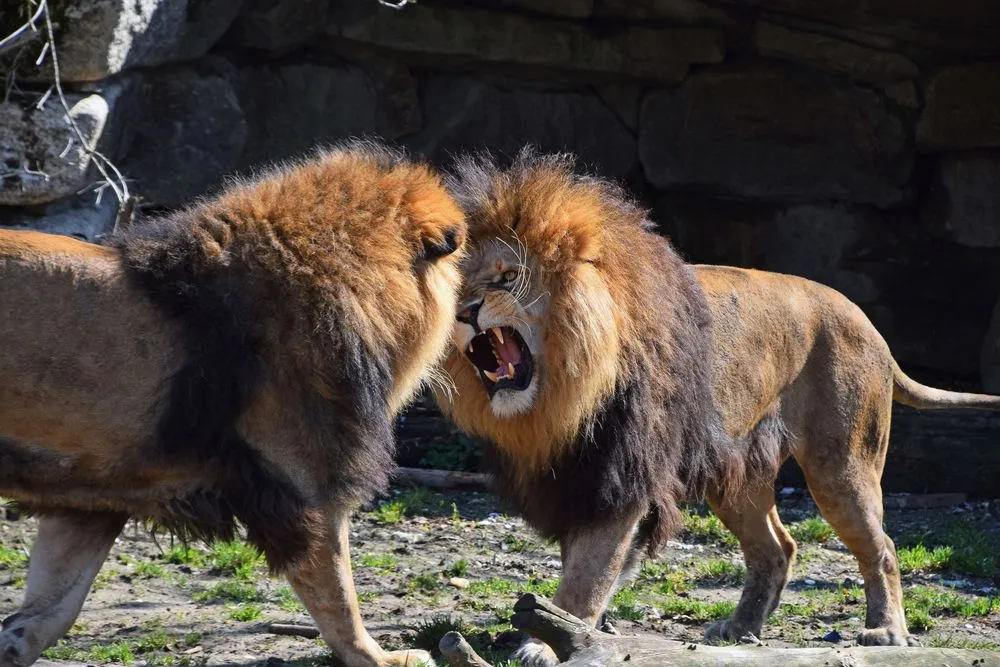
The Roar
The difference between the vocal folds of Panthera cats and other animals is in their shape. While our vocal folds form a triangular shape within our throats, the vocal folds of lions and tigers form a square shape. This is due to the big cats having some fat depositions located deep within the vocal fold ligament.
It is due to this deposited fat that the vocal folds get their flattened, square shape. This shape essentially stabilizes the vocal cords, enabling them to better respond to the air as it passes by. In this way, lions can produce loud roars without exerting too much pressure on their lungs!
The powerful roars of a lion can be as loud as 114 decibels, which is as loud as some rock concerts!

Interestingly, according to Ingo Titze, Executive Director of the National Center for Voice and Speech and a co-author on the 2011 PLOS ONE study, the roar of a lion is somewhat like a baby’s cry for attention, although in the lion’s case the voice is much deeper. According to his research, low-frequency roars of lions are predetermined not by nerve impulses from their brain, but by the physical properties of their vocal fold tissue (i.e., its ability to stretch and shear).
How Loud Is A Lion’s Roar, And How Far Can You Hear It?
So just how loud are we talking? Measured from about a meter (a little over 3 feet) away, a lion’s roar can hit roughly 114 decibels. That is a genuinely punishing volume. For comparison, the U.S. National Institute for Occupational Safety and Health (NIOSH) treats anything at or above 85 dBA as a hearing hazard over a long enough exposure, and for every 3 decibels above that, the “safe” listening time gets cut in half. By the time you reach 114 dB, you are well past the level of a front-row spot at a loud rock concert, and you are knocking on the door of physical pain.

Volume right next to the animal is one thing, but the truly impressive number is how far that sound travels. Under calm conditions, a lion’s roar can carry up to about 8 kilometers (roughly 5 miles) across open savanna. The low pitch is the secret here. Lions roar at very low frequencies (somewhere around 40 to 200 hertz), and low-frequency sound bends around obstacles and loses energy far more slowly than high-pitched sound, so it keeps going long after a higher squeal would have faded. That is why a single roar at dusk can announce a lion’s presence to every rival and pride-mate for miles around.
Lion Roar vs Tiger Roar: Whose Is Louder?
This one surprises people: a lion and a tiger are, for all practical purposes, equally loud. The 2011 PLOS ONE study that cracked open the science of roaring examined both species and found they share the very same trick: flat, square, fat-cushioned vocal folds that convert lung air into sound with brutal efficiency. Both can reach that same ballpark of around 114 decibels up close, so there is no clear “winner” on raw loudness alone.
Where they genuinely differ is in pitch, not power. Modeling in that same study predicted lions roaring across a lower band (about 40 to 200 hertz) than tigers (closer to 83 to 246 hertz). In plain terms, a lion’s roar tends to sound deeper and more of a chest-rattling rumble, while a tiger’s carries slightly more rasp and growl. So the next time you hear someone insist that one big cat “out-roars” the other, the honest answer is that they are running the same loud engine, just tuned to a slightly different note.
Why Do Lions Roar?
Just like humans, animals communicate among themselves, albeit in languages that we don’t understand. Lions are very social as far as large carnivores are concerned, which is not surprising, as they live in ‘prides’ in the wild, i.e., a group of lions, lionesses and cubs.
Male lions roar for various reasons. A lion may roar to scare off an intruder, another lion, or a predator. It could also roar to warn its pride of imminent danger. Or it could roar to simply ‘show off’ in front of other lions, which obviously has an advantage in the wild when it comes to mating!
Roaring is also surprisingly tactical. In a classic playback experiment in the Serengeti, researchers found that female lions actually count the roars of unseen rivals. When they hear what sounds like a single intruder, a group of lionesses will boldly move toward the sound, but when they hear three strangers roaring in chorus, they hold back unless they comfortably outnumber the newcomers. The roar, in other words, is not just noise. It is a long-distance headcount that helps a pride decide whether a territorial fight is worth the risk.
Next time you hear a lion roar, just think about how rapidly their vocal folds are vibrating to make that much noise, yet still withstanding all that stretching and shearing stress.
Or, you could just do what a ‘regular’ human being does, and… you know, be terrified.
References (click to expand)
- Born to Roar - UNews Archive - The University of Utah. The University of Utah
- M. H. Hast - The Larynx Of Roaring And Non-Roaring Cats - CiteSeerX
- Klemuk, S. A., Riede, T., Walsh, E. J., & Titze, I. R. (2011, November 2). Adapted to Roar: Functional Morphology of Tiger and Lion Vocal Folds. (B. S. Launikonis, Ed.), PLoS ONE. Public Library of Science (PLoS).
- McComb, K., Packer, C., & Pusey, A. (1994). Roaring and numerical assessment in contests between groups of female lions, Panthera leo. Animal Behaviour, 47(2), 379-387.
- Noise and Hearing Loss - NIOSH. Centers for Disease Control and Prevention (CDC).