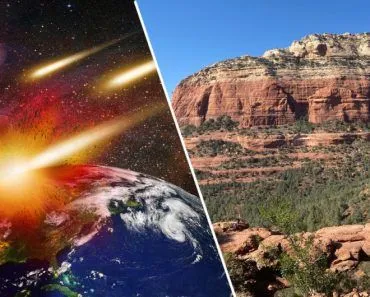
An asteroid roughly 10-12 km (6-7 mi) wide struck near Mexico's Yucatan about 66 million years ago and triggered the mass extinction that ended the dinosaurs. But many of them were already in trouble: global cooling and massive Deccan Traps volcanism in India may have driven a slow decline for millions of years before the impact delivered the final blow.
About 140 million years ago, Earth wasn’t anything like what we see today. The weather was warm and humid and the polar regions lacked continental ice sheets. In fact, they were covered with trees!
Dinosaurs roamed and dominated the animal kingdom on land and in the sea. This time during the Cretaceous period is famously known as the “Age of the Dinosaurs”.
However, what represented the real “fall” for these huge land creatures? There has been much debate about the cause of the non-avian dinosaur extinction at the K-T boundary, as all the major continents and seas were affected by this global K-T extinction.
The K-T border marks the divide between the Cretaceous and Tertiary periods. Geologists now usually call it the K-Pg (Cretaceous-Paleogene) boundary, since "Tertiary" has been retired as a formal period, but the older "K-T" label is still widely used. One of the biggest extinction events in Earth’s history occurred at this border, known as the K-T (or K-Pg) Event.
To read more about what marks the boundaries of Earth’s geological past, you may want to check out this article explaining the planet’s geological time scale.
What Killed The Dinosaurs?
This question does not have a definitive answer. There have been several explanations for the extinction of dinosaurs, some silly and others quite persuasive.
For instance, a book about the extinction event claimed that the dinosaurs may have died out because they had been out in the sun for too long. They developed cataracts, and consequently fell off cliffs due to poor vision.
That hypothesis aside, there are two popular theories that are the focus of major research around the K-T event. These are the significant meteor strike theory and the massive volcanic activity theory.
Did Volcanic Activity Play A Role In The K-T Event?
According to a 2021 study in the journal Nature Communications, dinosaur diversity went into a sharp decline roughly 76 million years ago, about 10 million years before the asteroid crash. The study focused on six of the most common families: three herbivorous groups (Ankylosauridae, Ceratopsidae and Hadrosauridae) and three carnivorous ones (Dromaeosauridae, Troodontidae and Tyrannosauridae).
By tracking when these families gained and lost species, the team found a gradual fall in both herbivore and carnivore numbers. The herbivores dwindled first, and as their numbers crashed the carnivores that hunted them followed, since their prey was disappearing. Such a process is referred to as cascading extinction.
It is possible that climate change was the trigger for this drastic drop in the dinosaur population. The decline lined up with a strong global cooling around 75 million years ago, when temperatures may have fallen by as much as 7 to 8 °C (13 to 14 °F), making life harder for animals that likely depended on warmth. It is worth noting, though, that not everyone agrees the dinosaurs were already dying out: a 2020 analysis in Royal Society Open Science found no clear sign of a terminal decline before the impact, so the question remains genuinely open. Around the same window, the planet also experienced enormous magmatic activity in India, evidence of which is preserved in the Deccan Traps.
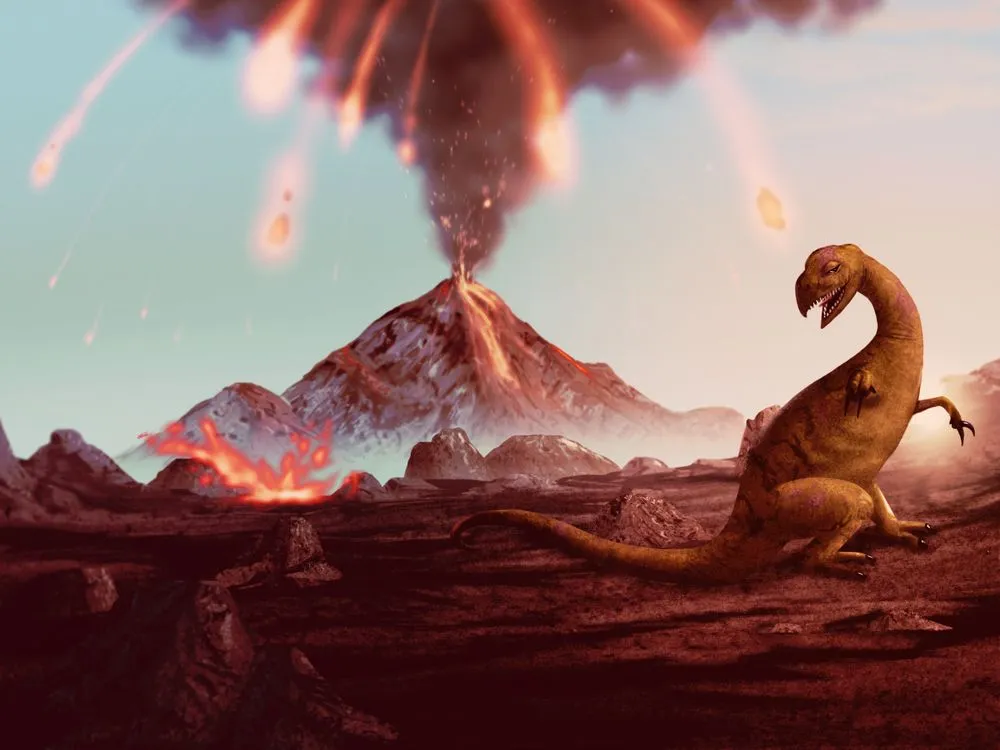
The Deccan Traps are a vast plateau of volcanic rock in west-central India (centered on the modern state of Maharashtra) that still holds traces of one of the planet’s most massive eruptions. According to research from MIT, the main pulse of volcanism began roughly 250,000 years before the asteroid struck and continued for about 750,000 years in all, pouring out enough lava to bury an area larger than France. It is possible that this protracted volcanism poisoned the environment and oceans by belching huge amounts of carbon dioxide, sulfur and toxic materials into the atmosphere.
How Is An Asteroid Responsible For A Mass Extinction?
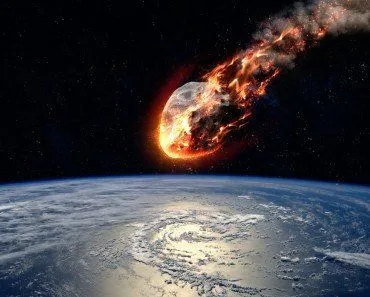
Asteroids are rocky objects circling the Sun, ranging from a few meters to hundreds of kilometers across. Around the same time as the K-T extinction, a giant one estimated at about 10 to 12 km (6 to 7 mi) wide struck the planet. Researchers have discovered that rocks which formed precisely at the K-T border carry unusually high concentrations of the element iridium, a metal that is rare in Earth’s crust but common in asteroids and comets. This iridium "spike" was first reported in 1980 by Luis and Walter Alvarez and their colleagues, and it became the founding clue for the impact theory.
In Earth’s crust, iridium is even scarcer than gold, yet the thin layer of K-T border clay is loaded with it. Thus, according to scientists, the iridium was scattered worldwide when an asteroid slammed into the planet and threw its debris around the globe. The crater from that impact, called the Chicxulub crater and measuring roughly 180 to 200 km (110 to 125 mi) across, has been mapped beneath Mexico’s Yucatan peninsula.
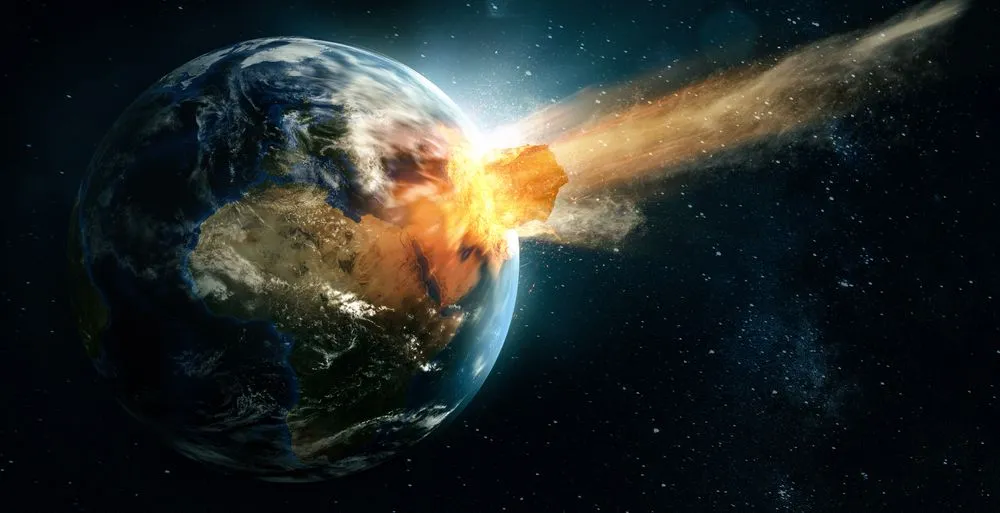
The asteroid’s impact entirely destroyed the nearby region, creating a large crater and an incredibly powerful shockwave. This caused soot to spread over the entire planet and partially blocked sunlight from traveling to the surface, which affected the development of plants.
This cascaded across the food web like dominoes, bringing the biosphere crashing down. Herbivore survival was severely impacted by the decline in plant life, so carnivores perished as well.
Would Dinosaurs Have Survived If The Asteroid Had Not Hit Earth?
It’s challenging to say for certain what the fate of the planet would have been if the asteroid did not hit Earth. The possibility of a diversity rebound is extremely hard to calculate, as certain groups may have persisted, while others may have died off.
We can infer that the asteroid struck when ecosystems were already under a lot of stress from climate change. Perhaps it was just the ultimate knockout blow to the dinosaur population. This is frequently the situation when a species becomes extinct.
First, the population begins to steadily decline, and then another unexpected catastrophe comes along and wipes it out completely.
References (click to expand)
- Condamine, F. L., Guinot, G., Benton, M. J., & Currie, P. J. (2021, June 29). Dinosaur biodiversity declined well before the asteroid impact, influenced by ecological and environmental pressures. Nature Communications. Springer Science and Business Media LLC.
- Why are birds the only surviving dinosaurs?. Natural History Museum, London
- What really killed the dinosaurs? | MIT News. news.mit.edu
- The KT extinction. The University of California Museum of Paleontology
- When did dinosaurs live? | Natural History Museum, London
- Bonsor, J. A., Barrett, P. M., Raven, T. J., & Cooper, N. (2020). Dinosaur diversification rates were not in decline prior to the K-Pg boundary. Royal Society Open Science.
- Chicxulub crater. Encyclopaedia Britannica.