Table of Contents (click to expand)
No, an asteroid cannot knock Earth out of its orbit. Earth is far too massive (about 5.97 × 1024 kg) and moving far too fast (roughly 30 km/s, or 67,000 mph) for any known asteroid to budge it. Even the 10-kilometer dinosaur-killer carried only a tiny fraction of our planet’s orbital energy, so it wrecked the climate, not the orbit.
We’ve all seen the blockbuster movies, where the entire planet is thrown into chaos when word comes that a planet-ending asteroid is headed for our little blue dot. From Deep Impact and Meteor Storm to the ultimate classic, Armageddon, Hollywood has done a good job striking fear into the hearts of millions at the mere thought of an asteroid impact.
 Furthering that fear is our widespread knowledge of so many asteroid impacts in our history, particularly the devastating ones, such as the asteroid impact that killed off the dinosaurs. In Earth’s history, there have been a number of cataclysmic asteroid impacts, as well as countless smaller strikes across the globe since time immemorial. Researchers believe that there may be more than 80,000 meteorites larger than 10 grams that hit our planet each year! While this debris adds incrementally to the mass of our planet, many people wonder if the impacts have a larger effect. More specifically, as this article asks, can an asteroid knock Earth right out of its orbit?
asteroids entering the Earth atmosphere(Oliver Denker)S” class=”wp-image-35262″ height=”515″ src=”https://uploads.scienceabc.com/2020/04/3D-rendering-of-a-swarm-of-Meteorites-or-asteroids-entering-the-Earth-atmosphereOliver-DenkerS.webp” width=”773″/> Depiction of swarm of Meteorites entering into the Earth’s atmosphere. (Photo Credit : Oliver Denker/Shutterstock)
Size Matters
When you’re having this sort of discussion, it’s important to consider the size of the astral objects in question. Our planet weighs about 5.97 × 1024 kg (roughly 6 sextillion metric tons) and is moving at nearly 30 km/s, or about 107,000 km/h (67,000 mph), in its orbit around the Sun. With something that large, moving that quickly, Earth carries a staggering amount of orbital momentum and energy. For an impact to nudge that orbit by even a sliver, the incoming object would have to deliver a comparable amount of momentum, which means being extremely large and extremely fast. To help put this in perspective, let’s take a quick look at some of the biggest meteor strikes that we know about in Earth’s history.
Chicxulub Crater
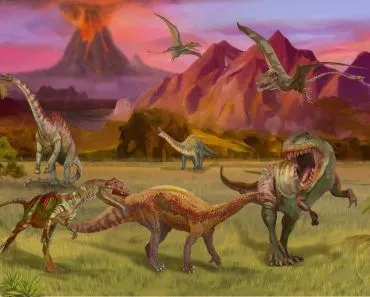
Famous for allegedly killing off the dinosaurs, the asteroid that struck off the coast of the Yucatan Peninsula about 66 million years ago was a massive strike. Although there is some debate about the actual size of the impact crater, since the impact site is now buried beneath the Yucatan, estimates run anywhere from 180 to 300 km (110-180 miles) across, which makes it one of the largest (if not the biggest) in our planet’s history. It is believed that this impact, from an asteroid roughly 10-15 km (6-9 miles) wide, caused a global winter within a matter of days, killing off three-quarters of all species on the planet. The KT Extinction, which came after the impact, allowed mammals to rise and soon become the dominant life form on the planet. While the effects of this impact were certainly devastating, it does not appear to have changed the course of Earth’s movement around the Sun.

Popigai Crater
About 35 million years ago, an asteroid struck Siberia and left an impact crater roughly 100 km (62 miles) wide, along with something called impact diamonds. The force of the impact on Earth was great enough to create billions of carats of diamonds, but this impact also didn’t shake Earth from its orbital foundations.
Sudbury Basin
Roughly 1.85 billion years ago, an asteroid struck an area of Ontario, Canada and left one of the largest and oldest impact structures on Earth, the heavily eroded remains of which still stretch about 130 km (81 miles) across. Even so, in comparison to Earth, which is nearly 40,000 km (25,000 miles) in circumference, it didn’t have nearly enough juice to knock Earth away from its annual loop.
Theia Impact
About 4.5 billion years ago, something crashed directly into our nascent planet, and the debris from that impact is believed to have gradually gathered together to form our orbiting Moon. The impactor, a hypothesized Mars-sized body astronomers call Theia, was vastly larger than any asteroid. In other words, something as large as another planet slammed into Earth, and it still didn’t knock us out of our orbit around the Sun.
Is There Any Chance Of A Supermassive Asteroid Strike?
While there is always the outside chance that the most well-trained astronomers in the world, armed with an array of advanced detection technologies, could miss an outlying asteroid on a completely unpredictable billion-year orbit, you can rest easy when it comes to asteroid impacts knocking us off our galactic course.
Most of the asteroids that will ever affect Earth are leftovers from the formation of our solar system, and most of them aren’t of a significant size. We have identified and categorized thousands of these asteroids, and some small proto-planets, and we understand their trajectories. We have become so accurate in our predictions, in fact, that we know precisely when and how close the majority of these asteroids will fly by us.
We are no longer just watching, either. In September 2022, NASA’s Double Asteroid Redirection Test (DART) deliberately slammed a spacecraft into Dimorphos, a small moonlet orbiting the asteroid Didymos, at about 22,500 km/h (14,000 mph). The collision shortened Dimorphos’ orbit around Didymos by 32 minutes, marking the first time humanity intentionally changed the motion of a celestial body. It is a powerful proof of concept for planetary defense, but it also drives the central point home: it took a purpose-built impactor to shift a 160-meter rock by a few minutes, so nudging an entire planet is in a different league altogether.
Major asteroid strikes like the one that killed the dinosaurs happen, on average, every 100 million years or so, but they can range in size and intensity. While a global winter following an asteroid strike would be devastating for the planet, and humanity, we would likely survive, and find new ways to succeed over time. However, if an asteroid large enough to knock Earth out of orbit came barreling towards us, it would also be large enough to destroy us entirely, so our orbital placement would be the least of our worries as a planet.
A Final Word
The world is definitely going to end in some dramatic fashion, whether it is a nuclear winter, an asteroid strike, or being gradually crisped to ash when the Sun swells into a red giant in about 5 billion years. For now, however, with experts around the world keeping their eyes to the skies, we’re safe from any world-ending cosmic visitors. We should be focused on the far more real dangers that we have on Earth, rather than worrying about death from above!
References (click to expand)
- Giant-impact hypothesis - Wikipedia. Wikipedia
- Asteroid Impacts:10 Biggest Known Hits - National Geographic. National Geographic
- NASA Confirms DART Mission Impact Changed Asteroid’s Motion in Space. NASA.
- Chicxulub crater. Encyclopaedia Britannica.
- Meier, M. M. M., Reufer, A., & Wieler, R. (2014, November). On the origin and composition of Theia: Constraints from new models of the Giant Impact. Icarus. Elsevier BV.
- POPE, K. O., KIEFFER, S. W., & AMES, D. E. (2004, January). Empirical and theoretical comparisons of the Chicxulub and Sudbury impact structures. Meteoritics & Planetary Science. Wiley.
- Schulte, P., Alegret, L., Arenillas, I., Arz, J. A., Barton, P. J., Bown, P. R., … Willumsen, P. S. (2010, March 5). The Chicxulub Asteroid Impact and Mass Extinction at the Cretaceous-Paleogene Boundary. Science. American Association for the Advancement of Science (AAAS).