Table of Contents (click to expand)
- What Is A Polar Bear’s Fur Like?
- If The Fur Isn’t White, Why Does It Look White?
- What Color Is A Polar Bear’s Skin? (Spoiler: It’s Black)
- What Does A Polar Bear Look Like Without Fur?
- Yellow, Gray, Orange, Brown… How Do You Like Your Polar Bear?
- Why Doesn’t Ice Stick To Polar Bear Fur?
- Why Did Polar Bears Lose The Pigment In Their Fur?
- A Final Word
Polar bears blend in with their snowy environment, and though the snow around them is white, their hair is not. So why do they appear white?
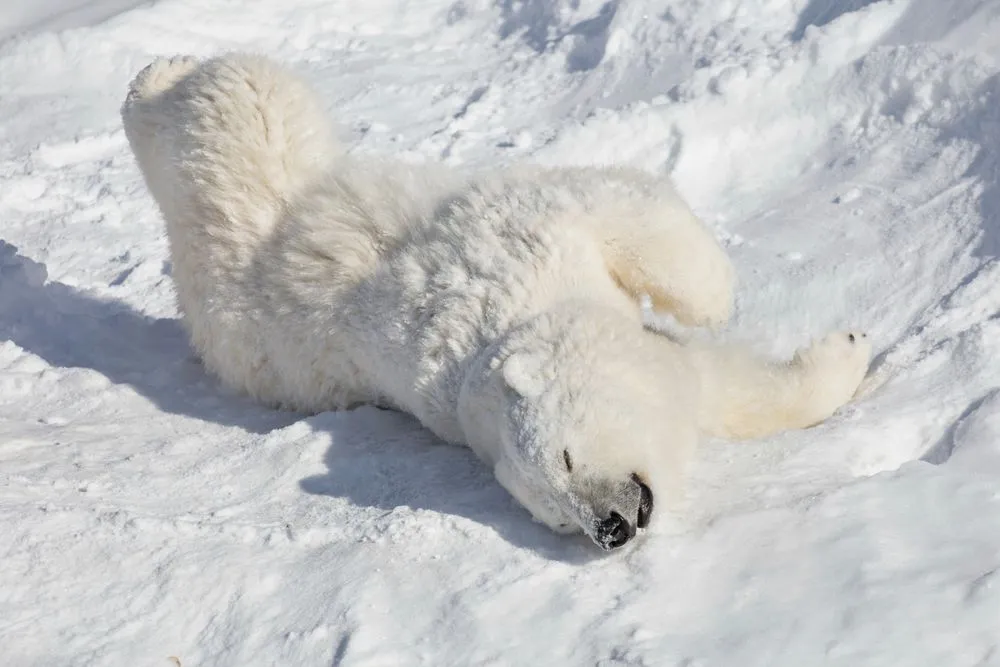
You would probably have a hard time spotting the big, burly bears of the North Pole in their natural habitat. You may actually mistake them for a huge pile of snow, unless they decide to poke out their black noses!
Now, if I were to ask you the color of the polar bear’s fur, you’d probably say, “White, obviously!” However, nature lives up to its reputation for playing tricks on us, and this is one such case.
What Is A Polar Bear’s Fur Like?
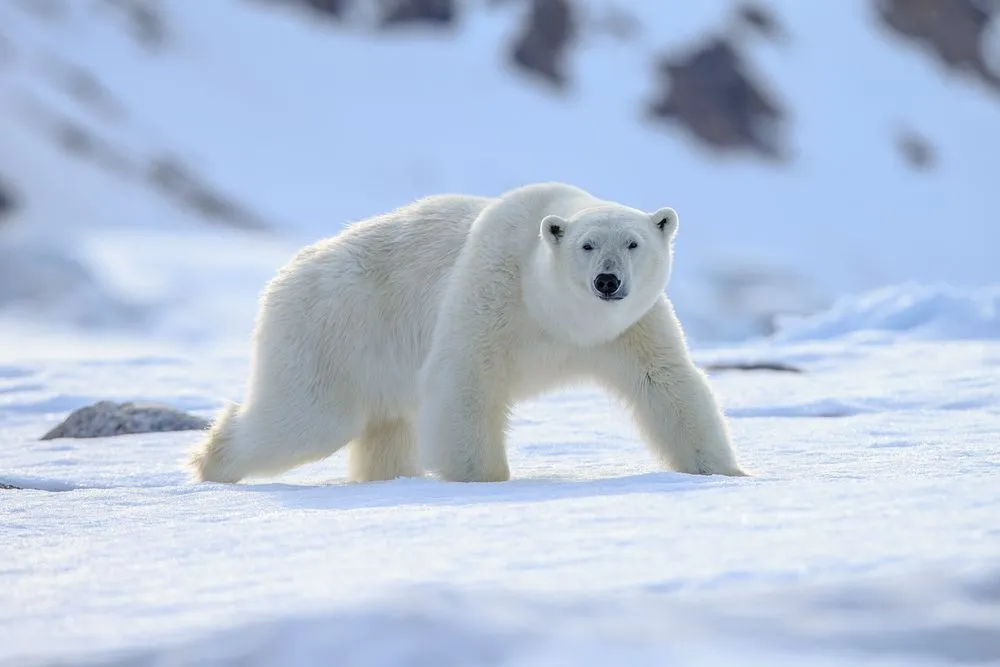
You’ll never hear a polar bear exclaim, “Brrrr, it’s cold.” They’ve adapted that well to the bone-chilling temperatures of the Arctic. Each bear sports a double-layered coat of fur, with two distinct hair types working together. Surprisingly, the coat is not especially crowded. A polar bear has only about 9 to 16 hairs per square millimeter (roughly 5,800 to 10,300 per square inch), a tiny fraction of the average 1,253 hairs per square millimeter packed into a sea otter’s fur. The coarse outer hair of a polar bear protects its undercoat and is called guard hair. According to Polar Bears International, the guard hairs are about 10 cm (4 inches) long, while the softer, wavy undercoat beneath them is about 4 cm (1.6 inches) long. It is these layers that are responsible for the actual color of the bear’s fur.
Every single strand of guard hair is transparent, with a hollow core and no colored pigments. The undercoat, a layer of thinner and softer hairs, is also pigment-free. In fact, Polar Bears International notes that both types of hair are transparent, with a mostly hollow, air-filled core.
These physical properties of the hair allow it to use light in a way that is very beneficial to its defense and predatory strategy of camouflaging.
If The Fur Isn’t White, Why Does It Look White?
If the hair of these bears is hollow and colorless, why does it appear so white? The answer lies in the physics of light. The hollow guard hair absorbs the light that the sun bathes the bear in, creating optical tricks.
Light Scattering
When a ray of light encounters an obstacle, it undergoes a deviation in its direction, thereby getting scattered. Short wavelengths of light tend to get more scattered than longer wavelengths. Sunrises and sunsets, and the colorful hues they create, are examples of this light-scattering phenomena.
When the sun’s rays hit the transparent fur of a polar bear, each hair shaft will absorb some amount of light. Each fiber of hair has several scattering points that act like individual obstacles.
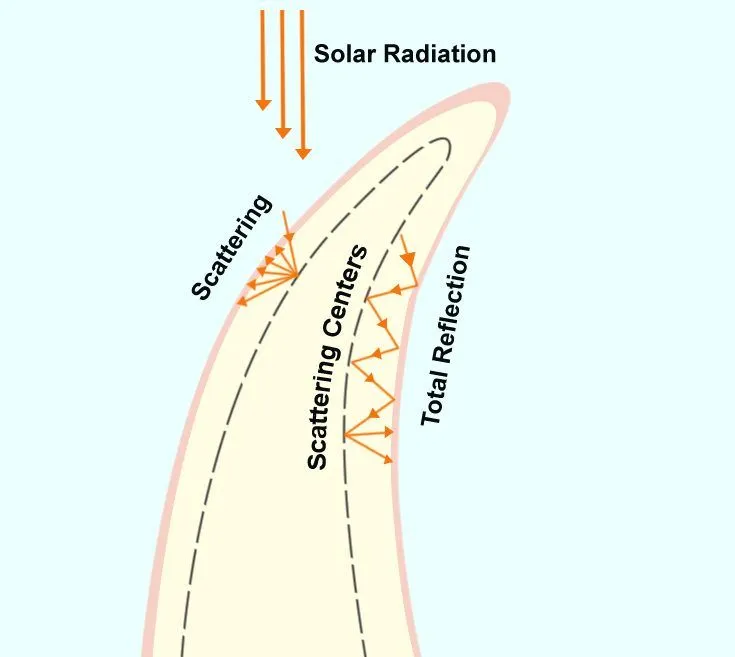
Upon collision with these points, light starts to bounce off against the inner walls of the hair shaft, setting off a chain of scatterings. Subsequently, this scattering effect further compounds, as the scattering in the other hair shafts is sustained by the ones present in the vicinity. This helps in amplifying the scattering effect of the fur.
The back-scattered light is therefore a result of the reflection of all wavelengths of the visible range. Since none of the wavelengths get absorbed, our eyes perceive the emanating light as white.
Does scattering and reflection happen to other animals with white fur? To find out, scientists tested the hair strands from different white and furry animals and found that only the polar bear’s hair strand had a tube-like core with several scattering points inside.
The light can become more intensified, due to more light-scattering particles, like the keratin protein and other salt particles that make up the strand of hair. Polar bears can even collect these salt particles while they’re out swimming in salty ocean water. More salt crystals on the hair means more light scattering on the hair’s surface.
The material that makes up our hair, skin and nails, also makes up the hair or fur of the polar bear. Emanating a slightly whitish color, this keratin protein reinforces the white of the bear’s fur.
What Color Is A Polar Bear’s Skin? (Spoiler: It’s Black)
Beneath all the fur lies… black skin. If you were to shave a polar bear, you would find black skin underneath (we will get to what a furless polar bear really looks like in a moment). Cubs are actually born with pink skin, which turns black when they are about 3 to 4 months old, around the time they leave the maternity den with their mother. On adults, the black skin is easiest to spot on the nose, lips, and foot pads. Even the tongue joins in: it starts out pink, becomes mottled with black after a few months, and in adults can be pink, blue, or nearly black. The dark color comes from a high concentration of the pigment melanin.
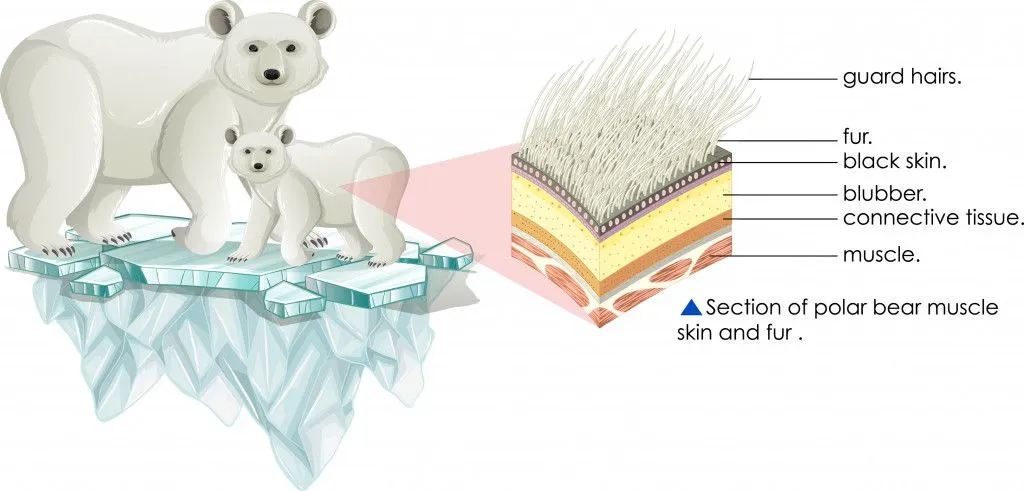
When light rays come in contact with the thick fur of the polar bear, only a small amount of light is back scattered. The rest of the light gets absorbed, owing to the strong absorptive property of the bear’s black skin.
You may have heard the popular claim that polar bear hairs work like “fiber-optic cables,” funneling sunlight down to the black skin to keep the bear warm. That idea has since been debunked. Direct measurements by physicist Daniel W. Koon showed that less than 0.001% of red light, and even less ultraviolet light, actually travels even an inch down a single hair shaft. That is nowhere near enough for the fur to act as an optical fiber.
What the fur does do superbly is insulate. The hollow guard hairs and dense underfur trap a thick layer of still air against the body, while the bear’s thick layer of blubber adds further insulation. Sunlight that does reach the black skin is absorbed and converted to heat, but most of the bear’s warmth comes from its own metabolism being held in by this remarkable insulation system.
What Does A Polar Bear Look Like Without Fur?
Nobody goes around shaving polar bears (for obvious reasons), but nature has occasionally run the experiment for us. From 1998 to 2012, scientists from the U.S. Geological Survey capturing polar bears in the southern Beaufort Sea of Alaska kept records of an alopecia syndrome, which is the medical term for hair loss. Affected bears lost patches of guard hair, and their undercoat thinned out around the head, neck, and shoulders. In severe cases, the exposed skin oozed and formed crusty lesions.

The condition turned up in 49 of the bears handled during 1,421 captures, or about 3.45%. However, it spiked in certain years, affecting 16% of sampled bears in 1999 and a striking 28% in 2012. Younger, subadult bears were the most likely to be affected, and bears with hair loss were in poorer body condition than their furry neighbors. That matters, because polar bears depend on their thick fat layer and dense coat to limit heat loss as they move between sea ice and open water.
What causes it? Nobody knows yet. The 2012 spike coincided with unusually high numbers of sick and dead ringed seals in the Beaufort, Chukchi, and Bering seas, which led NOAA to declare an unusual mortality event. A follow-up gene expression study found that bears with alopecia showed heightened activity in genes linked to immune response, viral defense, and stress, but the culprit itself remains unidentified.
As for the viral “hairless bear” photos that pop up online, the bear in them is not necessarily a polar bear. A widely shared one shows Dolores, a spectacled bear at Leipzig Zoo in Germany, one of three female bears there whose baldness made headlines in 2009. Captive Andean (spectacled) bears are prone to a distinct hair-loss condition, and a 2019 study of 63 Andean bears found that it affected 29% of the females in the North American zoo population and none of the males. It appeared only in females that had been housed with other bears, leading the researchers to suggest that the condition is a response to long-term social housing of an animal that would normally live alone.
Either way, the takeaway is the same. Strip away a polar bear’s coat, and its snowy disguise disappears, revealing the black skin that was there all along.
Yellow, Gray, Orange, Brown… How Do You Like Your Polar Bear?
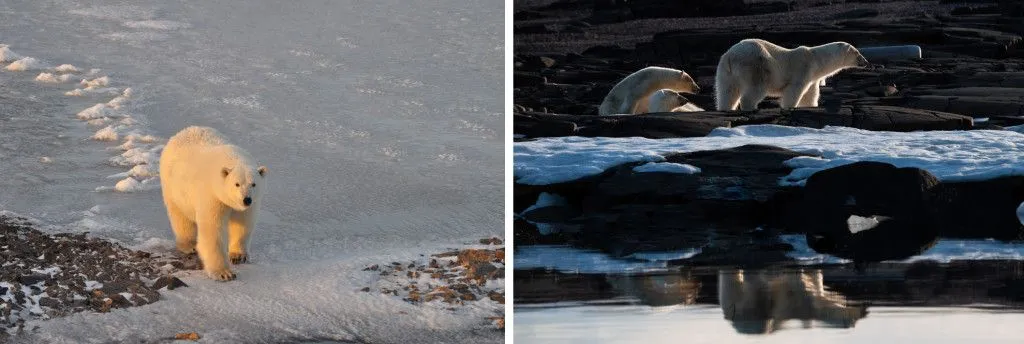
As stated before, direct sunlight makes for a whiter polar bear, but what if it’s a cloudy and gloomy day? You’d see the polar bear look pale and grey too! Drawing from the reflective nature of the polar bear’s hair, it only makes sense that their fur looks slightly like the color it is under. At sunset, you might even witness bears with a red or orange appearance.
Lighting is only half the story, though. Polar bears rarely look completely snow white, and when they do, it is most likely right after their yearly molt. For the rest of the year, their coats often pick up various shades of yellow from the oil of the seal fat and whale carcasses they feed on. A bear that has spent a long stretch on land can even look brownish or blackish from dirt. In other words, a yellow polar bear is often just wearing its last few meals.
Green Polar Bears?
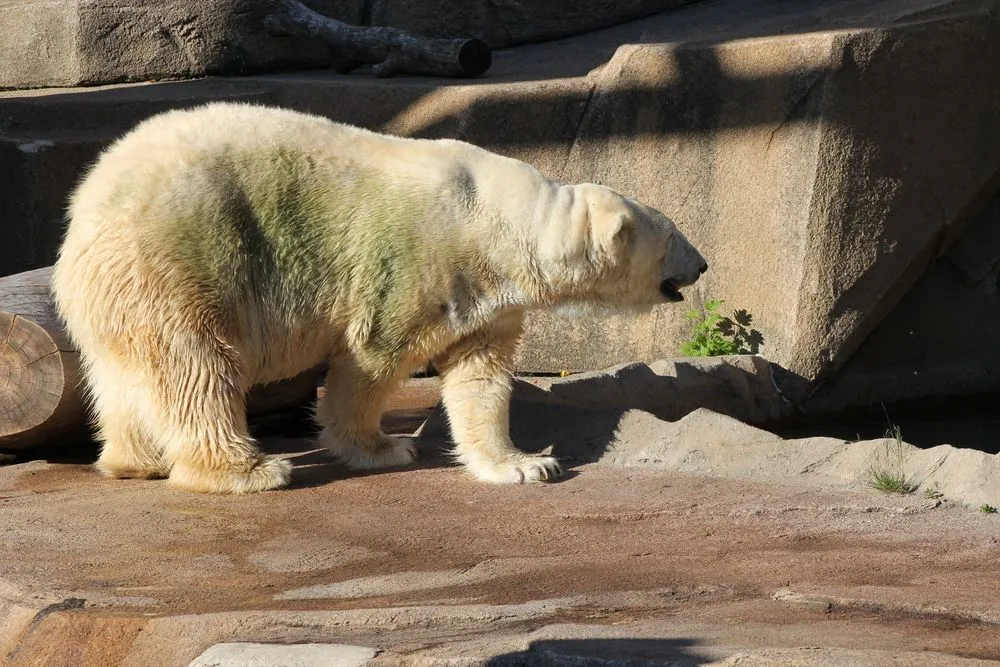
If this sounds ridiculous, you’re not alone. Everyone was surprised to see some captive polar bears turn green, but there’s a valid explanation for this.
The culprit is algae living inside the hair. At the San Diego Zoo, for example, algae grow on the floor of the bears’ freshwater pool when summer weather turns warm. As the bears swim and brush against the bottom and sides of the pool, they pick up some of the algae, which then settle into the hollow cores of their guard hairs and keep growing. Where there’s algae, there’s some green. As the National Wildlife Federation puts it, the warmer climate of zoos, combined with those hollow hair shafts, makes a natural breeding ground for algae. The green tint does not last forever, though; it fades when the bears molt their coat in spring.
Why Doesn’t Ice Stick To Polar Bear Fur?
Even after a polar bear hauls itself out of frigid Arctic water, you rarely see chunks of ice clinging to its coat. A 2025 study published in Science Advances finally figured out why. Researchers found that the natural oil (sebum) coating polar bear hair gives the fur ice-adhesion strengths comparable to high-tech fluorocarbon coatings. When the team washed the sebum off, the resulting fur stuck to ice roughly four times more strongly. The key ingredients include cholesterol, diacylglycerols, and certain fatty acids, while squalene, an oily compound common in the sebum of humans and sea otters, is notably absent. Scientists hope this natural recipe could one day inspire safer, more sustainable anti-icing coatings to replace harmful PFAS “forever chemicals.”
Why Did Polar Bears Lose The Pigment In Their Fur?
Here’s a question worth asking: if polar bears have black skin, why doesn’t their fur carry any pigment at all? The answer lies in their family tree. Polar bears are close relatives of brown bears, and a 2014 study in the journal Cell that analyzed 89 complete genomes of polar bears and brown bears estimated that the two species split only about 479,000 to 343,000 years ago. That is a blink of an eye in evolutionary terms, yet genes on the polar bear lineage have been under stronger positive selection than those of brown bears.

As the researchers point out, a white appearance is usually a liability in nature, but in the Arctic it shows up again and again, in beluga whales, arctic hares, and arctic foxes, where it likely provides an advantage. When the team searched the polar bear genome for the genes behind its colorless coat, two pigmentation-related genes stood out as having been under strong positive selection: LYST and AIM1.
LYST is the more telling of the two. It makes a protein that regulates the traffic of lysosomes, and melanosomes (the tiny compartments inside cells where melanin is made) are close relatives of lysosomes. When LYST is mutated in cattle, mice, rats, and mink, the animals end up with a light coat. Polar bears carry seven unique amino-acid-changing mutations in LYST, compared with just one in brown bears. Three of them sit close to the spots where human mutations cause Chediak-Higashi syndrome, a disorder that lightens the hair and eyes. The researchers predict that these changes, perhaps with help from other genes, dramatically suppress the production and transport of melanin, leaving polar bear fur without pigment.
Notice that evolution was selective about where it switched the pigment off. The hair lost its melanin, but the skin kept plenty of it. In fact, Polar Bears International notes that no albino polar bear has ever been documented, a hint that dark skin is too important to give up.
A Final Word
Seeing the many ways polar bear fur can use the science of light to change colors, people thought that some optical properties could also be associated with them. However, after a few experiments, this was deemed not to be the case.
Like every other scientific discovery, the color-changing fur of a polar bear shocked most of world. It truly is amazing to see the lengths to which a creature adapts to increase its odds of surviving. These great white bears aren’t just ambassadors of the North, but also color-manipulating masters of deception!
References (click to expand)
- Carolan, J., Jakubec, M., Xavier, N. F., et al. (2025). Anti-icing properties of polar bear fur. Science Advances, 11(5).
- Koon, D. W. (2010, September). The Myth of the Fiber-Optic Polar Bear. Optics & Photonics News.
- Khattab, M. Q., Biomimetics in Energy Systems, Carinthia University of Applied Sciences, Europastrasse 4, 9524 Villach, Austria, & Tributsch, H. (2016, January 27). Fibre-Optical Light Scattering Technology in Polar Bear Hair: A Re-Evaluation and New Results. Journal of Advanced Biotechnology and Bioengineering. Synergy Publishers.
- Smith, T. S., Amstrup, S. C., Kirschhoffer, B. J., & York, G. (2020, February 27). Efficacy of aerial forward-looking infrared surveys for detecting polar bear maternal dens. (L. Bartos, Ed.), Plos One. Public Library of Science (PLoS).
- New Research Reveals How Polar Bears Stay Warm. insidescience.org
- LEWIN, R. A., & ROBINSON, P. T. (1979, March). The greening of polar bears in zoos. Nature. Springer Science and Business Media LLC.
- PL Clarkson. Polar Bear - University of Alberta. The University of Alberta
- Hair, Glorious Hair - National Wildlife Federation. The National Wildlife Federation
- What Does Polar Bear Fur Feel Like? Polar Bears International.
- Why Do Polar Bears Have Black Skin? Polar Bears International.
- Atwood, T., Peacock, E., Burek-Huntington, K., et al. (2015). Prevalence and spatio-temporal variation of an alopecia syndrome in polar bears (Ursus maritimus) of the southern Beaufort Sea. Journal of Wildlife Diseases, 51(1), 48–59.
- Bowen, L., Miles, A. K., Stott, J., Waters, S., & Atwood, T. (2015). Enhanced biological processes associated with alopecia in polar bears (Ursus maritimus). Science of the Total Environment, 529, 114–120.
- Van Horn, R. C., Sutherland-Smith, M., Bracho Sarcos, A. E., et al. (2019). The Andean bear alopecia syndrome may be caused by social housing. Zoo Biology, 38(5), 434–441.
- Hairless Bear: The True Story Behind The Viral Image Of A Bald Bear. IFLScience.
- Liu, S., Lorenzen, E. D., Fumagalli, M., et al. (2014). Population genomics reveal recent speciation and rapid evolutionary adaptation in polar bears. Cell, 157(4), 785–794.
- Punk Rock Polar Bears? San Diego Zoo Wildlife Alliance.