Cats often stop eating once they have to dip their face deep into the bowl because their whiskers (facial vibrissae) are highly sensitive sensory organs packed with proprioceptors. The popular explanation is "whisker fatigue": repeated rubbing against the sides of a bowl overstimulates these receptors. The concept is not yet formally established in veterinary medicine, but a shallow, wide bowl (or a flat plate) lets a cat eat without its whiskers touching the sides, and many cats clearly prefer it.
You may have noticed this if you’ve observed a cat eating food from a container. They stop eating when the bottom of the container becomes visible, or when there’s still food left in the container, but not right in the middle of it.
Alternatively, some cats also nudge their food out of the bowl and eat off the floor instead, obviously making a mess of things in the process.
Another very common ‘cat tantrum’ is your feline friend hounding you endlessly to feed it, but when you actually put food right in front of it, your cat will refuse to eat.
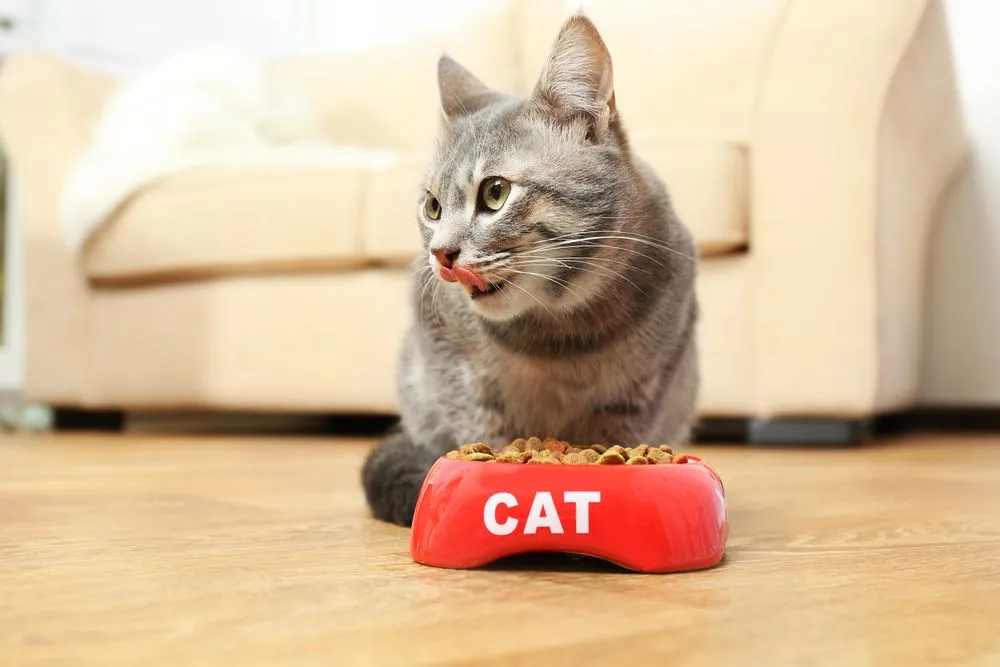
Why do cats do this? Why do they refuse to eat from their bowl when it still has plenty of food left?
As it turns out, it has a lot to do with cats’ whiskers!
What Are Cat Whiskers And What Do They Do?
Don’t you just love those cute, facial adornments around a cat’s mouth? Those little hairs are ‘smart’ biological antennae on a cat’s face.
Also known as facial vibrissae, these whiskers have proprioceptors at their ends, which keep the cat informed regarding the world around it. Each whisker is like a special sensor that converts mechanical information about the cat’s surroundings into electrical signals, which are then transmitted to their brain.
Although they appear cute and small on the outside, a cat’s whiskers are longer than you’d think by just glancing at them. Their length is approximately equal to the breadth of the cat. This helps a cat make sense of the size of an opening; basically, if its whiskers don’t touch on either side of the opening, it knows that the opening is big enough to fit through.
This is part of the reason why cats aren’t afraid to get inside really tiny boxes or jars.
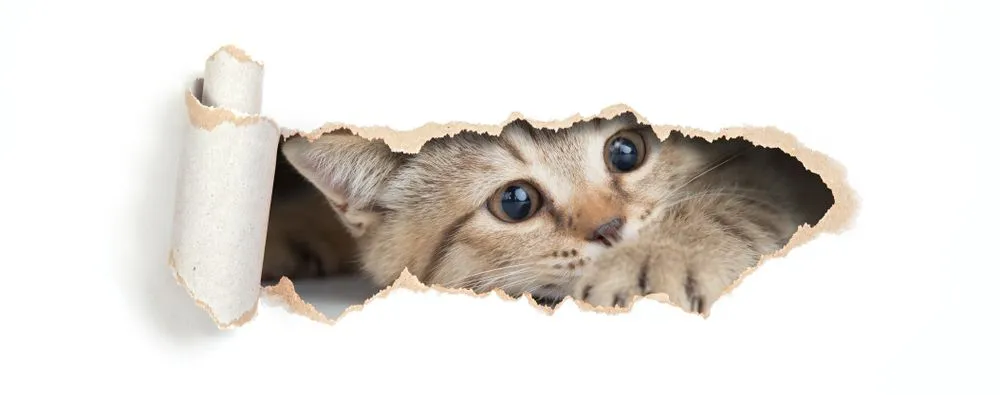
There are some other cool things that a cat’s whiskers can do. They can sense changes in air currents when hunting, which gives them a competitive edge as a predator. In other words, a cat’s whiskers help it ‘see’ up close by supplementing its short-distance vision (Source).
Why Does Your Cat Refuse To Eat When There’s Still Food In The Bowl?
A frequent reason for a healthy cat to refuse to eat from a bowl with plenty of food left behind is that the cat may have whisker fatigue.
As mentioned earlier, at the end of a cat’s whisker are proprioceptors, sensory receptors that respond to position and movement. These proprioceptors make cat whiskers so sensitive that they get fatigued or ‘tired’ by unnecessary contact, such as something repeatedly brushing against them, like the sides of a food bowl.
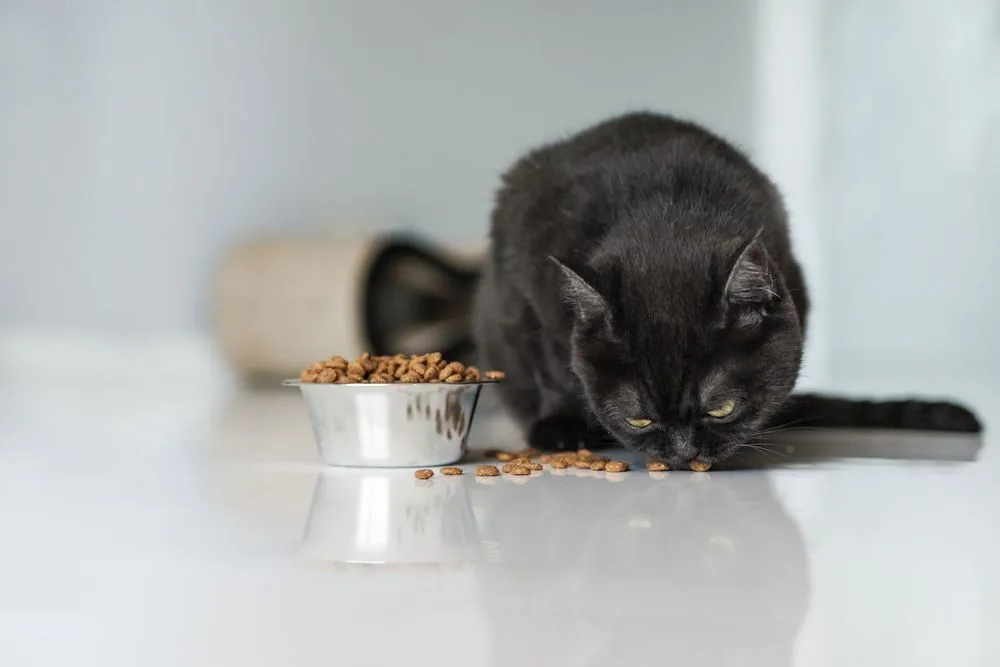
This is why cats generally eat from the center of the bowl. When the amount of food in the center gets depleted (and the base of the bowl becomes visible), the cat simply stops eating, as it realizes that eating from the sides of the bowl will hurt or cause stress.
This is also why a really hungry cat will sometimes tip the bowl and eat their food off the floor; this way, its whiskers don’t brush against the sides of the bowl, but they still get to finish their meal!
Wait, Can’t The Cat Just See The Food In Its Bowl?
This is the part that surprises most owners. You drop a treat right in front of your cat, it sniffs frantically in the wrong spot, and you start to wonder if your pet has gone briefly blind. In a sense, up close, it has.

Cats see beautifully at a distance, but they struggle to focus on anything right under their nose. A cat’s lens is large and barely changes shape, so it can clearly focus only on objects roughly 25 centimeters (about 10 inches) or farther away. Anything closer turns blurry. As veterinary ophthalmologist Paul Miller of the University of Wisconsin-Madison puts it, the result is “similar to a 45-year-old human” squinting at small print.
So when food is sitting in the bottom of a bowl, just a few centimeters from your cat’s eyes, it is effectively below the cat’s minimum focusing distance. The cat isn’t being dramatic or fussy. It genuinely cannot get a sharp look at what’s in front of it.
This is exactly where the whiskers earn their keep. Because the eyes are useless at point-blank range, a cat leans on its whiskers to “see” things right under its nose, sweeping them forward to map the food by touch and even detecting faint shifts in air currents like tiny radar antennae. Add in a powerful sense of smell, and the cat finds the meal without ever needing to focus on it. That also explains a couple of the odder behaviors owners report, such as a cat appearing to eat with its eyes half-closed or seeming convinced the bowl is empty when a thin film of food is still smeared around the edges.
What Kind Of Bowl Actually Fixes This?
If your cat reliably cleans out the center of the dish but bails the moment the base shows, the cheapest experiment is to change the dish itself. The fix that keeps coming up is a wide, shallow bowl or simply a flat plate or saucer, ideally wider than your cat’s whisker span so the food can be reached without the whiskers pressing against any walls.

It’s worth being honest about the evidence here, though. Whisker fatigue is a popular idea rather than a settled veterinary diagnosis, and a 2020 study that compared cats fed from “whisker-friendly” bowls against ordinary bowls found no difference in how long they ate, how much they ate, or how much food they dropped. That said, the same study noted that some cats clearly preferred the wide, shallow bowls. So a flat plate may not be a medical cure, but if it gets a particular cat to finish its dinner, it’s a harmless and almost free thing to try.
Material can matter too. Many cats turn up their nose at plastic dishes, which can also be linked to feline chin acne; vets often suggest switching a fussy eater to stainless steel, ceramic, or glass instead. A reluctance to eat from a brand-new bowl frequently comes down to the unfamiliar material or smell rather than the food, so give your cat a few days to adjust before assuming the food is the problem.
This Is NOT The Only Reason Why A Cat Won’t Eat
It’s important to note that whisker fatigue is not the only reason why cats occasionally refuse to eat. There are some other factors to consider, such as medical illness, stress, psychological issues, and recent vaccinations. A cat also might not eat if it’s in an unfamiliar or new environment.
This is why many cat owners struggle to feed their cats when they’re traveling. Furthermore, traveling may cause motion sickness, which can lead to nausea and a subsequent refusal to eat.
So, if your cat eats normally from a bowl’s center, but refuses to eat when the base of the bowl becomes visible, it’s time to get your cat a new food container with a design that doesn’t irritate their whiskers!
References (click to expand)
- Whiskers in Cats: An Introduction – Neuroethology Blog. New College of Florida
- Whisker Fatigue in Cats - Oklahoma State University. Oklahoma State University–Stillwater
- CATS' WHISKERS SERVE AS A KIND OF RADAR. Virginia Tech
- How Do Cats See the World? What To Know about Cat Vision. PetMD
- Why Do Cats Have Whiskers? VCA Animal Hospitals
- Whisker Fatigue in Cats: What It Is and How To Help. PetMD
- Cat Acne. PetMD