Table of Contents (click to expand)
Cats land on their feet thanks to a built-in “righting reflex.” While falling, a cat senses which way is up, then bends and twists its flexible spine to swing its front and back halves in opposite directions. This reorients the body without any outside push, and crucially, without ever gaining net rotation, so the cat rights itself with its total angular momentum staying at zero.
Cats are incredibly agile and flexible. They can squeeze into tight places and leap to seemingly impossible heights. Yet, they emerge unhurt from such risky endeavors, always landing on their four paws.
But how do they do this? And are cats the only animal with such a death-defying superpower?
Marey’s Falling Cat Experiment
Scientists of the 19th century were perplexed by the ability of some animals to inverse their body orientation while falling, such as the infamous phenomenon of cats.
Étienne Jules Marey was one such scientist. In 1894, Marey tried to understand the dynamics of a falling cat by dropping a cat upside down and clicking a series of images using chronophotography. Chronophotography is the method of capturing a series of phases of movement.
With the help of this photography technique, he captured the cat’s successive phases of falling motion and published them in the Nature journal.
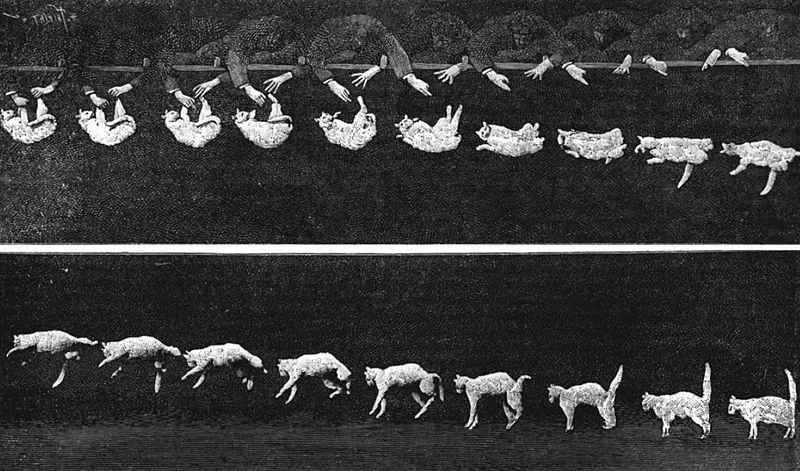
Photographs of a Falling Cat by Étienne Jules Marey, 1894 (Photo Credit: Etienne-Jules Marey/Wikimedia Commons)
Previously, some believed that a cat pushed against the hands of the person dropping it to flip its body, but Marey’s photos showed otherwise. The cat has no rotation at the beginning of the fall, yet still flips over before it lands. At first glance, that looks impossible.
After all, Newton’s laws tell us that an object can’t start spinning unless an outside torque acts on it, and a cat in free-fall has nothing to push against. So how does it turn over? The answer is that the cat never actually gains any net spin. Its total angular momentum stays zero from start to finish, and the secret lies in how it reshapes its body, as we’ll see next.
How Do Cats Rotate Their Body While Falling?
At the beginning of a fall, the cat is upside down with its four paws pointing toward the sky, while its back faces the ground. The only force acting on the cat is gravity, which pulls straight down and can’t make the cat spin sideways.
You might think the cat needs an outside push to flip over, but there isn’t one to be had in mid-air. The trick is that a cat doesn’t behave like a rigid object such as a thrown brick. Its spine is unusually flexible and it has no rigid collarbone, so it can twist the front and back halves of its body almost independently. By changing its shape this way, the cat reorients itself without ever needing an external torque, and without breaking any law of physics.
Righting Reflex
To protect the body and avoid any injuries from the free-fall, some animals turn themselves around mid-air in order to land safely on their feet. The ability of animals to reorient their body while falling is known as the righting reflex. This aerial righting reflex has been recorded in many mammals, including cats, guinea pigs, rabbits, rats and primates.
Before any of this can happen, the cat first has to work out which way is up. It does that using the vestibular apparatus in its inner ear, a set of fluid-filled canals and tiny sensors that detect gravity and the direction of motion. This is why even cats born without sight can still right themselves in a fall.
Cats and geckos reorient their bodies by changing shape while keeping their total angular momentum at zero.
Marey’s images show that the cat arches its back as it begins to fall. This effectively breaks the cat’s body into two different parts. To understand the falling cat problem, we need to look at the upper and hind parts of the cat as two rigid cylinders with different rotational axes.
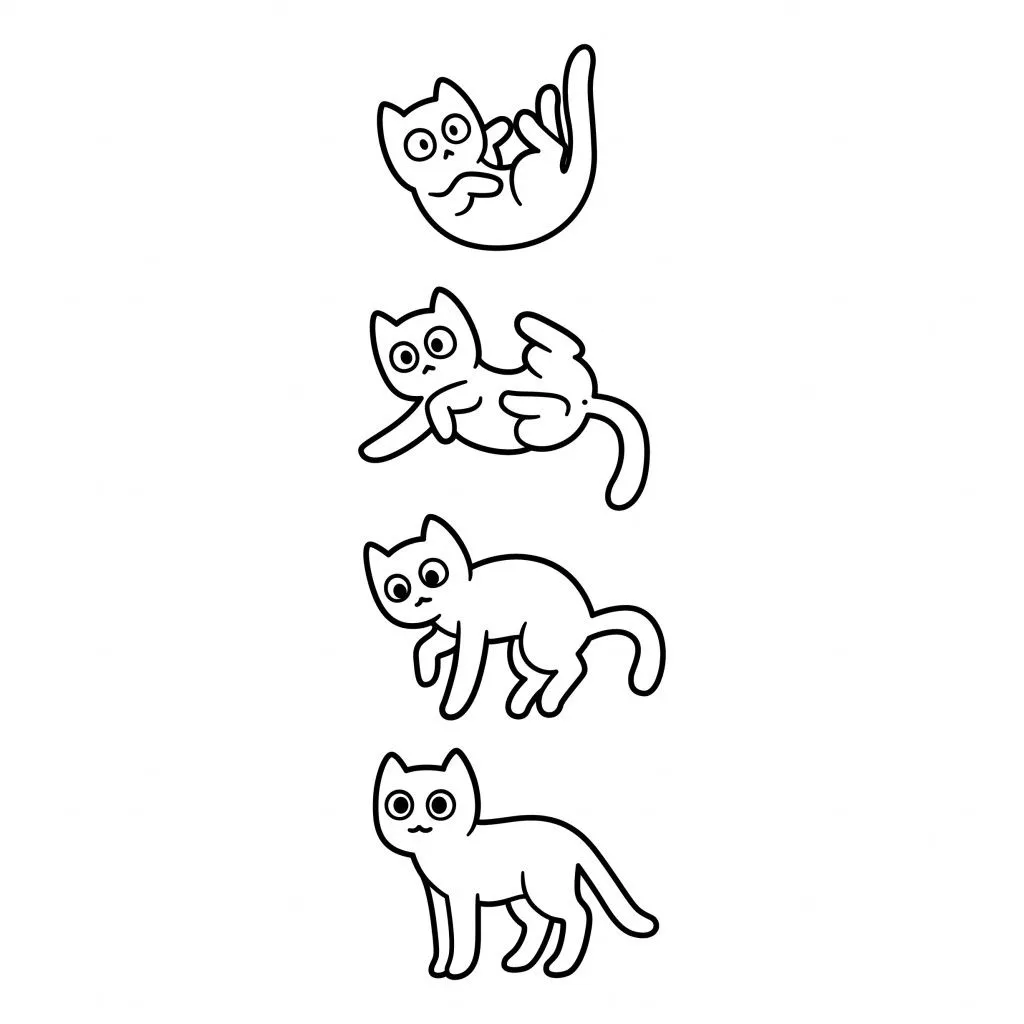
The cat starts to rotate its head towards the camera with its hind legs extended, while simultaneously pulling its front legs in. You might have seen figure skaters pull their arms in while spinning. By pulling their arms in, they increase their angular velocity, which helps them spin faster. Cats apply the same principle while falling.
As the front part of the cat’s body rotates by close to 180° about its waist, the hind part rotates a small amount in the opposite direction so that the total angular momentum doesn’t change. The two counter-rotations cancel out, so the resultant angular momentum stays at zero throughout, exactly as the laws of physics demand.

As its head and front paws face the ground, the cat extends its front legs while contracting its hind legs. This allows the hind legs to catch up with the front legs. Thus, by reversing the process, the cat can rotate its hind part and align it with the front.
With all four paws of the cat facing the ground, the cat can make a safe and cushy landing.
Sadly, we humans are not blessed with this amazing superpower. That being said, humans do exhibit a form of the righting reflex called the postural righting reflex. These include visual righting reflexes, labyrinthine righting reflexes and neck righting reflexes, to name just a few. These reflexes may not save our lives if we take a fall, but they certainly help us maintain proper body orientation and posture.
Conclusion
In 1984, a cat named Sabrina fell 32 stories from a New York high-rise onto the pavement below and survived, walking away with just a chipped tooth and a collapsed lung. She stabilized within 48 hours, and her case became one of the most famous examples of what vets call high-rise syndrome. The righting reflex has turned out to be a literal life-saving boon for cats across the world.
You may have heard that falling from higher up is somehow safer for a cat. That idea traces back to a 1987 study of 132 cats in New York, whose authors suggested that once a cat reaches terminal velocity and stops accelerating, it relaxes and spreads its legs out like a parachute, spreading the impact across its body rather than driving it through its legs. It is a charming explanation, and it has been repeated ever since, but the larger studies that followed have not backed it up. A 2004 series of 119 cats found that falls from the seventh floor and above produced more severe injuries and more chest trauma, not less. And a 2025 Berlin study of 1,125 cats, the largest yet assembled, found injury severity tracking with fall height, with survival holding above 80% for falls up to about 21 meters (69 feet) and dropping to roughly 60% beyond that. Veterinary researchers still call the height-versus-injury question unsettled, but the bigger and more recent the dataset, the less room there is for the idea that a longer fall is a gentler one.
That said, the righting reflex doesn’t make cats immune to the dangers of a serious fall. In that 2004 series, 96.5% of the cats survived, but many still suffered broken bones, chest injuries and lasting harm. So while cats are extraordinarily good at landing on their feet, they don’t always walk away unharmed.
References (click to expand)
- Whitney, W. O., & Mehlhaff, C. J. (1987). High-rise syndrome in cats. Journal of the American Veterinary Medical Association. PubMed.
- Vnuk, D., et al. (2004). Feline high-rise syndrome: 119 cases (1998-2001). Journal of Feline Medicine and Surgery. PubMed.
- Candela Andrade, M., et al. (2025). High-rise syndrome in cats (part 1): epidemiology and risk factors. Journal of Feline Medicine and Surgery. PMC.
- Candela Andrade, M., et al. (2025). High-rise syndrome in cats (part 2): injury patterns and survival rate. Journal of Feline Medicine and Surgery.
- Why Do Cats Always Land on Their Feet? - Phil Kesten. Santa Clara University
- Yang, J. (2021). The Development of Explanation of Falling Cat Problem and Applications of Falling Cat Phenomenon. Advances in Social Science, Education and Humanities Research. Atlantis Press.
- Jusufi, A., Zeng, Y., Full, R. J., & Dudley, R. (2011, September 19). Aerial Righting Reflexes in Flightless Animals. Integrative and Comparative Biology. Oxford University Press (OUP).
- Falling cat problem. Wikipedia.