Table of Contents (click to expand)
Fainting goats, formally called myotonic goats, don’t actually faint. When they’re startled or scared, an inherited muscle disorder called myotonia congenita makes their skeletal muscles seize up for several seconds, so they stiffen and topple over while staying fully conscious. The episode passes and they get back up unharmed.
Road trips are wonderful ways to enjoy the natural world and discover new areas of your region. Admiring the local wildlife and livestock is also a major draw for traveling by car, as you never know what you’re going to see! This is particularly true in the southern United States, where some of the goats display a peculiar habit of falling over and apparently fainting when they’re scared! Now, only a small percentage of goats have this odd habit, which is undeniably entertaining (and the source of many viral videos in recent years). The question is… why do some goats faint?
Tennessee Fainting Goats
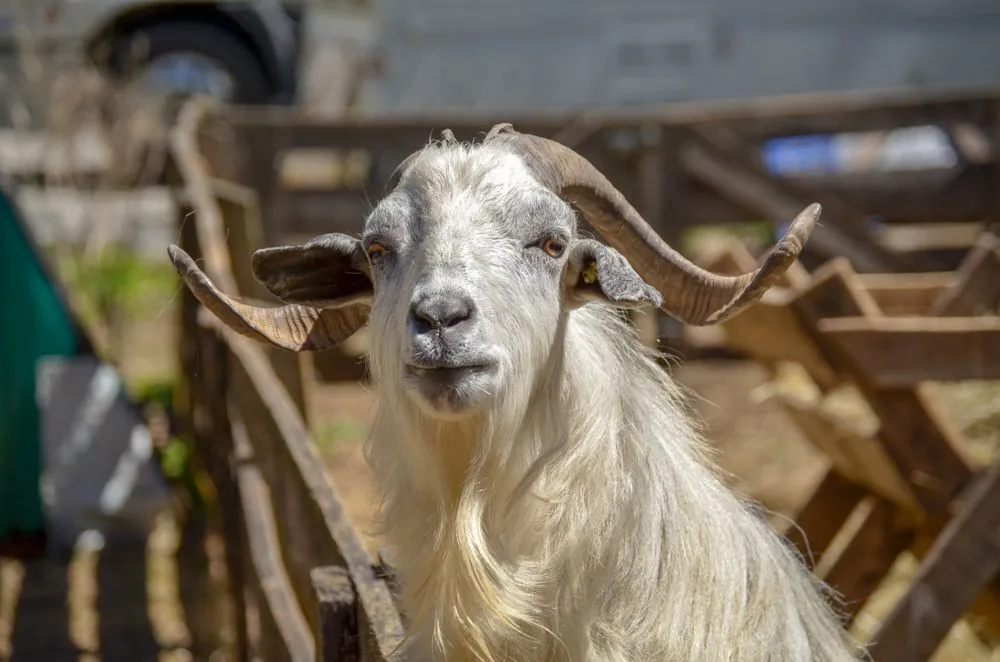
If you’ve ever spent any time in a barnyard, you’ve likely met a few goats full of attitude and silliness and swagger. Most goats have quick reflexes, but aren’t easily frightened, with their horned heads and stubborn demeanor. However, this isn’t true of all goats; the Tennessee fainting goat is an American breed whose story begins in the early 1880s, when a farmhand named John Tinsley reportedly arrived in Marshall County, central Tennessee, with four unusual goats that stiffened and fell over when startled. From that small handful, their peculiar behavior made them a popular breed, and they spread from Tennessee across the American South. Once dwindling toward extinction, the breed has rebounded enough to be listed as “recovering” by The Livestock Conservancy.
Thomsen’s Disease
Also known as myotonic goats, this “peculiar behavior” consists of the goats stiffening in place when they are surprised or scared, causing them to lock up and fall over, appearing to faint. The reason for this unusual habit is an inherited condition, myotonia congenita (the same family of muscle disorder that, in its dominant human form, is known as Thomsen’s disease). The primary symptom is the seizing of the skeletal muscles, most notably in the back legs, upon being frightened. Therefore, if you sneak up on a fainting goat, or make a loud noise, it will trigger their fight-or-flight response, which then seems to “short-circuit” in an unusual way.

If you seek out any of the countless videos of fainting goats on the Internet, you will see that the condition manifests differently; sometimes a goat will freeze immediately, all four legs locked in place, and then fall over, legs stiff! However, sometimes a goat will be able to take a few hops to escape the stimuli, but then their legs lock, and they quickly succumb to the force of gravity. While this is amusing to watch, it is the opposite of most fight-or-flight responses. In humans, for example, if something surprises/scares us, our muscles receive an instantaneous burst of energy, often allowing them to tense and then become active, making them able to function better, not worse.
Is Fainting Dangerous For Goats?
While this condition would make it hard for one of these goats to evade a predator, “fainting” and falling over does not typically hurt these creatures. They also don’t actually “faint”, as this suggests that they lose consciousness. No, wooden-leg goats, as they are sometimes called, remain conscious during the entire episode. Remember, this is basically the animal’s fight-or-flight response in overdrive, where their muscles tense up but are slow to release. The root cause isn’t in the brain at all, but in the muscle itself: a mutation in the CLCN1 gene cripples a chloride channel in the membrane of the skeletal muscle fibers. With too little chloride flowing across the membrane, the muscle stays electrically “switched on” far longer than it should, so it keeps contracting and is slow to relax.
Most of these “fainting spells” last for 10-20 seconds, about the same length of time as the initial adrenaline rush that humans experience when our own sympathetic nervous system is triggered. Now when most breeders or experts talk about mutations, or congenital disorders, it is typically considered a negative aspect and may be selectively bred out or treated in some way. For some reason, however, the unusual reactions of this fainting goat breed have had the opposite effect, to the point where breeders intentionally retain the mutation and encourage these clumsy goats to reproduce!
What’s even more interesting is that goats aren’t the only creatures that carry this disorder. Many other mammals, from mice and dogs to horses and humans, also inherit forms of myotonia congenita, but in smaller numbers that don’t get nearly as much viral attention. In people, the stiffness tends to ease with repeated movement (the “warm-up” phenomenon), and medications such as mexiletine can help relax the muscles and reduce symptoms.
The good news for goats who are tired of falling over all the time is that older fainting goats learn to cope and are less likely to topple. When they are triggered or scared, they often manage to brace their legs and hobble away (awkwardly, yes) rather than completely freeze and crash to the ground. The underlying gene defect doesn’t go away, but the goats grow more familiar with their surroundings and less “jumpy” with age, so their sympathetic nervous system is triggered less often.
A Final Word
The next time you find yourself at a petting zoo in Tennessee, be sure to ask them if they have any fainting goats. It may seem mean to surprise these funny creatures and cause them to take a tumble, but it is specifically this behavior that has made them loved by millions and bred in countless places. Just be sure that you’re sneaking up on a fainting goat, rather than some other variety (perhaps one with horns and a bad attitude)!
References (click to expand)
- Why 'Fainting Goats' Really Collapse in Fear. National Geographic
- Lossin, C., & George, A. L., Jr. (2008). Chapter 2 Myotonia Congenita. Advances in Genetics. Elsevier.
- Myotonia Congenita. StatPearls. NCBI Bookshelf.
- Physiology and Pathophysiology of CLC-1: Mechanisms of a Chloride Channel Disease, Myotonia. PMC.
- Myotonic or Tennessee Fainting Goat. The Livestock Conservancy.