Table of Contents (click to expand)
Animals play dead, a behavior called thanatosis or tonic immobility, mainly to escape hungry predators that lose interest in prey that seems already dead. But some animals also play dead for other reasons: to dodge unwanted mates, to avoid mating, or to avoid being cannibalized by a partner.
What would you do if you encountered a grizzly bear during your hike in a forest? You might yell and run as fast as possible, hoping it won’t catch up with you. However, if you’re smart, you might lie down on the ground, play dead and hope like hell that the bear will buy your act.
While it might not work on all animals, the act of playing dead is not unique to humans. There are plenty of animals who have mastered this tricky performance. Humans also are not the only creatures to understand the concept of mortality. Not only are animals aware of mortality, but they take it a step further and use death to their benefit. As paradoxical as it may sound, animals use death to stay alive.
What makes some animals fake their death? There’s more to this than the fairly obvious answer, namely to avoid turning into another animal’s meal.
Tonic Immobility
Tonic immobility acts as an anti-detection mechanism. By playing a simple game of freeze and blending into the stillness of the environment, prey can avoid catching the eye of a predator. If there’s no movement, the predator won’t even know it’s there.
Its other function expands beyond going incognito to predators; it also acts as an anti-consumption mechanism. In some cases, tonic immobility happens after the prey has been caught and physically restrained by the predator. Think of this as a desperate do-or-die attempt.
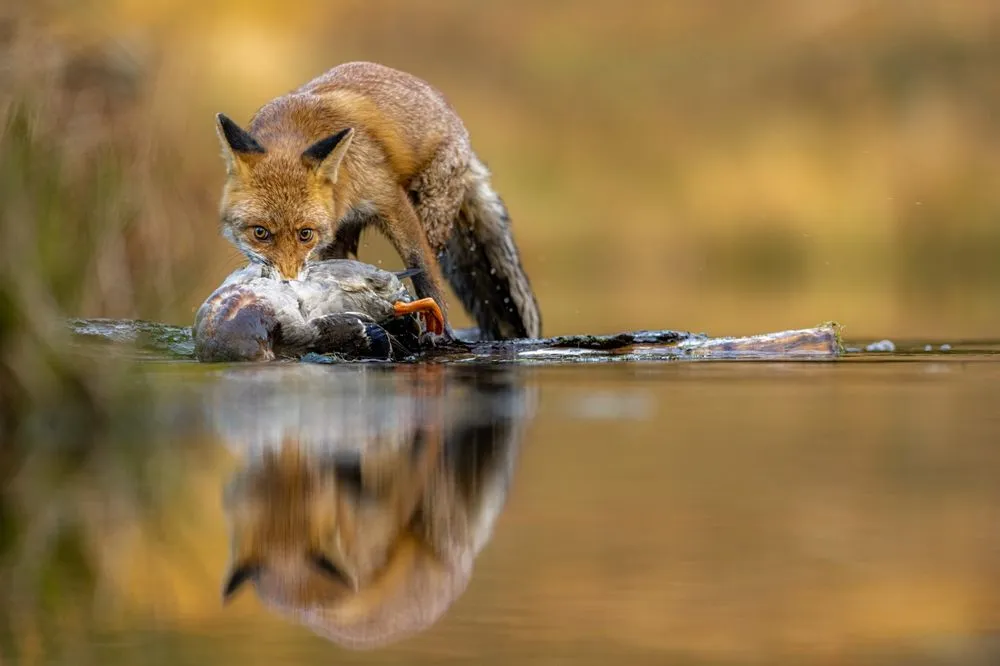
For instance, ducks often go limp the instant a fox seizes them. This can fool a fox into thinking the duck is already dead, meaning there is no need to further harm or hold onto the prey. The duck can then seize its chance to flee when the fox sets it down or wanders off after other birds. In one classic study of captive red foxes hunting ducks, more than half of the caught birds played dead well enough to escape.
Thanatosis
Thanatosis is the act of playing dead or feigning death to avoid getting eaten by a predator.
The Virginia opossum tactfully executes an elaborate ruse when faced with the possibility of death. It falls on its side with wide-open eyes and mouth, along with a limp tongue hanging out. Its heart rate slows down, along with decreased body temperature and slower breathing. When researchers measured these changes in real time, the opossum’s heart rate fell by about 46% and its breathing rate by roughly 30% during a feigning episode, while its body temperature dipped only slightly.
To make the act even more convincing, the opossum urinates and defecates on itself and produces a terrible-smelling liquid from its anal gland. In males, the erection of the penis is also observed. As disgusting as it all may sound, it works to save their life!
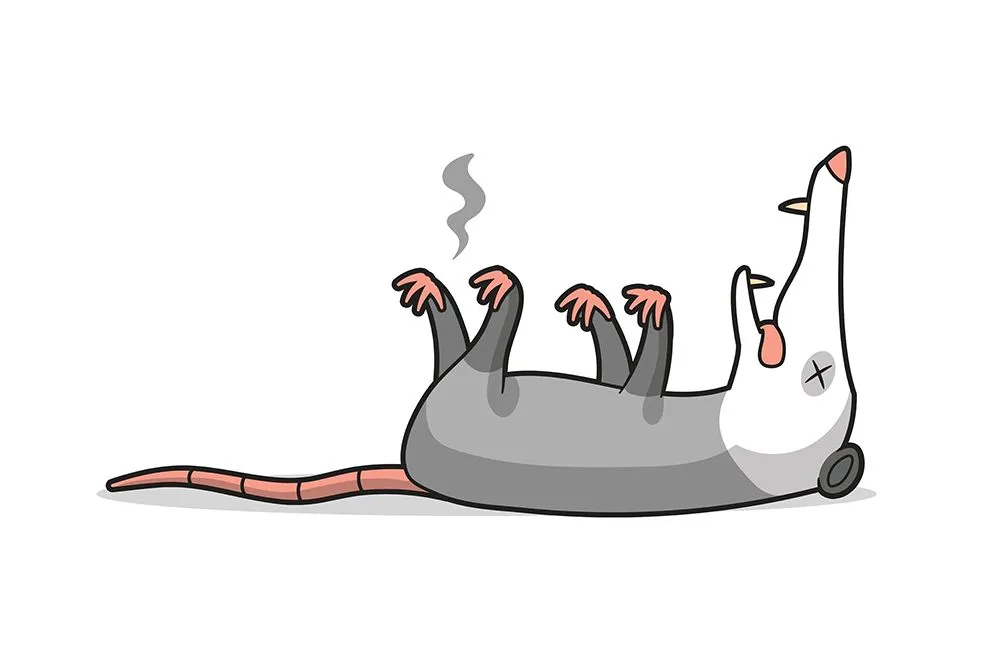
Despite looking utterly lifeless, the opossum stays fully conscious and aware of its surroundings the whole time, and it can sense the presence of danger. Once the predator moves on, convinced that the opossum is dead and not a suitable meal, the opossum rises back to life and goes right on living.
Now you know what playing possum means!
Certain frogs and the hognose snake perform similar anti-predation deception when faced with imminent death.
As we can see, thanatosis is much more complex than simply lying down still and going quiet, as with tonic immobility. While the animal does lie still, as in tonic immobility, thanatosis adds other accompanying behaviors (the slack jaw, the foul smell, the drooping tongue) that work together to convince the predator that the animal is dead.
Playing Dead To Avoid Creeps
Imagine a guy or girl that you aren’t interested in walking towards you to ask you out. How would you avoid the awkward conversation of rejecting them?
You could just hide behind someone or something and hope to god they don’t notice you and eventually drop the whole idea of asking you out. Pretty simple, right? What about dropping to the floor and pretending that you’re dead?
It might sound hilarious and a bit too extra, but believe me when I say that it’s a tried and tested solution. At least, it is tried and tested by female European common frogs (Rana temporaria). A 2023 study published in Royal Society Open Science found that some female frogs show tonic immobility, i.e., play dead, to avoid mating with unwanted males. These frogs are explosive breeders: thousands gather to mate in a short window, the males heavily outnumber the females, and a clump of males will pile onto a single female. Faking death is one way a female can wriggle out of that scrum.
One insect that has mastered this technique to get rid of unwanted advances is the moorland hawker dragonfly. Once a female has mated and is ready to lay her eggs, she has no reason to mate again, but patrolling males keep trying to coerce her anyway. To get rid of these undesirable suitors, the female suddenly stops flying and crashes to the ground, lying belly-up as if she’s dead. The male hovers over her for a few seconds to check, then eventually gives up and flies off to find another mate. In the study that first documented this, 21 of 27 females that played dead managed to fool the chasing male, a success rate of around 78%.
I think the males of the animal kingdom need to be taught the concept of “No means no,” so females won’t have to put together such elaborate acts of avoidance.
For Sex
You might find it absurd to think that playing dead would help males secure sex with a female, but the Pisaura mirabilis, aka the nursery web spider, proves this notion wrong. It is not necrophilia that I’m suggesting, but rather an ingenious attempt on the male spider’s part to avoid sexual cannibalism.
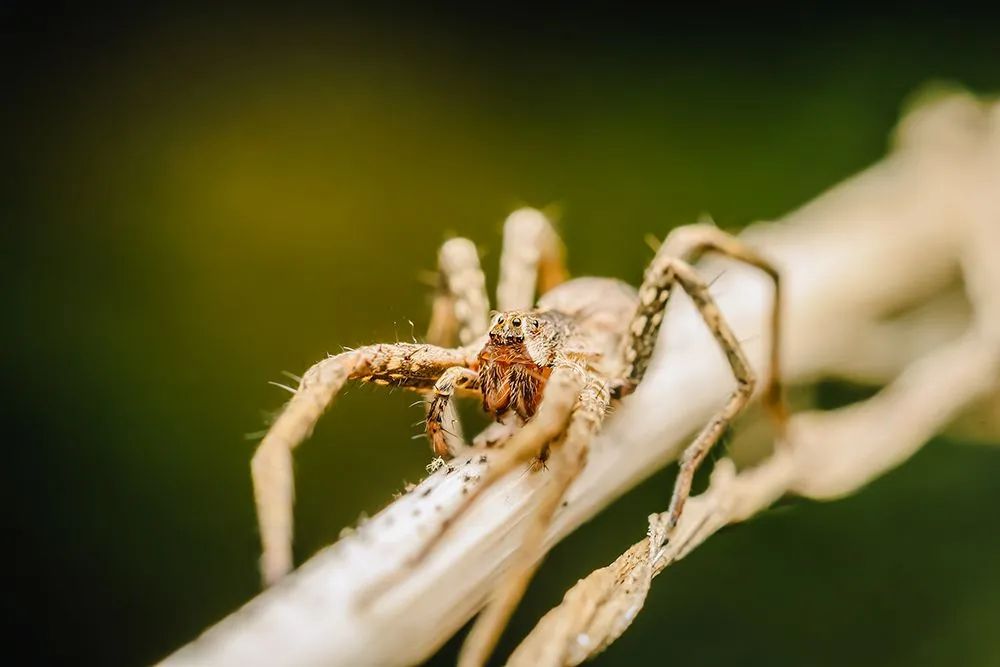
A study found that male spiders that practiced thanatosis were much more likely to mate successfully, and to avoid getting killed in the process. Later work showed just how big the payoff is: death-feigning males raised their odds of copulating from under a third to nearly 90%.
The male usually brings a nuptial gift (usually prey, such as a fly) while courting the female. At times the male pretends to drop dead when the approaching female attacks him. Without losing its grip on the gift, the male lies on the ground, continuing to act dead. As the female starts to eat the gift he brought, the male comes “back to life” and slowly moves under her to begin mating. A sly move indeed!
Conclusion
By all accounts, it seems that playing dead is not just a trick one can teach their pets for fun. Many animals out in the wild have been practicing it for millions of years to save their lives.
For some, it is the art of staying still to remain undetected, while for others it is the art of putting forth a realistic act of death to evade actual death. A few other animals adapted this behavior not to protect themselves from death, but from the unwanted attention of males. Talk about being innovative! No matter what the purpose, the idea of animals consciously and cleverly faking their own death is fascinating.
References (click to expand)
- Ruxton, G. D., Allen, W. L., Sherratt, T. N., & Speed, M. P. (2018, July 26). Thanatosis. Avoiding Attack. Oxford University PressOxford.
- Animals wrestle with the concept of death and mortality.
- Humphreys, R. K., & Ruxton, G. D. (2018, January 15). A review of thanatosis (death feigning) as an anti-predator behaviour. Behavioral Ecology and Sociobiology. Springer Science and Business Media LLC.
- Rogers, S. M., & Simpson, S. J. (2014, November). Thanatosis. Current Biology. Elsevier BV.
- Sargeant, A. B., & Eberhardt, L. E. (1975). Death Feigning by Ducks in Response to Predation by Red Foxes (Vulpes fulva). American Midland Naturalist. USGS Publications Warehouse.
- Gabrielsen, G. W., & Smith, E. N. (1985). Physiological responses associated with feigned death in the American opossum. Acta Physiologica Scandinavica.
- Dittrich, C., & Rödel, M.-O. (2023). Drop dead! Female mate avoidance in an explosively breeding frog. Royal Society Open Science.
- Khelifa, R. (2017). Faking death to avoid male coercion: extreme sexual conflict resolution in a dragonfly. Ecology.