Yes. Stressed plants emit airborne ultrasonic clicks in the 20–100 kHz range, far too high-pitched for human ears. A 2023 study in Cell recorded tomato and tobacco plants making roughly 25–50 popping sounds per hour when dehydrated or cut, most likely produced by cavitation (collapsing air bubbles) in the water-carrying xylem. These are sounds, not radiation, and the plants are not "screaming" on purpose.
Roald Dahl published a short story titled ‘The Sound Machine’ in 1949. It talked about how crazy a person could become upon hearing sound frequencies from plants using a machine he made.
The level of his madness was such that he called for a doctor and asked him to put iodine and a bandage on a tree trunk that had been damaged during a storm.
Fast forward to today, and it turns out Dahl’s fictional short story has edged closer to reality. Plants really do emit ultrasonic sound, and we’ve finally built the microphones sensitive enough to hear it!
What Is Ultrasonic Radiation? Can We Hear It?
Despite the word “radiation” in this article’s title, what plants emit is sound, not electromagnetic radiation. “Ultrasonic” simply means the pitch sits above the range we can hear. The human ear handles frequencies ranging from about 20 hertz to 20,000 hertz.
Sound frequencies belonging to the bracket below 20 Hz represent the infrasonic range of sound waves. Similarly, the ultrasonic waves belong to the frequency range that is higher than 20,000 Hz. Naturally, the human ear would not be able to hear ultrasonic frequencies.

However, this doesn’t imply that other organisms cannot detect or hear ultrasonic or infrasonic waves. For example, bats and whales are known to navigate using ultrasonic frequencies. Animals like rhinoceroses and elephants can hear infrasonic sound, below the range we can detect.
Ultrasonic Radiation Emitted By Plants
Plants, being mute and sessile (unable to perform locomotion), have been found to respond to many signals, including tactile and optical signals. For example, the touch-me-not plant responds to tactile signals by closing up in an instant!
In 2023, for the first time, scientists confirmed that plants produce airborne sound.
Researchers from Tel Aviv University, led by Lilach Hadany and Yossi Yovel, studied two plants in particular: tobacco and tomato. Ultrasonic microphones were set up inside a soundproof acoustic box, and later in a greenhouse, while sensors monitored each plant. The team exposed the plants to two categories of stress, drought and physical damage (cutting the stem), and recorded the sounds they produced. The clicks fell in the ultrasonic range of roughly 20 to 100 kHz, well above human hearing, and were loud enough to be picked up from 3 to 5 meters (10 to 16 feet) away.
First posted as a preprint in 2019, the work was peer reviewed and published in the journal Cell in March 2023, so this is no longer a tentative claim.

The Results Of The Experiment
The researchers found that the average number of sounds emitted by a drought-stressed tomato plant was 35.4 per hour. Under the same conditions, a tobacco plant clicked 11.0 times per hour. In the case of stress from stems being cut, the average stood at 25.2 sounds per hour for the tomato plant and 15.2 per hour for the tobacco plant. Unstressed plants, by contrast, were almost silent, clicking fewer than one time per hour.
Additionally, the tomato sounds were observed for 10 days, starting from the day when it was properly irrigated. The plants released fewer sounds when they were watered fully. Then, as their water content decreased, the number of sounds started increasing. The sounds finally decreased as the plant nearly dried up. Remarkably, a machine-learning model trained on the recordings could tell drought stress from cutting, and even tomato clicks from tobacco clicks, with accuracies of roughly 70 to 84 percent, suggesting the sounds carry real information about what the plant is going through.
A Possible Explanation Of These Sounds
So how, exactly, does a plant make a clicking sound? The leading explanation points to the xylem. When a plant suffers from dehydration, water transport through this tissue is disrupted. Xylem, made of dead tube-shaped cells lined up one after another, is the plumbing responsible for water conduction in plants.
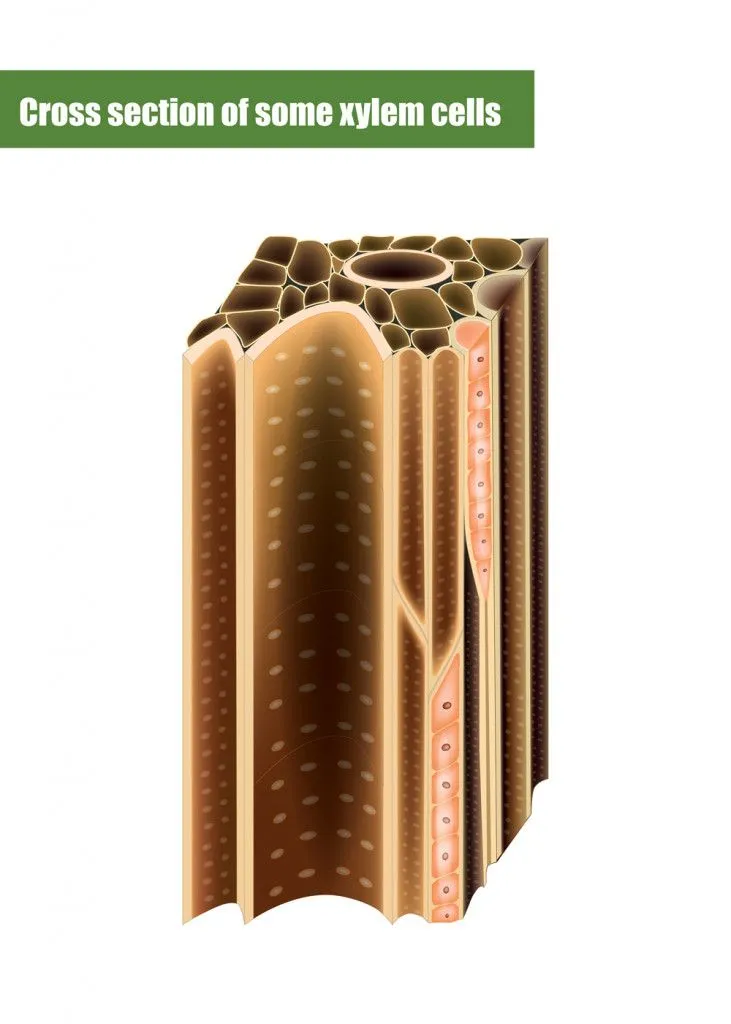
As the xylem dries up, a phenomenon called cavitation usually takes place. In this, air bubbles are formed in the xylem and these air bubbles gradually expand and then explode. This popping of air bubbles may cause vibrations in the form of acoustic emissions.
Research published in 2008 also detected ultrasonic acoustic emissions (UAE) from pine and oak trees found in the Alps due to drought conditions, changes in the stem radius, and immediate air and soil conditions. Those researchers hypothesized a similar reason for the plants emitting sound.
The research still has its limits. The Tel Aviv team also picked up clicks from wheat, corn, grapevine, and cactus, but most plant species remain untested, and the exact link between cavitation and every click is still being worked out. There is plenty left to confirm before we can read these sounds like a language.
Moreover, the conditions in response to which the sounds are emitted might also vary, depending on plants and the types of stress to which they’re exposed. Stress could be due to excessive sunlight (UV radiation), herbivores, wind, cold or diseases that the plant might be suffering from.
What Ultrasonic Plant Signals Can Mean In The Future
The range in which plants emit signals might not be audible to humans, but these frequencies do fall in the audible range of other mammals and insects. Moths that use tobacco and tomato plants as hosts for their larvae can hear these ultrasonic frequencies. In a 2025 follow-up study published in eLife, the same Tel Aviv group showed that female moths actually use these clicks when choosing where to lay their eggs: given a quiet, healthy plant and one playing back the sounds of a dehydrated plant, the moths laid far more eggs near the quiet one. When the moths’ hearing organs were disabled, the preference vanished, which is the first direct evidence of an animal acting on a sound a plant makes.
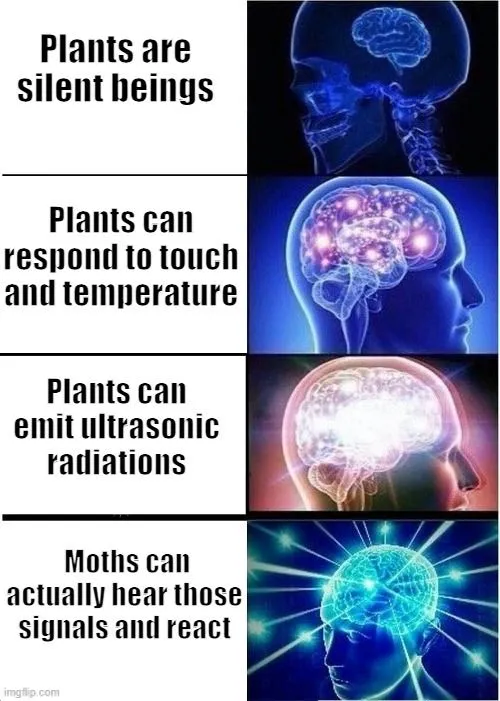
They also speculate that neighboring plants might hear these signals and react accordingly. The signals coming from drought-affected plants could therefore act as alarms and signal the ‘unstressed plants’ to close their stomata.
More importantly, as the water crisis in the world increases, proper understanding and utilization of these ultrasonic signals could help in the more prudent use of our resources by farmers. Plants might receive customized treatment in the form of more accurate and precise irrigation, for example.
Instances Of Plants Responding To Sound Signals?
Sound vibrations of a certain frequency and amplitude can significantly enhance cell division of the callus. Additionally, the rates of enzymatic and hormonal activity have also been found to rise in response to certain audio stimuli. Plants like cucumber, tomato, lettuce, and spinach showed improved growth rates upon exposure to sound waves. Furthermore, diseases like spider mite, grey mold, and other viral diseases that affect tomato plants were found to drop in their rates of occurrences in plants exposed to sound.
Interestingly, even the microscopic world can be impressed by sound signals. Escherichia coli shows a marked increase in colony formation upon perceiving sound vibrations. Even yeast shows a boosted rate of growth when exposed to sound signals.
Natural sound vibrations like the chirping of a bird, the buzzing of bees, and the stridulation of crickets can be accredited for the improved rate of seed germination in Abelmoschus esculentus and Cucurbita pepo. To know more about whether plants can hear, click “here“.
Sound has been helping the animal world achieve clear communication for ages. As research advances, it will help in communication and understanding of the silent plant world, which will prove beneficial to the human race, ultimately improving harmony among our interconnected ecosystems.
References (click to expand)
- Khait, I., et al. (2023). Sounds emitted by plants under stress are airborne and informative. Cell, 186(7), 1328-1336.
- Seltzer, R., Zer Eshel, G., et al. (2025). Female Moths Incorporate Plant Acoustic Emissions into Their Oviposition Decision-Making Process. eLife.
- Hassanien, R. H., HOU, T.-. zhen ., LI, Y.-. feng ., & LI, B.-. ming . (2014, February). Advances in Effects of Sound Waves on Plants. Journal of Integrative Agriculture. Elsevier BV.
- Zweifel, R., & Zeugin, F. (2008, August 6). Ultrasonic acoustic emissions in drought‐stressed trees – more than signals from cavitation?. New Phytologist. Wiley.
- Mishra, R. C., Ghosh, R., & Bae, H. (2016, June 23). Plant acoustics: in the search of a sound mechanism for sound signaling in plants. Journal of Experimental Botany. Oxford University Press (OUP).