Table of Contents (click to expand)
These specialty grapes were developed by crossing two different species of grapes: European or wine grapes (Vitis vinifera) with Concord grapes (Vitis labrusca). Vitis vinifera was the male parent and the variety used was called ‘Princess’. Vitis labrusca was the female parent. It took almost 10 years to breed Cotton CandyTM grapes.
We all know what cotton candy is… spun sugar and air that tastes intensely sweet! But have you ever tried a grape that tastes just like cotton candy? Breeders in California creatively bred a light green seedless grape variety that is intensely sweet and named it Cotton CandyTM. These grapes have the flavor, in addition to the sweetness, of beloved cotton candy.
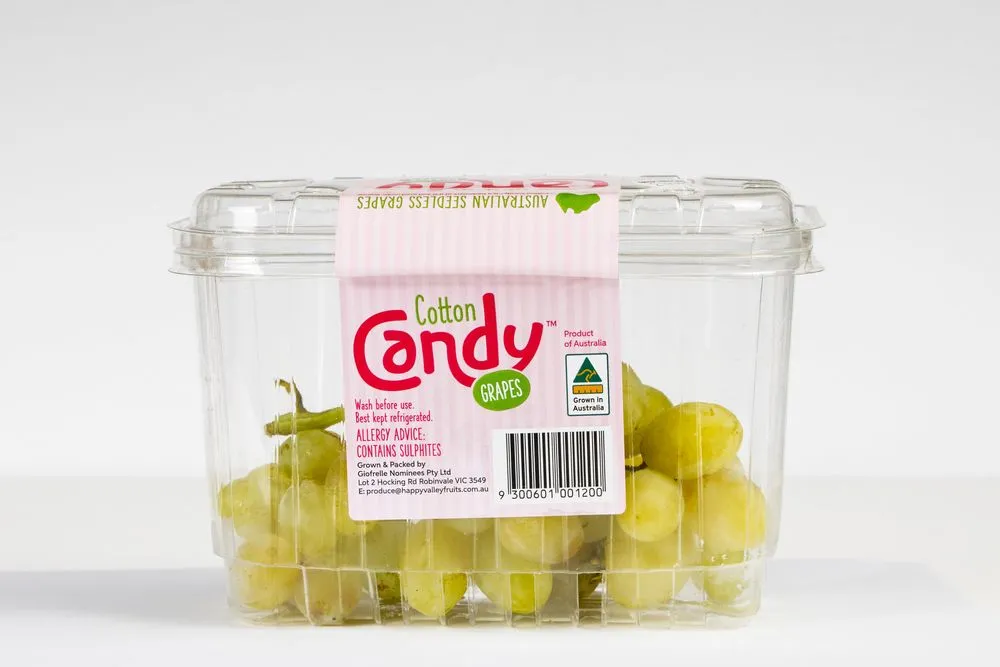
Cotton CandyTM grapes are the fruit (literally!) of almost 10 years of careful breeding. They were launched in 2012 and have become hugely popular among consumers. They were developed to be an alternative snack to sugar candies. The breeders believed that in order to shift the average person from snacking on sugary candies to reaching for fresh fruit, consumers would need something that gives them a sugary burst, but is actually healthy!
How Sweet Are Cotton CandyTM Grapes?
Plant breeders and fruit growers use the term ‘brix’ to measure the sugars and soluble solids in fruits. Brix is measured by a machine called the refractometer and is a measure of the total soluble solids per 100 grams of the fruit. These soluble solids are primarily sugars, but can also include other compounds. Cotton CandyTM grapes have a brix of 18-22 when grown under ideal conditions. Brix can vary based on environment and growing conditions.
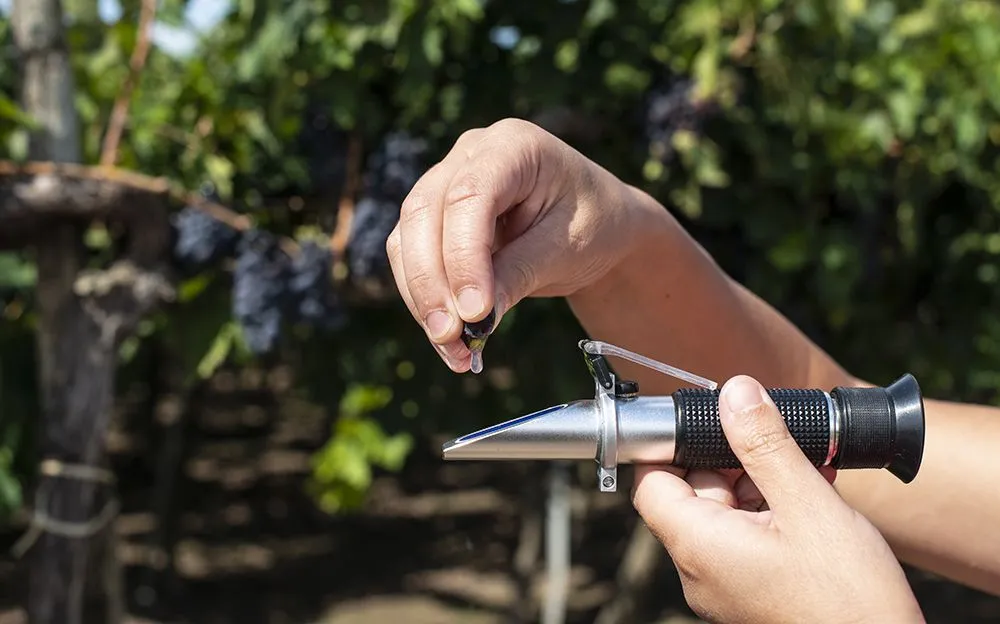
Cotton CandyTM grapes have an average of 18 grams of sugar per 100 grams and very little acidity. This means that when we bite into one of these grapes, we experience a burst of juicy sweetness. There is also ‘a hint of vanilla flavor’ in Cotton CandyTM grapes.
In comparison, regular grapes have about 12% less sugar and a fair amount of acidity to balance the sweetness.
How Were Cotton Candy Grapes Created?
Cotton CandyTM grapes were created with good ol’ plant breeding!
In traditional plant breeding, breeders cross two varieties of grapes with complementary traits. They take the pollen from the male parent and brush it on the stigma of the female parent. Then they wait for the fruit to mature, harvest the seeds, grow them and test the quality of each plant for important traits (e.g., yield, fruit quality, disease resistance). Then they save the best plants and collect their seeds.
They may even decide to do further crosses with the best plants. They could collect the seeds and grow them out and repeat the process all over again. It takes multiple cycles, the screening of hundreds of thousands of plants, and many years of hard work to come up with a commercially viable product.

Cotton CandyTM grapes were bred by David Cain at International Fruit Genetics in Bakersfield, California USA. One of the goals of his breeding program is to bring back the flavors of old grape varieties.
These grapes were developed by crossing two different species of grapes: European or wine grapes (Vitis vinifera) with Concord grapes (Vitis labrusca). Vitis vinifera was the male parent and the variety used was called ‘Princess’. Vitis labrusca was the female parent, of an unnamed variety obtained from the University of Arkansas. Concord grapes have unique flavors and are the source of the ‘hint of vanilla’ in Cotton CandyTM.
Apparently, David Cain was inspired to develop a cotton candy-flavored grape after tasting a Concord grape with a similar flavor.
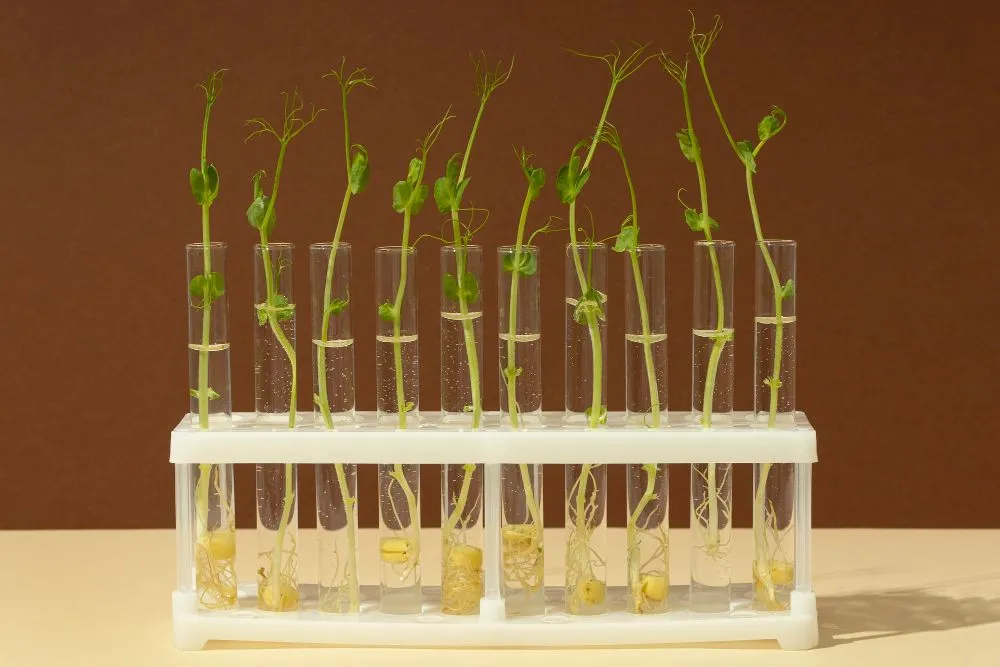
Breeding Cotton CandyTM was a bit challenging, as the interspecific cross between Vitis vinifera and Vitis labrusca does not normally produce viable seeds. The breeders couldn’t simply cross two plants and wait to harvest the seeds from the fruits. Instead, they crossed two plants and soon after fertilization, they harvested the young embryos. These baby grape plants were grown in tubes of nutrient media in the lab until they developed into little plants that were strong enough to be planted in the field.
It took almost 10 years to breed Cotton CandyTM grapes. The variety was patented and trademarked in 2011, and commercialized in 2012-13 by their marketing partner The Grapery. They are sold only in the US.
In order to experience the best-tasting Cotton CandyTM grapes, they should be harvested when they are completely ripe and refrigerated within 6 hours
Are Cotton Candy Grapes GMO Or Injected With Flavoring?
Because they taste so unnaturally sweet, plenty of people assume Cotton CandyTM grapes must be genetically modified, or that someone is injecting them with cotton candy syrup. Neither is true. As we saw above, these grapes are the product of old-fashioned cross-pollination between two grape species, followed by years of patiently selecting the best seedlings. No foreign genes were inserted and no DNA was edited, so the variety is not a genetically modified organism.
The step that tends to confuse people is the laboratory part, where the breeders rescued the young hybrid embryos and raised them in tubes of nutrient media. That technique is called embryo rescue, and it is one of the oldest tools in conventional plant breeding. When you cross two different species, the resulting embryos often die before they can form a viable seed, so breeders remove the immature embryo and nurse it along on a culture medium until it is sturdy enough to plant out. It rescues a cross that nature would otherwise have aborted, but it does not alter the plant's DNA, which is exactly why embryo rescue is not classed as genetic modification.
And the flavor? It is entirely homegrown. Cotton CandyTM grapes are not dipped, coated, or injected with anything, and no artificial flavoring is added at any point. Every bit of that sweetness and aroma is built into the fruit while it hangs on the vine.
Why Do Cotton Candy Grapes Taste Like Cotton Candy?
If nothing is added, why does biting into one taste so much like spun sugar? Two things are happening at the same time: extreme sweetness and a very particular aroma.

The sweetness is the easy half. With a brix of 18-22 and very little acid to balance it, there is nothing to mask the sugar, so each grape arrives on the tongue as a pure, candy-like rush. But sugar on its own would simply taste like a very sweet grape. The unmistakable 'cotton candy' impression comes from aroma, and that is the gift of the Concord parent.
Concord and other Vitis labrusca grapes carry a distinctive scent that flavor chemists call 'foxy'. Research on Concord grapes has shown that this aroma is driven above all by a single ester, methyl anthranilate. It is the very compound that gives grape soda, grape candy, and grape jelly their instantly recognizable, slightly artificial 'grape' note. So when the high sugar of the Vitis vinifera side meets the nostalgic candy aroma inherited from the Concord side, our brain stitches the two signals together and reads the whole package as cotton candy. The result is a flavor that feels engineered, even though it was simply coaxed out of two existing grapes.
Can You Grow Cotton Candy Grapes At Home?
This is the question every fan eventually asks, and the honest answer is: not really. The Cotton CandyTM variety is patented and trademarked, and it is grown under license almost entirely by its marketing partner, The Grapery, along with a small number of licensed growers. You cannot buy certified vines or cuttings of the trademarked variety at a garden center, and propagating a patented plant without the patent holder's permission is not allowed.

Saving seeds would not help either. These grapes are seedless, and even if you found a stray seed, a seedling would not grow 'true' to its parent. Thanks to the genetic shuffle that happens in every cross, the offspring would almost certainly lose the precise sugar-and-aroma balance that makes the original so special.
So the realistic plan is simply to buy them in season. In the United States the window is short: the fruit usually starts appearing around mid-July and peaks through August and September. Counter-season shipments from Mexico in spring and from South America in winter have begun to stretch that availability, but Cotton CandyTM grapes remain very much a seasonal treat. When you do track them down, remember that their flavor fades quickly after harvest, so refrigerate them promptly and enjoy them while they are at their sweet, just-picked best.
There Are Other Candy Grapes Out There
Cotton CandyTM grapes are just one of a series of intensely sweet grapes marketed by The Grapery.
Other varieties in the candy series are: Candy HeartsTM (brix 18-23), Candy CrunchTM (brix 18-23), Candy SnapsTM (brix 20-23), Candy DreamsTM (brix 20-24), and Candy DropsTM (brix 19-21).
Although these grapes have a high sugar content, nutrition experts estimate that we would need to eat roughly 100 of these grapes to consume the sugar equivalent of a single candy bar.
Conclusion
If you’re looking for a healthy snack to replace your addiction to sugary candies, you should try out the sugary burst offered by Cotton CandyTM grapes. It may seem like these are just as bad as a candy bar, but nutrition experts have confirmed that these are indeed healthier. Of course, you will need to be in the US to try them, since they are currently not sold in any other country!
References (click to expand)
- On Gum Drop Grapes and Other Fruits Designed to Taste ....
- The Cotton Candy Grape: A Sweet Spin On Designer Fruit.
- Cotton Candy grapes – Wikipedia.
- International Fruit Genetics – Wikipedia.
- Fruit breeder hits the sweet spot with Cotton Candy grapes.
- US20130055476P1 - Grapevine 'ifg seven'.
- A key ‘foxy’ aroma gene in the grape ‘Concord’ – Horticulture Research / NIH.
- Embryo Rescue in Plant Breeding – Plants (Basel) / NIH.
- When Cotton Candy Grapes Hit Store Shelves – Chowhound.