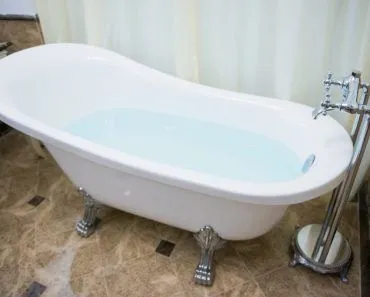
A bathtub is a last-resort tornado shelter, not a first choice. The National Weather Service and FEMA both recommend going to a basement, FEMA-rated safe room, or community storm shelter if you have one. If you don't, the safest spot in a typical home is an interior room on the lowest floor, and an interior bathroom often qualifies. A heavy bathtub, especially a cast-iron one, can act as a hard barrier between you and flying debris, but only when the bathroom is windowless and walled off from exterior surfaces.
When talking about defensive strategies against catastrophes, there are some that are quite scientific (like assuming a ‘brace for impact’ position), while others are not as obvious (like running away from a tornado as fast as possible). Nevertheless, all sorts of facts and myths surround the idea of surviving a disaster. There is one particular theory that is very interesting regarding tornados, namely that bathtubs are the best place to hide if you’re trying to survive a killer twister.
As nice as that may seem, we want to know if this is a myth or if it does in fact have scientific viability?
Places You Shouldn’t Be
First of all, let’s be clear about the places where you shouldn’t be during a tornado; first and foremost, avoid places that are covered on top but exposed on the sides, such as freeway underpasses, places under a flyover and so on. Apart from these, also avoid being in a mobile home or a car; if you think that will keep you safe… think again!

Also, you can never outrun a tornado. Any automobile can be easily lifted up and tossed around easily by a tornado (and it can be much worse if the tornado is a severe one).
Places That Can Protect You
According to researchers at Stanford University, your best bet for protecting yourself against a tornado is a modern building with reinforced concrete. There are certain specific places for protection against tornadoes, such as designated areas in schools or strong buildings that have been designated as significantly safe in case of a tornado. Apart from these, if you have one, basements are a great place to be in during a tornado, as they have no windows or openings, rendering it an ideal spot to be in if you find yourself in a home during one of these violent events.
What About A Bathtub?
In an extreme condition, however, when you’re standing in the middle of the living room of your house (that doesn’t happen to have a basement) and those designated safe houses are far away, then your best shot is the solitary inanimate object that sits unnoticed in the bathroom: the bathtub.

However, this is not as straightforward as it seems. This strategy comes with a few conditions. It is only a viable option if the bathroom is located deep inside your house and doesn’t have any windows. If it’s next to a wall that is exposed to the outside (or if the wall has windows to the outside), then you should leave that idea behind and look for a better spot. The idea here is that you want to put as many walls as you can between you and the raging twister to ensure that you are not caught up in the twister. The more resistance, the better!
Another option can be hiding inside a cupboard or a wardrobe, where you can bury yourself as deep as possible. Also, make sure that you wrap a blanket (or many blankets) tightly around yourself to shield against any flying debris caused by the tornado.
In terms of “protection” against a tornado, a ‘fool proof plan’ doesn’t exist. All you can do is find the best place possible that offers you protection against the swirling gusts of wind and debris, or at least minimize the effect of the tornado if you are unfortunately caught up in it.
Why Is The Bathroom The Safest Room In The House?
So the bathtub helps, but why does a tiny bathroom keep coming up as the go-to room in the first place? It really comes down to two things: geometry and plumbing. A bathroom is usually a small, boxy room tucked deep inside the house, which means it puts the maximum number of walls between you and the wind. Every wall a tornado has to chew through bleeds off some of its energy and blocks some of the debris, so the more layers you can hide behind, the better. That is exactly why the U.S. National Weather Service and the CDC tell you to head for "an inside room, without windows, on the lowest floor," and they specifically list a center hallway, a bathroom, or a closet as good candidates.

The second factor is the plumbing itself. The walls around a bathroom are packed with water and drain pipes, and those pipes are bolted into the framing and run down into the foundation. That dense web of metal and reinforced framing tends to make the room a little stiffer and better anchored than an ordinary bedroom, which is part of why you so often see a lone bathtub or toilet still sitting on the slab after the rest of a home has been swept away. Just remember the room earns this reputation only when it is interior and windowless. A bathroom on an outside wall, or one with a window over the tub, throws away the very advantage you were counting on.
Tornado Watch vs. Tornado Warning: Which Is Worse?
Before you ever need to dive for the bathtub, two phrases will come over your phone or weather radio, and people mix them up constantly: a tornado watch and a tornado warning. They sound almost identical, but they mean very different things, and knowing which is which buys you precious minutes.

A tornado watch is the "be prepared" message. According to the National Weather Service, it is issued by the Storm Prediction Center in Norman, Oklahoma, when conditions are favorable for tornadoes to form across a large area, and it typically covers a window of about 4 to 8 hours. Nothing is spinning yet; it just means the atmospheric ingredients are in place. This is the moment to review your plan, keep an eye on the sky, and make sure that interior room is clear.
A tornado warning is the "take action now" message. It is issued by your local Weather Forecast Office when a tornado has actually been spotted by trained storm spotters or detected on Doppler (WSR-88D) radar, and it usually lasts only around 30 minutes for a much smaller area. A warning means a tornado is imminent or already on the ground near you, so you should get to your safe spot immediately rather than waiting to see it for yourself. So which is worse? The warning, every time: a watch says danger is possible, while a warning says it is here. If you remember nothing else, remember that a tornado is far more violent than even a severe thunderstorm, and unlike a slow-moving hurricane you may only get a few minutes of notice. While you are sheltering, the NWS and CDC advise getting under something sturdy and covering your head and body with a mattress or blankets, since flying and falling debris, not the wind alone, causes most tornado injuries.
References (click to expand)
- Should You Get in Your Bathtub During a Tornado?. HowStuffWorks
- Safety During Tornadoes - www.public.iastate.edu:80
- 3 Ways to Survive a Tornado - wikiHow. wikiHow
- Bathtubs Provide Shelter During Tornadoes - www.accuweather.com
- Safety Guidelines: During a Tornado. Centers for Disease Control and Prevention (CDC)
- Severe Weather Definitions. NOAA National Weather Service
- Tornado Safety. NOAA National Weather Service