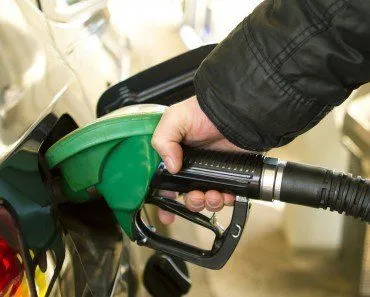
The fastest way to empty a bathtub is to pull the plug while you are still sitting in it. Your body displaces water and raises the level, and a higher water level means greater hydrostatic pressure at the drain (P = ρgh). That pressure pushes the water out faster (Torricelli’s law, v = √(2gh)), so the tub drains quicker than if you step out first.
This may seem like a weird question to most of you. In fact, it may seem utterly stupid to many people. Emptying a bath tub? Come on now…. just drain the water out of it and it’s empty, right?!

Emptying a tub is very easy, obviously, but what’s the fastest way to do it? How can you empty it faster – draining it while still sitting inside or stepping out and letting it drain then?
As it turns out, a very basic physics equation can help you drain your tub fast. However, first we need to understand a very important term related to this concept…
Hydrostatic Pressure
In simple words, hydrostatic pressure is the pressure exerted by a fluid at equilibrium at a given point within the fluid, due to the effect of gravity. It has a proportional relationship with the height of the liquid; in other words, hydrostatic pressure increases as a fluid’s height from the surface increases. This is because, as the height increases, its weight increases due to the enhanced effect of gravity.
Now, for the million-dollar equation:
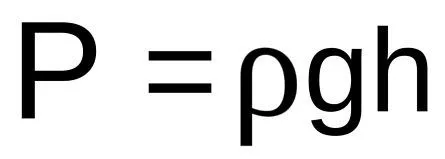 where P is the (gauge) pressure, ρ (pronounced “rho”) is the density of the fluid (water), g is the acceleration due to gravity, and h is the height, or depth, of the liquid (the water level in the tub). Strictly speaking, the total pressure at depth h is the atmospheric pressure pushing down on the surface plus this ρgh term (P = P0 + ρgh); the ρgh part is the bit that actually changes as the water gets deeper.
As you can see in the equation above, the pressure at a given depth grows in direct proportion to that depth, h. So the deeper you go in a body of water (in this case, the water in the tub), the more pressure there is bearing down at that point.
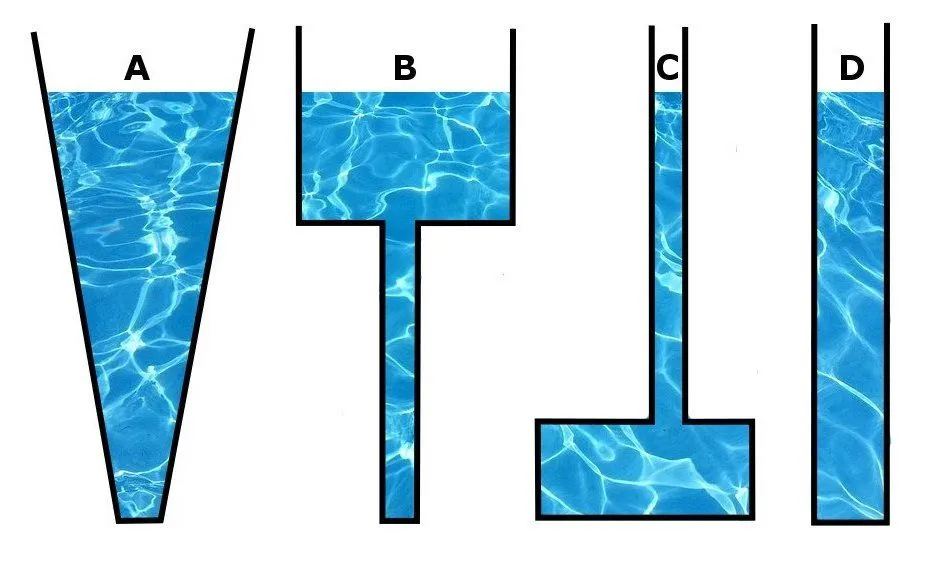
Furthermore, hydrostatic pressure at a given height doesn’t depend on the shape of the container enclosing the liquid; only the depth influences the pressure. (Source)
You might already know that under standard conditions, more height translates to more velocity of ejection for a liquid. Consider a water filter, for example. You have surely noticed that when it’s full, water comes out with maximum speed from the tap.
Also, have you ever wondered why they always put a tap near the base of a filter, or any fluid container, for that matter? What’s wrong with installing it somewhere near the top? Wouldn’t it be more convenient up there (for a person of normal height) than stooping to fill your mug?
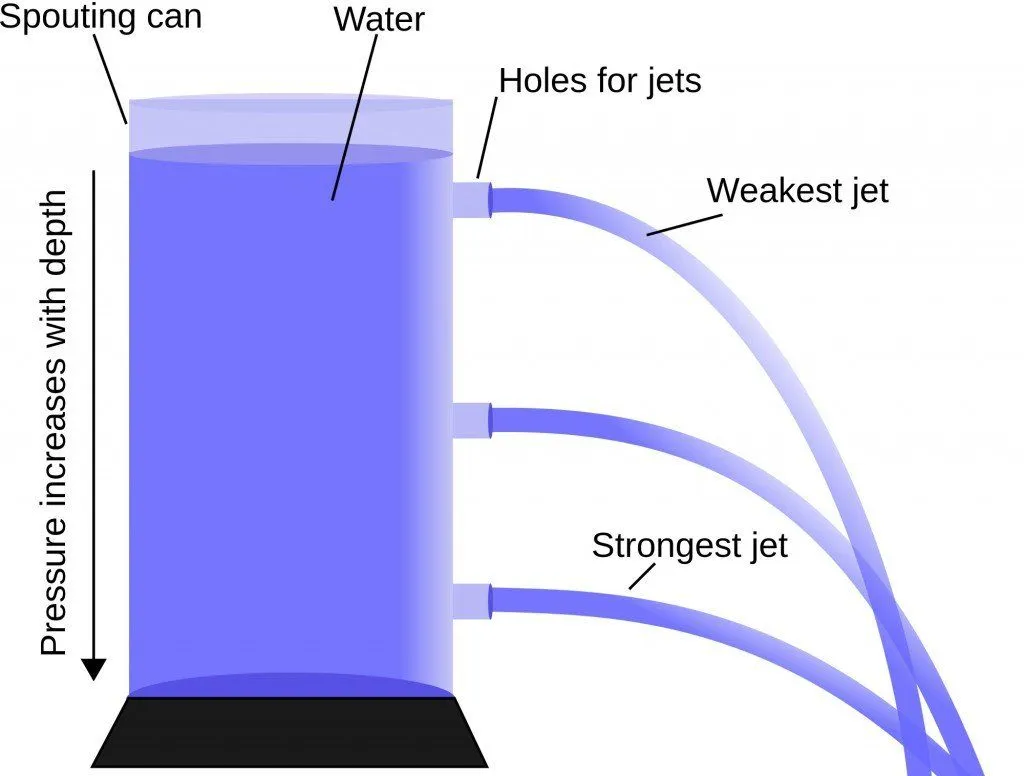
This is true for the same reason again… more height means more pressure, and more pressure means a faster jet of escaping liquid. There’s even a tidy equation for it, called Torricelli’s law: the speed at which water shoots out of the hole is v = √(2gh), where h is the height of water sitting above the opening. Notice that h again: raise the water level and the drain speed climbs with it. Lift the level from 25 cm to 30 cm (about 10 to 12 in) above the plughole, for example, and the exit speed rises from roughly 2.2 m/s to 2.4 m/s (a little over 5 mph), so the tub keeps draining briskly for longer.
So, how can you personally increase the height or level of water present inside the tub – by being inside it or stepping out?
Answer: You should remain inside the tub.

This is because your body displaces some of the water from its original position (Archimedes’ principle in action), so that water has to accommodate itself wherever it finds space, nudging up the water level of the tub in the process. The higher level means a bit more pressure at the plughole, and so the water leaves faster than it would if you climbed out first. Granted, the head start is small and it shrinks as the tub empties, but while there’s a decent depth of water left, staying put genuinely wins the race.
The case of bathtubs aside, this basic relationship between height and pressure can help you in many other situations too. Whenever you want to empty/drain a container filled with water quickly, no matter how small or large, just figure out a way to increase the water level by some means and you’ll be done a lot faster.
What Does The P = ρgh Formula Actually Mean?
Plenty of people arrive here typing “rho g h” or “p = ρgh” into a search bar, so let’s slow down and pull the equation apart, one letter at a time. It looks intimidating, but every symbol is doing an honest, intuitive job.

- P is the pressure the fluid exerts at the depth you care about. In the metric system it comes out in pascals (Pa), and one pascal is just one newton of force spread over one square meter (1 Pa = 1 N/m2).
- ρ (the Greek letter rho) is the density of the fluid, measured in kilograms per cubic meter. For fresh water that number is almost exactly 1,000 kg/m3.
- g is the acceleration due to gravity, about 9.81 m/s2 at the surface of the Earth.
- h is the depth, the vertical distance from the surface of the water down to the point you’re measuring, in meters.
Multiply those three together and you have the pressure. Say the water in your tub stands 30 cm (about 12 in) deep above the plughole. Then P = ρgh = 1,000 × 9.81 × 0.30 ≈ 2,940 Pa, which is roughly 2.94 kilopascals, or about 0.43 psi of extra push at the drain. Drop that depth to 25 cm (10 in) and the figure falls to about 2,450 Pa. Less water on top, less pressure below: that is the whole story of the bathtub in one line. One thing worth noting is that this ρgh value is the gauge pressure, the pressure on top of the air already pressing down on the surface. The full pressure is P = P0 + ρgh, but since the atmosphere bears down on the plughole and on the water equally, it is the ρgh part that decides how fast your tub drains.
How Many Gallons Of Water Does A Bathtub Hold?
If P = ρgh tells you how hard the water pushes, the next obvious question is how much water there is to push out in the first place. According to the U.S. Geological Survey, a full tub varies from home to home, but 36 gallons (about 136 liters) is a good average amount for a single bath. A standard alcove tub is roughly 150 cm (60 in) long and holds something in the neighborhood of 40 to 60 gallons (150 to 230 liters) when filled toward the overflow, while a deep soaking or freestanding tub can swallow well over 80 gallons (300 liters).
Two caveats keep the real number lower than the brochure figure. First, you almost never fill a tub to the brim; the overflow drain caps the level several inches below the rim. Second, and more fun for our purposes, the moment you climb in your body shoves water aside (that’s Archimedes’ principle again), so the water you actually heated is less than the marked capacity. The upside is that the same displacement is exactly what nudges the level up and helps the tub drain a touch faster while you’re still sitting in it.
How Long Does It Actually Take A Bathtub To Drain?
Here is the slightly frustrating part: a tub does not drain at a steady pace. It starts fast and finishes slow, and the physics already on this page tells you exactly why.

Torricelli’s law says the exit speed is v = √(2gh). As the tub empties, h shrinks, so the jet through the plughole slows down, and the last few centimeters always feel like they take forever. For a simple straight-sided tank, the total drain time works out to roughly T = (A/a)√(2H/g), where A is the surface area of the water, a is the area of the drain opening, H is the starting depth, and g is gravity. The depth itself falls along a tidy curve, h(t) = H(1 − t/T)2, which is why the level drops quickly at first and then crawls. The lesson is plain: a bigger drain hole (large a) empties the tub far faster than a deeper starting level does, because a sits in the denominator while H only enters under a square root.
Real plumbing drains a bit slower than that ideal predicts. As the water squeezes through a sharp-edged opening, the jet pinches inward to a narrower stream called the vena contracta, so the effective hole is smaller than the physical one. For a plain round hole, that discharge coefficient is only about 0.65, meaning a real tub drains at roughly two-thirds of the textbook speed. And if your tub stubbornly won’t drain at all, the culprit is almost never the physics; it’s a clog of hair and soap scum throttling a down toward zero, at which point even a meter of water on top can’t force its way through.
References (click to expand)
- Applications of Hydrostatics. The Pennsylvania State University
- Torricelli’s law. Encyclopaedia Britannica
- Static Fluid Pressure - Hyperphysics. Georgia State University
- Fluids, Density, and Pressure. University Physics Volume 1. OpenStax
- Torricelli’s law. Wikipedia
- Per capita water use. USGS Water Science School