Table of Contents (click to expand)
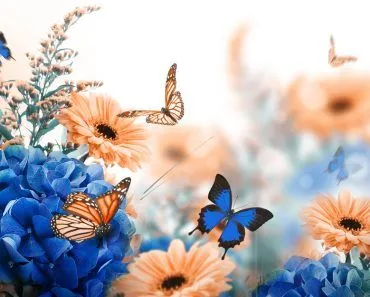
Butterflies are so colorful because of two sources: pigments and iridescence. Pigments such as melanin (black and brown) and pterins (yellow, orange and red) produce fixed color. Iridescence comes from light bouncing through the wing's microscopic, nanostructured scales, so the color shifts with viewing angle. Together they create the brilliant, sometimes shimmering hues we see.
When many people think of a garden or a park, part of the image in their head will surely be butterflies flitting from one plant to another. The main reason that everyone is so fond of butterflies is because of the brilliant colors of their wings.
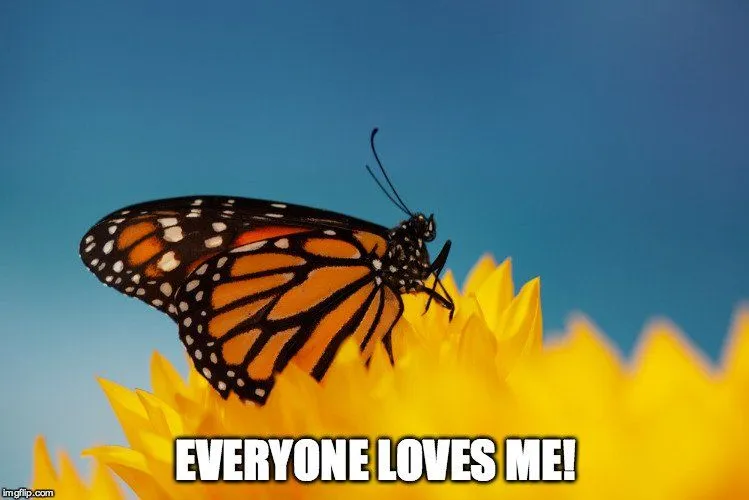
How exactly do butterflies manage to do this? Let’s explore the two main qualities a butterfly wing possesses that give it such a striking color.
Pigmentation
One of the sources of those amazing colors on a butterfly wing is pigmentation.
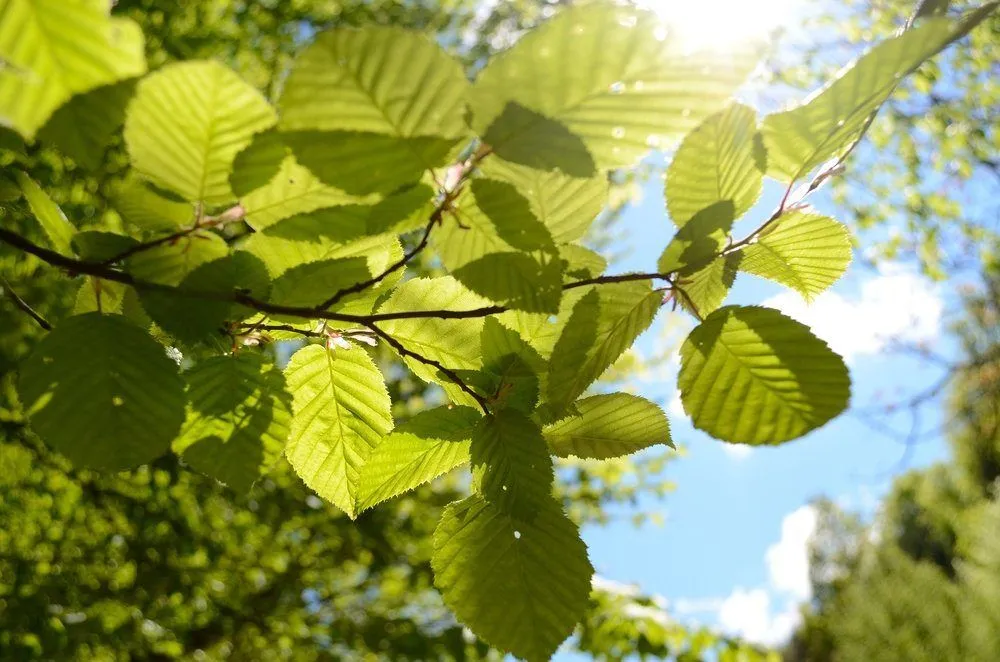
This pigmentation is responsible for ordinary color. What do we mean by ordinary color? Basically, it means color that is unchanging, regardless of how you look at it. For example, the color of plant leaves is green, due to the pigment chlorophyll. This perception of ours of the leaves being green is because chlorophyll absorbs the light of every other wavelength, except green. This is why we see the color green, since it is reflected back towards us. This color is going to remain green regardless of the angle at which you look at the leaves.
The same principle applies to butterfly wings, as they too contain coloring pigments. Melanin gives them their darker shades of brown and black, while a separate family of pigments called pterins is responsible for many of the yellows, oranges and reds. Melanin is the same coloring pigment present in human skin, which also gives our skin its distinctive color. See, butterflies and humans aren’t that different after all!
Iridescence
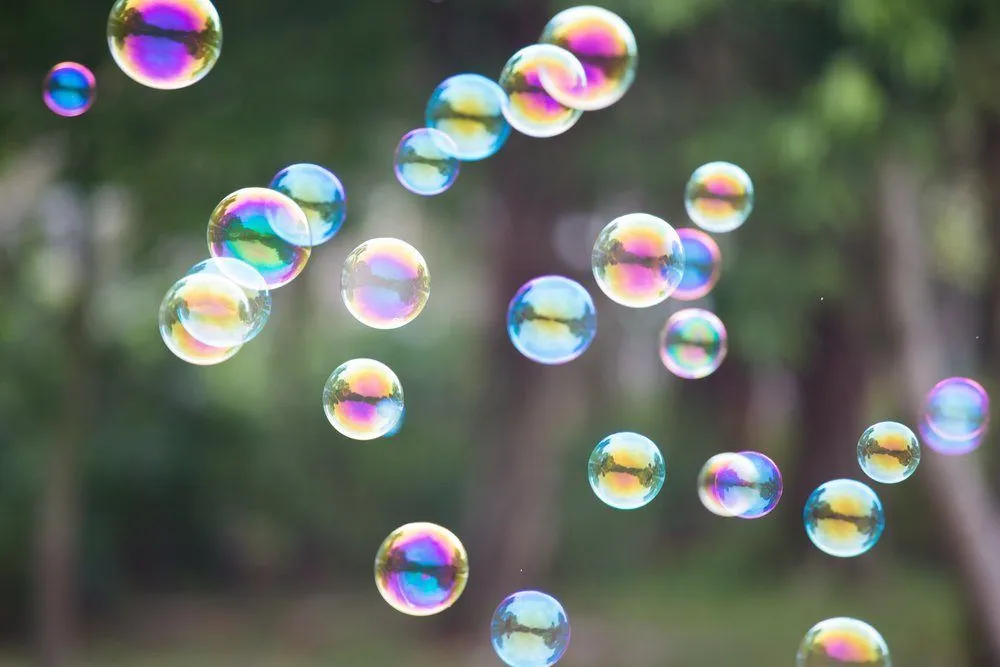
This is where the color of butterfly wings gets a bit more complex. The second source of their color is a fascinating phenomenon known as iridescence. In terms of iridescence, as you change your position with respect to the object, the color of the object also changes! Why does this happen, you may ask? Well, this occurs when light strikes a surface built from many ultra-thin transparent layers, stacked with spacings close to the wavelength of light itself. The light reflects off each layer, and these reflected waves interfere with one another to reinforce some colors and cancel others, with the result changing depending on the angle at which you look at it. A great example of this phenomenon can be seen in soap bubbles.
Butterfly wings are actually covered in thousands of tiny scales, and each scale carries microscopic ridges and layers, built from the protein chitin and separated by thin gaps of air. Therefore, depending on their exact structure, the wings will give off different colors of varying intensities. When light hits a butterfly wing, it reflects off these many nanoscale layers, and the combination of all these reflections gives the butterfly’s wings their iridescent color. The dazzling blue of the Morpho butterfly is one of the most famous examples, and it comes entirely from structure rather than any blue pigment.
The most interesting aspect of a butterfly’s color, however, is when the two aspects of pigmentation and iridescence combine to create a unique color. A classic example is a butterfly whose scales hold a yellow pigment but are also structured to reflect blue light; the two blend and you see a green butterfly! This color may even shift as the butterfly moves its wings (due to the iridescence, of course), flickering through greens, blues and everything in between.
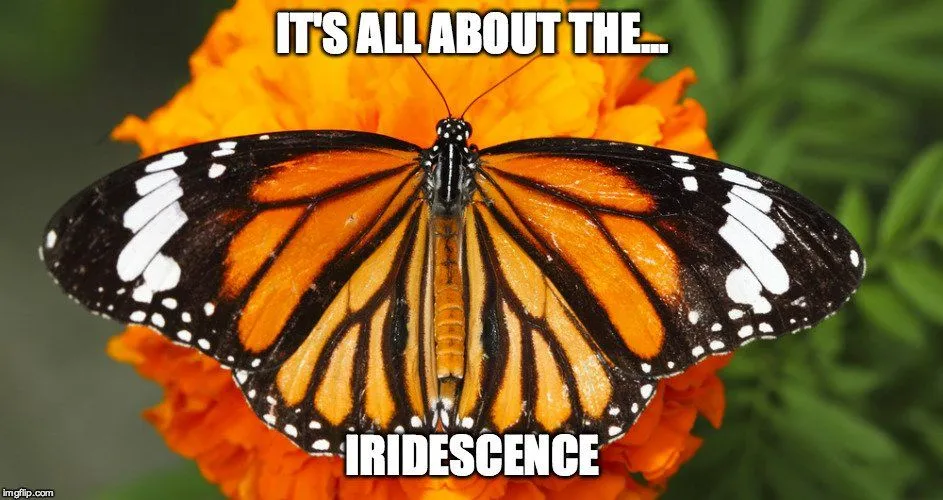
The colors of a butterfly’s wings are, without doubt, nature at its aesthetic best.
Why Did Butterflies Evolve Such Colorful Wings?
So far we’ve talked about how butterflies make their colors. But there’s a deeper question: why would an insect bother to be so flashy in the first place? Bright wings make a butterfly easy to spot, and that seems like a terrible idea when hungry birds are around. As it turns out, those colors are doing several jobs at once, and they have been shaped over millions of years by natural selection.

The most famous reason is a warning. Many brightly colored butterflies are genuinely nasty to eat, and the bold colors are basically a "do not eat" sign. This is called aposematism, or warning coloration. The classic example is the orange-and-black monarch: as a caterpillar it feeds on milkweed and stores up bitter, heart-affecting toxins (cardenolides) that stay with it into adulthood. A bird that bites a monarch and feels sick quickly learns to associate that color pattern with a bad meal, and it leaves monarchs alone afterwards. Studies on warning-colored butterflies show that models painted yellow or red are attacked far less often than dull-colored ones, because those high-contrast colors stand out against green leaves and are easy for predators to remember.
Color also lets harmless butterflies cheat the system through mimicry. The viceroy butterfly looks strikingly like the toxic monarch, so predators that have learned to avoid monarchs steer clear of viceroys too. Not every butterfly shouts for attention, though. Many use color for the opposite reason, camouflage, with the undersides of their wings patterned to look like dead leaves or bark so they vanish when resting. Some go a step further and carry eyespots, large eye-like markings near the wing edge that either startle a predator into hesitating or draw a peck toward the expendable wing tip instead of the body. Finally, color is a way to attract a mate: a male butterfly’s wing pattern (including parts we humans can barely see) advertises his species and his quality to females. So the same wing can warn an enemy, fool a predator, hide its owner, or charm a partner, depending on who is looking.
Can Butterflies See The Colors On Their Own Wings?
Here’s a question people often ask: if butterfly wings are so beautiful, can the butterfly actually appreciate its own colors? The short answer is that a butterfly can certainly see colors, and in some ways it sees a richer world of color than we do, though it can’t exactly admire itself in a mirror.

Humans have three types of color-sensing cells, or photoreceptors, tuned to red, green and blue, which makes us trichromats. Many butterflies have a similar three-channel system, but it is shifted so they can also see ultraviolet (UV) light, a part of the spectrum that is completely invisible to us. Some butterflies go much further. The Japanese yellow swallowtail (Papilio xuthus), a close relative of the swallowtail shown above, has an eye with eight different kinds of spectral receptors covering ultraviolet, violet, blue, green and red. Even with all of that machinery, its actual color vision is tetrachromatic, meaning it builds color from four channels rather than our three, and it can tell apart wavelengths just a nanometer or two apart, a feat that rivals the human eye.
This matters for the wings themselves. Many butterflies have patches that reflect UV light (much like the hidden UV patterns that help make flowers so colorful to a bee), and to another butterfly those patches glow in a color we simply cannot perceive. Males and females use these hidden UV signals to recognize their own species and to size up potential mates, which is why two butterflies that look identical to us may look obviously different to each other. So while a butterfly isn’t sitting around admiring its own wings, its eyes are very much built to read the colorful, UV-rich wings of every other butterfly it meets.
References (click to expand)
- Structural coloration - Wikipedia. Wikipedia
- Why Do Butterflies Have Such Vibrant Colors and Patterns? - news.nationalgeographic.com
- Coloration principles of nymphaline butterflies - thin films, melanin, ommochromes and wing scale stacking. Journal of Experimental Biology
- Brilliant iridescence of Morpho butterfly wing scales is due to both a thin film lower lamina and a multilayered upper lamina. Journal of Comparative Physiology A (NCBI PMC)
- Aposematism: Nature's Warning Signals Explained. American Museum of Natural History
- Yellow and the Novel Aposematic Signal, Red, Protect Delias Butterflies from Predators. PLOS ONE
- Monarch butterfly - Wikipedia. Wikipedia
- Tetrachromacy in a butterfly that has eight varieties of spectral receptors. Proceedings of the Royal Society B (NCBI PMC)
- Visible beyond Violet: How Butterflies Manage Ultraviolet. Insects (NCBI PMC)