Table of Contents (click to expand)
- Plants Have Many Colored Pigments
- Why Do Different Plants Have Different Shades Of Green?
- The Habitat Influences The Color Of A Plant
- Age Of The Leaf Influences Its Green Color
- Deficiencies In Plants Influences The Green Color
- Why Don’t Plants Just Absorb Green Light Too?
- Where Do The Hidden Reds And Yellows Go?
Plants have different shades of green because of different amounts of chlorophyll in their leaves as well as different combinations of other pigments.
Take an adventure out in nature and you’ll find an artist’s palette laid at your fingertips. The gorgeous hues of pink and purple flowers, the firm and reliable colors of browns in the tree bark, and the canopy of green in the leaves rustling in the wind. Within the world of greens, there are so many varieties, fern green, myrtle green, pine green, not to mention mint green, lime green, and avocado green. Teal, olive and dark moss green are just a few more.
Within this wondrous diversity of greens lies a fantastic molecular secret that sustains all life on our planet.
Plants Have Many Colored Pigments
In biology, color comes from complex organic pigment macromolecules. The green that colors a tree’s leaves is the result of chlorophyll. That word finds its roots in the Greek words chloros (“green”) and phyllon (“leaf”). Sitting within the cells of leaves is an organelle called the chloroplast, with the job of harvesting the sun’s energy. The energy it collects is used by plants to make its food through a process with which we’re all familiar: photosynthesis. It gets its green color from the kind of light it traps energy from.
All pigments get their color by reflecting and absorbing certain wavelengths in natural light. Chlorophyll appears green, since it strongly absorbs wavelengths from the blue and red regions of the electromagnetic spectrum, while reflecting wavelengths from the green, yellow and orange spectrum in varying degrees.
Chlorophyll’s green color can be explained through its molecular structure. Chlorophyll is made of a planar porphyrin ring with a magnesium bonded (coordinately) to the four nitrogen atoms in the porphyrin ring. Attached to the porphyrin ring are different organic moieties. This structure is the reason for its strong absorbance of light in the visible region. The porphyrin ring, along with the coordinate bond with metal ions, makes porphyrin offer a vast range of colors, from the red of heme in hemoglobin (with iron at its core, rather than magnesium) to the greens we seen in chlorophyll.
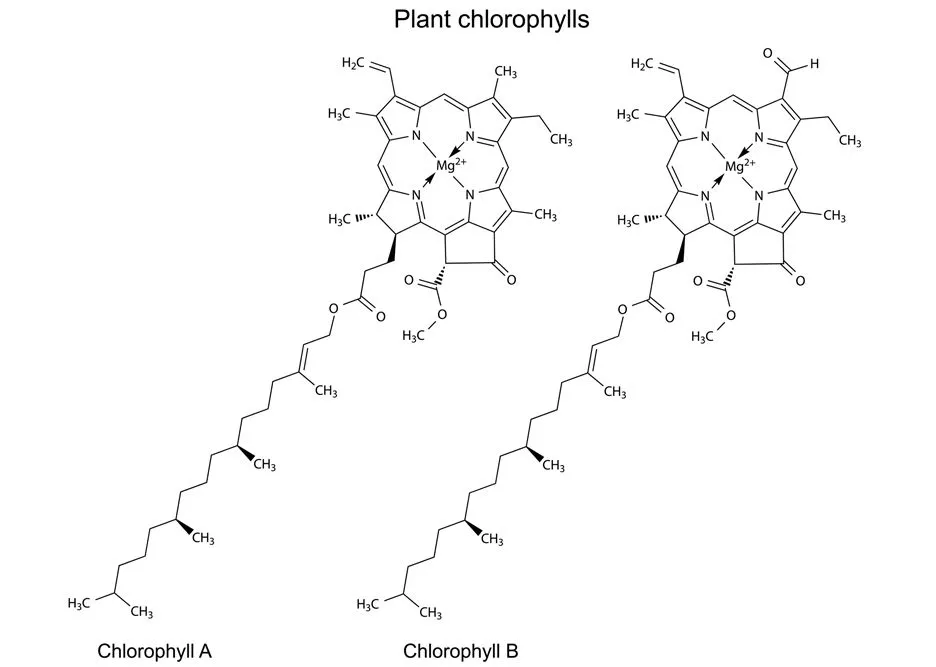
These absorption and reflection differences arise from structural and molecular differences in the chlorophyll molecules. These differences have thus far given us six broad categories of chlorophyll: a, b, c1, c2, d, f. Plants mostly have only two types of Chlorophyll in them: “a” and “b”. Chlorophyll a is teal-green in color, whereas Chlorophyll b is yellow-green in color. A combination of these two types of chlorophyll makes them into a shade of green.
Why Do Different Plants Have Different Shades Of Green?
However, these aren’t the only light-harvesting pigments present in leaves. To a much lesser degree, pigments that color orange, red, and yellow are also present in leaves, but they play a secondary role to chlorophyll. Carotenoids and xanthophyll are only two others of the numerous pigments within leaves that capture the energy of the sun. Carotenoids give vibrant orange and yellow hues. They are the pigments that give carrots their iconic orange. Xanthophylls are the reason sunflowers have such sunny yellow petals, as well as reds and oranges of various other fruits and vegetables.
The different concentrations of these pigment will dictate the color of green in the plants around us. The different types and amounts of pigment in different species of plant can reflect their evolutionary roots and reveal information about the plant’s habitat, its nutritional status and needs, and its age.
The Habitat Influences The Color Of A Plant
It’s all about survival. Where a plant grows and thrives can indicate a lot about its photosynthetic pigment concentrations. There are several factors that play a role here.
Light, its intensity and quality, are factors that affect the concentration of different chlorophylls, especially the ratio of chlorophyll a to chlorophyll b.
Plants that get abundant sunlight have less overall chlorophyll concentration and higher amounts of chlorophyll a than chlorophyll b. Plants that grow under shade, like those in densely forested areas, have a high overall chlorophyll concentration, but have more chlorophyll b than chlorophyll a.
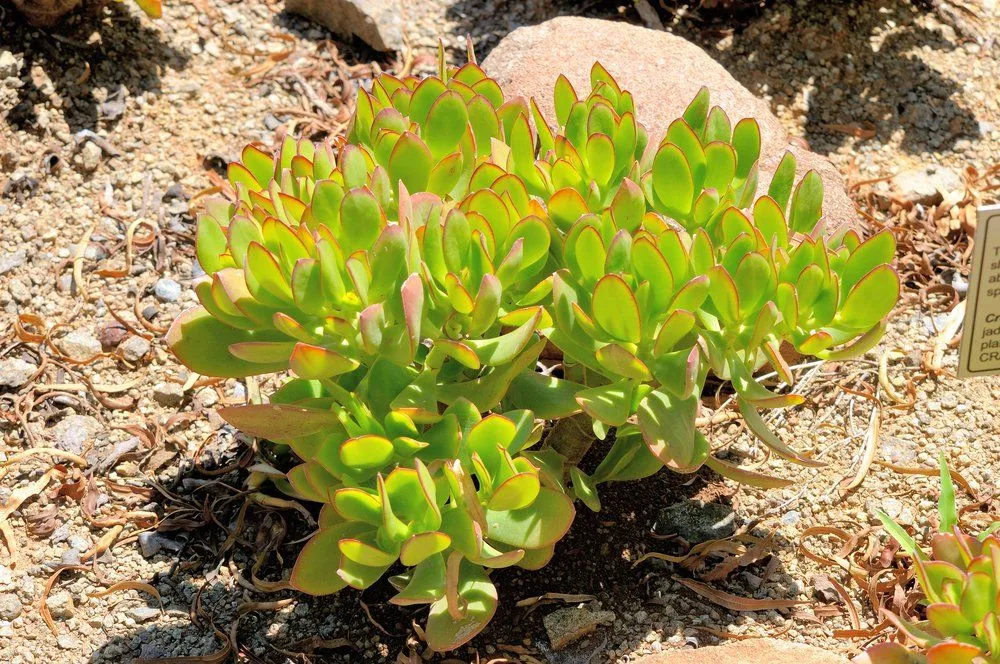
Chlorophylls are excellent light harvesters, but too much light can be a bad thing. In sun plants, the excess and intense sunlight can harm the chlorophyll in its leaves. With the abundance of sunlight, less chlorophyll is enough, and to protect the chlorophyll in the leaves, these plants often have red pigmented regions. These red pigments serve to shade the chlorophyll and allow them to regenerate and utilize the sun’s energy. (Source)
For shade plants, the sun’s rays are a coveted commodity. To use the little they get as efficiently as possible, they make their light-harvesting complexes—the protein structures within which the chlorophyll are present—significantly larger. This means they can have more chlorophyll b pigments to absorb light, yet the amount of chlorophyll a changes very little, since they are mainly present at the center of the LHCs, and since the number of LHCs do not change, their concentration doesn’t increase either. Increasing chlorophyll b is important, since light under shaded canopies is filtered, and there is less red light available, which is the wavelength at which chlorophyll a absorbs best. Chlorophyll b, on the other hand, absorbs light at blue wavelengths more efficiently.
Some plants have thin leaves, but some have very thick leaves. Thicker leaves are either juicy (called succulents, like a cactus or jade plant), or non-juicy with dense, leathery tissue (called sclerophyllous leaves, like those of Eucalyptus). Sclerophyllous leaves tend to look darker green because they have dense, tightly-packed chloroplasts that absorb sunlight efficiently and reflect very little. Succulent leaves tend to look lighter, as their cells are bulked up with water, so the concentration of chlorophyll near the surface is lower.
The upper part of a leaf is darker, owing to the high concentrations of chloroplasts present, as compared to the lighter bottom part.
Age Of The Leaf Influences Its Green Color
Young leaves have a lighter shade of green than mature, older leaves. Their chloroplasts are still developing and their chlorophyll content has not yet ramped up, so they can’t achieve photosynthesis as efficiently, both of which contribute to a lighter shade. As the leaves mature, they become darker green. Many leaves even turn yellow or orange before death, resulting in beautiful fall foliage in various parts of the world.
Deficiencies In Plants Influences The Green Color
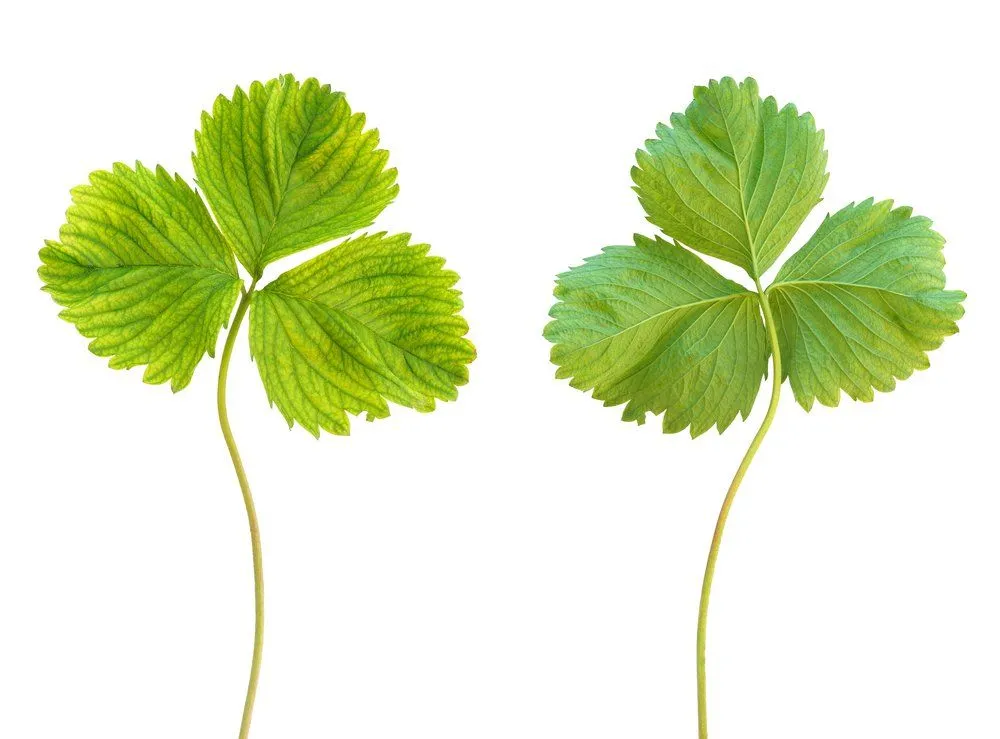
Yes, we are not alone in this… even plants get nutrient deficiencies! Nutrient deficiencies such as that of nitrogen, low magnesium and iron (also called Chlorosis) can make the plant go yellow or yellowish-green. This happens because these chemical components are necessary for making chlorophyll.
Why Don’t Plants Just Absorb Green Light Too?
Here’s a puzzle that bothered scientists for a long time. The sunlight reaching the ground is actually brightest in the green band of the spectrum, yet that is precisely the band a leaf throws away. Chlorophyll a and b drink up blue light (around 430–450 nm) and red light (around 640–660 nm) greedily, but they barely touch the green and yellow wavelengths in between (roughly 500–600 nm). This dip is nicknamed the “green gap”. Reflecting the most abundant light in the sky looks, at first glance, like a terrible design choice.

So why did evolution leave that energy on the table? A 2020 study published in the journal Science by Trevor Arp, Nathaniel Gabor and colleagues at the University of California, Riverside, working with Richard Cogdell at the University of Glasgow, offered an elegant answer: plants are not tuned for maximum energy, they are tuned for a steady energy supply. Their model showed that by absorbing at the steep red and blue edges of the solar spectrum rather than at its bright, flat green peak, the two chlorophylls smooth out the rapid flickers in sunlight that occur as clouds drift past and leaves shift in the wind.
That steadiness matters more than you might think. A sudden surge of captured energy can flood a cell with damaging reactive molecules, while a sudden dip can starve it. By reading light from the calmer edges of the spectrum, a leaf buffers itself against this “noise” and keeps its light-harvesting machinery running safely. In other words, looking green is simply the price plants happily pay for a reliable, self-protecting energy supply.
Where Do The Hidden Reds And Yellows Go?
We mentioned earlier that carotenoids and xanthophylls, the orange and yellow pigments, sit inside leaves right alongside chlorophyll. So why do we never notice them in a summer garden? The answer is sheer quantity. A healthy leaf pumps out so much chlorophyll that its strong green simply masks the weaker yellows and oranges underneath. The other pigments are present all season long; we just cannot see past the green.

This is exactly why a forest catches fire with color every autumn. As the days shorten and temperatures drop, a tree stops making fresh chlorophyll and the green pigment already in its leaves breaks down. With the green curtain pulled back, the carotenoids that were hiding all along finally show through as warm yellows and oranges. The deep reds and purples of some species are a slightly different story: those come largely from anthocyanins, pigments the leaf manufactures fresh in the autumn rather than ones it merely unmasks. Either way, the colors of fall are a neat reminder that green was only ever the loudest pigment in the leaf, never the only one.
Now that we know about the various shades of green in a garden, let’s play a game! You already know everything there is to know. Look around you and observe as many leaves as you can and start categorizing those plants according to their age!
References (click to expand)
- Leaf Pigments. Harvard Forest, Harvard University
- Leaf Color Change in Autumn. University of Wisconsin Horticulture Extension
- Rodríguez-Castañeda, G. (2012, October 16). The world and its shades of green: a meta-analysis on trophic cascades across temperature and precipitation gradients. (M. Sykes, Ed.), Global Ecology and Biogeography. Wiley.
- Daughtry, C. (2000, November). Estimating Corn Leaf Chlorophyll Concentration from Leaf and Canopy Reflectance. Remote Sensing of Environment. Elsevier BV.
- Ruban, A. V. (2009, January). Plants in light. Communicative & Integrative Biology. Informa UK Limited.
- Mathur, S., Jain, L., & Jajoo, A. (2018, March 1). Photosynthetic efficiency in sun and shade plants. Photosynthetica. Institute of Experimental Botany.
- Arp, T. B., et al. (2020, June 26). Quieting a noisy antenna reproduces photosynthetic light-harvesting spectra. Science, 368(6498), 1490-1495.
- Why Are Plants Green? To Reduce the Noise in Photosynthesis. Quanta Magazine.
- Chlorophylls and Carotenoids. Kimball’s Biology Pages, LibreTexts.