Table of Contents (click to expand)
Cutting an onion ruptures its cells, releasing the enzyme alliinase. A second enzyme then rearranges the products into a volatile gas, syn-propanethial-S-oxide. This gas drifts up and stimulates the sensory nerves in your cornea, which your brain reads as stinging. To wash the irritant away, your tear glands flood your eyes, so you cry.
One of the worst parts about cooking is being subjected to the torture of Chopping Onions. That’s right. I capitalized it for the emphasis that it deserves. One minor cut into that evil vegetable can send even the strongest and staunchest people into a steady stream of uncontrollable tears. No matter how hard you try to prevent it, the onions will always get to you.
The question is… what is it about onions that immediately launches the waterworks in your eyes?
What Happens Inside The Onion
The automatic reaction that our bodies experience in the face of cutting an onion might almost make you believe in nature’s ability to create sorcery. In a way, it’s true, except that this “sorcery” we’re talking about is just pure chemistry.
Onions are neatly packed little stink bombs from hell. Alone, onions appear to be harmless, innocent vegetables, but once you cut them open, that changes pretty quickly.
“See, the onion is a perennial bulb that lives in the ground with lots of critters who are looking for a snack,” says Eric Block, the chemist who has written the book Garlic And Other Alliums, “so it has evolved a chemical defense system.”
Basically, the onion really really wants you to stop slicing it up.
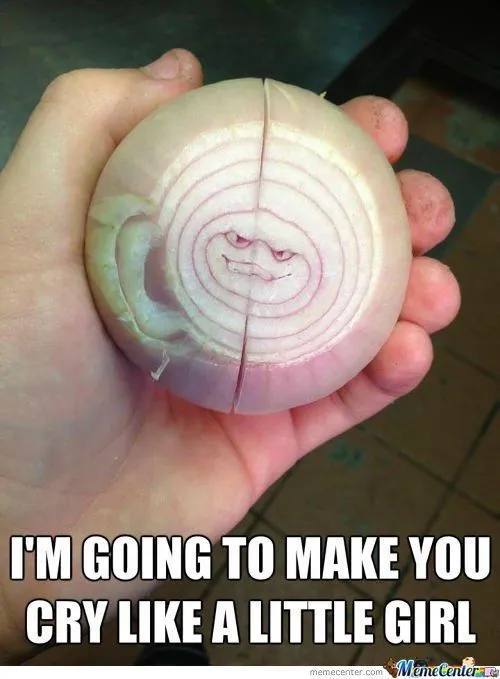
The layers of the onion are also not just an accidental design flaw. They are actually quite ingenious! Within each onion cell, there’s a tiny glob (a sealed vacuole) filled with an enzyme called alliinase. This enzyme is basically the fuel for any and all of the onion’s mischief.
When you cut or bite into an onion, you’re basically tearing these cells apart, and opening up those previously tightly sealed vacuoles. By doing this, the alliinase escapes its prison and is free to interact with the amino acid sulfoxides of the onion.
Separately, both chemicals (the enzyme and the amino acid sulfoxides) are pretty neutral. However, once combined, thanks to your brutal act of piercing the onion’s heart, they create sulfenic acid.
What Happens In Your Eyes
Sulfenic acid is a restless chemical that does not quietly concede to its new form. Because sulfenic acid is inherently unstable, many different chemical reactions occur in the onion within an instant. Finally, a second enzyme called lachrymatory factor synthase grabs hold of the sulfenic acid and rearranges it into syn-propanethial-S-oxide, the troublemaker behind your tears.

The molecules of syn-propanethial-S-oxide are volatile, so they waft up towards our unsuspecting eyes. (You may have read that they then react with the moisture in your eyes to brew up sulfuric acid. That is a popular story, but not quite what happens.) Instead, the gas settles on the cornea and directly tickles the free nerve endings there. These are the same sensory nerves that warn you about anything irritating, and they fire off a strong stinging signal to your brain.
The brain, reading this as a threat to your delicate cornea, signals the lacrimal gland to increase tear production. The industrious lacrimal gland upgrades the basal tears into reflex tears by stuffing them with antibodies, which fight any harmful incoming micro-organisms. The lacrimal gland typically ends up creating waaaaaay more tears than it needs to wash away the irritants.
Therefore, you’re left sobbing and sniffling and wondering if industrial-level safety eyewear might be worth investing in.

Does Every Onion Make You Cry?
Not equally, no. Some onions are far bigger crybabies than others, and it mostly comes down to two ingredients: how much sulfur the bulb soaked up from the soil, and how much lachrymatory factor synthase it carries. The pungent, eye-watering varieties (your everyday yellow and white storage onions) are loaded with both. The mild ones are not.

This is the whole secret behind sweet onions like Vidalia, Walla Walla and Maui. They are not a different species; they are ordinary onions grown in low-sulfur soil. With less sulfur in the ground, the bulb builds up fewer of the sulfur-rich precursor compounds that the enzymes later turn into the tear gas. According to the University of Georgia, sulfur is the single biggest influence on an onion's flavor, and onions grown over a sandy, low-sulfur profile come out noticeably milder than those grown where a clay layer traps sulfur near the roots.
Onion breeders even put a number on it. They measure the pyruvate released when a bulb is crushed (a stand-in for how much of that pungent chemistry fired off), and an onion has to score low on this pungency scale before it can legally be sold as "sweet". So if red onions, shallots or sweet varieties make you tear up less, you are not imagining it. And garlic? Garlic belongs to the same family and carries the alliinase enzyme, but it lacks lachrymatory factor synthase entirely, so it can never brew the syn-propanethial-S-oxide that an onion does. Chop a whole bulb of garlic and your eyes stay dry.
Why Do Raw Onions Burn Your Mouth?
The same chemical machinery that ambushes your eyes also goes after your mouth, just by a slightly different route. When you bite into a raw onion, you rupture exactly the same cells, and the alliinase enzyme meets the amino acid sulfoxides to spawn those unstable sulfenic acids. This time, though, they rearrange into a family of sharp sulfur compounds called thiosulfinates, the molecules responsible for the characteristic bite and pungency of a raw onion.

These compounds irritate the free nerve endings in your mouth and on your tongue, the same kind of warning sensors that flag the heat of a chili pepper. Your brain reads the chemical assault as a burning sting, which is why a raw onion can leave your mouth tingling for minutes. The most pungent yellow and white onions, packed with sulfur, deliver the strongest burn, while low-sulfur sweet onions feel gentle by comparison.
It also explains why cooking is such a reliable fix. Heat denatures the alliinase enzyme, so the burning thiosulfinates are never made in the first place. That is why a sauteed onion tastes mellow and sweet rather than sharp, and why those who love raw onion in a salad or sandwich are signing up for the full, undiluted experience.
Solutions?
Of course, the simplest solution to this problem is cooking the bulb. By heating an onion, you basically inactivate the alliinase enzyme. By debilitating the basic component of the chemical reaction, you successfully eliminate all chances of suffering an unprovoked emotional trauma.
There are, however, other ways to avoid these tears. You could choose a well-ventilated area for your battle against the onion. By dissipating the concentration of molecules of syn-propanethial-S-oxide, you lower the chances of it invading your optical territory.
Another creative solution is to refrigerate the onions before chopping them. Molecules tend to move faster when they’re hot, and slower when they’re cold. By freezing or chilling the onions before cutting them, you significantly slow down their propensity to form harmful chemicals!

Of course, you could also just suck it up and deal with this peculiar effect of onions. After all, what is pleasure without any pain?
References (click to expand)
- Why does chopping an onion make you cry?. The Library of Congress
- What is the chemical process that causes my eyes to tear when I peel an onion?. Scientific American
- Enzyme That Makes You Cry - Crystal Structure of Lachrymatory Factor Synthase from Allium cepa. ACS Chemical Biology (PMC, NCBI)
- Onions: Why do they make us cry? - Ask Dr. Universe. Washington State University
- How to Chop Onions Without Tears: 13 Steps (with Pictures). wikiHow
- Silencing Onion Lachrymatory Factor Synthase Causes a Significant Change in the Sulfur Secondary Metabolite Profile. Plant Physiology (Oxford Academic)
- Soil conditions, fertilizers affect the sweetness of Vidalia onions. University of Georgia (CAES)
- Why do onions make you cry?. National Capital Poison Center (Poison Control)