Table of Contents (click to expand)
There is no sharp physical edge between Earth's atmosphere and space, but the most widely cited boundary is the Kármán line, set at 100 km (62 miles) above mean sea level by the Fédération Aéronautique Internationale. NASA, the U.S. FAA, and the U.S. Air Force use a lower threshold of 80 km (50 miles), and astrophysicist Jonathan McDowell's 2018 reanalysis argues this lower line is the better physical match. Above either boundary, the atmosphere is too thin for ordinary aircraft to fly—you need rockets.
I recently watched a video that featured dozens of fighter jets engaged in a fierce dogfight (an aerial battle between fighter aircraft). The jets continued to climb through the bluish-white sky as they fired missiles at their opponents, but suddenly, the sky became pitch-black, indicating that they had entered ‘space’! Credit: Call of Duty: Infinity War (Official Trailer)
The second thing that I wondered while watching that transition (the first thing I thought was WHOA!) was whether aircraft could actually reach outer space if they continued going up? And how close/far is ‘space’ in the first place?
That answer depends entirely on what you call ‘space’; and yes, if you have a special aircraft that can manage to achieve such high speeds, you could actually reach space!
However, let’s tackle the most basic question first…
What Is ‘Space’?
That might seem like a dumb question at first, right? Space is where the rest of the solar system and the broader expanse of the universe is located. It’s where astronauts go, and it’s what you see at night when you look up at the sky. None of these definitions are incorrect, but they don’t do much to help define the boundary between our planet and the vacuum of space.
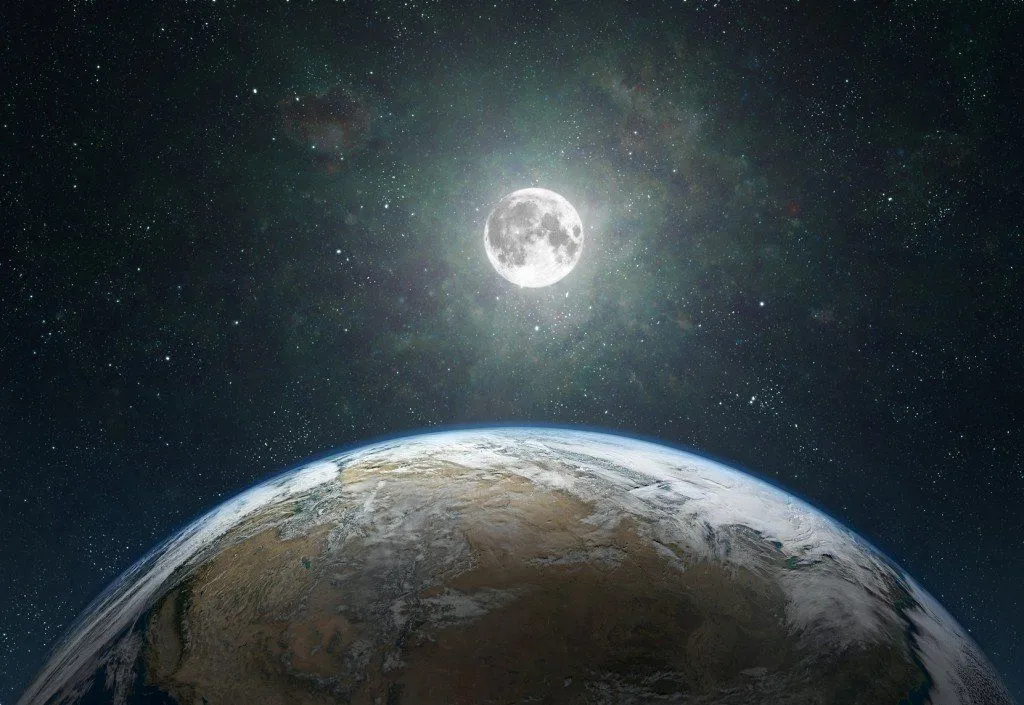
From the perspective of Earth, space is where the atmosphere becomes thin – even to the point of non-existence. This is obviously a very simplified and subjective definition of ‘space’, but for the scope of this article, it will suffice to understand the distinction between the Earth and space itself.
How High Is Space?
Many would answer this by saying that, ‘space starts where the atmosphere ends’. Although this is not incorrect, it doesn’t really answer the question, as it leads to an inevitably follow-up question (imagine having a really curious kid pulling at your sleeve): where does the atmosphere end?
Again, this is not an easy question to respond to, in that it doesn’t have a definite answer. You see, the atmosphere that covers our entire planet is not a single entity; instead, it is a collection of a number of gases and dust particles. This layer of gases continues to thin as you go higher up in the sky. This is why most commercial airplanes can’t fly beyond 28,000-35,000 feet above the ground.
Here’s a picture to visualize the situation a bit better:
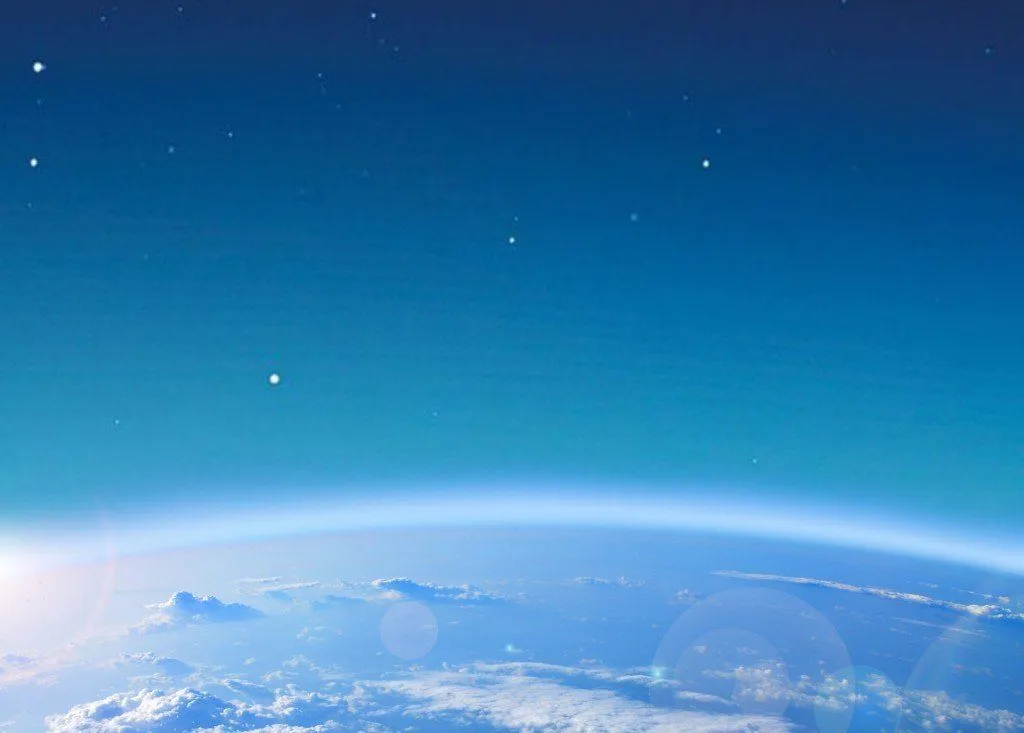
This is how the atmosphere looks. Now, can you pinpoint – with exact certainty – the altitude at which the atmosphere ends? Probably not, because as you can see, the atmosphere is a collection of progressively thinning layers of gases, rather than a well-defined entity, so it doesn’t have an exact boundary.
How High Do You Have To Go To Be In ‘Space’ Officially?
Although there is no definite boundary where space starts, there is a limit, and if you crossed it, you would have entered space… at least, officially. This boundary is known as the Karman line (also spelled Kármán line), which is often referred to as the ‘edge of space’.

The Karman Line is an imaginary boundary set at 100 kilometers (62 miles) above mean sea level by the Fédération Aéronautique Internationale (FAI), the international body that sets standards for astronautics and aeronautics. It owes its name to Theodore von Kármán—a Hungarian-American physicist who was the first to estimate the altitude at which the atmosphere became too thin to generate aerodynamic lift, so that any vehicle hoping to remain airborne above it must rely on rocket-style thrust rather than wings. NASA, the U.S. Federal Aviation Administration, and the U.S. Air Force, however, use a lower threshold of 80 km (50 miles). Astrophysicist Jonathan McDowell's 2018 reanalysis in Acta Astronautica argues that 80 km is actually closer to the physical boundary—the lowest altitude at which a satellite can complete an orbit without atmospheric drag pulling it back down—and the FAI itself has been weighing whether to adopt the lower number.
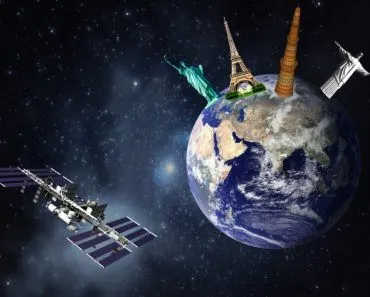
Note that the atmosphere still exists beyond the Kármán line; in fact, the exosphere extends much further than once thought—a 2019 reanalysis of SOHO satellite data showed Earth's geocoronal hydrogen reaches roughly 630,000 km from the surface, well past the Moon. From that perspective, the International Space Station, which orbits at around 400–420 kilometers above the Earth, is technically still inside the very outer fringes of our atmosphere.
So, it’s not that the atmosphere ends at the Karman line, it’s simply that at that altitude, it becomes too insignificant to support flights that rely on ‘air quality’. Here’s a fun fact: you don’t have to fly beyond the Karman line to officially be considered an ‘astronaut’; according to the US Air Force’s definition of an ‘astronaut’, all you have to do is fly more than 50 miles (80 km) above mean sea level to earn that title!