Table of Contents (click to expand)
- A Little Something About Atmospheric Pressure
- How Atmospheric Pressure Changes With Altitude
- What Does Atmospheric Pressure Have To Do With Temperature?
- Why Does The Sun Feel Stronger At High Altitudes If It’s So Cold?
- How Does Altitude Shape A Region’s Climate And Plant Life?
- What Does Thin, Cold Mountain Air Do To The Human Body?
High-altitude regions are cold for two reasons working together. First, the atmosphere is heated from below: sunlight passes through it and warms Earth’s surface, which then heats the air above it, so the lower air is always warmer than the air higher up. Second, when air rises into the lower-pressure regions of the troposphere it expands and cools adiabatically, doing work against its surroundings; temperature drops by roughly 6.5°C per kilometre of altitude (the environmental lapse rate). It has almost nothing to do with being “closer to the Sun.”
If you think about it, if you really step back and consider it logically, doesn’t it seem counter-intuitive that the higher up you go, the colder it gets? Shouldn’t it be the exact opposite? After all, by going towards high-altitude regions, you’re essentially moving closer to the Sun, i.e., reducing the distance between yourself and the Sun, even if it’s an incredibly minuscule amount. Going by this reasoning, one should feel hotter on hills and mountains, but as we all know, that doesn’t happen. Why is that?
In short, it’s because the atmosphere is heated mostly from below by Earth’s surface, and because rising air expands and cools as the surrounding pressure drops.
A Little Something About Atmospheric Pressure
To start with, you need to understand that the Sun is incredibly far from the Earth; so moving to higher altitudes makes no difference whatsoever in terms of the heat it provides. You would have to leave the planet altogether and continue moving much closer to our star to experience a noticeable change in the heat your skin experiences. Therefore, moving to mountainous regions doesn’t bring you a significant distance closer to the Sun, at least in terms of heat.
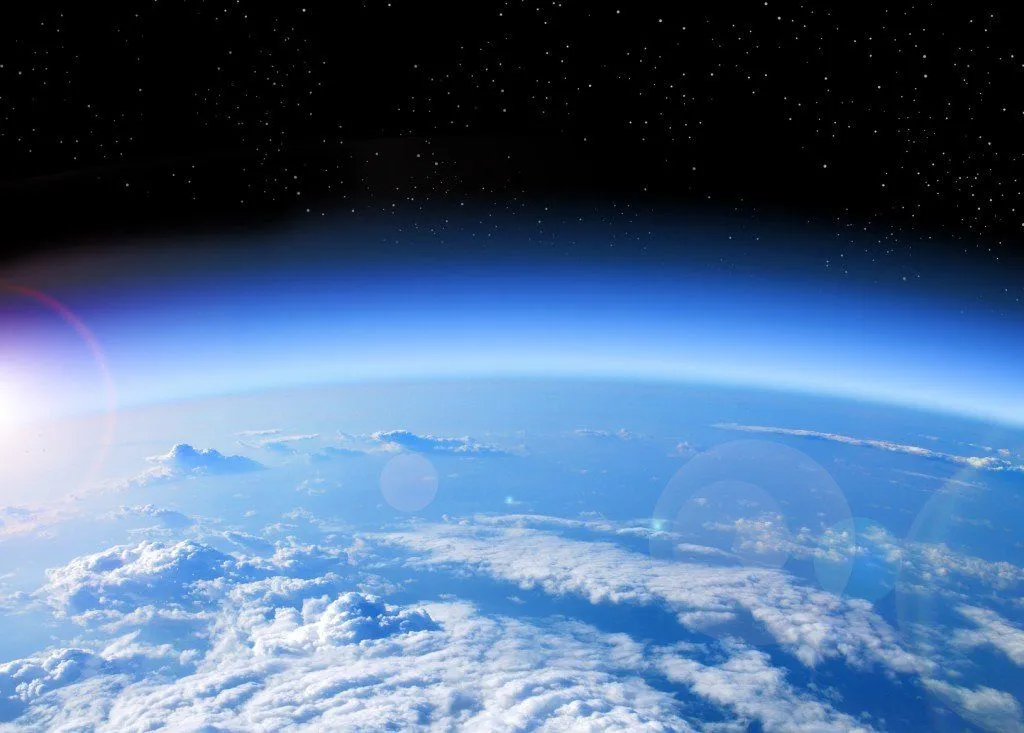
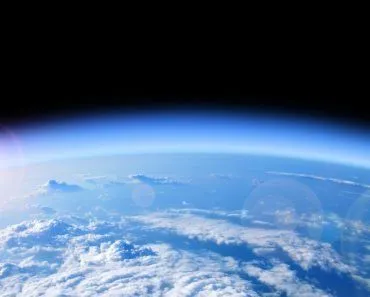
Now, let’s talk about the atmosphere. As you probably already know, it’s composed of a mixture of gases that envelops the Earth. Since the atmosphere envelops the Earth, i.e., it can be found practically everywhere on the planet, it also exerts a certain amount of pressure, which is known as the atmospheric pressure (sometimes also referred to as ‘barometric pressure’). To put it simply, just think of the atmosphere as a load that’s pushing down on the planet; the pressure with which it pushes down is what scientists call atmospheric pressure.
Now, let me tell you, this is no ordinary load; it’s a huge mixture of gases and dust particles that weighs a huge amount. It’s akin to holding a small car on top of your head at all times. In theory, humans, and almost everything on the planet should be crushed by the sheer weight of the atmosphere.
However, it’s quite interesting to note that the value of atmospheric pressure is not same everywhere – it changes with altitude. This is why a number of things happen – or don’t happen – at higher elevations.
How Atmospheric Pressure Changes With Altitude
As mentioned earlier, the atmosphere is simply a mixture of gases that hover above the Earth’s surface. At sea level, the value of the atmospheric pressure is 14.7 pounds per square inch (Source), but as you go up into higher altitude regions, it begins to decrease and becomes almost non-existent beyond a particular point.
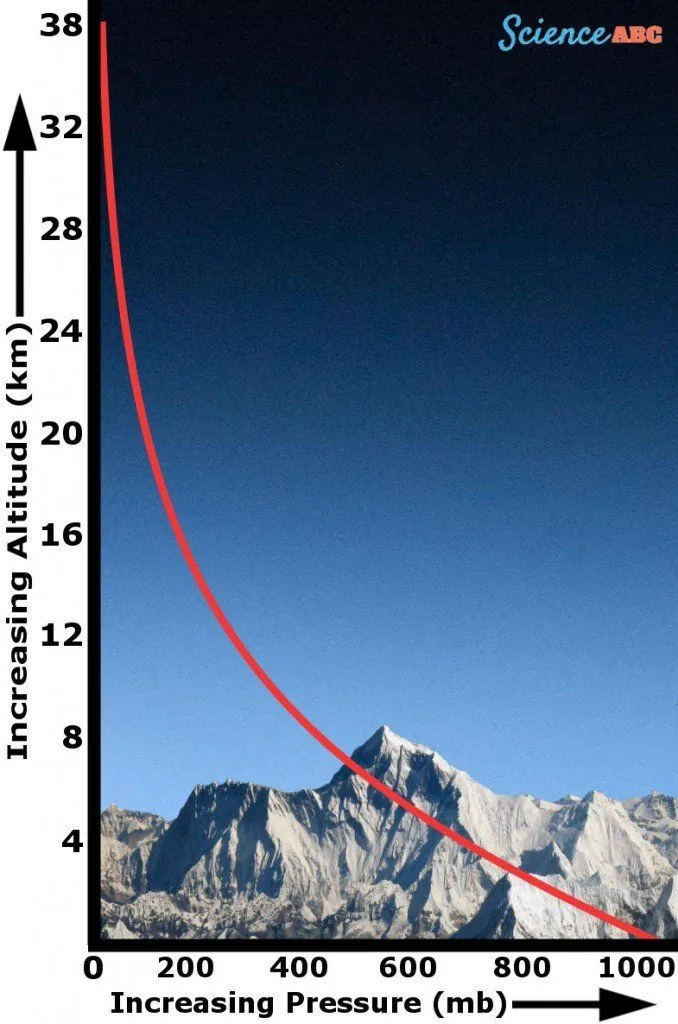
The atmospheric pressure has this trend due to the decreasing quantity of air molecules as the altitude increases. Consider it this way: the higher you go up, there are fewer and fewer molecules pushing down from above. This is why high-altitude regions experience a much lower atmospheric pressure than regions at sea level.
What Does Atmospheric Pressure Have To Do With Temperature?

Two things are going on. First, the atmosphere is heated mostly from below: sunlight passes through the largely transparent air, is absorbed by the land and oceans, and that warm surface then heats the air directly above it. So air closest to the ground starts out the warmest, and the further up you go, the further you get from that heat source.
Second, when a parcel of warm air at the surface rises, it moves into surroundings at lower pressure and therefore expands. Since the parcel doesn’t exchange heat with its environment quickly, this expansion is roughly adiabatic, and the gas has to do work pushing against its surroundings. That work comes out of its own internal energy, and so its temperature drops. In Earth’s lower atmosphere (the troposphere), this combination produces a fairly steady environmental lapse rate of about 6.5°C per kilometre: every kilometre you climb, the air gets about 6.5°C cooler on average.
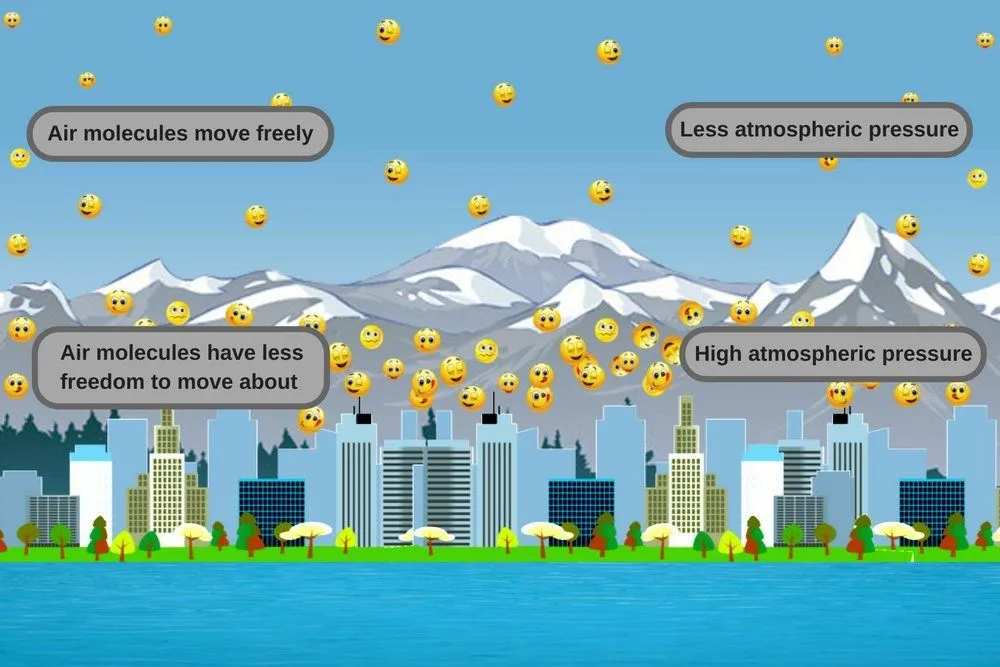
In contrast, in low-altitude regions, air pressure is high, so air molecules don’t have as much freedom to move about. Carrying a lot of energy, they collide with each other more frequently, which causes the temperature of the system to increase. This is why low-altitude areas are hotter than mountainous regions. This physical law applies everywhere, whether it’s a mountain range on the equator or in polar regions – regardless of its geographical location on the planet.
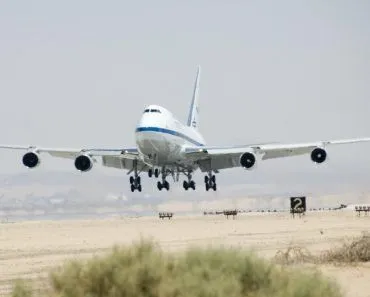
So, if you had any plans to ride in a soaring aircraft until you experience the soothing warmth of the sun, you should just forget that idea entirely, or else get ready to leave the planet and experience the not so pleasant consequences of interplanetary space!
Why Does The Sun Feel Stronger At High Altitudes If It’s So Cold?
Here’s a puzzle that trips up a lot of people. The air on a mountain is freezing, yet hikers and skiers often come back with raw, peeling sunburns far worse than anything they would pick up at the beach. If high places are so cold, why does the Sun seem to punish your skin up there? The trick is that “cold” and “sunny” are measuring two different things. Air temperature depends on the heating-from-below story we just walked through. The strength of the Sun on your skin, though, is mostly about ultraviolet (UV) radiation, and that behaves in the opposite way.

Remember that the atmosphere is thinner the higher you go. That same shrinking blanket of air that holds less warmth also filters out less UV. The atmosphere is what shields us from most of the Sun’s ultraviolet rays, so when there is less of it overhead, more of those rays reach your skin. According to the World Health Organization, UV levels rise by roughly 10% for every 1,000 metres (about 3,300 feet) of altitude. So a sunny ridge at 3,000 metres can hit you with around 30% more UV than the same sunshine at sea level.
Snow makes it worse. Fresh snow is a superb reflector and almost doubles a person’s UV exposure, bouncing as much as 80% of the ultraviolet that lands on it back up at you (it’s also why “snow blindness” is a real hazard for climbers). So the Sun isn’t actually warmer up there; it just delivers a stronger ultraviolet wallop because there is less air and more reflective snow. The cold air can even fool you into staying out longer, since you don’t feel yourself burning. The same physics is why you can get sunburnt in situations you’d never expect: it’s the UV, not the warmth, that does the damage.
How Does Altitude Shape A Region’s Climate And Plant Life?
That steady drop of about 6.5°C per kilometre doesn’t just make the summit chilly; it stacks entire climate zones on top of one another as you climb a single mountain. Geographers call this altitudinal zonation: because temperature falls so reliably with height, the band of life a slope can support changes the way it would if you travelled hundreds of kilometres toward the poles, except here it happens over a short, steep walk.

Start at the base and you typically find ordinary forest or farmland. Climb higher and the broadleaf trees give way to the hardy conifers of the montane forest. Higher still you reach the treeline, the altitude beyond which it is simply too cold for trees to grow. Right at this boundary the last survivors are stunted and wind-twisted, a growth form known by the German word krummholz (“crooked wood”). Above the treeline lies the alpine zone of grasses, sedges, mosses and cushion plants, and above that the bare rock and permanent snow of the nival zone.
This is also the plain-language answer to a question many people search for: why do places at high altitude have a cold climate, and why are tall peaks snow-capped even in midsummer? It is the lapse rate doing its work. The growing season shrinks and the average temperature falls with every kilometre of elevation, so a mountaintop near the equator can wear a glacier while the jungle bakes at its foot. The pattern holds whether the mountain sits in the tropics or near the poles; latitude only shifts where each band sits.
What Does Thin, Cold Mountain Air Do To The Human Body?
The same thinning air that keeps high places cold also makes them physically demanding for visitors. Because atmospheric pressure drops with altitude, the partial pressure of oxygen falls too. The air at altitude still contains about 21% oxygen, but each lungful packs fewer molecules into the same space, so your blood picks up less oxygen with every breath. This is called hypobaric hypoxia, and it is the root of the trouble climbers run into.

Push up too fast and you may develop acute mountain sickness (AMS). According to StatPearls (NCBI Bookshelf), AMS is uncommon below about 2,500 metres (roughly 8,200 feet) but becomes common above it, usually showing up within hours to a day or two of arriving high. The classic signs are a throbbing headache plus nausea, dizziness, fatigue and broken sleep, the body protesting that it isn’t getting the oxygen it’s used to. In serious cases the same low-oxygen stress can lead to dangerous fluid buildup in the lungs or brain.
The fix isn’t to fight the mountain but to give your body time to adjust. Within minutes of going high you start breathing faster, and over the following days your blood chemistry retunes to wring more oxygen out of the thin air, a process called acclimatization. That’s why guides preach a slow ascent, modest daily height gains and rest days. It also explains why high-altitude air feels so harsh: it is cold, dry, low in pressure and stingy with oxygen, all at once. If you’ve ever wondered how scientists figured out there’s no oxygen in space long before anyone went there, the thinning air of mountains was an early clue.
References (click to expand)
- Atmospheric pressure - Wikipedia. Wikipedia
- Why Is It Colder at the Top of a Mountain Than It Is at Sea Level?. HowStuffWorks
- pressure decreases with increasing altitude - WW2010. The University of Illinois Urbana-Champaign
- Change in the Atmosphere with Altitude. UCAR Center for Science Education
- Radiation: Ultraviolet (UV) radiation. World Health Organization
- Acute Mountain Sickness. StatPearls. NCBI Bookshelf