Table of Contents (click to expand)
- Low-altitude Flying: How Low Can Planes Really Fly?
- How Do Fighter Jets Fly So Close To The Ground?
- Risks Of Flying A Fighter Jet Close To The Ground
- Types Of Aircraft That Can Perform NOE Flights
- Do Radars Have A “Kill Zone” (Or Blind Spot)?
- How Does The B-2 (And Other Stealth Aircraft) Avoid Radar?
- End Note – Are Radars Getting Smarter?
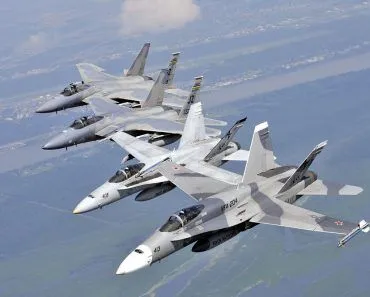
Military aircraft can fly at altitudes as low as 100 feet to avoid detection by surveillance systems and anti-aircraft establishments.
One of the common traits shared by the most formidable armies of the world is stealth. This figurative cloak of invisibility and the attached element of surprise gives them a considerable advantage over their nemesis. However, as is true with other things, smaller things are easily hidden, whereas larger things require more work.
If larger things are as large as military aircraft, then the task becomes even more difficult. While traceability is desirable for commercial aircraft, it can be dangerous for military craft. When technology and material engineering fail to come their assistance, pilots must rely on their skill alone.
Low-altitude Flying: How Low Can Planes Really Fly?
Top Gun: Maverick is a great representation of what goes into preparing for and flying extremely close to the ground. However, how close is close exactly?
Low-altitude Flying In Civil Aviation
In an industry where standard flying heights measure across several tens of thousands of feet, flying a couple hundred feet off the ground is definitely considered low-altitude flying.
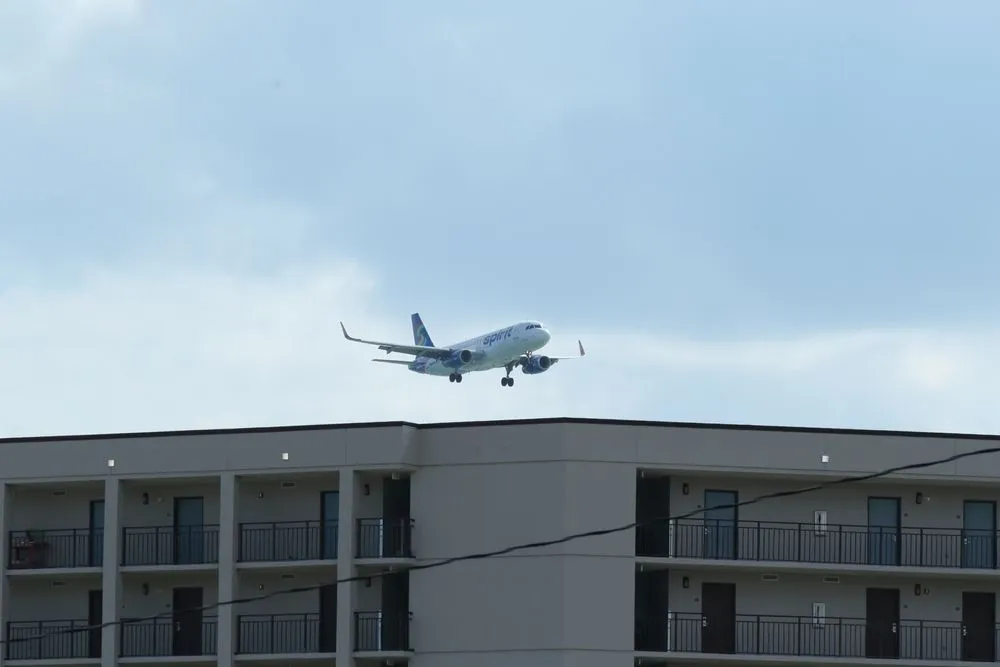
While the Federal Aviation administration, in its safety circular, mentions the lowest height to be no less than 500 feet in civilian areas, the US air force has aircraft capable of flying as low as 100 feet (Source).
Low-altitude Flying For Military Purposes
Low-altitude flying is no big deal; it is the ability to fly at low altitudes at high speeds that makes it risky.
Low-altitude, high-speed flights undertaken for military operations are also called Nap of the Earth (NOE) flights.
Modern war technology has resulted in the development of various anti-aircraft establishments that work in conjunction with radar and other surveillance units. These include surface to air missiles (SAMs), air/land-borne radars and anti-aircraft artillery, amongst others.
In NOE flights, military aircraft follow the contours of Earth’s terrain very closely, as opposed to flying over them. This presents them with the advantage of using fixed elements, such as hillocks, valleys, tall trees etc. as a ruse to escape the radar’s field of vision.
How Do Fighter Jets Fly So Close To The Ground?
In order to fly close to ground level, pilots spend countless hours practicing in regions similar to the actual zone of operation. To further assist pilots, their aircraft are outfitted with special radar systems called terrain-following radars (TFRs). TFRs are specially mounted pieces of equipment that plot the terrain ahead and calculate a flight path that enables pilots to maintain a constant altitude.
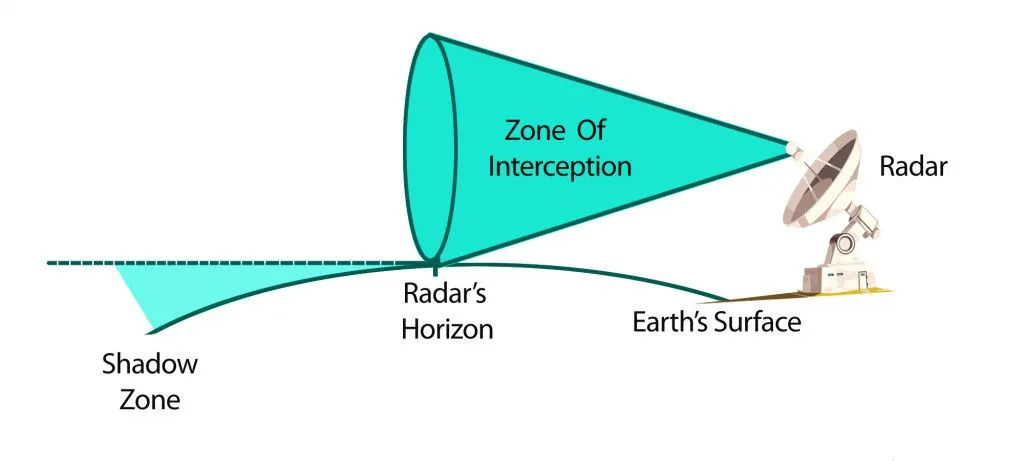
At the same time, pilots are trained to fly in regions below the enemy radar’s line of sight. This region, known as the shadow zone, is formed between the radar’s horizon and the earth’s curvature.
The radar's coverage forms a roughly conical volume above the antenna, detecting objects by bouncing radio and microwaves off them — but its lower edge is cut off by the Earth's curvature and any intervening terrain, defining what is known as the radar horizon.
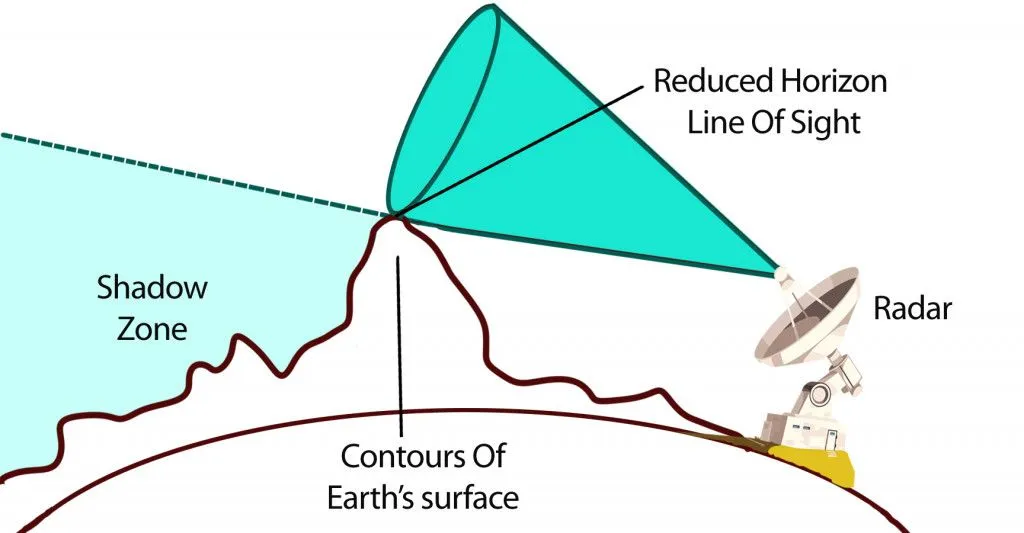
The lower limit of this horizon is determined by the highest obstacle present at ground level, as illustrated in the diagram. The field of view, which is already restricted by the earth’s curvature, is further restricted in the presence of contours. Consequently, radars situated in flat plains have a better field of view compared to those situated amongst mountains.
Risks Of Flying A Fighter Jet Close To The Ground
Unlike other modes of stealth flight, which are backed by technological witchcraft and material engineering wizardry, NOE flights are largely dependent on a pilot’s skill. The proximity to terrain at high speeds is the biggest risk, as the probability of collision increases significantly. At the same time, traversing through variable terrain exposes the pilot to extreme G forces, which can result in G-LOC (G-induced loss of consciousness).
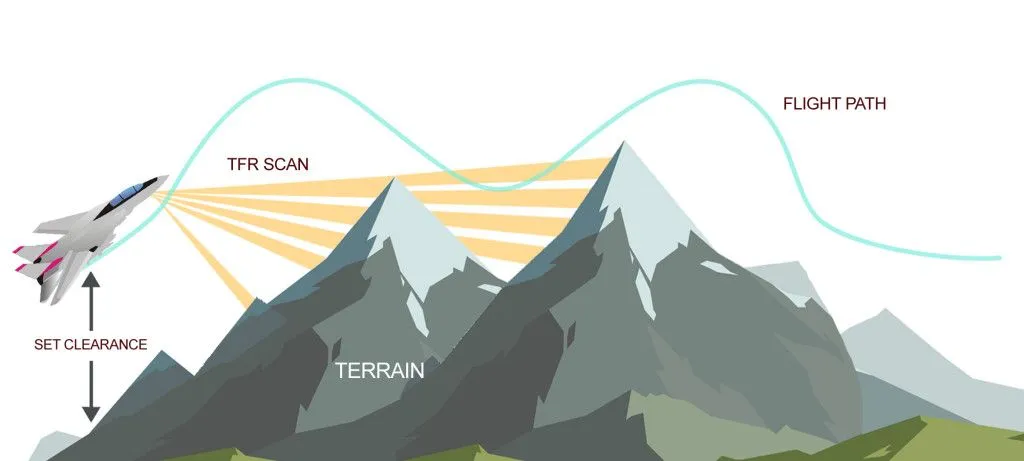
Low-flying aircraft also face the risk of the radio waves from their TFRs being intercepted by enemy radar, potentially exposing their positions. Apart from the terrain’s own elements, many manmade fixtures, such as cables and antennae, pose threats due to their lower visibility to unaided eyes.
Types Of Aircraft That Can Perform NOE Flights
Low-altitude flying can be achieved by both fixed-wing aircraft and helicopters alike. While helicopters cannot achieve speeds equal to that of the former, they are capable of keeping sustained flight at much lower heights. This makes them useful for extraction missions where armed personnel are involved in ground work.
A Famous Low-altitude Operation
It’s not often that we come across publicly disclosed operations where NOE flying came in handy. Amongst the most important military adventures embarked upon by American forces, Operation Neptune Spear was carried out by U.S. Navy SEALs on May 2, 2011 to neutralize Osama bin Laden at his compound in Abbottabad, Pakistan (Source).
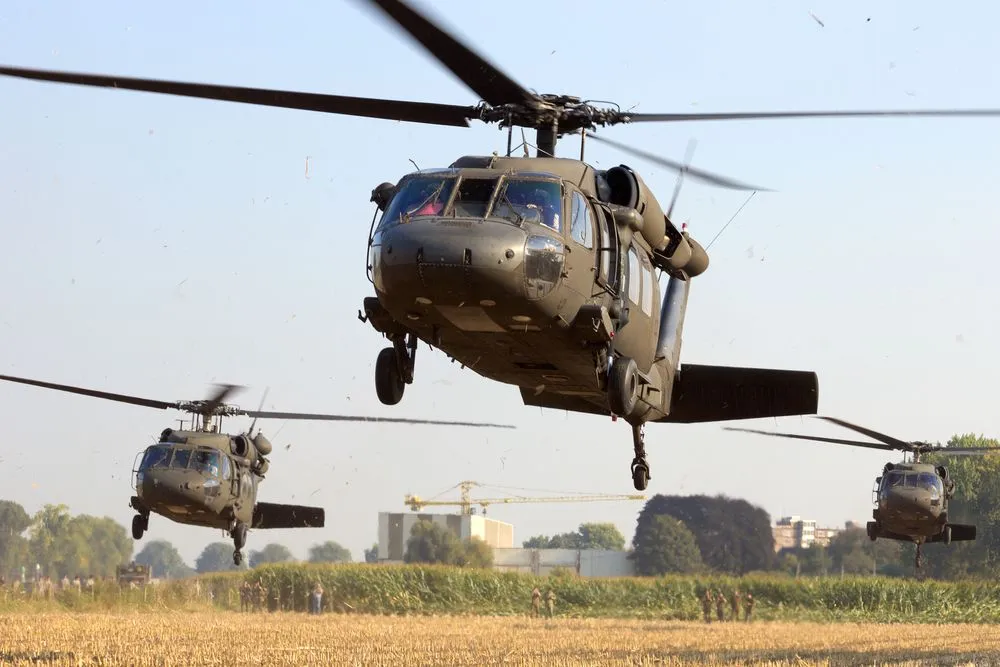
The feature of interest in this case was the use of two highly modified, stealth-coated MH-60 Black Hawk helicopters (built by Sikorsky), with edge-aligned panels, radar-absorbent treatments and a redesigned tail rotor for noise reduction. These aircraft were noted for their extremely low flying altitude and ability to avoid Pakistani air defence radar during the ingress. It remains one of the best-executed missions of its kind, despite one of the two Black Hawks suffering a hard landing inside the compound — the SEALs deliberately destroyed the wreck before exfiltrating on a backup MH-47 Chinook.
Do Radars Have A “Kill Zone” (Or Blind Spot)?
People often ask whether a radar has a “kill zone” around it. It is a slightly misleading phrase, because a ground radar does not kill anything; it simply tells the missiles and guns where to look. What readers are really asking about is the radar’s detection envelope, and that envelope has two well-known blind spots that low-flying pilots exploit.
An air-surveillance radar does not sweep a perfect dome. According to radar engineering references, the practical coverage looks more like a flat cylinder around the antenna, roughly 120 nautical miles (about 220 km) across but only around 10,000 feet (about 3,000 m) tall. The first blind spot is the one we have already met: below the radar horizon, where the Earth’s curvature and terrain hide an approaching aircraft. That is exactly the gap a nap-of-the-earth pilot dives into.

The second blind spot sits directly overhead and is called the cone of silence. A rotating antenna is tilted to scan from just above the horizon up to roughly 70 degrees, so the airspace almost straight up is never illuminated. The cone is wider than you might expect: as a rule of thumb, its radius is about twice the target’s height, so an aircraft cruising at 10,000 feet slips into the cone once it comes within roughly 3¼ nautical miles (about 6 km) of the radar. In other words, a plane can be detected on the way in and then briefly “disappear” as it passes over the station. So no, a radar has no kill zone, but it does have two reliable blind spots, and good crews are trained to live inside them. For more on how the underlying technology builds that coverage in the first place, see our explainer on how radar works.
How Does The B-2 (And Other Stealth Aircraft) Avoid Radar?
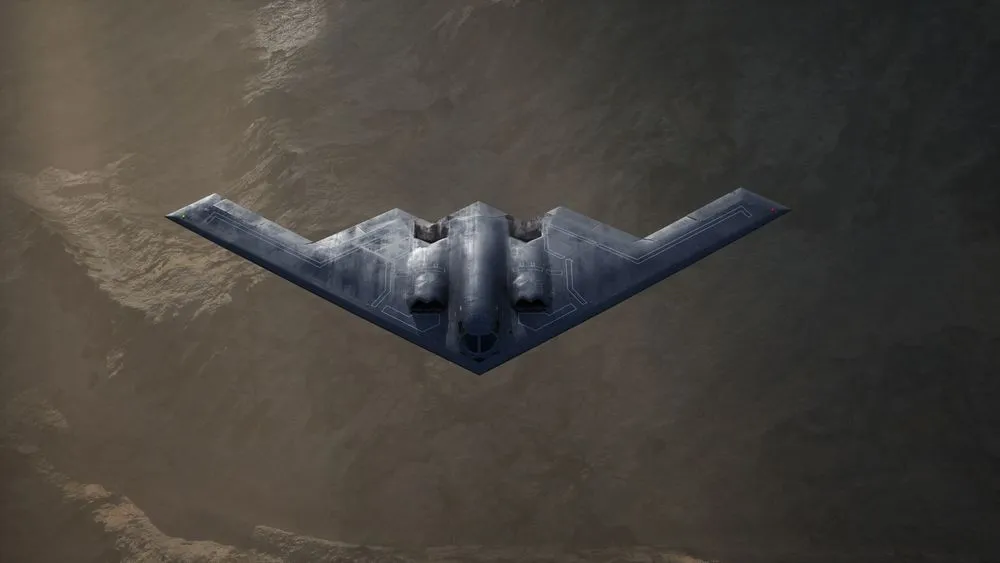
Flying low is one way to beat a radar. The B-2 Spirit, the flying-wing bomber pictured at the top of this article, uses a completely different trick: instead of hiding under the radar’s line of sight, it makes the radar struggle to see it even in plain view.

The key idea is radar cross-section (RCS), a measure of how detectable an object is to radar, expressed in square metres. Crucially, RCS is not the same as physical size; it depends on shape and surface. A B-52 bomber has an estimated RCS of around 100–125 m², yet the much larger-looking B-2 reportedly sits near 0.1 m² or less, closer to a small bird than a bomber on a radar screen, while the F-117 Nighthawk is quoted at roughly 0.025 m² (Source).
That enormous reduction comes from two tools used together. The first is shaping: angled, faceted, or smoothly blended surfaces (faceted on the F-117, curved on the B-2) reflect incoming radar energy off to one side rather than straight back to the receiver. The aim is to create a narrow “cone of silence” in the direction of the radar so very little of the beam returns home. The second is radar-absorbent material (RAM), special coatings and composites that soak up radar energy and convert it to a tiny amount of heat instead of bouncing it back. The U.S. Air Force describes this combination as “low-observable,” and it lets a B-2 penetrate defences that a conventional bomber could never survive. We dig into the physics in our piece on how stealth aircraft absorb radar waves.
End Note – Are Radars Getting Smarter?
Conventionally programmed radars are hampered by their line of sight being affected by the Earth’s curvature. Even though radar waves bend ever so slightly with the earth’s curvature, they cannot detect low-slung aircraft approaching in the shadow region.
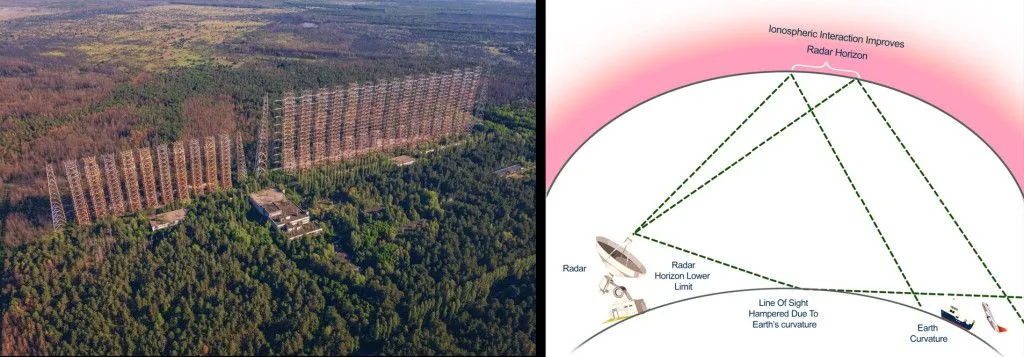
To overcome this, special radar systems called 'over the horizon' (OTH) radars have been developed. Rather than relying on a direct line of sight, they bounce high-frequency (3–30 MHz) signals off the ionosphere, allowing them to see thousands of kilometres beyond the conventional radar horizon and bringing into sight what would have previously been invisible.
Operational systems such as Australia's Jindalee Operational Radar Network (JORN) and the U.S. Navy's Relocatable Over-the-Horizon Radar (ROTHR) routinely surveil ranges of 1,000–3,000 km using this principle. In March 2025, Canada announced an AU$6.5 billion deal to acquire JORN technology to watch its Arctic approaches — and the U.K. has since signalled interest in the same system. Combined with the rise of low-flying drones in conflicts like the war in Ukraine, this push reflects how seriously modern militaries now treat the once-comfortable low-altitude gap that nap-of-the-earth flight has long exploited.
References (click to expand)
- FAA Guide to Low Flying Aircraft. faa.gov
- Low-Altitude Flying Training > Air Force > Fact Sheet Display. The United States Air Force
- OPERATION Neptune Spear: 10 year anniversary > Nellis Air .... Nellis Air Force Base
- Radar Line of Sight - radartutorial.eu. radartutorial.eu
- Over-the-horizon radar. Wikipedia
- Li, L.-W. (1998, September). High-frequency over-the-horizon radar and ionospheric backscatter studies in China. Radio Science. American Geophysical Union (AGU).
- CA Gainer. AIRCREW TRAINING REQUIREMENTS FOR NAP-OF ... - DTIC. apps.dtic.mil
- (1991) Simulation of Nap-of-the-Earth Flight in Helicopters. The National Aeronautics and Space Administration
- Radar Coverage. radartutorial.eu
- Radar Cross Section (RCS). GlobalSecurity.org
- Stealth | Military, Aircraft, Low Observable, Radar Absorbing & Radar Deflecting. Encyclopaedia Britannica
- B-2 Spirit Fact Sheet. The United States Air Force