Table of Contents (click to expand)
Black holes emit faint Hawking radiation. A small, artificial black hole (a "Kugelblitz") would radiate intensely enough that, in theory, the energy could power a "black hole starship," an idea formalized by Crane and Westmoreland in 2009. Real stellar black holes radiate far too feebly to be useful.
Ever since theoretical physicist John Wheeler popularized the term “black hole” in a 1967 talk (the phrase was actually suggested by someone in his audience, and Wheeler adopted it for its brevity), these celestial objects have made a permanent home in pop culture and science fiction. From Star Trek to Interstellar and everything in between, black holes have become ingrained in scientific folklore.
However, while movies, comics and TV shows have made global audiences familiar with black holes, very few actually understand it. There is a lot more to black holes than just being large holes in space that are devoid of light. Theoretically, they can also be used as an energy source. Perhaps, they could even be a source powerful enough to fuel an interstellar ship. In fact, before scientists even began to consider the possibility, renowned science fiction author Arthur C. Clarke already had a black hole-powered starship in his story, Imperial Earth. However, before we tumble further down this rabbit hole, let’s try to better understand the concept of a black hole.
What Is A Black Hole?
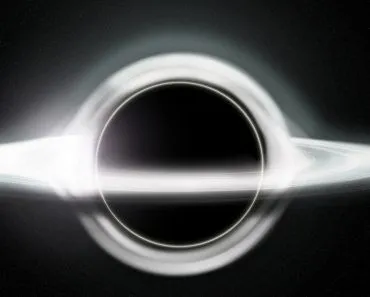
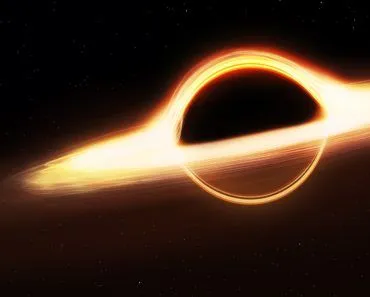
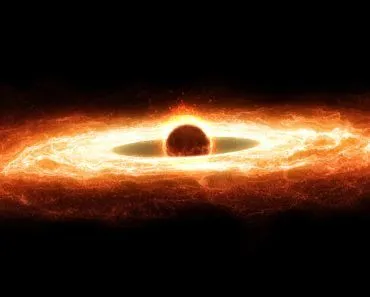
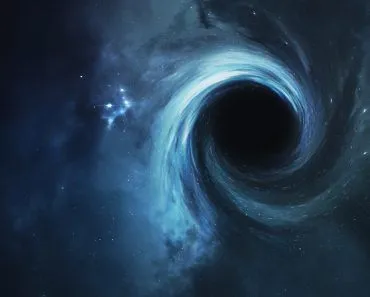
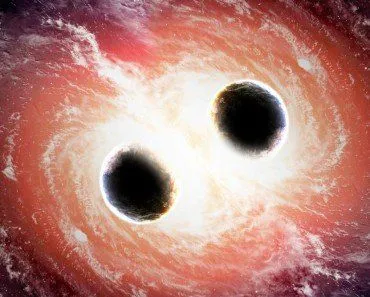
A black hole is essentially a region of space where the pull of gravity is so strong that even light, the fastest thing in the universe, cannot escape it. It is this property of absorbing all light that gives black holes the appearance of being completely void of color, hence the term “black hole”. It’s a region of extremely high density, since matter has been squeezed tightly into a relatively tiny space. This type of extreme compression often takes place at the end of a star’s life.
A star’s life involves a constant tug of war between its own gravity pulling it inward and the pressure caused by fusion reactions pushing it outward. For the most part, these two forces balance each other out almost exactly, so the star remains steady. Eventually, however, the star begins to run out of nuclear fuel for fusion reactions and gravity gains the upper hand. The star explodes into a powerful supernova with the outer parts being expelled violently into space and the core completely collapsing under its own weight. After the supernova, the remnants of the star’s core collapse inward to a point of zero volume and infinite density known as a singularity.

It would take an object moving at a velocity greater than the speed of light to escape the powerful gravitational pull of the singularity. Since nothing travels faster than the speed of light, anything caught in the gravitational field of a singularity is entombed forever. The edge of the field’s influence, where you would need to travel at exactly the speed of light to escape, is called the event horizon of the black hole.
With all of this in mind, it’s important to note that renowned physicist Stephen Hawking discovered that there was in fact some kind of radiation being expelled from black holes. Since his efforts led to this groundbreaking discovery, it is naturally known as Hawking Radiation.
What Is Hawking Radiation?
In 1975, Stephen Hawking discovered that black holes are not quite as “black” as previously thought. They do possess a slight glow by virtue of some radiation coming from them consisting of photons, neutrinos and an assortment of larger particles.

The simplest way to picture it (the heuristic Hawking himself used) is this: particle-antiparticle pairs are continually flickering into existence and annihilating across the vacuum of space, but when a pair appears right at the edge of a black hole’s event horizon, one partner can fall in while the other escapes as radiation. The escaping particle carries away energy, and by E=mc2 the black hole loses an equivalent amount of mass, slowly shrinking. The full picture is more subtle (Hawking radiation is really a thermal, blackbody-like glow that arises from quantum effects in the warped spacetime near the horizon), but the upshot is the same: black holes are not perfectly black. Of course, the next big question became, if a black hole is leaking energy, is there any way to harness it?
Can A Black Hole Be Used As An Energy Source?
Theoretically, a black hole could act as a power source, but a natural one would be hopelessly feeble. A black hole with the mass of our Sun has a Hawking temperature of just 60 nanokelvin and radiates with a power of around 10−28 watts. That is so weak it would take roughly 1067 years to evaporate, far longer than the current age of the universe (about 1.4 × 10¹⁰ years). In fact, a stellar black hole today absorbs more energy from the cosmic microwave background than it gives off, so it is still gaining mass, not losing it. The more massive the black hole, the cooler it is and the weaker its Hawking radiation, since the temperature is inversely proportional to mass.
On the other hand, a much smaller black hole would be far hotter and would therefore blaze with Hawking radiation at a far more significant rate (the trade-off being that it also evaporates much faster).

However, we could in principle create an artificial black hole that produces substantial Hawking radiation, enough for it to work as a viable power source. Counterintuitively, such a black hole would be tiny in size (its event horizon smaller than a proton) yet enormous in mass, packing something like a million tonnes into that pinprick of space.
Kugelblitz
While successfully creating one is still at least a few decades away, we do have promising theories as to how we could go about it. In his 1955 paper on “geons,” John Wheeler pointed out that if you concentrate enough pure energy into a small enough region of space, that energy can warp spacetime so severely that it collapses into a microscopic black hole. He borrowed the German word “Kugelblitz” (ball lightning) for it. Because such a black hole would be non-rotating and uncharged, it is described by the equations Karl Schwarzschild solved back in 1916, hence the full name “Schwarzschild Kugelblitz” (SK).

To be suitable, this black hole would have to be small enough to expel a significant amount of radiation, yet large enough that it does not immediately vaporize. We would have to establish a Goldilocks size of a black hole to be able to effectively use it as a power source. According to Hawking, we would need some kind of black hole generator, possibly created using gamma ray lasers and a spherical shield, to house this generator and the black hole itself. If we are able to accomplish this, we could generate enough energy to power our cities for generations.
What Is A Black Hole Starship?
One of the most ambitious ideas for an interstellar starship in the scientific community is a black hole starship. The concept was worked out in detail by physicists Louis Crane and Shawn Westmoreland in their 2009 paper Are Black Hole Starships Possible? Specifically, this would be a starship equipped with a ‘Schwarzschild Kugelblitz’ (SK) drive. Basically, it would be an engine with a tiny black hole at the center of it, lending it incredibly powerful thrust.

Theoretically, an SK drive would trap the Hawking radiation streaming off the decaying black hole and use it to propel the starship. Crane and Westmoreland found that a black hole of around a million tonnes (its event horizon smaller than a single proton) would radiate at roughly 1016 watts and live for several decades, which is about the smallest object that could plausibly do the job. With that power, the ship could accelerate to something on the order of 10% the speed of light. Because each black hole steadily evaporates and would need to be replaced, the ship would come equipped with gamma ray lasers to manufacture fresh ones ‘on-demand’.
Yes, technically, a black hole-powered spaceship isn’t outside the realm of possibility. Once technology catches up with our ambitious theories, we might be able to leave Earth behind and bravely go where no one has gone before!
References (click to expand)
- What Is a Black Hole? NASA Space Place. The National Aeronautics and Space Administration
- Kugelblitz! Powering a Starship With a Black Hole - Space.com. Space.com
- Crane, L., & Westmoreland, S. (2009). Are Black Hole Starships Possible (Version 1). arXiv.
- Hawking Radiation - UCR Math. The University of California, Riverside
- Black Holes - NASA Science. The National Aeronautics and Space Administration