Table of Contents (click to expand)
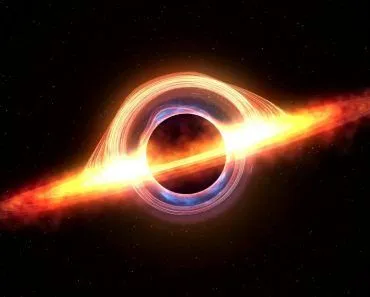
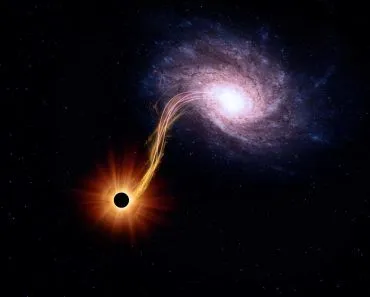
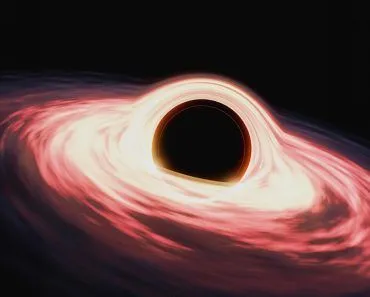
A black hole itself gives off almost no heat, but the accretion disk swirling around it does. As that gas spirals inward it heats up to millions of degrees and radiates intense light, so the black hole looks as if it is burning even though the glow comes entirely from the disk outside it.
Picture yourself in a spaceship, looking out the window at a black hole. You’d expect it to be completely dark, right? After all, they’re famous for swallowing everything that comes near them, but here’s the catch: black holes often look like they’re on fire, radiating intense amounts of light and energy. How does this happen? In this article, we will explore the fascinating elements and processes that create this fiery illusion.
To understand this phenomenon, we need to start with what black holes are. They’re not “holes” in the traditional sense; instead, they are areas where gravity is so powerful that nothing, not even light, can escape. Anything that gets too close is pulled in and disappears.
Black holes come in various sizes. Stellar-mass black holes, which form from the remnants of massive stars, are relatively small. When one of them is feeding, the inner part of its disk can reach temperatures of several million degrees, hot enough to blaze in X-rays like a cosmic ember.
On the other hand, supermassive black holes, which can be millions or billions of times the mass of our Sun, are the giants of the cosmos. When they feed on surrounding matter, they become luminous quasars, radiating immense amounts of energy. Their disks are far larger but actually cooler than those of their stellar-mass cousins, glowing mostly in ultraviolet and visible light rather than X-rays. Even so, the accretion disks around supermassive black holes are like the fiery hearts of galaxies, shining brilliantly. However, it’s important to note that all of this light comes from the disk outside the black hole, not the black hole itself.
Accretion Disk
Now, here’s where the fiery part comes in. When stars, planets, or any other form of matter get too close to a black hole, they form what’s called an “accretion disk.” This is like a swirling, superheated cosmic traffic jam around the black hole.
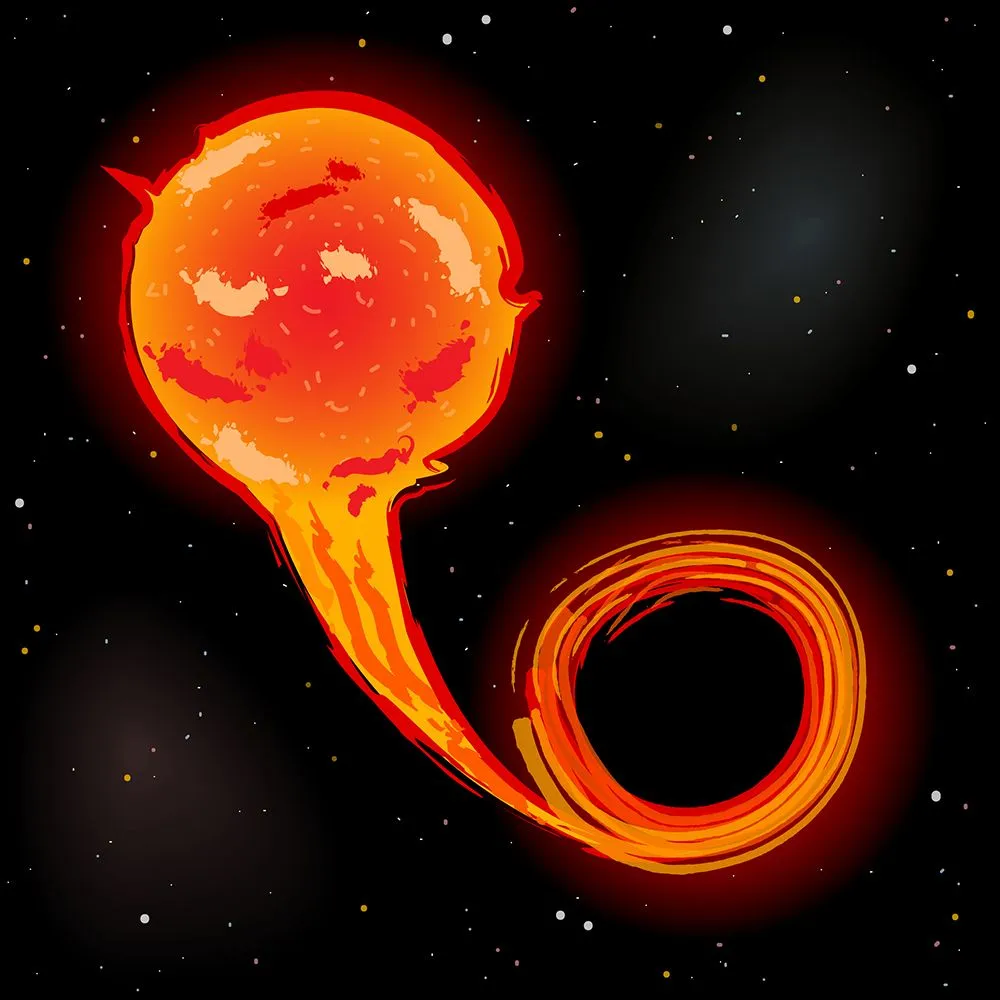
As matter in the accretion disk gets closer to the black hole, it gets incredibly hot, heating up and emitting energy. This intense heat generates bright X-rays, ultraviolet light, and even visible light. Thus, the fiery spectacle around black holes actually comes from this swirling disk, not the black hole itself.
As this material gets closer and closer to the black hole, it reaches incredible speeds and temperatures far hotter than the surface of the Sun (whose visible surface sits at about 5,500 °C, or 9,900 °F). This fiery disk emits a brilliant glow, making it look like the black hole is on fire.
The Event Horizon
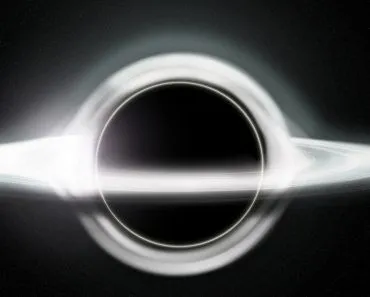
At the center of this ring of fire lies the black hole itself, surrounded by its event horizon. This is the ultimate point of no return, where anything that crosses will inevitably be pulled into the black hole. It’s the defining line between the visible universe and the hidden depths of a black hole.
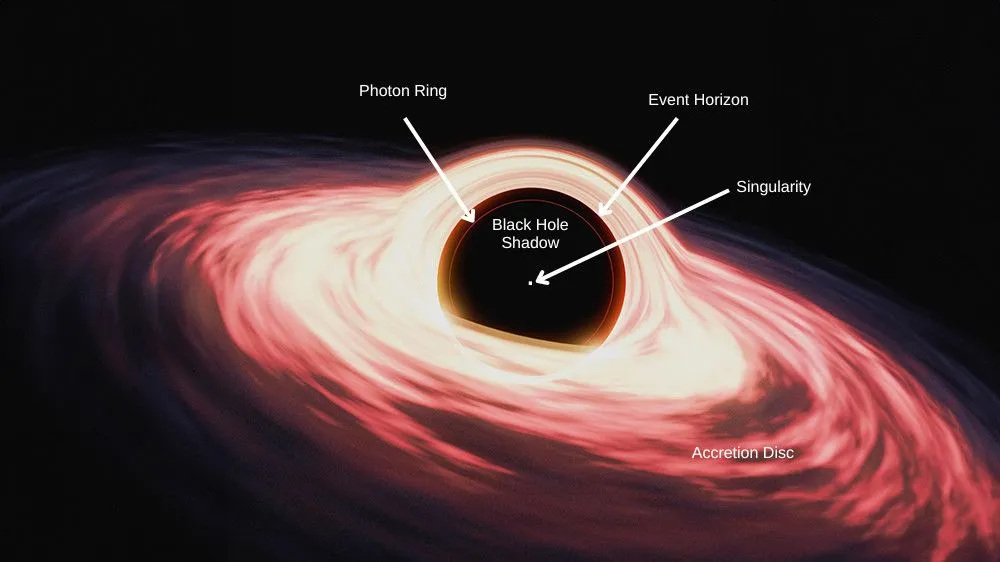
The event horizon serves as an impassable barrier, hiding the immense gravitational forces and whatever strange occurrences await inside. When something crosses this line, be it a star or even a speck of light, it’s trapped forever within the black hole. This is why black holes seem dark when we look at them from the outside. Anything that goes past the event horizon can’t come back, nor can it emit any form of light.
Photon Sphere
A closer look at a black hole reveals fine rings of light towards the edge of the event horizon shadow, known as the photon sphere. These bright rings are not separate light sources, but rather contorted representations of the surrounding accretion disk. Within the photon sphere, light from the accretion disk loops around the black hole multiple times before breaking free.
These rings of light, though fainter and more distorted as they get closer to the black hole, create the illusion of a radiant and fiery boundary around the black hole’s event horizon. The interplay of light and gravity in this region intensifies the idea of a burning outer shell.
Particle Jets
Close to the inner rim of the accretion disk, an even more confusing phenomenon occurs. Some of the matter spiraling in the direction of the black hole is suddenly redirected. This gives rise to a pair of particle jets that shoot away from the black hole opposite to the sides of the accretion disk (edge-on view). These jets include particles moving at extreme speeds and they emerge with such force that they approach the speed of light!
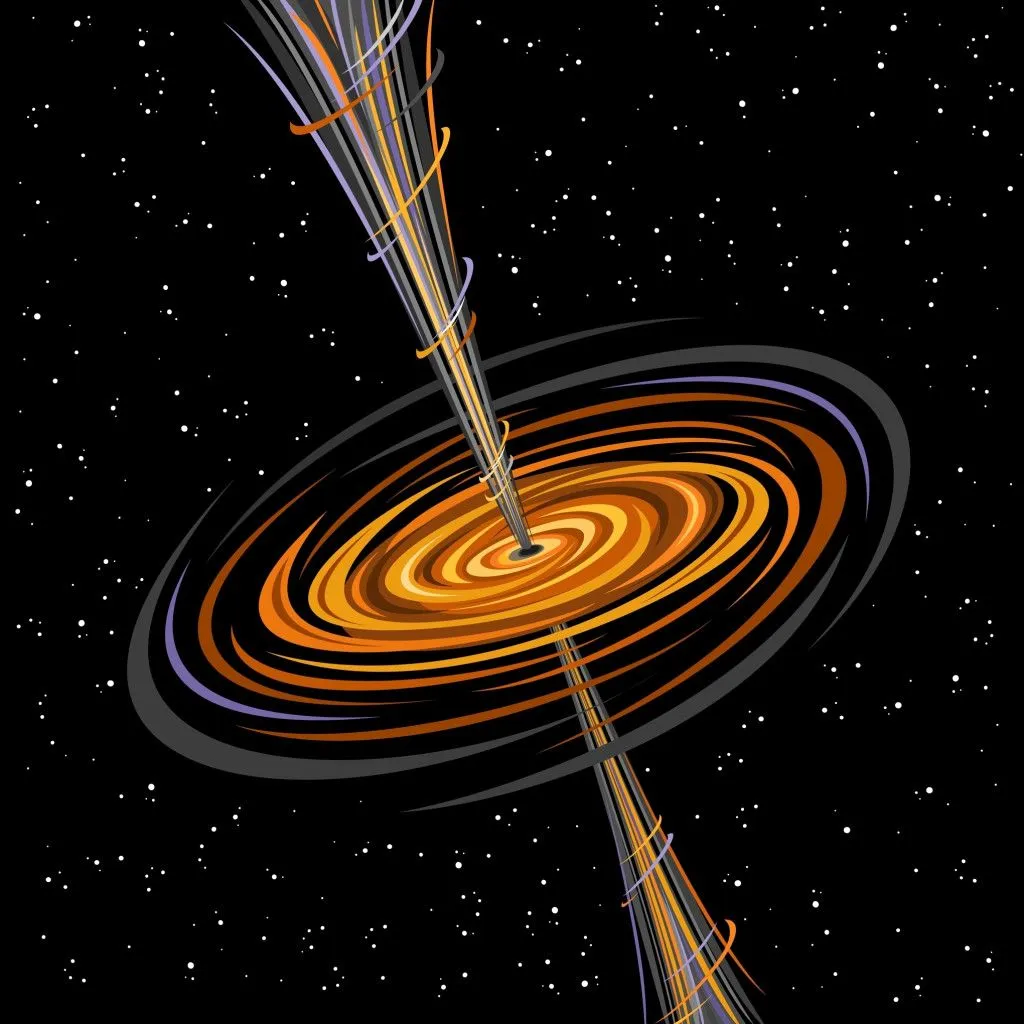
Astronomers are still trying to understand the mechanisms behind these particle jets, but they offer yet another element of the illusion of a burning black hole. In the case of black holes with a mass over one billion times the Sun’s, which reside at the galactic centers, these jets can extend for vast distances, reaching hundreds to even thousands of light-years. When these jets align with our viewing angle, Doppler beaming amplifies the brightness of the jet pointed toward us, which again makes it look as if these are jets of fire.
Hawking Radiation
Now, here’s the mind-bending part… black holes don’t just consume! They also emit a whisper of something called “Hawking radiation.” This radiation is the result of quantum effects near the event horizon. In the popular picture Stephen Hawking used to describe it, pairs of particles and antiparticles flicker into existence near the event horizon; one gets pulled into the black hole while the other escapes into space as Hawking radiation, causing the black hole to lose mass over time. (Physicists stress this is only a cartoon of a deeper calculation, but it captures the gist.)
Here’s the catch, though: this is not the heat you see. Hawking radiation is fantastically faint. A black hole the mass of our Sun would have a Hawking temperature of only about 60 billionths of a kelvin, and a supermassive one is colder still, far colder than the 2.7 K (−270 °C, or −455 °F) glow of the cosmic microwave background left over from the Big Bang. So a real black hole gives off essentially no warmth of its own, and it would take far longer than the current age of the universe, more than 1060 years, for a Sun-mass black hole to evaporate this way. Every bit of the fiery brilliance we actually observe comes from the accretion disk, jets, and photon ring outside the event horizon.
In the end, the fiery appearance of black holes is a fascinating paradox. They consume everything in their path, but they also produce stunning amounts of light and heat. This duality reminds us that the universe is full of surprises, and black holes are no exception.
So, when you look up at the night sky and ponder the wonders of the cosmos, remember that even the darkest corners of space can amaze us with their luminous beauty. Black holes may devour all, but they also have a fiery side that keeps astronomers and stargazers captivated by their celestial dance.