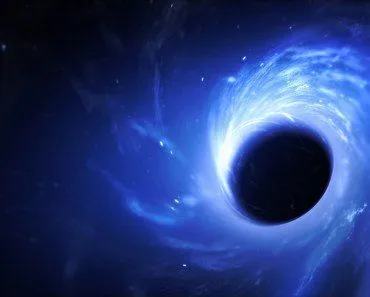
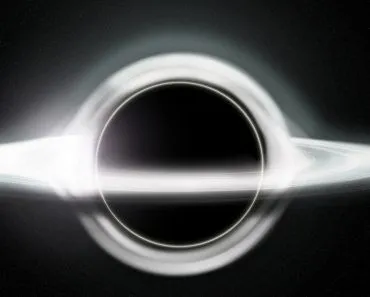
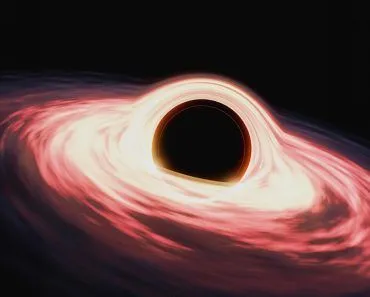
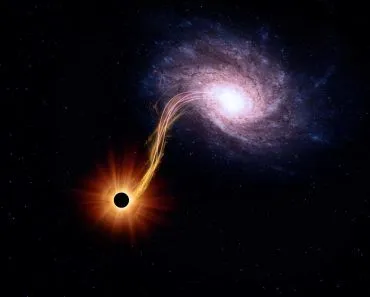
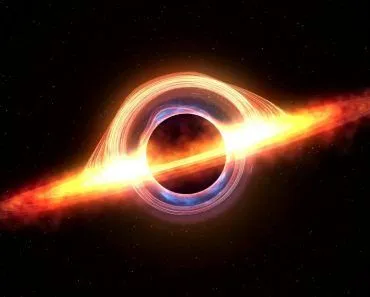
When two black holes collide, gravity drags them into a tighter and tighter spiral, throwing off enormous amounts of energy as gravitational waves. The waves bleed orbital energy from the pair until the two event horizons touch and merge into one new, larger spinning black hole. LIGO confirmed this picture with its first detection (GW150914) on 14 September 2015.
There seems to be a lot of black hole talk in recent months and years, and while these mysterious phenomena of the universe have been studied for the better part of a century, there are still a number of unanswered questions. The gravitation power of a black hole is so strong that light cannot escape it – and apparently, neither can the secrets of black holes!
On 14 September 2015, the LIGO observatories caught their first signal: a billion-year-old echo from two stellar-mass black holes spiralling into each other. The detection (now catalogued as GW150914) was announced in February 2016 and earned Rainer Weiss, Barry Barish, and Kip Thorne the 2017 Nobel Prize in Physics. In the decade since, LIGO and its partners Virgo and KAGRA have catalogued more than two hundred black-hole mergers, and have even begun picking up signals from the far heavier supermassive black-hole pairs through pulsar timing arrays like NANOGrav (2023). The "what happens when black holes collide?" question is no longer a thought experiment.
It’s only natural, with all this excitement about black holes, that people would want to know the dramatic details… so what happens when black holes collide?
The Death Spiral Of Black Holes
Black holes are the remnants of dead stars that have collapsed in on themselves, leaving these incredibly dense black holes that float menacingly in the hearts of galaxies, devouring more and more matter and growing in size and strength. The collision of two black holes would be the ultimate galactic grudge match, but since nothing can escape the grasp of a black hole once it crosses the event horizon (“the point of no return”), it’s difficult to know exactly what occurs when two of these titanic phenomena crash into one another.
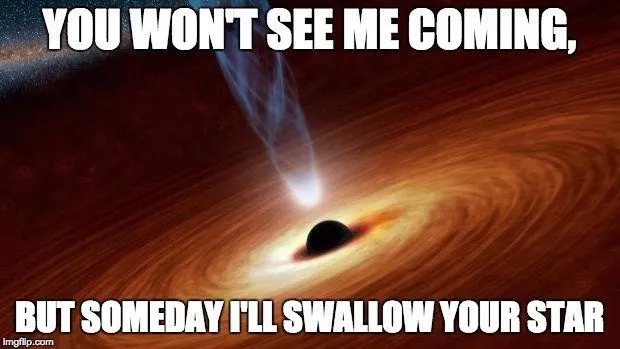
Theories predict that when two black holes begin affecting one another gravitationally, they will begin to orbit one another, closing into an ever-tighter spiral. Eventually, the two black holes will merge into a single, larger black hole, but there would be an incredible amount of energy produced by this merger. Black holes spin at incredibly fast rates (1/3 to 1/2 the speed of light, in some cases), and are often more than 100 million times as massive as our Sun. Therefore, an opposing theory also exists, saying that the two black holes may negatively interact and recoil from one another due to their rapid rotation.
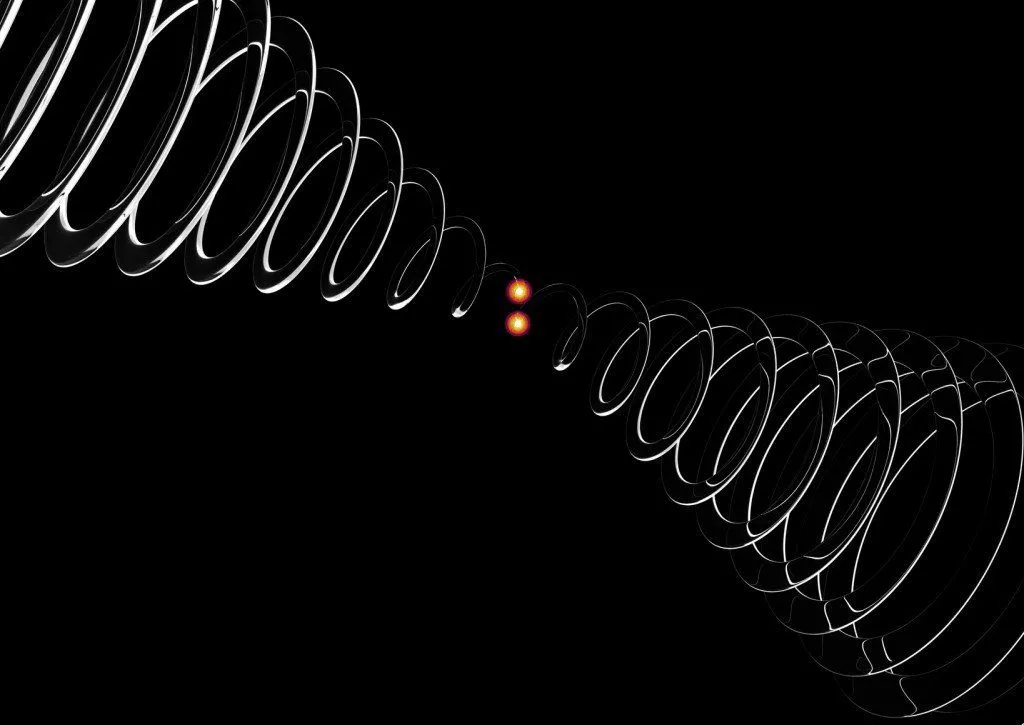
There are huge magnetized gas clouds that surround any black hole, and as the incredible magnetic and gravitational fields of the two black holes begin to interact, they will form a funnel-shaped vortex above the accretion disk of the black hole. In the final stages of the collision, the two black holes may be orbiting as fast as half the speed of light, and then finally come together in a burst of energy that can be felt across the universe.

What we do know is that when black holes collide, they release a huge amount of gravitational waves, which are actually responsible for the two black holes’ loss of orbital energy and eventual merger. These gravitational waves are sent outwards as a “flash” when two black holes colliding, acting as “ripples” through the fabric of space-time. These rare waves can be detected by highly sensitive instruments on Earth, such as those found at the Laser Interferometer Gravitational-Wave Observatory (LIGO), a pair of astronomical instruments located in Washington and Louisiana, in the United States.
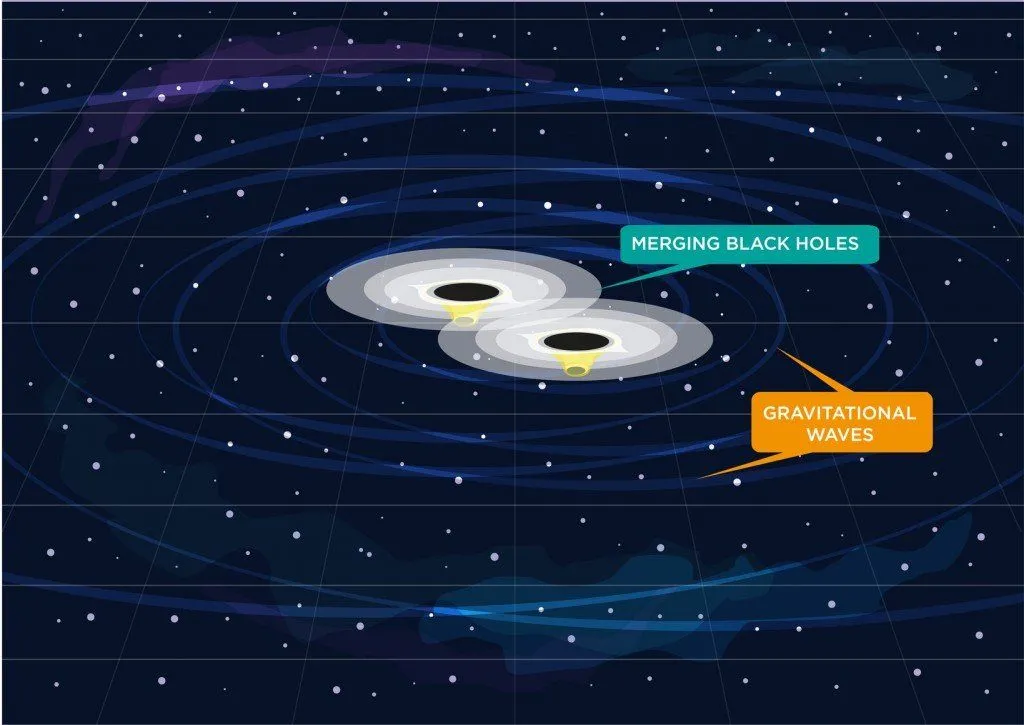
The signal LIGO caught in 2015 came from two black holes (roughly 29 and 36 solar masses) that had merged about 1.3 billion light-years away. Those gravitational waves had been racing through space for 1.3 billion years, which means the actual merger took place around the time complex multicellular life was first appearing on Earth, long before any plants or animals existed. About three solar masses of energy was radiated away as gravitational waves in a fraction of a second, briefly making the event more luminous (in gravitational-wave power) than the entire visible universe combined.
The network of detectors keeps growing. Virgo in Italy and KAGRA in Japan now run alongside the two LIGO sites, and India’s LIGO-India is under construction with first observations targeted for the late 2020s. The European Space Agency’s space-based LISA mission (planned launch 2035) will listen for the much slower, lower-frequency rumble of supermassive black-hole mergers at the cores of colliding galaxies. Every new detector tightens the localization, so future events can be cross-checked with optical, radio, and X-ray telescopes, the kind of multi-messenger astronomy that turned the 2017 neutron-star merger GW170817 into a watershed moment.
What Is It Actually Called? Inspiral, Merger, And Ringdown
So far we have called it a collision and a death spiral, but physicists have precise names for the act, and people often search for exactly that. The whole event is a binary black hole merger (or coalescence), and it unfolds in three distinct movements: the inspiral, the merger, and the ringdown.

During the inspiral, the two black holes circle one another in a gradually shrinking orbit. The first stages take an extraordinarily long time, because the gravitational waves they emit are very weak while the pair is still far apart. As they draw closer, they speed up and the waves grow stronger, draining orbital energy and tightening the spiral even faster. This rising signal, climbing in both pitch and volume, is famously known as a chirp.
The merger is the violent instant the two event horizons touch and fuse into one. Here the gravity is so strong and so rapidly changing that the neat pen-and-paper approximations break down completely, and physicists can only model it with numerical relativity, solving Einstein's equations on supercomputers. Gravitational-wave emission peaks during this moment.
Finally comes the ringdown. The newborn black hole arrives lopsided and distorted, and it settles into a smooth, stable spinning shape by shedding its irregularities as gravitational waves. The remnant literally "rings" like a struck bell whose tone fades away, an effect that physicists describe as damped quasinormal-mode oscillations. When the ringing stops, what remains is a single, larger rotating spinning black hole.
How Often Do Black Holes Collide, And Should We Worry?
When the first detection was announced in 2016, a black hole merger felt like a once-in-history event. A decade on, it is almost routine. The LIGO-Virgo-KAGRA network has now logged roughly 300 black hole mergers, with about 200 of them gathered during its most recent observing run alone. At its current sensitivity, LIGO catches a new merger about once every three days.

That number sounds alarming until you notice where these collisions happen. Every merger detected so far has taken place far beyond our galaxy, typically more than a billion light-years away. The 2015 signal, and a near-identical event caught a decade later, both came from around 1.3 billion light-years off. By the time those ripples reach us, they have spread out and faded almost to nothing, stretching and squeezing space by less than one ten-thousandth the width of a proton. It takes the most sensitive instruments humans have ever built just to register them.
So would two colliding black holes hurt us? In any realistic scenario, no. The destructive power of a black hole is a local affair, dangerous only to objects close enough to fall in. A merger billions of light-years away delivers nothing to Earth but a whisper of gravitational waves that passes straight through the planet without leaving a mark. These collisions are some of the most violent events in the universe, and yet from our safe vantage point they are completely harmless.
What If A Black Hole Met A White Hole (Or A Gravastar)?
A surprising number of people ask what would happen if a black hole crashed into a white hole, so it is worth being honest about it. A white hole is the mathematical mirror image of a black hole: a time-reversed solution to Einstein's equations that nothing can enter, but from which matter, light, and energy can only escape. On paper it shares the same mass, charge, and spin as the black hole it reverses.

The catch is that a white hole has never been observed, and very few scientists believe one actually exists. There is no known astrophysical process that could ever build one, so the idea remains a mathematical curiosity rather than something out there waiting to be struck. In some exotic solutions, a white hole appears as the far "exit" of a black hole linked through an Einstein-Rosen bridge, better known as a wormhole. That makes a tidy "two ends of the same tunnel" picture, but it is not a scenario where you could send two separate objects smashing into each other.
The one place white holes get serious attention is quantum gravity. Physicists Carlo Rovelli and Francesca Vidotto have proposed that a dying black hole might not simply vanish, but instead reach a maximally compressed state called a Planck star and quantum-tunnel, or bounce, into a white hole that releases the energy and information that fell in. In that picture a white hole is the next chapter in a single object's life, not a separate body you could collide with. You can read more in our look at the death of a black hole.
People ask much the same about a gravastar, another hypothetical alternative to a black hole. Proposed by Pawel Mazur and Emil Mottola in 2001, a gravastar would have no event horizon and no singularity, replacing them with a shell of ultra-dense matter wrapped around a core of repulsive dark energy. If gravastars were real, their solid surface should make a merger "echo" in the gravitational-wave signal, a faint repeat after the main ringdown. So far, careful searches of LIGO's data have found no convincing echoes, which keeps black holes firmly as the best explanation for what is actually colliding out there.
References (click to expand)
- Black Holes: Gravity's Relentless Pull. HubbleSite (archived).
- What Happens When Black Holes Collide? - Universe Today. Universe Today
- Castelvecchi, D. (2016, March 23). The black-hole collision that reshaped physics. Nature. Springer Science and Business Media LLC.
- BBC Earth: Watch what happens when two black holes collide.
- GW150914: First Observation of Gravitational Waves from a Binary Black Hole Merger. LIGO Scientific Collaboration / Caltech.
- The 2017 Nobel Prize in Physics (Weiss, Barish, Thorne). NobelPrize.org.
- NANOGrav 15-year evidence for a gravitational-wave background from supermassive black-hole binaries (2023).
- What are Gravitational Waves? LIGO Caltech.
- Ten Years Later, LIGO is a Black-Hole Hunting Machine. LIGO Lab / Caltech (2025).
- Binary black hole (inspiral, merger and ringdown). Wikipedia.
- White hole. Wikipedia.
- Rovelli, C. & Vidotto, F. Planck stars, White Holes, Remnants and Planck-mass quasi-particles. arXiv:2407.09584.
- Gravastar (Mazur-Mottola model). Wikipedia.