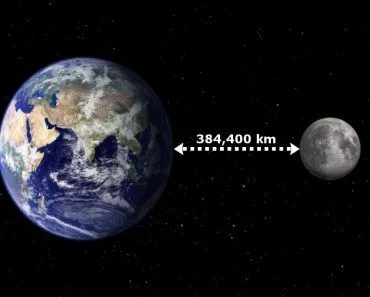
If Earth had two moons, a second moon orbiting roughly halfway to our current Moon would raise tides nearly eight times higher than today, triggering giant tidal waves, earthquakes and volcanic activity. We would also see more solar and lunar eclipses and brighter nights. Living near shorelines would become nearly impossible, so it’s good that we have only one moon.
We’re so used to the presence of that lone, bright, whitish-grey sphere hanging up in the night sky that we rarely think about what its presence means to us. We also don’t thank our lucky ‘stars’ that we have only one moon to influence and cause a number of the natural phenomena on Earth.
However, what if Earth had more than one moon? What if you saw multiple moons instead of one when you stared up into the night sky?
The Case Of Multiple Moons – Effect On Tides
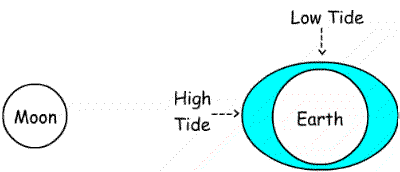
The Moon exerts a gravitational pull on Earth that causes the creation of tides in huge bodies of water; in fact, the gravitational pull of the Moon causes oceans to bulge outwards in the direction of the pull (did you know that?). Although the gravitational attraction between the Sun and Earth is 177 times stronger than the Moon and Earth, when it comes to creating tides in our oceans, the Moon dominates the Sun. Therefore, all the big tides that you see roaring in the distance from the beach are primarily caused by our single Moon. Can you imagine what would happen to the scale of tides if there were more than one moon?
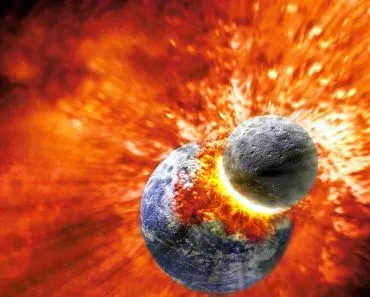
Neil Comins, an astronomer and a Physics professor at the University of Maine, has written an entire book on the topic ‘What if Earth Had Two Moons?’ In his book, he claims that a second Moon (he calls it ‘Lluna’) would settle in an orbit halfway between the Moon and Earth. Its gravitational pull on Earth would be high enough to create tides almost eight times higher than those we see today. Tidal forces of such magnitude would flex Earth’s crust enough to set off powerful earthquakes and reawaken dormant volcanoes, while colossal tidal waves swept across the oceans. Needless to say, all of this would cause destruction of epic proportions, resulting in mass extinctions for a large number of living things.
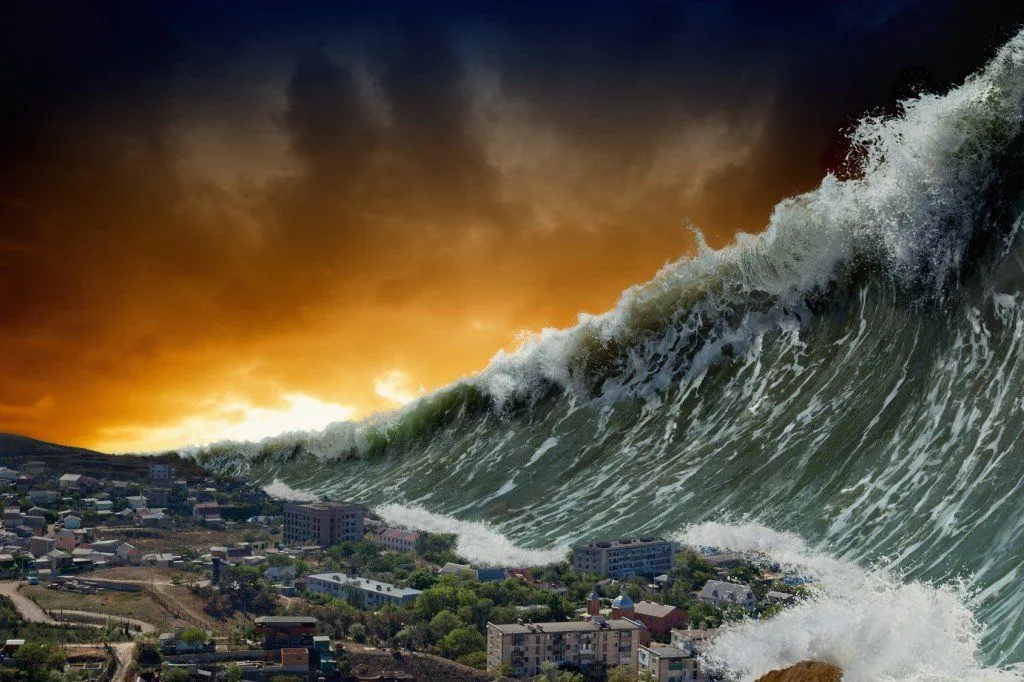
In the case of having more than two moons, the tides would be even stronger and more destructive. However, it also depends on the moons’ respective positions relative to Earth. The amplitude of waves would either be larger or smaller, since having so many moons would either add to or compensate for each other’s effects on Earth’s tides. Also, the cycle of tides (e.g., we have two high tides and two low tides in the span of 24 hours on our planet) would not be as regular as it is now.
Human life would undoubtedly take a nasty hit, but once the newer moons settle into their respective places around Earth, things would begin to settle down. We would certainly have more solar and lunar eclipses than we experience now. Nights would also be much more illuminated than what we experience today, since presently, there’s only one moon to reflect the Sun’s light to Earth. We would also have fewer hours of darkness.
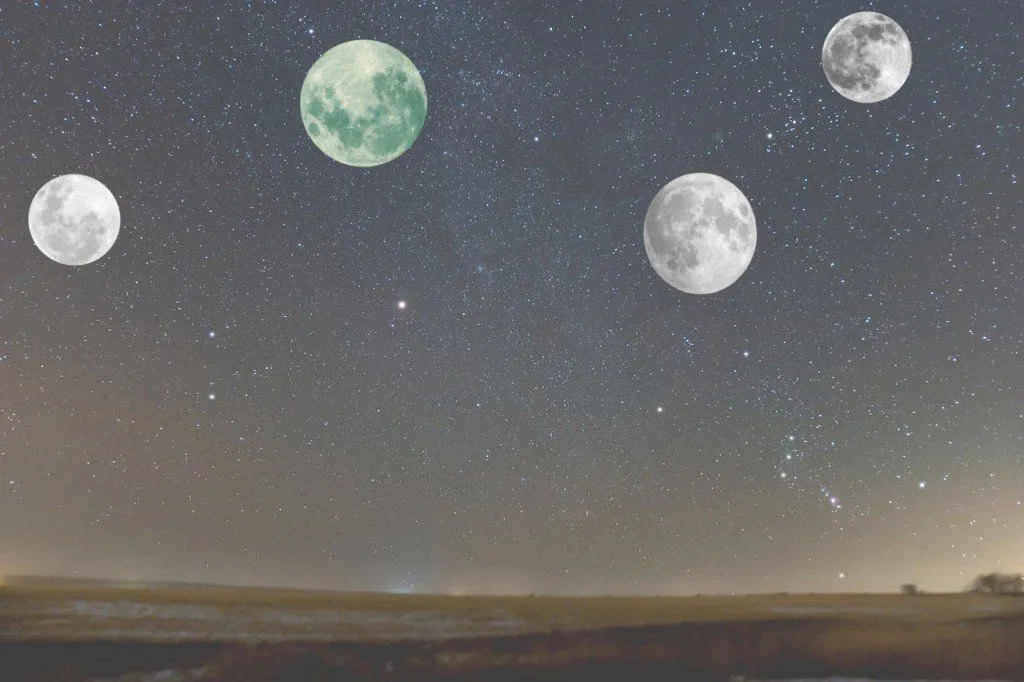
However, this is not necessarily a good thing, at least not for star-gazers and astronomers, because having so much illumination at night would make the observation of stars much more difficult.
Since the difference between high tides and low tides would be thousands of feet, living along shorelines would also be almost impossible.
This would significantly shrink the habitable area on Earth, resulting in a tremendous rise in the population of inland urban areas. With such unpredictable waters, using waterways as a means of transport would be nothing short of throwing yourself into an impromptu duel with a Gladiator!

There would be many other indirect and far-reaching effects on Earth due to the presence of multiple moons. So as it turns out, it’s good that we have only one moon, and it’s even better that it’s going to stay that way in the near future.
Does Earth Really Have More Than One Moon?

Here’s the question everyone secretly wants answered: does Earth actually have a second moon hiding somewhere? Officially, the answer is no, Earth has exactly one natural satellite, the Moon. But nature has a habit of bending the rules, and the real story is more interesting than a flat “no”.
Every so often, Earth’s gravity reaches out and briefly grabs a small passing asteroid, slipping it into a temporary loop around our planet. Astronomers call these tiny visitors minimoons. In February 2020, NASA’s Catalina Sky Survey spotted one called 2020 CD3, a rock only about 1 to 2 meters (3 to 6 ft) across that had quietly been circling Earth for at least a year before it broke free and drifted back into orbit around the Sun. More recently, in 2024, an object named 2024 PT5 tagged along with the Earth-Moon system from late September to late November, prompting headlines about a “second moon” that, as usual, didn’t last.
Then there are the quasi-satellites, which are sneakier still. The best-known is 469219 Kamoʻoalewa (first cataloged as 2016 HO3), discovered in 2016 by the Pan-STARRS 1 telescope on Haleakala, Hawaii. It doesn’t truly orbit Earth at all; it orbits the Sun on a path so close to ours that it merely appears to circle us. NASA reckons it has been Earth’s stable companion for roughly a century and will stay for centuries more, never straying closer than about 38 times the Moon’s distance, nor farther than about 100 times. As planetary scientist Paul Chodas put it, “Since 2016 HO3 loops around our planet, but never ventures very far away as we both go around the sun, we refer to it as a quasi-satellite of Earth.” So while you’ll never look up and see two moons, Earth is rarely as alone in space as it looks.
What If Earth Had 100 Or 1,000 Moons?
If two moons sound like trouble, you might wonder what 100, or even 1,000, would do. It’s a fun thing to picture, a night sky crowded with glowing spheres, but physics puts a hard ceiling on the fantasy long before you reach those numbers.
A planet can only hold onto satellites inside a region called its Hill sphere, the zone where the planet’s gravity wins out over the Sun’s tug. Anything orbiting too far out gets peeled away by the Sun; our Moon sits at only about a quarter of Earth’s Hill radius, so there genuinely isn’t unlimited room up there. Pack that space with hundreds of moons and you hit a second problem: every moon pulls on every other one. Those competing gravitational nudges make tightly crowded orbits unstable over time, so the moons wouldn’t politely share the sky. They’d jostle, swap orbits, fling some of their number off into space, and crash the rest together.
That’s why no planet in our solar system carries hundreds of large moons neatly stacked around it. The worlds that do boast huge tallies, as we’ll see next, mostly count tiny, distant, captured chunks of rock rather than a tidy fleet of full-sized moons. For an Earth-sized world, a handful of sizeable moons is realistic; a thousand is the stuff of science fiction, not stable orbital mechanics.
Which Planets Have More Than One Moon?

Earth makes do with one moon, but plenty of our planetary neighbors are far better stocked. So which planets actually have more than one?
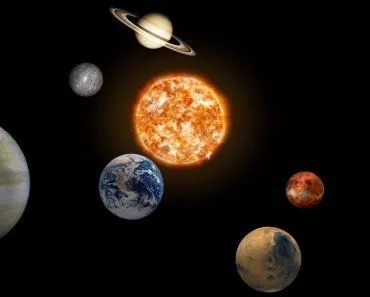
The two innermost planets, Mercury and Venus, have no moons at all. Mars has two small ones, Phobos and Deimos, both probably captured asteroids. After that, the numbers explode. Jupiter has 101 moons officially recognized by the International Astronomical Union (as of early 2026), among them the four giant Galilean satellites, Io, Europa, Ganymede and Callisto, that Galileo first spotted in 1610. Saturn is the runaway champion with 274 confirmed moons, far more than any other planet in the solar system, after a 2025 survey added 128 small new ones in a single haul. Uranus counts 28 known moons and Neptune 16.
It’s worth keeping perspective, though. Beyond a handful of major satellites, most of these tallies are made up of tiny irregular moons, captured rubble only a few kilometers wide, looping far out from their planet. That’s exactly the picture our earlier look at crowded orbits predicts: a giant planet can shepherd a swarm of small, distant rocks, but not a stable wall of full-sized moons. Earth’s lone, large Moon, big enough to steady our planet’s tilt and drive the tides, turns out to be a far rarer and more valuable arrangement than a sky full of lesser ones.
References (click to expand)
- What would happen if Earth had more than one moon? (Intermediate) - Curious About Astronomy? Ask an Astronomer - curious.astro.cornell.edu
- What If the Earth Had Two Moons?. HowStuffWorks
- Tides - NASA Science
- Small Asteroid Is Earth’s Constant Companion (Kamoʻoalewa / 2016 HO3) - NASA Jet Propulsion Laboratory
- Tiny Object Discovered in Distant Orbit Around the Earth (2020 CD3) - CNEOS, NASA JPL
- Jupiter Moons - NASA Science
- Saturn Moons - NASA Science