Table of Contents (click to expand)
If Earth had no Moon, our tides would shrink to roughly a third of their size (the Sun alone would still raise them), nights would be far darker, and days would have stayed about 6 hours long. Worst of all, Earth’s axial tilt would no longer be stabilized near 23.4 degrees and could swing chaotically, triggering wild climate shifts.
There are many things that humans simply take for granted. For example, how many times have you thought of the existence of our moon as an absolute? Ever wonder where we’d be without it? It has been one of the main reasons why humans have looked up at the sky and wondered about our place in the universe for thousands of years.
For most people, it has been the ultimate proof that we’re part of something bigger, deeper, and more consequential than our lives here on this blue rock. The moon has been an integral part of our past and present. It has an incredible story, and we need to realize that the story isn’t finished… not even close!
The Past
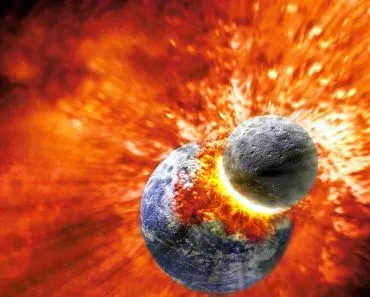
The most scientifically accurate theory regarding the origins of the Moon is nothing short of mind-boggling. Earth is an old creation, but our Moon is only slightly younger. The Moon formed roughly 4.5 billion years ago, only a few tens of millions of years after Earth itself began taking shape. During that time, our Solar System was a chaotic neighborhood of creation and destruction. One such case of destruction resulted in a far more elegant creation. A proto-planet the size of Mars was set on a collision course with Earth, and out of the ashes of that collision, our satellite moon was born. The debris borne from this collision is what coalesced to form our silvery companion in the sky.
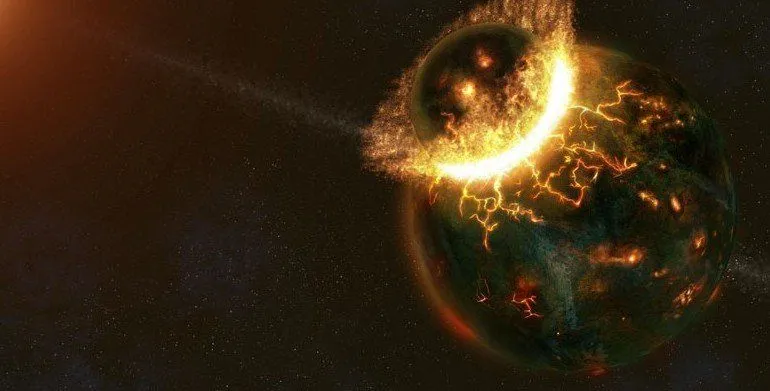
Therefore, it is safe to assume that the moon is a part of our history, in an extremely profound way. Moon rock samples support this, since their isotopic makeup is almost indistinguishable from Earth’s, which is exactly what you’d expect if the Moon condensed from debris that once belonged to our planet.
The Present
The Moon is bound to Earth in orbit by the gravitational force that the Earth exerts on it, but the Moon also exerts the same gravitational force on our planet, which causes the movement of the Earth’s oceans, forming a tidal bulge. This bulge manifests itself in a form of deceleration of Earth’s rotational speed. As the earth gets slower, the centrifugal force that it exerts on the moon decreases.
To compensate for this change, the moon begins to revolve in a larger orbit. This effect is much like what you observe in a merry-go-round when an object placed on the rotating disc moves away from the center unless it is secured in place. The only thing that’s different is that the object doesn’t exert a significant amount of gravitational force on the merry-go-round to keep it stable and locked in equilibrium.
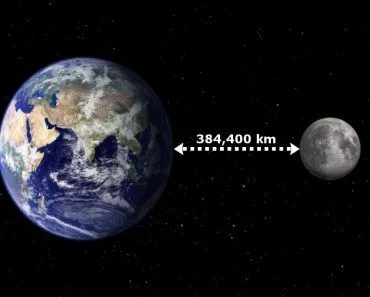
The moon is therefore moving away from the Earth at an average of about 3.8 cm (1.5 inches) per year. It once sat much closer to the Earth – a mere 22,500 km away, as compared with the 384,400 km (according to NASA) that sits between the Earth and the Moon today. Without the moon, the Earth might slow down on its own, but it would take much more time.
On early Earth, when the Moon was newly formed, days were only about six hours long, but with the Moon’s braking effect operating on the Earth in the form of a tidal bulge for the last 4.5 billion years, days have slowed down to the 24 hours we are now familiar with, and they will continue to slow down in the future. You might wonder about the Sun, which is far more massive than the Moon. The Sun does raise tides on Earth, but only about 45% as strong as the Moon’s, because tidal pull falls off with the cube of distance and the Sun sits roughly 390 times farther away. That is why the Moon, not the Sun, sets the rhythm of our tides and does most of the work braking Earth’s spin.
The Future
The seasons of Earth are dictated by the fact that our rotational axis is tilted by about 23.4 degrees. What keeps that tilt steady is the Moon: its gravity exerts a stabilizing torque that holds Earth’s obliquity within a narrow band of roughly 22 to 24.5 degrees. Without the Moon, modeling by Jacques Laskar and colleagues suggests the tilt could wander chaotically anywhere from 0 to about 85 degrees, which would bring disastrous swings in our planet’s climate. For now, though, the Moon’s slow retreat of about 3.8 cm per year is tiny compared to the Moon-Earth distance of about 384,400 km, so we don’t need to worry about hailstones in the Sahara for the foreseeable future
.
In principle, the Earth and Moon are heading toward a shared state of equilibrium. Earth would eventually slow down enough to become tidally locked to the Moon, the same way that the Moon is locked to us, and a day would stretch from 24 hours to roughly 47 current Earth days (source). The catch is that mutual locking would take on the order of 50 billion years, and the Sun will swell into a red giant in only a couple of billion years, long before that. So in reality the Sun will have died out first, and there’s no point in talking about seasons without our favorite star!
What If We Had No Moon?
So, we know that the moon is moving slowly away, but let’s take a look at the hypothetical scenario in which we were satellite-free, and the moon didn’t exist. This might be the best way to understand the moon’s importance.
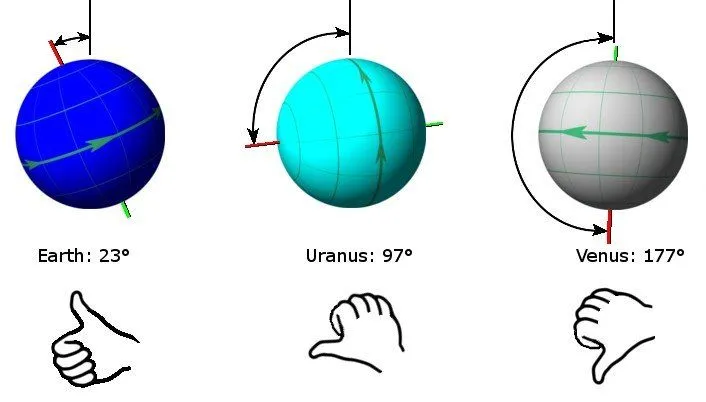
Firstly, we need to understand the importance of axial tilt, which the Moon keeps stable as it orbits the Earth. Without that steadying influence, the Earth could have ended up wobbling wildly, or in the opposite extreme, rotating almost bolt upright like Mercury, which has virtually no tilt. Due to this, there are no seasons on Mercury. On the other extreme is Uranus, with an axial inclination of about 90 degrees and a daily change of seasons. Can you imagine what it would be like to be buried in snow at 6 am, but sweating in the heat by 6pm?
Secondly, our nights would be much less illuminated. While it’s definitely dark at night, it’s the reflected light from Moon that provides us with some semblance of illumination. Now, imagine seeing the next brightest object in the night sky, Venus, which shines at well under 1/1,000th the brightness of a full moon. You wouldn’t be able to see the hand right in front of your face.
Thirdly, our tides would shrink dramatically but not vanish. The Sun would still raise tides on its own, leaving us with roughly a third of the tidal range we get today. The dramatic spring tides that come when the Sun and Moon pull together would be gone, and coastal life tuned to today’s big tides would be in for a rude shock.
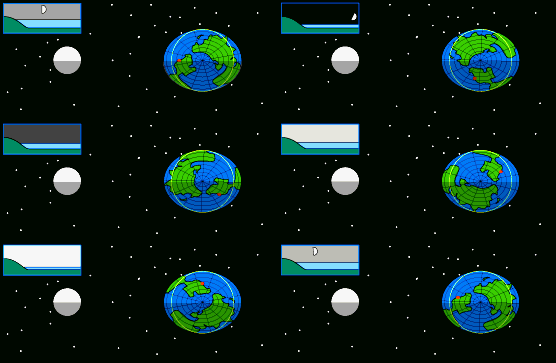
Finally, assuming that there had been no collision 4.5 billion years ago, and there was no moon, the Earth would still be rotating at its original speed. The days would be about 6 hours long, and many of you would be able to realize that crazy fantasy of doing your favorite activity, like playing, reading and sleeping, for an entire day!
References (click to expand)
- What would happen if we did not have a Moon? (Intermediate) - Curious About Astronomy? Ask an Astronomer - curious.astro.cornell.edu
- Stabilization of the Earth's obliquity by the Moon. Laskar, Joutel & Robutel, Nature (1993)
- What if the Earth had no Moon?. Rochester Institute of Technology
- Tides. NASA Science
- Moon Facts. NASA Science