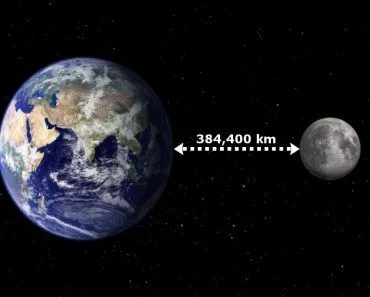
Earth’s gravity could break the Moon apart only if the Moon drifted inside Earth’s Roche limit, roughly 9,500 km from Earth’s center, where tidal forces would overpower the Moon’s self-gravity. The Moon currently orbits at about 384,400 km and is actually moving away by 3.8 cm a year, so a natural break-up is essentially impossible without an extreme external disturbance.
The Moon has been Earth’s constant companion for millions of years, and yet we often forget the many ways it affects the Earth. It is responsible for several phenomena occurring on Earth’s surface, like tides, weather patterns, stabilizing Earth’s rotation, etc.
We also know that it is slowly moving away from us. While it seems like it will eventually escape from the Earth’s gravity, the prediction is that in about 5 billion years the Sun will swell into a red giant and engulf them both before that can happen.
However, as the Moon appears smaller and the Sun gets bigger, total solar eclipses will certainly be things of the distant past.
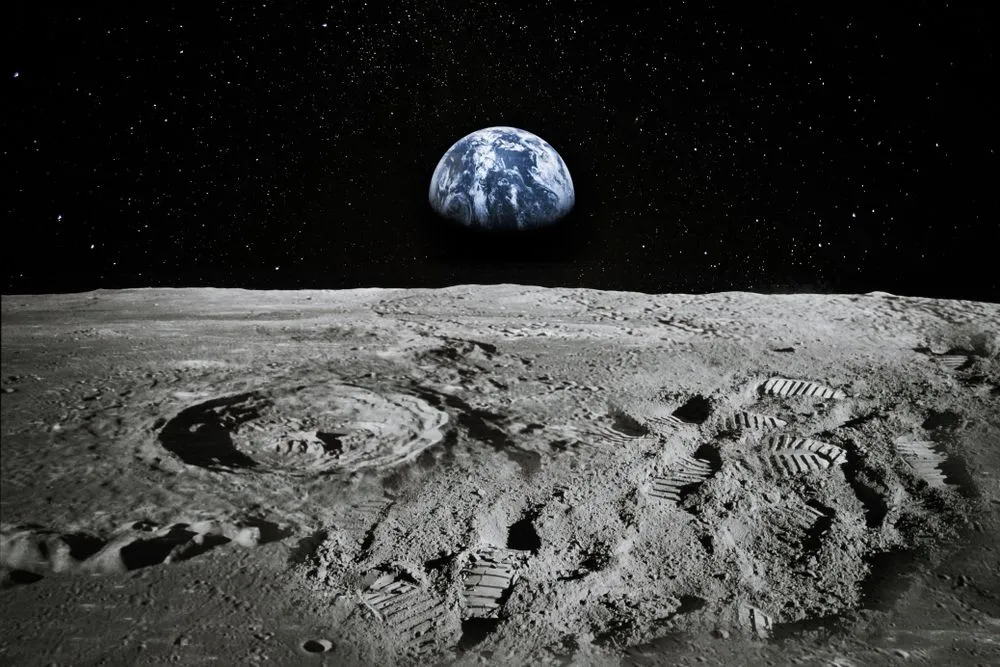
However, let’s consider another case. Is it possible for Earth’s gravity to destroy the Moon? What conditions would be needed for that to happen?
To answer this question, we must understand the concept of the Roche limit and how it is relevant for finding the point when gravity starts breaking space objects apart.
Roche Limit And Tidal Forces
To better understand the concept of the Roche limit, we need to clarify what tidal forces are and how they are relevant to this discussion.
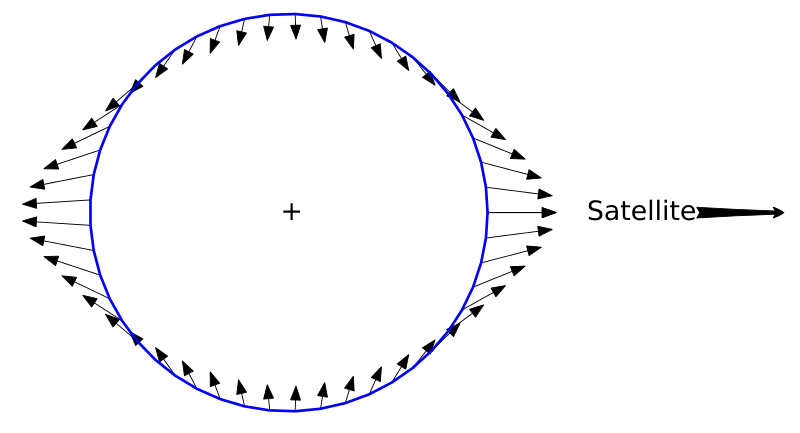
Tidal forces arise due to gravitational forces having two different values at different points on the same body.
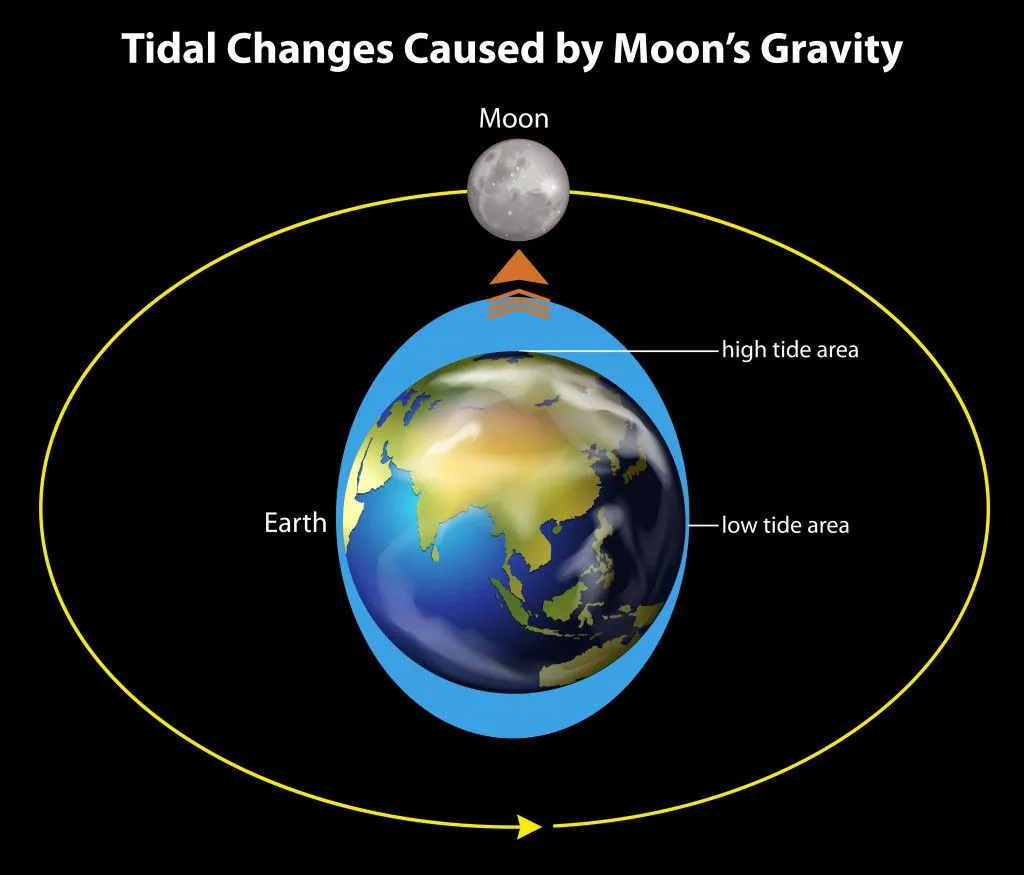
Let’s consider the Earth-Moon system first. A point on the Moon’s surface closer to the Earth will experience a slightly higher gravitational pull from Earth than a point on the far side. Once you subtract the Moon’s overall orbital acceleration, the leftover (tidal) force at the near and far points of the Moon tugs outward, while at the “top” and “bottom” of the Moon (relative to the Earth-Moon line) it squeezes inward toward the Moon’s core.
A net effect of these differences and anomalies is that the moon becomes slightly stretched along its equator and flattened along the poles. The Moon and Sun exert a similar influence on the Earth. This results in the stretching and squeezing of Earth along its equator and the poles, respectively.
Now, regarding the Roche Limit, it is the minimum distance from a planet at which any smaller object (like a moon, asteroid, etc.) can approach it without getting ripped apart by its tidal forces. If this object crosses a planet’s Roche limit, the planet’s gravity will tear that object apart into many tiny fragments.
Once an object is inside a planet’s Roche limit, the difference in the gravitational forces between the opposite ends of that object is large enough to overcome the force that keeps that object bound together. We can state that when that object is within a planet’s Roche limit, the tidal effect is strong enough to break it apart.
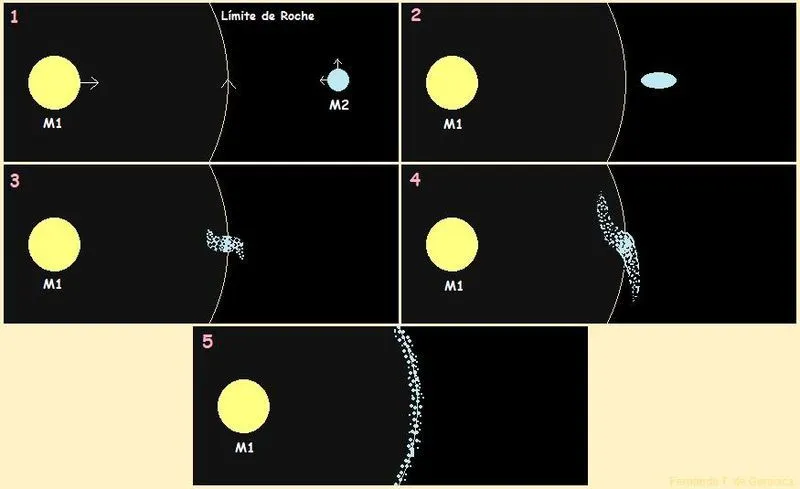
There have been several instances in our solar system where objects have entered a planet’s Roche limit and been consequently split apart.
The famous rings of Saturn might have originated that way, from a moon or another large object that crossed its Roche limit and got destroyed in the process. Saturn’s rings lie within that limit, and recent simulations published in 2022 even suggest the culprit may have been a now-vanished icy moon, nicknamed Chrysalis, that was ripped apart roughly 100 to 400 million years ago.
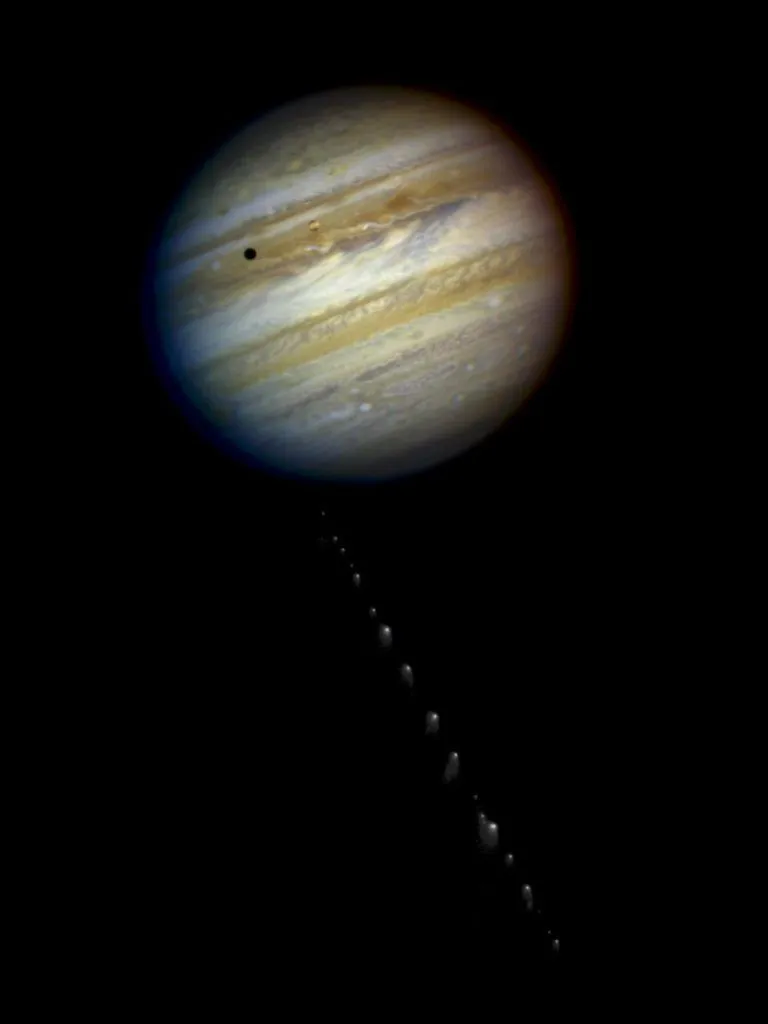
Another instance was when the comet Shoemaker-Levy 9 was broken into 21 fragments (labeled A through W) by the tidal effects of Jupiter’s gravity. The comet had already disintegrated when Carolyn and Gene Shoemaker and David Levy discovered it in March 1993. Further observations indicated that the comet had passed inside Jupiter’s Roche limit in July 1992. The string of fragments smashed into Jupiter between July 16 and July 22, 1994, releasing energy comparable to hundreds of millions of tons of TNT.
So far, we have been describing the Roche limit from a planet’s point of view. However, the fact is that every object in the Universe has its own Roche limit. Every star, planet, moon, and black hole has its own Roche limit.
Another point to note is that humans, animals, plants, satellites, and any other similar objects, while inside Earth’s Roche limit, will not get disintegrated. There can be two reasons for this.
One reason is that the Roche limit applies to gravitationally bound objects. Animals and plants are held together by chemical bonds arising from electromagnetic force. Thus, the Roche limit is not applicable here. Also, the gravitational attraction between them and the Earth is significantly small, and the tidal effects in such cases would be too weak to do anything.
Will The Moon Get Destroyed?
After discussing how gravity can disintegrate objects, we can look at the possibilities of a scenario where the Moon breaks apart due to Earth’s gravity. The Moon currently sits at an average distance of about 384,400 km, and lunar laser ranging using the retroreflectors left behind by the Apollo missions shows it is drifting away from Earth at roughly 3.8 cm a year (about the rate your fingernails grow). For comparison, Earth’s Roche limit for an object as dense as the Moon works out to only about 9,500 km from Earth’s center, with a more cautious “fluid” estimate around 18,400 km. The Moon is more than 20 times further out than even that fluid limit, so if things stand as they are, the obvious answer is that Earth’s gravity will not break it apart.
But suppose we consider a case where some massive interstellar object comes and affects the Earth-Moon system, causing the Moon to get much closer to the Earth. In this situation, it would probably disintegrate after entering the Earth’s Roche limit. If that happens, the Earth would develop a ring system similar to Saturn’s.
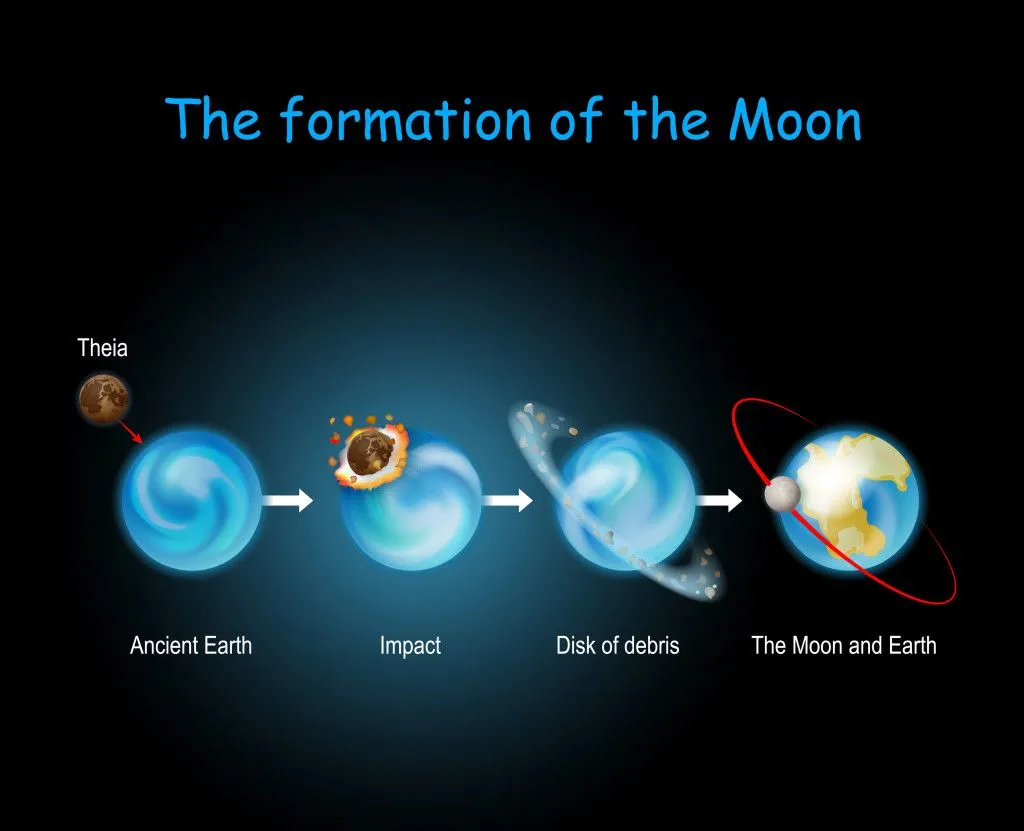
That said, this need not be the only case. If the Moon comes in too fast, it will directly crash onto Earth, since there won’t be sufficient time for Earth’s gravity to break it down. This would end most life on Earth. This scenario is similar to the formation of the Moon in the first place. About 4.5 billion years ago, a Mars-sized protoplanet (often called Theia) collided with the young Earth, and the Moon was created from the debris left after the impact.
However, it is possible that even in the previous case, large fragments of the Moon would hit the Earth, causing severe damage to all life forms and the climatic conditions for thousands of years.
How Does The Moon’s Gravity Compare To Earth’s?
A question that pops up almost as often as whether Earth could rip the Moon apart is a simpler one: how strong is the Moon’s gravity next to our own? At its surface, the Moon pulls on everything with an acceleration of about 1.62 m/s², compared with 9.81 m/s² here on Earth. That makes lunar gravity roughly one-sixth of what we feel at home, which is exactly why the Apollo astronauts could lug bulky suits around and still bounce across the surface like children.

The difference comes down to size and mass. Gravity depends on how much matter a body contains and how far you are from its centre, and the Moon loses on both counts. It holds only about 1/81 of Earth’s mass, and its radius of roughly 1,737 km is dwarfed by Earth’s 6,371 km, making our planet about 3.7 times wider. A weaker grip also means it is far easier to leave: the Moon’s escape velocity is just 2.4 km/s (about 8,550 km/h), while breaking free of Earth demands 11.2 km/s (roughly 40,300 km/h).
Does the Moon, in turn, affect Earth’s gravity? It does not change how hard our own planet pulls, but the Moon’s gravity does reach across the 384,400 km between us. In fact, the slight difference in that pull from the near side of Earth to the far side is precisely what raises our ocean tides.
What Would Happen To The Moon If Earth’s Gravity Suddenly Switched Off?
Plenty of readers arrive wondering about the opposite of a break-up: what if the gravitational tie between Earth and the Moon simply vanished? It is a favourite physics-class puzzle, and the answer tends to surprise people. The Moon would not fall toward Earth, nor would it hang motionless in the sky. It would sail off in a straight line and never come back.

The reason is inertia, captured by Newton’s first law of motion: an object in motion stays in motion, in a straight line, unless a force acts on it. The Moon is not sitting still. It sweeps around Earth at about 1 km/s (roughly 3,680 km/h), and gravity is the only thing constantly bending that sideways rush into a curve. Take gravity away and nothing is left to do the bending, so the Moon would coast off along a straight tangent at a steady speed. As physicists at Ohio State University put it, without gravity the Moon would travel about 1,000 metres in a straight line every second, instead of curving around us.
Isaac Newton pictured this with a cannon on a very tall mountain. Fire the ball gently and it drops to the ground; fire it fast enough and the ground curves away beneath it just as quickly as the ball falls, so it keeps missing Earth and circles the planet forever. The Moon is essentially that cannonball. Remove the pull that keeps it falling, and, much as in the case where things would drift off without gravity, our companion would simply glide away from Earth for good.
A Final Word
In short, it seems very unlikely that the Moon will be destroyed by Earth’s gravity. In order for that to happen, very bizarre or extraordinary situations would have to take place. While this will almost certainly not happen, the consequences would be very hard for life on Earth if it did.
It’s better that the Earth and the Moon stay just the way they are. Their relationship is responsible for the sea tides and controlling Earth’s rotation rates, tilt, and climate. If the moon did not exist, several natural events on Earth would be much more extreme. The temperatures would vary vastly, and ice ages would occur more frequently.
References (click to expand)
- Roche limit. Encyclopaedia Britannica
- The Roche Limit. The University of Maryland, College Park
- Comet Shoemaker-Levy 9. NASA Science
- Gravitational tidal field - Caltech (Tapir). The California Institute of Technology
- How does the Moon affect the Earth? | Institute of Physics. iop.org
- How the Earth and moon formed, explained - UChicago News. The University of Chicago
- What Happens as the Moon Moves Away from the Earth?. The National Radio Astronomy Observatory
- Moon: By the Numbers. NASA Science
- Orbits and Gravity. The Ohio State University