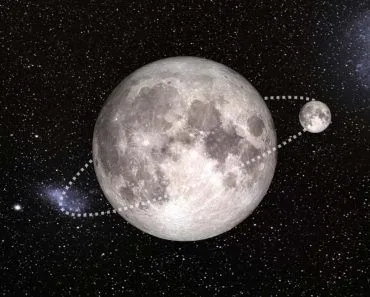
The moon is moving away from Earth because it is being pulled by the Earth’s tidal bulge. The bulge is created by the Earth’s rotation, which is faster than the moon’s rotation. The difference in rotational speed causes the bulge to push the moon into a higher orbit around Earth.
Due to its force of gravitation, the moon pulls certain parts of the Earth closer to it more strongly, creating the tidal bulge in the oceans of our planet. Since the Earth rotates much faster than the moon, this bulge occurs slightly ahead of the latter, which, due to a number of physical phenomena, pushes the moon into a higher orbit around Earth.
It’s dangerously easy to take the moon for granted. The same thing is true for the sun. However, if it weren’t for their eternal presence in our skies, life on Earth would be very, very different from what it is now, and it wouldn’t be a particularly pleasant thing for us!
However, our only natural satellite – the moon – is actually moving away from Earth. Its orbit is getting larger every year!
Effects Of Tidal Forces
The moon has been revolving around the Earth for the last 4.5 billion years. Thanks to Earth’s superior mass, it exerts a far greater gravitational force than the moon does on Earth, meaning that it pulls the moon more strongly towards itself. This gives rise to tidal forces, which cause the tides in our oceans.
The gravitational attraction between the moon and the Earth is stronger on the side of the Earth that faces the moon. Moreover, this force is the strongest in the area that is closest (has the minimum distance) to the moon.
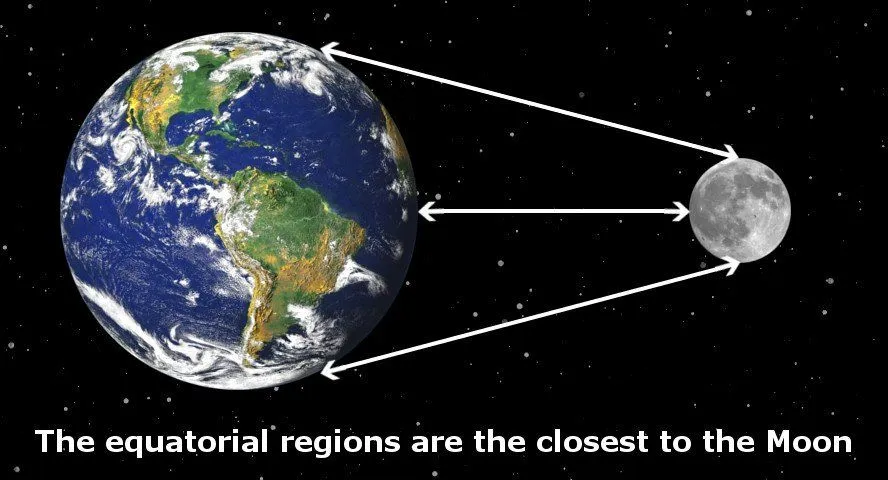
Because the moon’s gravity falls off with distance, the side of Earth closest to the moon feels a stronger pull than the planet’s center, and the far side feels a weaker pull. The net effect is to stretch Earth slightly along the Earth–moon line, raising two tidal bulges in the oceans — one on the side facing the moon, and a smaller one on the opposite side. (This is distinct from Earth’s permanent equatorial bulge, which is caused by Earth’s own rotation.)
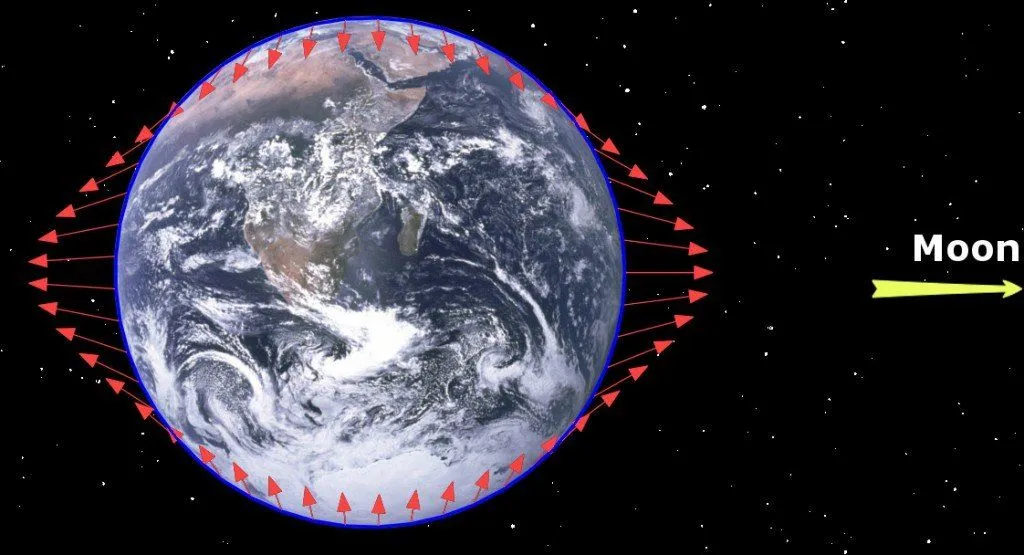
For a better visualization of this phenomenon, check out this fantastic animation depicting how the combined effect of the gravitational forces of the sun, moon and Earth create a tidal bulge on our planet.
The effect of tidal forces is experienced by both parties involved, i.e., just like how our planet experiences a bulge (note that the actual solid body of Earth is distorted only a few centimeters as a result of this bulge) caused by the moon’s gravity, the moon also experiences a tidal bulge at the side closest to the Earth.
Rotation Of The Moon And Earth
The drifting away of the moon can be attributed to the rotational motions of both the Earth and the moon. You see, Earth rotates quite fast (more specifically, it has a high rotational velocity). It completes one rotation on its axis in just 24 hours. On the other hand, the moon takes 27.3 days to complete one rotation on its axis! Obviously, the moon is far slower than the Earth when it comes to their respective rotational speeds. Here’s a gif that depicts the differences in the rotational speeds of the Earth and the moon:
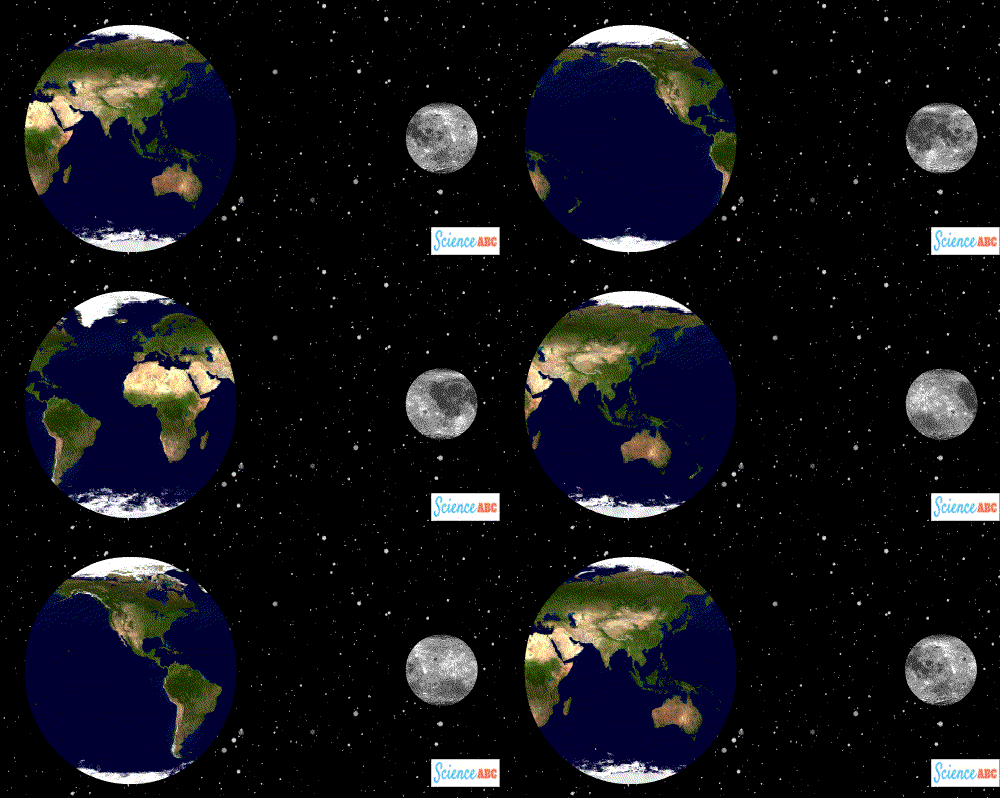
Since there is a significant difference in their speeds, the tidal bulge on Earth tries to pull the moon ahead in its orbit and tends to speed it up (albeit only slightly). As every action has an equal and opposite reaction, the moon also pulls back on the tidal bulge of Earth, resulting in a decrease in Earth’s rotational velocity.
This decrease in Earth’s rotational speed causes a loss of angular momentum (rotational energy), which is then transferred to the orbit of the moon via tidal force, making it slightly bigger every year.
The result of all this is that the moon’s orbit around Earth widens at a rate of 3.8 centimeters (about 1.5 inches) per year. Lunar laser-ranging — bouncing laser pulses off mirrors left on the Moon by the Apollo missions — measures the recession at about 3.82 centimeters per year.
Similarly, Earth’s rotation is gradually slowing. Lunar laser-ranging and ancient eclipse records put the long-term lengthening of the day at roughly 1.7 milliseconds per century — so 100 years from now, an Earth day will be about 1.7 milliseconds longer than it is today.
So yes, the moon is moving away from us, but it’s doing so really slowly, so don’t start worrying about long, moonless nights quite yet! That naturally raises a few follow-up questions: how far away is the moon to begin with, exactly how fast is it leaving, will it ever stop, and what does its slow retreat actually change for us? Let’s take them one at a time.
How Far Away Is The Moon, And Is It Even Spinning?
Before we talk about the moon drifting away, it helps to know where it is right now. On average, the moon sits about 384,400 km (238,900 miles) from Earth, measured center to center. That distance isn’t fixed, though, because the moon’s orbit is a slight ellipse: at its closest point (perigee) it comes in to roughly 363,300 km, and at its farthest (apogee) it swings out to about 405,500 km. So the moon is constantly nudging a little nearer and a little farther over the course of each month, on top of the slow, permanent retreat we’re really here to discuss.

How fast is it travelling? The moon races around the Earth at a mean orbital speed of about 1.022 km/s, or roughly 2,290 mph (3,680 km/h), completing one lap of its orbit every 27.3 days. And here’s a point that trips a lot of people up: the moon is spinning. It just spins at exactly the same rate that it orbits us, so a single rotation on its axis also takes 27.3 days. Because those two clocks are locked together, the moon keeps almost the same face pointed at Earth at all times, which is why we never see the far side from the ground. Astronomers call this neat coincidence tidal locking (or synchronous rotation), and the same tidal forces that are pushing the moon away are exactly what slowed its spin to match its orbit long ago.
How Fast Is The Moon Drifting Away, And Has It Always Been This Fast?
The headline number is small but precise. By bouncing laser pulses off reflectors that the Apollo astronauts left on the surface, a technique called lunar laser ranging, scientists have measured the moon’s recession at 38.30 ± 0.08 mm per year over the 1970–2015 baseline, which is the familiar “about 3.8 centimeters (roughly 1.5 inches) a year.” That’s close to the rate at which your fingernails grow, so the moon’s departure is genuinely glacial.
What’s less widely known is that this rate has not been constant. Reading the recession backward in time using rock records, geologists find that the long-term average over the past 620 million years was closer to 2.17 cm per year, about half of today’s figure. The present rate appears unusually high because the natural sloshing frequencies of our current oceans happen to be near resonance with the tidal pull, which makes the tidal friction unusually efficient right now. In other words, today’s 3.8 cm/year is a snapshot of a rate that changes as continents drift and ocean basins reshape, not a fixed cosmic constant. Run that backward and the moon was much closer in the deep past, which is part of why early Earth had far shorter days.
Will The Moon Ever Stop Drifting Away (Or Come Back)?
A common worry is whether the moon is sneaking off for good, or whether it might one day reverse course and fall back toward us. The short answer is that, for the foreseeable future, the moon is only moving outward; it is not getting closer, and there’s no mechanism that would reel it back in under current conditions.
In principle, the recession does have a natural stopping point. Earth’s spin keeps slowing while the moon’s orbit keeps widening, and if you let that exchange of angular momentum run to completion, you eventually reach a state called mutual tidal locking: Earth would rotate exactly as long as the moon takes to orbit, so a “day” and a “month” would be the same length (calculations put that future day at well over 40 of our current days), and the moon would hang fixed over one spot on Earth. The catch is timing. That endpoint is tens of billions of years away, far longer than the Sun has left. Long before then, in roughly 1 to 1.5 billion years, a steadily brightening Sun is expected to boil off Earth’s oceans, and without oceans there’s very little tidal friction to keep the process going. And in about 5 billion years the Sun will swell into a red giant, likely destroying the Earth–moon system entirely. So the honest answer is that the moon will never actually finish drifting away. Something else will end the story first.
What Happens As The Moon Drifts Away?
If the moon is leaving so slowly, does its retreat matter at all? Over a human lifetime, no. Over geological time, very much so. The same tidal exchange that lifts the moon into a higher orbit is steadily putting the brakes on Earth’s spin, so our days are getting longer. The long-term lengthening works out to roughly 1.7 milliseconds per century, which sounds trivial until you stack up the eons. Evidence preserved in ancient tidal sediments suggests an Earth day was only around 19 hours during a long stretch of the mid-Proterozoic, more than a billion years ago, before resuming its slow climb toward today’s 24 hours. As the moon recedes further, its gravitational grip on our oceans also weakens, which gradually softens the tides.

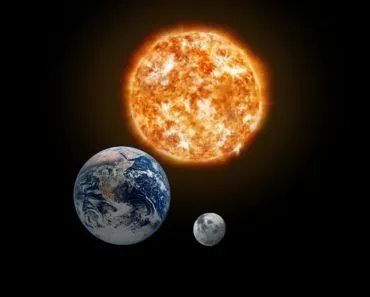
There’s also a more poignant consequence overhead. Total solar eclipses only happen because of a lucky coincidence: the Sun is about 400 times wider than the moon but also about 400 times farther away, so the two appear almost the same size in our sky, and the moon can just barely blot out the Sun’s disk. As the moon keeps retreating, it will eventually look too small to cover the Sun completely. NASA scientists estimate that in roughly 600 million years, Earth will witness its last-ever total solar eclipse, after which only partial and annular (“ring of fire”) eclipses will remain. That figure assumes the recession holds steady, which, as we saw, it may not, so the date is a ballpark rather than a deadline. Either way, total eclipses are a passing gift of this exact moment in the moon’s long, slow departure.
References (click to expand)
- Moon Facts — NASA Science
- Lunar distance — Wikipedia (with lunar laser ranging citations)
- Misconceptions about tides. - www.lhup.edu:80
- NOAA National Ocean Service Education: Tides and Water Levels - oceanservice.noaa.gov
- Tidal Locking — NASA Science
- Orbit of the Moon — Wikipedia (distance, orbital speed and period)
- Tidal acceleration — Wikipedia (recession rate and long-term fate)
- Mid-Proterozoic day length stalled by tidal resonance — Nature Geoscience
- Earth's last total solar eclipse in ~600 million years — Space.com (NASA's Richard Vondrak)