Table of Contents (click to expand)
Star Trek’s warp drive works like the real-world Alcubierre metric: rather than moving the ship through space, it contracts space-time in front of the vessel and expands it behind, carrying a “warp bubble” faster than light while the ship sits still inside. It remains theoretical because it would require exotic negative-energy matter we don’t know how to make.
Star Trek has given us some very memorable characters and story arcs over the years. I don’t think anyone would ever be able to forget Nimoy’s distinguishable character of Spock or the iconic USS Enterprise. Star Trek gave us a glimpse of what the world could be like if we leave this galaxy we call home and explore realms in the farthest parts of the universe. But how exactly were Kirk and his crew able to travel to such vast distances in the universe for their adventures? Warp Drive!

Why Warp Drive?
Before talking about how the Warp Drive works, we need to understand why those cosmic explorers needed it in the first place; for that, we first have to wrap our minds around the size of the universe (spoiler alert: it’s huge).
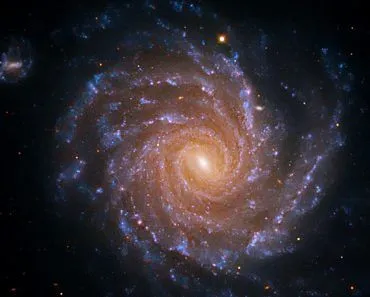
The closest known galaxy to us, the Canis Major Dwarf, sits around 236,000,000,000,000,000 km (roughly 147,000,000,000,000,000 miles) away (that’s more zeros than I can count on my fingers). Astronomers still argue over whether it’s a true dwarf galaxy being shredded by the Milky Way or just a clump of stars in our own galactic disk, but either way the distance gives us a useful yardstick. Now, simply throwing out a figure doesn’t help you picture how huge such a distance is, so I’ll try to give some context.
The farthest that humans have ever traveled in space is about 406,772 km (252,756 miles), the record set by NASA’s Artemis II crew during their lunar flyby on April 6, 2026 (narrowly beating the Apollo 13 mark of 400,171 km that had stood since 1970). Impressive as that sounds, it’s only around 0.00000000017% of the distance to the nearest galaxy.
To be able to cover such large distances in a reasonable span of time, we need to travel very fast, and according to Einstein (always there to ruin the fun) there is a limit to how fast we can travel. That limit is the speed of light. So, assuming that we find a way to travel at the speed of light, which is around 300,000 km/sec (or 186,000 miles/sec), it would still take 25,000 years to reach our nearest galaxy.

This is where Warp Drive comes in, because it can help us travel faster than the speed of light, which is how Kirk and his crew don’t just visit those nearest galaxies, but go much farther than that!
What Is Warp Drive?
If Einstein is firmly standing with a speed limit sign on the interstellar highway, then how does Warp Drive manage to go faster than that speed? Well, there is a catch to Einstein’s limit. Technically, the law states that no information can travel faster than the speed of light. And what is information? Information is anything that consists of energy or matter. Humans and our spaceships are made of energy and matter, and thus we qualify as information.
So how does Warp Drive exploit this law? Well, it makes use of the one thing that doesn’t count as information: space-time. In general relativity, space and time are interconnected. One cannot exist without the other. They are the two sides of the same coin. Space-time in itself does not contain any information. Although it is imagined and visually conceived as a fabric, it is purely hypothetical.

Since space-time has no physical significance and does not count as information, it can be made to accelerate faster than the speed of light. Imagine a surfer surfing on the waves of the ocean. The surfer himself does not travel anywhere, but simply rides the wave that is traveling in the ocean. In the case of the Warp Drive, the ocean is space-time, the wave is the Warp Drive bubble, and the surfer is the spaceship.
How Does It Work?
Now that we have some gist of what Warp Drive is, let’s dig in to how it works. Just like a wave in the ocean, one creates two waves in space-time, one in front of the ship and the other behind the ship. Space-time is contracted in front of the ship and expanded behind it, effectively folding space so the destination is dragged closer while the journey home is stretched out. This can be seen clearly in the illustration.
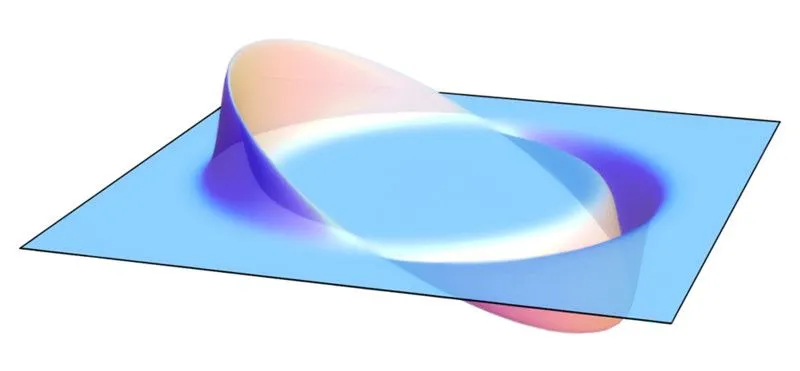
We can intuitively understand that the wave in the front would pull the ship while the wave behind would push it. Now, it’s all fun to just talk about bending space-time, but how does it actually happen? Where does this idea come from? Does it have any origin in Physics? Well, Miguel Alcubierre, a theoretical physicist from Mexico (and a huge fan of Star Trek) was troubled by the same question, which was when he came up with the idea of the Alcubierre Drive.
The Alcubierre Drive is a way of formalizing a Warp Drive using a certain set of solutions for the Einstein Field Equations (the equations of general relativity that describe how mass and energy curve space-time; in everyday, low-gravity situations they collapse back down to Newton’s familiar law of gravitation, but they hold in far more extreme scenarios too). Alcubierre found a solution to these equations in which the physical scenario is a Warp Drive bubble. The solution is nothing but a metric that, in a simple sense, gives the information about what shape the space-time would have in a certain range.
When the spaceship is inside this bubble, created by the Alcubierre metric, even though it stays in its place in its own frame of reference, the bubble around it moves faster than the speed of light and takes the spaceship with it. Since the spaceship itself isn’t moving, it does not experience relativistic effects, such as time dilation and length contraction. This is why the characters in Star Trek do not age differently while traveling at such high speeds (imagine having to cast an increasingly older man every single time McCoy travels to some other galaxy).
So why aren’t we already zipping between galaxies? Here’s the catch that Alcubierre himself pointed out: to contract space-time in front of the ship, his metric needs a region of negative energy density, the kind that would come from hypothetical “exotic matter.” Nobody has ever found or made such matter in bulk, and early estimates suggested you’d need an amount of negative energy comparable to the mass-energy of the entire observable universe. Later refinements trimmed that number, but it stayed wildly impractical.
The story isn’t completely hopeless, though. In 2021, physicist Erik Lentz argued that carefully shaped “soliton” waves could in principle produce a warp bubble using only ordinary positive energy, and the same year Alexey Bobrick and Gianni Martire laid out a general framework for warp-drive geometries that don’t demand exotic matter. The energy budgets involved are still astronomical (think planet-sized masses), so a real warp drive remains firmly in the realm of theory, but these results suggest the idea may not be as physically forbidden as once thought.
Conclusion
In theory, a Warp Drive can be constructed by manipulating a localized area of space-time, according to the metric created by Alcubierre. The Warp Drive from Star Trek works on this very principle and gives us (and Kirk’s crew) a way to cover vast intergalactic distances. For now the exotic matter and colossal energy it would take keep it strictly on the drawing board, but the math is real, and recent work hints that the idea might not be impossible forever. The next time someone scolds you for watching yet another sci-fi movie, tell them that you’re trying to figure out a way to make it all real… that’s what Alcubierre did!
References (click to expand)
- Alcubierre, M. (1994, May 1). The warp drive: hyper-fast travel within general relativity. Classical and Quantum Gravity. IOP Publishing.
- González-Díaz, P. F. (2000, July 14). Warp drive space-time. Physical Review D. American Physical Society (APS).
- The Nearest Galaxies - Imagine the Universe! - NASA. The National Aeronautics and Space Administration
- NASA’s Artemis II Crew Eclipses Record for Farthest Human Spaceflight. The National Aeronautics and Space Administration.
- Lentz, E. W. (2021). Breaking the warp barrier: hyper-fast solitons in Einstein-Maxwell-plasma theory. Classical and Quantum Gravity. IOP Publishing.
- Bobrick, A., & Martire, G. (2021). Introducing physical warp drives. Classical and Quantum Gravity. IOP Publishing.