Table of Contents (click to expand)
No amount of water could put out the Sun. The Sun is not a chemical fire but a ball of nuclear fusion, so it does not need oxygen and cannot be smothered. Pouring water on it would only split the water into hydrogen and oxygen and feed the reaction, making the Sun heavier, hotter and brighter rather than snuffing it out.
We usually perceive the Sun as being a huge ball of fire that has been burning away for an eternity to provide us with warmth, light and life. However, what if, hypothetically speaking, we wanted to put out the Sun? To our meager human minds, the best way to extinguish a fire is to pour water on it, so what would happen to the Sun if we managed to find a large enough amount of water to snuff it out?
Nuclear Fusion
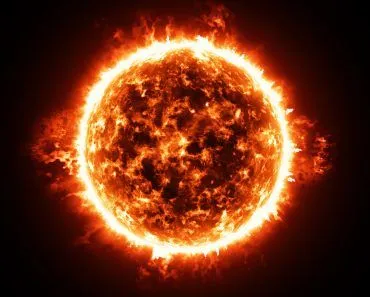
As it happens, the Sun is not a ball of ‘fire’, per se, at least not the kind of fire that we find on Earth. The Sun has a very different source of fuel that keeps it chugging along at the heart of the solar system. That fuel-driven process is nuclear fusion.
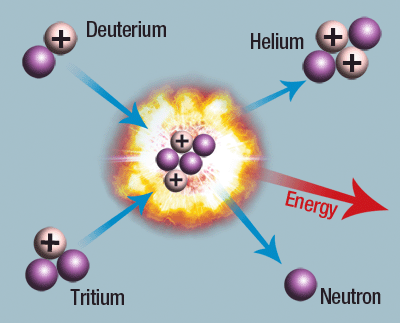
To put it simply, nuclear fusion is when, under immense pressure, hydrogen atoms combine to form helium atoms. Before we get any further, let’s try and understand the basic principle of how nuclear fusion works.
First and foremost, nuclear fusion is extremely difficult to recreate on Earth, as it can take place only under extreme conditions. With a pressure of around 250 billion times the air pressure at sea level on Earth and a temperature of about 15 million degrees Celsius (27 million degrees Fahrenheit), calling the Sun’s core ‘extreme’ would be a gross understatement. Hydrogen atoms succumb to the pressure and fuse with each other to form helium, consequently giving off neutrinos, positrons and gamma rays. The net mass of the fused helium nuclei is therefore much smaller than the sum of its constituents and the lost mass is released as pure solar energy.
How Does Water Affect Nuclear Fusion?
Imagine if we somehow managed to find a source of water in the same volume as that of the Sun. Impossible, I know, but hypothetically, let’s assume that we can generate that much water. Considering that it would be exposed to outer space, that that water would be dead frozen, but what would happen if we pushed that ball of ice towards the Sun? Would the Sun receive its own version of the ice bucket challenge?
Of course, the water would evaporate the second it neared the Sun’s atmosphere and dissipate. That would therefore be your first hurdle – somehow directing an incredible amount of water vapor towards the Sun’s core. Assuming you manage to do that, does that mean that the Sun would be extinguished by an equal amount of water vapor?
As it happens…. no. The Sun is far too extreme for that to occur. The water vapor would break down even further to its essentials, i.e., hydrogen and oxygen.
Now remember, the main fuel for nuclear fusion is hydrogen atoms, so instead of snuffing out the Sun, you just gave it even more fuel! Congratulations, you did the exact opposite of what you envisioned.

The kind of nuclear fusion that powers the Sun is called the proton-proton chain, and it accounts for roughly 99% of the Sun’s energy today. Other kinds of fusion do exist in the universe, taking place in stars that have chemical compositions different than that of the Sun. One of these is the carbon-nitrogen-oxygen (CNO) cycle, which already supplies about 1% of the Sun’s energy but takes over completely in heavier, hotter stars. Dumping in all that water would deliver a fresh load of both hydrogen and oxygen, and because water is far less dense than the Sun, that Sun-sized volume would leave the Sun roughly 1.7 times heavier than before. That extra mass and oxygen are exactly what the CNO cycle needs to take charge.
With the CNO cycle running and that kind of increased mass, you would get a hotter F-type star about 1.3 times the radius and 6 times the luminosity of the present Sun, with a surface temperature near 7,200 degrees Celsius (13,000 degrees Fahrenheit) instead of the current 5,500 degrees Celsius (9,900 degrees Fahrenheit). Instead of its normal healthy yellow glow, our Sun would burn a harsh white and pour out far more ultraviolet radiation. And we would all be fried to death, because the Earth would be soaking up roughly 6 times as much energy as it does today.

So, probably not a great idea.
Is There Actually Water On The Sun?
Here is a twist that sounds like it belongs in a riddle: even though water cannot survive anywhere near the Sun’s ferocious core, there really is water on the Sun. Not liquid water, of course, and not oceans, but genuine H2O molecules, and we have the spectral fingerprints to prove it.

The catch is where you look. The Sun’s visible surface, the photosphere, sits at about 5,500 degrees Celsius (roughly 5,800 Kelvin), which is far too hot for a fragile molecule like water to hold together. But the Sun is not uniformly hot. Sunspots, those dark blemishes that drift across its face, are cooler magnetic islands where the temperature drops to around 3,300 Kelvin (about 3,000 degrees Celsius). That is still hot enough to boil iron, yet it is just cool enough for water molecules to briefly hang together as superheated steam.
In 1995, a team led by Lloyd Wallace and Peter Bernath aimed a high-resolution infrared spectrometer at a sunspot and found a dense forest of absorption lines that matched hot water vapor, publishing the results in the journal Science under the wonderfully blunt title “Water on the Sun”. Two years later, another group finally decoded the fiendishly complicated spectrum of superheated water, confirming the identification beyond doubt. So while you certainly cannot pour water on the Sun to put it out, the Sun has quietly been hoarding tiny traces of its own all along. If you are curious about how we work out what the Sun is made of, reading these spectral fingerprints is exactly the trick.
Better Solution
The good news, if you can call it that, is that hotter and heavier stars like this burn through their fuel far faster than slow, steady stars like our Sun. Where the Sun has a lifespan of roughly 10 billion years, a beefed-up version like this would last only a couple of billion years before swelling into a red giant and finally collapsing into a white dwarf. (It would still be nowhere near the roughly 8 solar masses a star needs to go out as a supernova.) So, on the cosmic calendar, you would have shortened the Sun’s life and eventually killed it, but only through a long, slow process of revenge rather than a quick and dramatic death.
However, that’s not what you wanted, right? You wanted to destroy the Sun completely!
There is actually one way to do it, but it would require the same ridiculous amount of water that we proposed using before. This time however, we would have to rev up that same water and hurl it straight into the Sun at nearly the speed of light. This won’t ‘extinguish’ any fires, no, but it would certainly challenge the gravitational integrity of the Sun. This could cause the Sun to break apart and practically destroy the big ball of fiery gas.
You don’t necessarily need water to do this, though. Anything can come in like a wrecking ball and switch off the Sun.

Of course, that would also mean that all life would freeze and the planets would be aimlessly flung into the universe without the Sun’s gravity to hold them together.
So, as a thought experiment, it’s certainly interesting, but in practicality, it would be suicide!
References (click to expand)
- How Much Water Would Extinguish the Sun? - Universe Today. Universe Today
- How Much Water Would It Take To Extinguish The Sun? - futurism.com
- Could the Sun Be Extinguished By a Bucket of Water Just As .... Gizmodo
- Let me ask you this: If we pour a sun-sized bucket of water on the Sun, will it go out? - The Independent
- How large would a bucket of water have to be to put out the sun? - West Texas A&M University
- Water on the sun (Wallace et al., 1995, Science) - PubMed
- Water Found on Sun - Stanford Solar Center