Yes, spaceships can explode in space — but only if they carry their own oxidizer (like the liquid oxygen on board a SpaceX Starship). The blast looks nothing like the movies: a brief spherical flash, no persistent fireball, no rising smoke, and a debris cloud that keeps moving outward forever because there’s no air to slow it down. Real footage of Starship test failures (2023–2025) shows it perfectly.
There are plenty of things about Hollywood blockbusters that are hard to believe, and every new space epic — from the latest Star Wars spin-off to Zack Snyder’s Rebel Moon — drags the same piece of movie magic back into question. When those starships are battling in outer space, shooting lasers in every direction, we see tiny fighters zooming in and around explosions, while unlucky ones catch a stray blast and blow up in dramatic fashion. Real footage from SpaceX’s Starship test flights, several of which exploded spectacularly during ascent in 2023–2025, gives us actual reference material — and it looks nothing like the movies.
It makes for great cinema, but what’s the reality behind it? What would an explosion really look like in space?
A Very Different Type Of Explosion
An explosion, as we commonly understand it, is a rapid outburst of gas, heat and pressure as a material releases its stored energy. The "rapid" part is what separates an explosion from ordinary burning, and on Earth, the burning bit is what produces the iconic fireball.
That fireball is the real point of contention, because it arises from the burning of flammable gas or liquid together with an oxidizer. Fire is usually described by the "fire tetrahedron": fuel, heat, an oxidizer (oxygen, on Earth) and a self-sustaining chemical chain reaction. This basic list of "ingredients" is why fire is likely the first chemical reaction humans ever experienced, and yet it still fascinates us to this day.
Many people would argue that explosions and fireballs can therefore not exist in space, because it is a vacuum, without oxygen. Therefore, the belief is that fuel and heat may exist in space, but without the requisite oxygen, fire wouldn’t form. The thing is, that isn’t completely true.
An oxidizer is required for a fire to exist, and "oxidizer" is actually a much broader class of substances than just oxygen. On Earth, the most readily available oxidizer is oxygen, which is why we think a fire "needs" oxygen to survive. However, if a spaceship carrying its own liquid oxygen — paired with liquid hydrogen, like NASA’s SLS, or with liquid methane, like SpaceX’s Starship and Blue Origin’s New Glenn — happened to rupture, that onboard oxidizer would happily combust with the fuel and produce a real explosion.
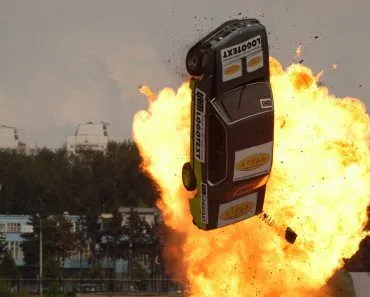
The explosion would look very different, however. The debris from the explosion would be forced outward in every direction from the center of the blast, and continue moving in a straight line without any atmospheric force to stop it. Smoke wouldn’t go "upwards" — there’s no buoyancy in microgravity — and any sustained burning would form spherical flames rather than the teardrop shape we see on Earth (NASA’s FLEX experiments on the ISS even discovered "cool flames" that can persist invisibly in microgravity in ways impossible down here). But the full-speed shrapnel flying in every direction arguably makes explosions even more dangerous in space.
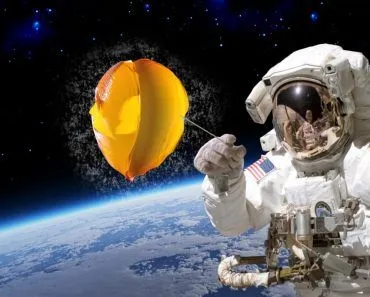
An explosion in space would realistically look like a brief, expanding spherical flash of light and hot gas, followed by a permanently expanding cloud of debris and droplets that travels outward without slowing down (energy and light both travel just fine in a vacuum). For a moment, the area around the exploding ship would no longer be a vacuum, given the outpouring of oxidizer from the ship. It would take only an instant for the pressure to rebalance and for the fuel to be burned up. As soon as the available oxidizer was used up, that would be the end of combustion and any "fire", but the force of the blast would still be significant — and the debris field would persist.
When it comes to an exploding spaceship, however, most movies miss one important aspect. The explosion would continue forward at the same velocity as the ship was moving, considering that all the ejecta and materials involved in the explosion wouldn’t have any atmospheric force to stop it. This is one detail that most movies skip, typically showing things becoming stationary once they “blow up”.
What Would An Explosion In Space Actually Look Like?
So if you stripped away the Hollywood orange-and-black, what would your eyes actually register? In the first instant, you would see a brief, intensely bright sphere of light as the released energy heats the escaping gas to incandescence. Light needs no medium to travel, so the flash itself reaches you perfectly well across the vacuum. But that flash is fleeting. With no surrounding air to keep feeding the reaction, the glow dies almost as soon as the onboard oxidizer is used up.

What follows is the part movies always get wrong. There is no rolling fireball, no churning black smoke and nothing that "billows", because billowing requires hot gas rising through cooler, denser air, and in microgravity there is no "up" for it to rise toward. Instead, you would see an expanding shell of glowing droplets and shrapnel, spreading outward in a near-perfect sphere from the point of the blast. And because nothing slows that debris down, the cloud just keeps growing and drifting, carried along on whatever trajectory the ship already had.
We actually have a real reference image for a high-energy blast near the edge of space. When the 1.4-megaton Starfish Prime device was detonated 400 km (250 mi) above the Pacific in 1962, observers did not see a mushroom cloud at all. They saw a searing flash, then a shimmering artificial aurora and a red sky-glow that lingered for the better part of an hour, visible from Hawaii to New Zealand. That eerie, silent light show is far closer to the physics of a space explosion than anything you will see in a space opera.
Can You Hear An Explosion In Space?
Here is the detail that even the visual cues miss: in a real space battle, you would not hear a single thing. Sound is a mechanical wave, which means it travels only by squeezing and stretching the particles of a medium, passing the disturbance from one molecule to the next. Air does this job for us constantly. A true vacuum has essentially no particles to pass the vibration along, so the sound wave has nowhere to go. The explosion could be enormous, and to a nearby observer it would still be utterly silent.

This is exactly why a famous physics question, "in a sci-fi movie a nearby ship explodes and you hear it on your own ship, is that realistic?", has a flat answer: no. The flash would arrive at the speed of light, but the "boom" never would. It is also why astronauts and spacecraft talk to each other and to mission control using radio waves rather than shouting. Radio is electromagnetic, like light, so it crosses the vacuum just fine, whereas a spoken word would die the instant it left an air-filled cabin. For more on this, see our piece on whether there is sound in space at all.
There is one genuinely strange exception, and it is not in any movie. Space is not a perfect vacuum. A galaxy cluster is wrapped in a vast cloud of thin, hot gas, and that gas is a medium. In the Perseus cluster, NASA's Chandra X-ray Observatory found that pressure waves rippling out from the central supermassive black hole behave like sound, registering as a note roughly a B-flat about 57 octaves below middle C, a pitch far too low for any human ear. In 2022, NASA scaled those real ripples up into our hearing range and released them as an audible "song of the black hole". So sound technically can travel through space, just not in the empty stretch where a starship duel would actually take place.
What About Chemical And Nuclear Explosions?
Chemical explosions are slightly different from the physical ones we are used to seeing in Earth-based movies. Most military and industrial high explosives — TNT, RDX, HMX, PETN, nitroglycerin — are self-oxidizing: the oxygen they need is already chemically bound inside the molecule (usually in nitro or nitrate groups). When detonated, the molecule rapidly tears itself apart, with its own bound oxygen reacting with its fuel atoms, so no air is required for the reaction.

Nuclear explosions have actually been tested quite extensively in space, most famously in the Starfish Prime test on July 9, 1962. With a yield of about 1.4 megatons of TNT, that nuclear detonation occurred 250 miles above Johnston Atoll. That resulted in much more than a "brief" flash of light: the bright artificial aurora was visible for several minutes, and a red sky-glow lingered for nearly an hour across the Pacific, observed all the way from Hawaii to New Zealand.
Similar to chemical explosives, fission reactions don’t require oxygen, and they create an intense amount of light and energy. But a nuclear explosion in vacuum looks nothing like one in atmosphere: there’s no fireball, no mushroom cloud and essentially no shockwave, because all of those are atmospheric phenomena. Most of the bomb’s energy comes out as X-rays, gamma rays and high-velocity particles, with only a brief, intense flash of visible light. Think about it this way: the Sun is constantly running fusion reactions, and both fission and fusion can drive nuclear explosions — the most powerful weapons ever built (thermonuclear or "hydrogen" bombs) use fission to ignite a much larger fusion reaction. The Sun doesn’t blow itself apart only because its enormous gravity holds the fusion in stable equilibrium.
We don’t even have to imagine what this looks like. Several SpaceX Starship test flights between 2023 and 2025 — IFT-1, IFT-2, IFT-7, IFT-8 — ended with the methalox vehicle exploding during ascent or after stage separation, sometimes high in the upper atmosphere where the blast already behaves more like one in vacuum. The footage shows exactly what physics predicts: a brilliant but short flash, an expanding cloud of debris travelling on the original ballistic trajectory, no rising mushroom cloud. The Russian anti-satellite test in November 2021, which destroyed the defunct Cosmos 1408 satellite, is the cleanest counter-example to Hollywood: no movie-style fireball, just a permanent cloud of more than 1,500 trackable debris pieces in low Earth orbit, dangerous enough that the ISS crew had to shelter in their escape capsules.
To summarize, explosions can definitely happen in outer space, but they depend entirely on the chemical and physical conditions of what is exploding. Most blasts would last for a much shorter duration and would be far less cinematic than the version we see in Hollywood action flicks.
Sorry… didn’t mean to burst your Star Wars bubble!
References (click to expand)
- What Happens If a Nuclear Weapon Goes Off in Space? - Scientific American
- NUCLEAR WEAPON EFFECTS IN SPACE - NASA History. The National Aeronautics and Space Administration
- Cool Flames Created During a First for International Space Station Research - NASA
- How does sound travel through space? - Smithsonian National Air and Space Museum
- Data Sonifications: Black Holes - NASA Science