Table of Contents (click to expand)
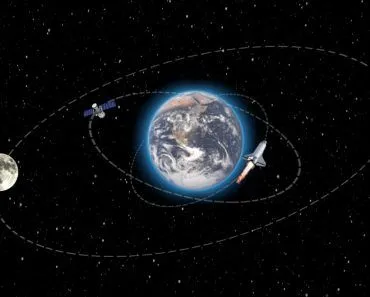
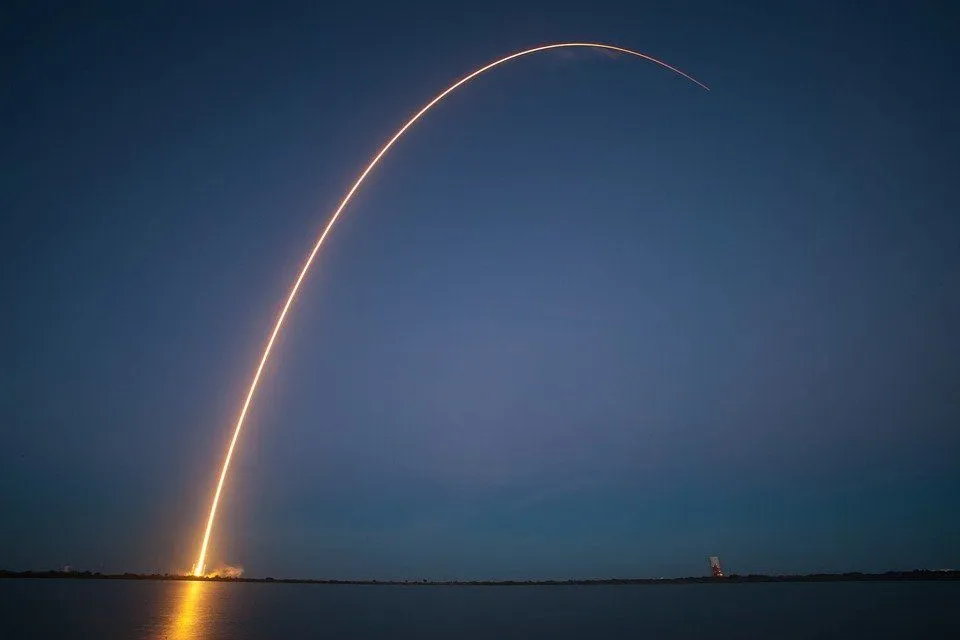
Escape velocity is the minimum speed an object needs to break free of a celestial body’s gravity for good, without ever falling back. It is given by the formula vesc = √(2GM/r), where M is the body’s mass and r is the distance from its center. For Earth it works out to about 11.2 km/s (25,020 mph); for the Moon, only 2.38 km/s.
Contrary to popular wisdom, the moon does have an atmosphere, which is technically called an exosphere. It is so incredibly thin and sparse that its particles seldom collide. The reason why it’s so thin is that, unlike Earth, the moon’s gravitational pull is so incredibly weak, that it cannot hold onto the gases that hover above it or exude from its craggy interior.
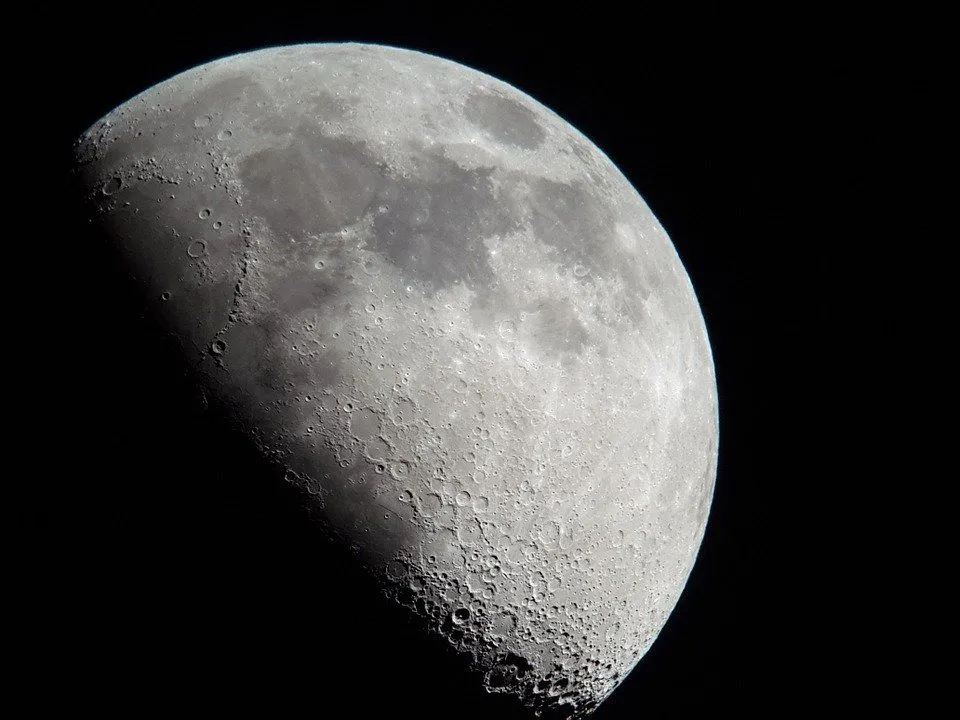
The majority of the gas particles the lunar rocks release dart upwards at a velocity that is greater than the moon’s escape velocity – the minimum velocity an object must have to escape a celestial body’s gravitational field permanently, or without ever falling back again.
Escape Velocity
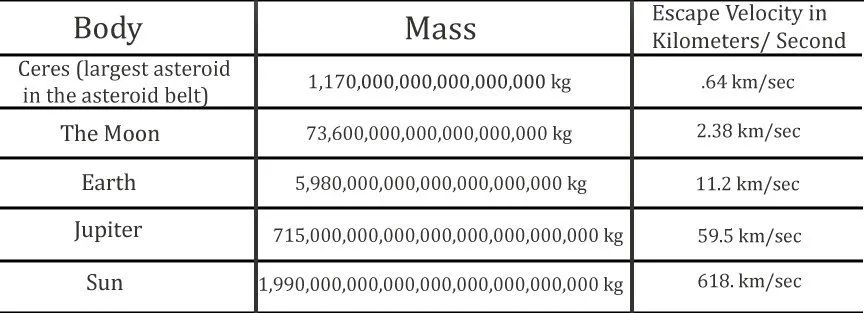
Now, because the gravitational strength of a body is a function of its mass, it is obvious that massive celestial bodies are much harder to escape. Naturally, Earth’s escape velocity (11.2 km/s) is much greater than the Moon’s (2.38 km/s), but much less than that of Jupiter, which boasts the highest escape velocity of any planet in the Solar System at about 59.5 km/s, thanks to its massive size.
One consequence of the velocity’s dependence on mass is the paradoxical problem we face while sending a probe to planets more massive than Earth. The probe must carry a huge surplus of fuel because the amount of fuel it must combust to take off and escape that newly explored planet is drastically greater than the amount it combusted to take off and escape Earth. However, when it totes this extra fuel along on the trip, it becomes heavier and therefore more difficult to accelerate to Earth’s escape velocity.
Escape Velocity Equation
An object can escape a celestial body of mass M only when its kinetic energy is equal to its gravitational potential energy. The kinetic energy of an object of mass m traveling at a velocity v is given by ½mv². The gravitational potential energy of this object, by definition, is a function of its distance r from the center of the celestial body. This is given by GMm/r, where G is the Gravitational constant, whose CODATA-recommended value is 6.674 × 10⁻¹¹ N·m2·kg−2. Equating the two, we get:
½mv2 = GMm/r
vesc = √(2GM/r)
One can substitute different values of M and r in this equation to determine the escape velocity of different celestial bodies. The dependence on r also implies that objects high above the body’s surface find it easier to escape than objects resting on it. This is obvious because the strength of a planet’s gravitational pull decreases as we move away from its surface.
Lastly, one can infer from the equation that a planet’s escape velocity is independent of the object’s mass. This is counterintuitive, but whether it is a dinosaur or a turtle, it must travel at 11.2 km/s (neglecting air resistance) to escape Earth! Acceleration, however, is a function of mass, so even though the dinosaur escapes at the same velocity as the turtle, accelerating it to 11.2 km/s is much more difficult than accelerating the turtle to the same velocity.
What Is the Escape Velocity of Every Planet?
Because escape velocity scales as the square root of a body’s mass divided by its radius, every planet has its own value, and the spread is enormous. The gas giants, swollen with hydrogen and helium, sit at the top, while the small, rocky worlds barely hold on to anything at all. Here are the surface escape velocities for the eight planets, plus the Moon, Pluto and the Sun, taken from NASA’s Planetary and Sun fact sheets.

| Body | Escape velocity (km/s) | Escape velocity (mph) |
|---|---|---|
| The Sun | 617.6 | 1,381,600 |
| Jupiter | 59.5 | 133,100 |
| Saturn | 35.5 | 79,400 |
| Neptune | 23.5 | 52,600 |
| Uranus | 21.3 | 47,600 |
| Earth | 11.2 | 25,000 |
| Venus | 10.4 | 23,300 |
| Mars | 5.0 | 11,200 |
| Mercury | 4.3 | 9,600 |
| The Moon | 2.4 | 5,300 |
| Pluto | 1.1 | 2,500 |
So Jupiter has the highest escape velocity of any planet, at roughly 59.5 km/s, while Pluto (now classed as a dwarf planet) has the lowest at about 1.1 km/s. The Sun dwarfs them all at 617.6 km/s, more than 50 times Earth’s, which is why hurling matter clear of it takes such ferocious speeds. One subtlety: the gas giants have no solid ground, so their quoted figures are measured at the 1-bar pressure level deep in their atmospheres rather than at a true surface. The values ignore atmospheric drag, which a real spacecraft would still have to fight through.
How Do You Calculate Escape Velocity? A Worked Example
Calculating escape velocity is just a matter of plugging three numbers into vesc = √(2GM/r): the gravitational constant G, the body’s mass M, and the radius r from its center to where you start. Let’s run the numbers for Earth and see whether the famous 11.2 km/s falls out.

We use G = 6.674 × 10⁻¹¹ N·m2·kg−2, Earth’s mass M = 5.97 × 1024 kg, and Earth’s mean radius r = 6.37 × 10⁶ m. Substituting:
vesc = √(2 × 6.674 × 10−11 × 5.97 × 1024 ÷ 6.37 × 10⁶)
The quantity inside the root works out to about 1.251 × 10⁸ m2·s−2. Taking the square root gives roughly 11,185 m/s, or 11.2 km/s (about 25,020 mph), exactly the figure quoted everywhere. Notice that the object’s own mass never appears, which is why escape velocity is the same for a pebble and a probe. Swap in the Moon’s mass (7.35 × 10²² kg) and radius (1.74 × 10⁶ m) and the same formula returns about 2.37 km/s, matching the value we met earlier. Because r sits under the root as well, launching from a mountaintop or from orbit lowers the speed you need, since you start farther from Earth’s center where gravity has already weakened.