The moment of inertia (I) of a thin uniform rod of mass M and length L depends on where the axis of rotation sits. For an axis through the rod’s centre of mass and perpendicular to its length, I = (1/12)ML². For an axis through one end and perpendicular to the rod, I = (1/3)ML². Both results follow from integrating r² dm along the rod.
Moment of inertia (I) of a thin uniform rod: I = (1/12)ML² for an axis through its centre, and I = (1/3)ML² for an axis through one end. Derived by integrating r² dm. It is denoted by ‘I’. Similarly, the ‘moment of force’ is the rotational equivalent of linear force, also known as torque.
How Do We Calculate Moment Of Inertia?
The moment of inertia ‘I’ of a point mass rotating about an axis is given by the product of its mass and the square of its distance from the axis of rotation. This simple I = mr² form is exact only for an idealized point mass, such as a small orb attached to a string whirling around at a certain angular velocity (where the size of the orb is negligible compared to the radius).
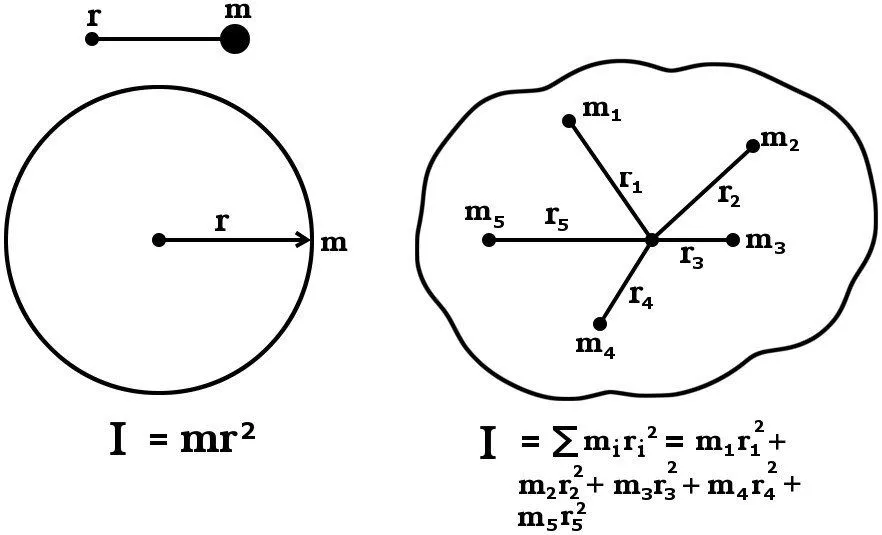
For any extended object, the moment of inertia is calculated by summing the products of each individual point mass and the square of its distance from the axis of rotation. This generalized relationship can be used to calculate the moment of inertia of any system, since any object can be constituted as an aggregation of point masses.
To calculate the moment of inertia of such a continuous distribution of mass at various distances, we use calculus, due to its dexterity with continuous variables.
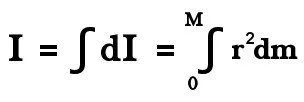
We use a differential element of mass, an infinitesimal chunk of mass dm. The differential moment of inertia is then, dI = r²dm. To calculate the moment of inertia ‘I’ of the whole of mass ‘M’, we sum the differential moment of inertia dI contributed by dm throughout the surface. Or simply, we integrate.
Moment Of Inertia Of A Rod
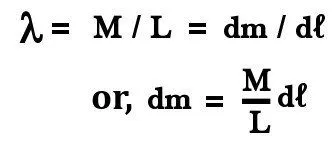
Consider a rod of mass ‘M’ and length ‘L’ such that its linear density λ is M/L. Depending on the position of the axis of rotation, the rod illustrates two moments: one, when the axis cuts perpendicular through the center of mass of the rod, exactly through the middle; and two, when the axis is situated perpendicular through one of its two ends.
Axis Through The Center Of Mass
Similar to the infinitesimal element of mass dm, consider an infinitesimal element of length dl corresponding to it. Drawing the origin at the center of mass resting on the line of the axis, we realize that the distance of the rod to the left from the origin to its end is -L/2, while the distance from the origin to the other end to its right is +L/2.
Assuming that the rod is uniform, the linear density remains a constant such that:
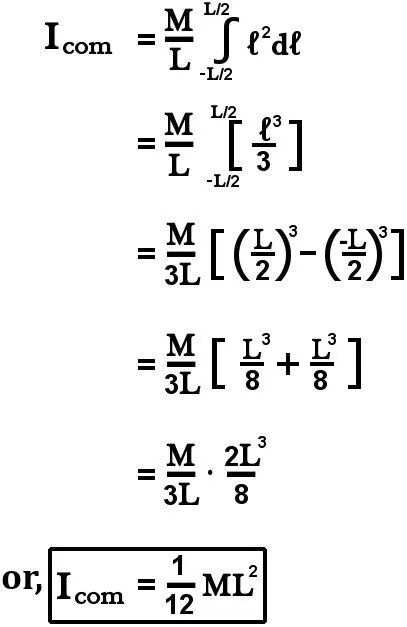
Substituting the value of dm in our expression to calculate moment of inertia, we get: 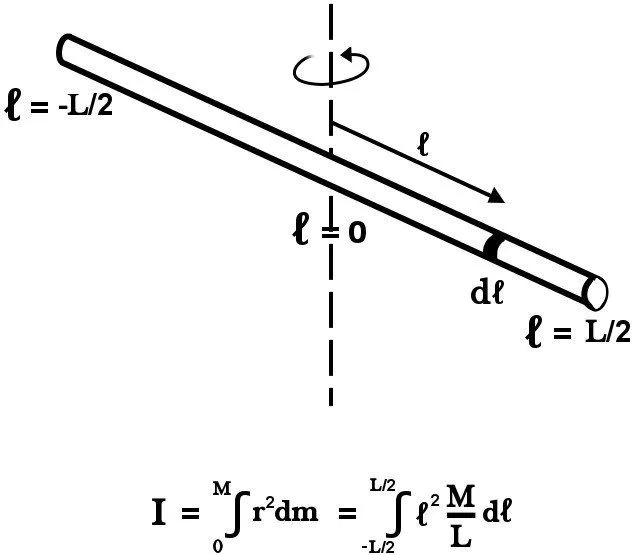
Because the variable of integration is now length (dl), the limits have changed from the previously depicted M to a required fraction of L.
Axis Through An End
In order to calculate the moment of inertia of a rod when the axis is at one of its ends, we draw the origin at this end.
We are required to use the same expression, however, with a different limit now. Because the axis rests at the end, the limit over which we integrate is now zero (the origin) to L (the opposite end).
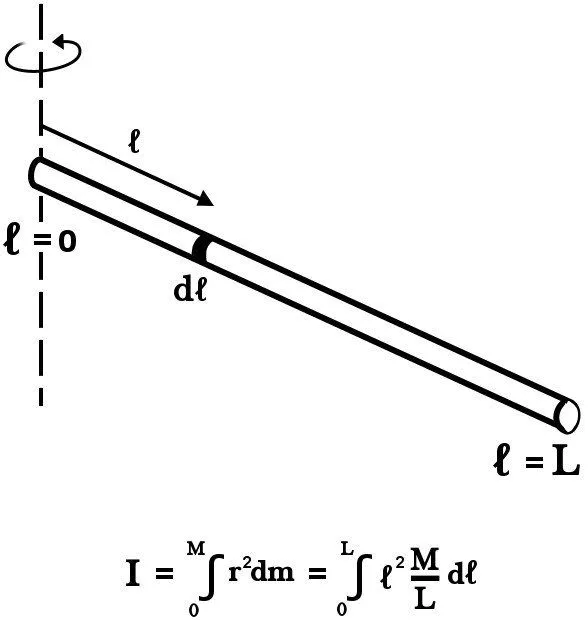
After integrating, we get:
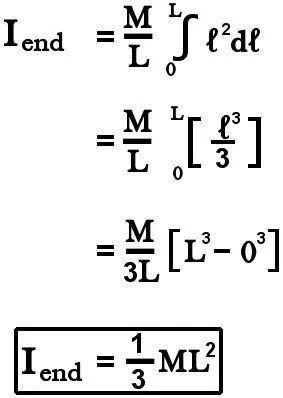
We can also arrive at the same result for the moment of inertia about the end by using the parallel axis theorem, according to which:
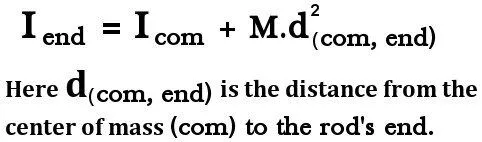
As L (com,end) is L/2, we find that:
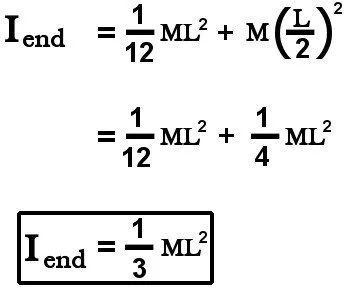
This is in agreement with our previously derived result.
What Is The Moment Of Inertia Of A Point Mass?
Strip away the calculus and every moment-of-inertia problem starts in the same place: a single point mass. A point mass is an idealized particle whose size is negligible compared with how far it sits from the axis, like a small bob whirling on the end of a string. For that lone particle, the moment of inertia is simply I = mr2, where m is the mass and r is its distance from the axis of rotation. Notice there is no fraction out front. Those tidy fractions you see for a rod (1/12, 1/3), a disk (1/2) or a sphere (2/5) only appear once you spread the mass out and integrate over a shape.
Real objects are never single points, so we treat them as a crowd of point masses and add up what each one contributes. For a system of discrete particles, the total moment of inertia about an axis is the sum I = Σ miri2, taken over every particle i at its own distance ri from the axis. The continuous integral ∫r2dm used above for the rod is just this sum pushed to its infinitesimal limit.
A worked example makes the point. Picture a barbell: two equal masses m fixed to the ends of a light rod of length 2R, with the connecting bar treated as massless. Spin it about an axis through the center and each mass sits a distance R away, so I = mR2 + mR2 = 2mR2. Now move the axis to one end. One mass lies on the axis (r = 0, contributing nothing) while the other is a distance 2R away, giving I = m(0)2 + m(2R)2 = 4mR2. Same barbell, same masses, yet shifting the axis doubles the rotational inertia. That sensitivity to where the axis sits is exactly why the rod above has two different answers, and why a moment of inertia is always quoted relative to a stated axis.
Moment Of Inertia Of Common Shapes (Quick Reference)
Once you can integrate ∫r2dm for a rod, the standard textbook shapes follow from the same recipe; only the geometry of the mass distribution changes. The diagram and table below collect the results students reach for most, each for an axis of high symmetry through the center of mass (unless noted otherwise), with mass M and the relevant radius R or length L.

| Object (axis) | Moment of inertia |
|---|---|
| Point mass (distance r from axis) | I = mr2 |
| Thin rod (axis through center) | I = (1/12)ML2 |
| Thin rod (axis through one end) | I = (1/3)ML2 |
| Thin hoop or ring (central axis) | I = MR2 |
| Solid disk or cylinder (central axis) | I = (1/2)MR2 |
| Thin spherical shell (diameter) | I = (2/3)MR2 |
| Solid sphere (diameter) | I = (2/5)MR2 |
Two patterns are worth noticing. First, the more mass an object keeps far from the axis, the larger its moment of inertia: a thin hoop (all its mass out at radius R) scores a full MR2, while a solid disk of the same mass and radius, with plenty of mass crowded near the center, manages only half that. The same logic separates a hollow spherical shell (2/3)MR2 from a solid sphere (2/5)MR2. Second, every entry is still just M multiplied by a length squared and a shape-dependent number, the dimensionless fraction set entirely by how the mass is arranged. For any axis that does not pass through the center of mass, you do not need a fresh formula; reach for the parallel axis theorem we used for the rod, exactly as we did to move from the rod's center to its end.