Table of Contents (click to expand)
- Who Actually Discovered Gravity?
- Fundamentals Of Newtonian Gravity
- Which Objects Have The Strongest Gravitational Pull?
- What Is The Gravitational Force On An Object Called? Weight Vs Mass
- Mechanics Of Rotating Objects
- Dynamics Of A Two-Body System
- The Answer
- So Does Spinning Change Gravity At All? The Relativistic Answer
A rotating object has a very slightly greater gravitational pull than the same object at rest. Spinning adds rotational kinetic energy, and because energy has mass (E = mc2), that energy adds to the object’s total mass-energy and so to its gravity. The effect is far too tiny to notice for everyday objects. In Newtonian gravity, where pull depends only on mass, rotation makes no difference.
Over the centuries, various theories have been formulated to explain physical phenomena. One such phenomena is the attraction of objects towards the Earth. Many scientists and philosophers in the ancient world tried to explain this observation. In the 17th century, Newton formulated the first explicit mathematical model for gravity in his book, Principles of Natural Philosophy, which was groundbreaking and launched a new epoch in natural sciences.
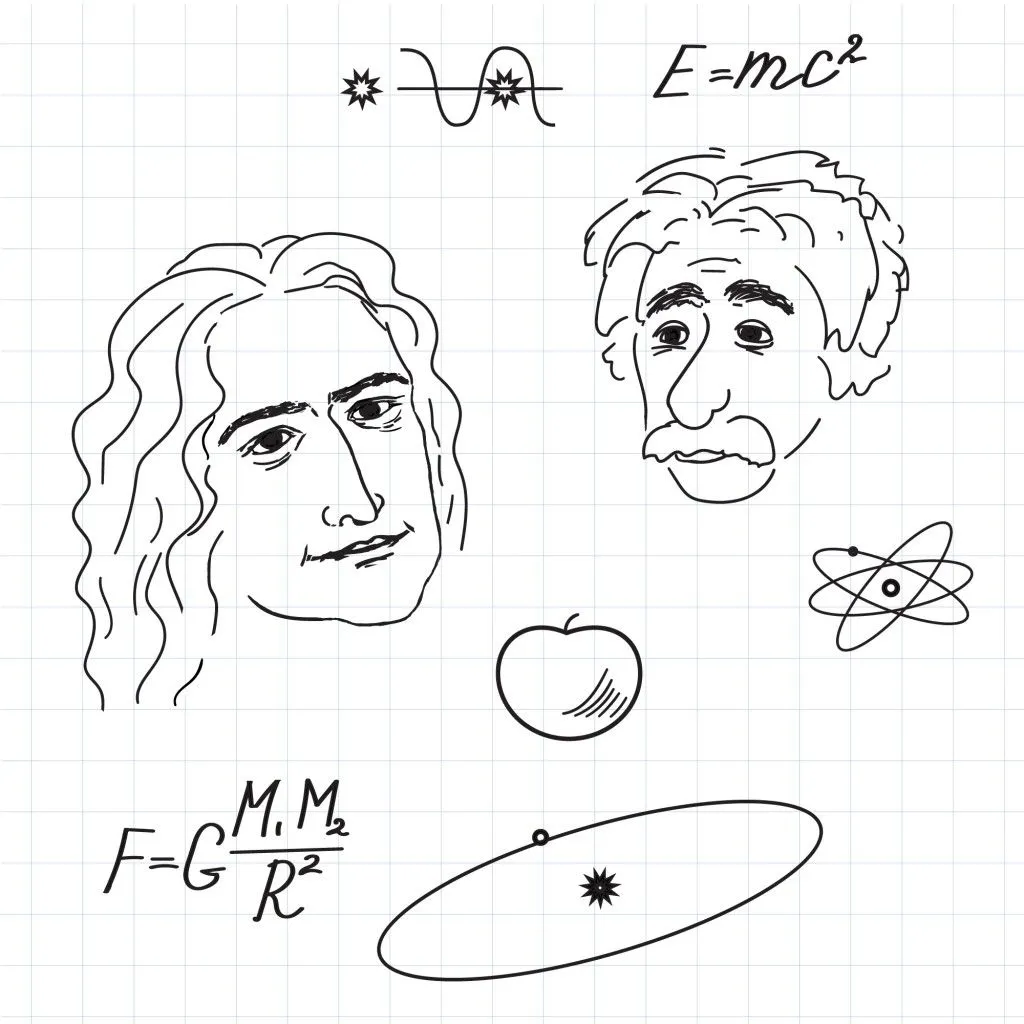
Newtonian gravity ruled the discussion until the 20th century, when Einstein formulated his General Theory of Relativity.
General Relativity gives the most accurate picture of gravity to date, but is mathematically quite rigorous. For most everyday situations, Newtonian gravity works just fine without going very deep into challenging mathematics. So let’s start with Newton’s theory, because it explains why a spinning planet does not change how strongly its own gravity pulls. Here is the twist, though: Newton alone cannot actually settle the question in the title. For the honest answer we have to return to Einstein at the end. (If you want a deeper dive, you can read Einstein in his own words.)
Who Actually Discovered Gravity?
Newton’s theory did not appear from nowhere, and gravity was never really “discovered” in a single flash of insight. It was pieced together over roughly two thousand years. The ancient Greek philosopher Aristotle, writing in the 4th century BCE, gave the first influential account: he held that heavier objects fall faster than light ones, in proportion to their weight. It sounds reasonable, but it is wrong. Aristotle seems to have generalized from objects sinking through water and other media, where resistance genuinely does hold lighter things back.
The person who got it right was Galileo Galilei. Around the turn of the 17th century he showed, by rolling balls down inclined planes to slow the motion enough to measure it, that falling bodies speed up at a constant rate, and that all objects fall with the same acceleration when air resistance is negligible, whatever their mass. The famous image of Galileo dropping two unequal weights from the Leaning Tower of Pisa comes from his biographer Vincenzo Viviani; most historians now treat it as a demonstration or a legend rather than a documented experiment, even though the underlying result was sound.

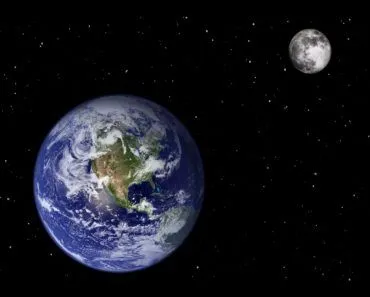
Isaac Newton supplied the missing piece in his 1687 masterwork, the Principia. His real leap was to see that the very same force pulling an apple to the ground also reaches out to hold the Moon in its orbit, and that this force weakens with the square of the distance. In one stroke that united the heavens and the Earth under a single law.
And the apple? The story is not pure myth, but it is often mistold. It traces back to William Stukeley’s Memoirs of Sir Isaac Newton’s Life (1752), which records Newton recalling how the fall of an apple set him thinking. The apple did not bonk him on the head; he simply watched it drop straight down and asked why it always falls perpendicular to the ground. The whole point, as the Royal Society is fond of noting, is that gravity is a universal force and nothing special to one piece of fruit. So there is no single discoverer of gravity, only a relay of curious minds across the centuries, with Newton credited for turning it into the first predictive mathematical law.
Fundamentals Of Newtonian Gravity
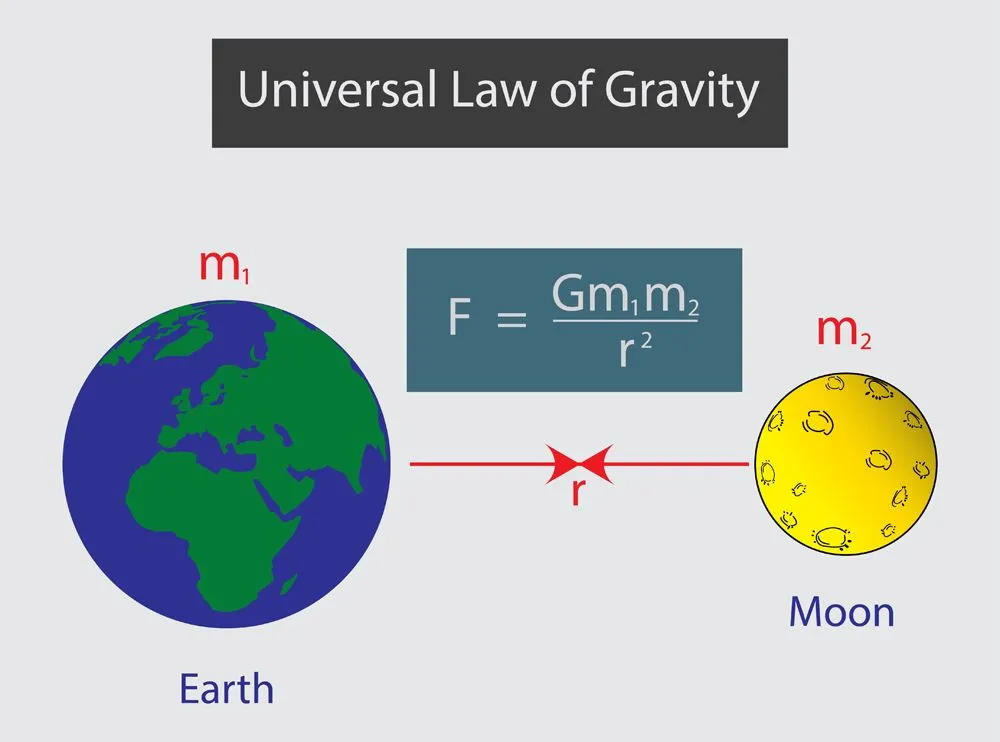
Newtonian theory is based on observations of nature (empiricism). Gravity is a force that attracts two masses separated by some distance and always acts along the line joining the center of mass of both the objects. To be more precise, the attractive force between two objects is proportional to the product of the two masses and the reciprocal of distance squared. Mathematically, gravitational force, F:
| F = G mamb/r2 |
where,
G = Universal Gravitational Constant ~ 6.674 × 10⁻¹¹ m3/kg/s2
ma = mass of object A
mb = mass of object B
r = distance between the two masses
Which Objects Have The Strongest Gravitational Pull?
That formula, F = G Mm/r2, quietly answers a question people often ask right next to this one: out of everything in the universe, what actually has the most gravity? Two ingredients set the strength of an object’s pull. The first is mass. The more mass an object packs, the harder it pulls, which is why a boulder tugs on you far more noticeably than a pebble does. The second is distance. Because the r sits squared in the denominator, the pull weakens quickly as you move away: double your distance from an object and its pull on you drops to a quarter.

Put those two ingredients together and a clear ladder appears. At Earth’s surface, gravity accelerates a falling object at about 9.8 m/s2. Jupiter, far heavier, manages roughly 24.9 m/s2, about 2.5 times Earth’s. The Sun, heavier still, reaches around 275 m/s2 at its surface, close to 28 times Earth’s pull.
The real extremes are the collapsed corpses of stars, where an enormous mass is crammed into a tiny radius. A neutron star squeezes more than the Sun’s worth of mass into a sphere only about 20 kilometers across, and with such a small r its surface gravity soars to roughly 1012 m/s2, on the order of a hundred billion times Earth’s. A black hole is the ultimate case. Its mass is crushed so tightly that at the boundary known as the event horizon, the speed needed to escape exceeds the speed of light itself, so not even light can get out. The honest short answer, then, is that black holes have the strongest gravitational pull of anything known, not because they are unusually massive, but because their mass sits at a vanishingly small radius.
What Is The Gravitational Force On An Object Called? Weight Vs Mass
One more piece of vocabulary is worth pinning down, because it is easy to muddle. The gravitational force experienced by an object is its weight. On Earth’s surface that force is simply W = mg, the object’s mass multiplied by the local gravitational acceleration g (about 9.8 m/s2), and like any force it is measured in newtons.
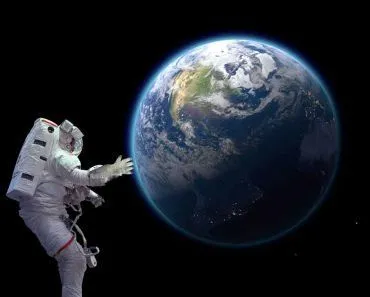
That makes weight a very different thing from mass. Mass is the amount of matter in an object, an intrinsic property that does not change no matter where you take it. Weight is the pull that mass feels in a particular gravitational field, so it shifts with your surroundings. An astronaut with a mass of 90 kilograms weighs about 882 newtons standing on Earth, but only around 146 newtons on the Moon, where g is roughly one-sixth as strong. Her mass never changed; only the gravitational force acting on it did. Keep that distinction in mind, because it is exactly why a spinning planet can change an object’s apparent weight without changing the planet’s actual gravitational pull, as the next sections show.
Mechanics Of Rotating Objects
A mass rotating in a circular path experiences the following forces:
- An inertial force that acts along a tangential direction (at 90o to the radius). If the mass were to be released from orbit, then it would move along the tangential path.
- A force directed towards the center of the circular path, along the radial line, is called centripetal force. This force is responsible for keeping the mass in orbit.
- A force directed away from the center of the circular path, along the radial line, is called centrifugal force. This is a fictitious (inertial) force that appears to push mass away from the center of orbit when you work in the rotating frame. Despite the common claim, it is not the Newtonian reaction to the centripetal force.
Mathematically, centripetal force, Fcp :
| Fcp = mv2/r = mω2r |
where,
m = mass of the object rotating in a circular trajectory
v = linear velocity of rotation
r = radius of circular path
ω = (v/r) = angular velocity (amount of rotation within a fixed time interval)
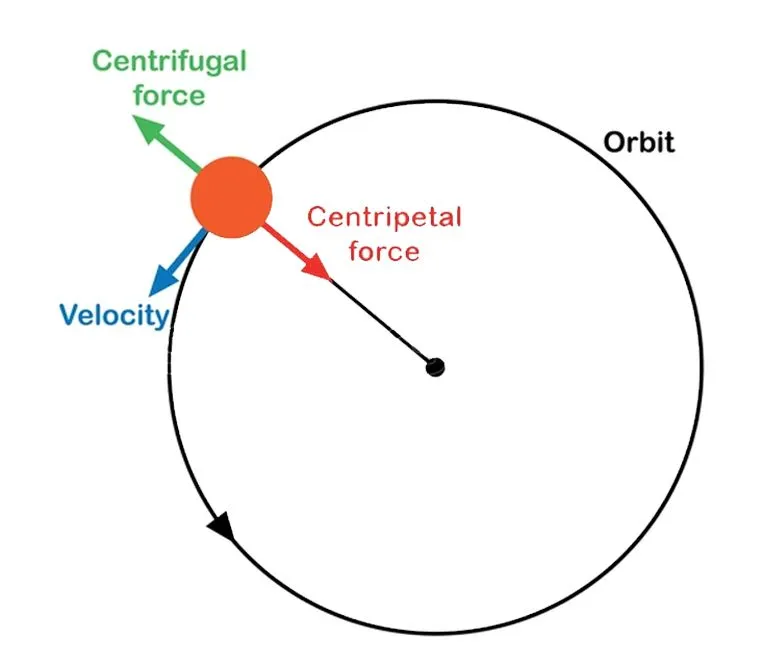
Fcp is a real force experienced by the object. A common mistake is to call the centrifugal force the Newton’s 3rd law reaction to the centripetal force, but it is not, because an action and its reaction always act on two different bodies. The fictitious centrifugal force, Fcf, is instead an inertial (pseudo) force that only shows up when you do the bookkeeping from inside the rotating frame itself. It is equal in magnitude, but opposite in direction to Fcp .
Therefore,
| Fcf = −mv2/r = −mω2r |
Here, the negative sign (-) signifies the opposite direction to Fcp .
Dynamics Of A Two-Body System
In physics, whenever two or more forces act on a particle simultaneously, the resultant force is the vector sum of the individual forces. A vector sum is a mathematical operation similar (but not identical) to simple algebraic addition, but also takes into account the direction of the forces.
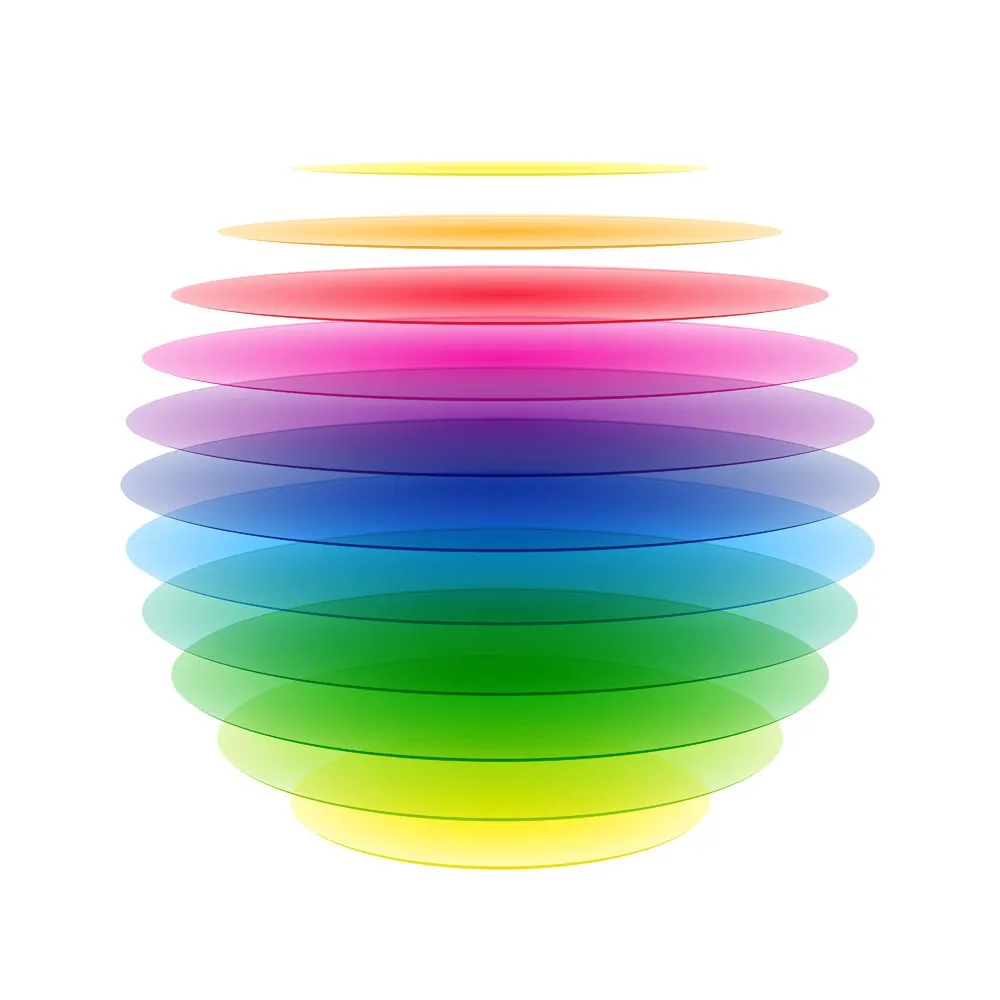
For easier calculations, let’s assume the presence of a perfect sphere, having mass M and radius R. The sphere can be modeled as a collection of infinitesimally thin (extremely thin) circular disks placed on top of each other. The radius of the central disk (equatorial line) is maximum, i.e., R, and the radius of the poles is zero.
Before diving in, one clarification matters: the calculation below tracks the net force felt by a small test mass m sitting on (or orbiting) the big sphere. That is its apparent weight, which is what you would read on a bathroom scale. It is not the gravitational pull the sphere exerts on the outside universe, a distinction we return to at the end. Consider the following cases:
CASE 1: The sphere does not rotate
The gravitational force experienced by a small object of mass m, at a distance r from M is:
| F = G Mm/r2 |
Here, M>>>m and r>>>R (this approximation is analogous to satellites orbiting the Earth).
Since the sphere is not rotating, the centrifugal force, Fcf, is zero. Net force on m:
| Fnet = F = G Mm/r2 |
CASE 2: The sphere starts rotating
Now, assume that the sphere of mass M and radius R starts rotating, with its axis of rotation along the +z direction. Gravitational force is:
| F = G Mm/r2 |
Centripetal and centrifugal forces start acting on the surface of the sphere. Fcf is maximum at the equator (−Mω2R) and minimum at the poles (approaching zero). The magnitude of centrifugal force, Fcf at the equator and poles is given by:
| Fcf = −Mv2/R = −Mω2R (Equator) Fcf = 0 (Poles) |
Therefore, the net force on m due to gravitational attraction from M and the rotation of M about the +z axis is:
| Fnet = F − Fcf = G Mm/r2 − Mω2R ......(Equator) Fnet = F − Fcf = G Mm/r2 ......(Poles) |
The Answer (As Far As Newton Is Concerned)
In the rotating frame, the centrifugal force shaves a little off the net force felt by m at the equatorial plane. That net force grows as you move toward the poles, where it reaches its maximum and equals the full gravitational force. The shortfall is tiny for a slow rotator like Earth. Measured at sea level, the acceleration due to gravity, g, is about 9.798 m/s2 at the equator and 9.863 m/s2 at the poles. (Two effects combine here: the centrifugal force and the fact that the equator, sitting on Earth’s bulge, is farther from the center than the poles are.)
But notice what this actually tells us. The centrifugal term changes the apparent weight of an object resting on the spinning sphere. It does not change the mass M in F = G Mm/r2, so the gravitational pull the sphere exerts on the rest of the universe is exactly the same whether it spins or not. In short, within Newtonian gravity, rotation makes no difference to an object’s gravitational pull at all, because that pull depends only on its mass. So Newton, strictly speaking, says “no difference,” and to do better we have to call in Einstein.
So Does Spinning Change Gravity At All? The Relativistic Answer
Here is where it gets interesting. In general relativity, gravity is sourced not by mass alone but by all forms of energy and momentum (bundled together in something called the stress-energy tensor). And a spinning object carries extra energy that a stationary one does not: its rotational kinetic energy.
Einstein’s most famous equation, E = mc2, tells us that energy has mass. So that rotational energy Erot behaves like an added sliver of mass, Erot/c2, bumping up the object’s total mass-energy. More mass-energy means a marginally stronger gravitational field. So a rotating object really does have a very slightly greater gravitational pull than the same object sitting still.
How slight? Absurdly slight. Because we divide by c2 (roughly 9 × 10¹⁶ in SI units), the spin of an everyday object, a flywheel, a planet, even a star, adds a vanishingly small fraction to its mass. For Earth, the rotational energy works out to something like 10-13 of its rest mass-energy. No instrument could weigh the difference; it is a matter of principle, not of practice. But the principle is the real answer to the title’s question, and it points the opposite way from what the simple centrifugal picture might suggest.
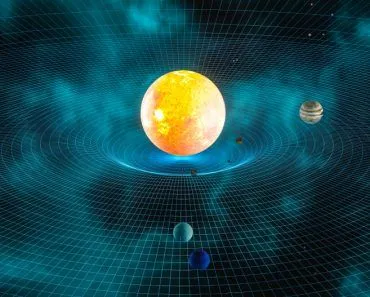
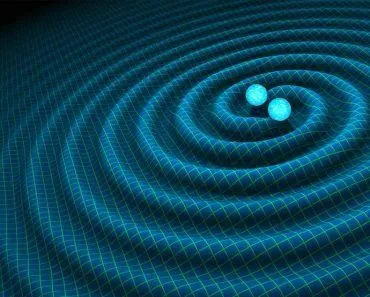
There is a second, completely separate relativistic effect worth knowing about. A rotating mass does not just sit in spacetime; it drags spacetime around with it, a bit like a spinning ball stirring honey. This is called frame-dragging (or the Lense-Thirring effect), and it is described exactly by the Kerr metric, the relativistic solution for a spinning body. Frame-dragging is not the same thing as the energy effect above and it does not make the pull stronger; it twists the geometry around the spin axis. It is real, though: NASA’s Gravity Probe B mission, launched in 2004, used ultra-precise gyroscopes in orbit and in 2011 confirmed Earth’s frame-dragging at about −37.2 milliarcseconds per year, close to the −39.2 mas/yr that relativity predicts.
So the full answer has two layers. Ask Newton, and rotation changes nothing about gravitational pull. Ask Einstein, and a spinning object has an immeasurably tiny bit more pull (thanks to its rotational energy), plus it warps the spacetime around it in a way a stationary object never could.
References (click to expand)
- Do I weigh less on the equator than at the North Pole?. West Texas A&M University
- Newton's Three Laws of Motion - CCRMA. Stanford University
- Sir Isaac Newton: The Universal Law of Gravitation. The University of Rochester
- Centripetal Force | COSMOS. The Centre for Astrophysics and Supercomputing
- Lecture: The Earth in Space, Dr. Rodrigue. California State University, Long Beach
- Vector Addition and Subtraction (College Physics). University of Central Florida / OpenStax
- Gravity - Stanford University. Stanford University
- GP-B (Gravity Probe B). NASA Science
- Gravity Probe B Final Results. Stanford University / NASA
- Frame-dragging. Wikipedia
- Gravity Fact Sheet. University of Virginia, Department of Physics
- Neutron Star Surface Gravity. Mullard Space Science Laboratory, UCL
- Black Holes. NASA Science
- Weight Equation. NASA Glenn Research Center
- Discovering Gravity. University of Virginia, Department of Physics
- History of gravitational theory. Wikipedia
- Newton’s apple tree. The Royal Society