Table of Contents (click to expand)
At the center of the Milky Way sits a supermassive black hole called Sagittarius A*, about 27,000 light years away. It packs roughly 4.3 million times the mass of our Sun into a region smaller than our solar system. In May 2022, the Event Horizon Telescope captured the first direct image of it.
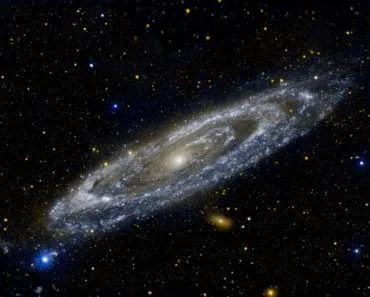
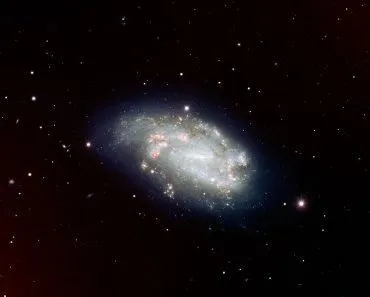
The Milky Way is a massively vast galaxy composed of about 300 billion stars, one of which happens to be our Sun. The planets and asteroids orbiting the Sun form the solar system. Our galaxy is one of the hundreds of billions of galaxies in the observable universe, each with its own unique star systems, including white dwarves, red giants, pulsars, neutron stars, and a handful of other star types peppered throughout the cosmos. We’ve all seen pictures of our galaxy – individual stars shimmering in spiral arms that seem to be spinning out from the center – but what’s at the heart of the massive galaxy we call home?
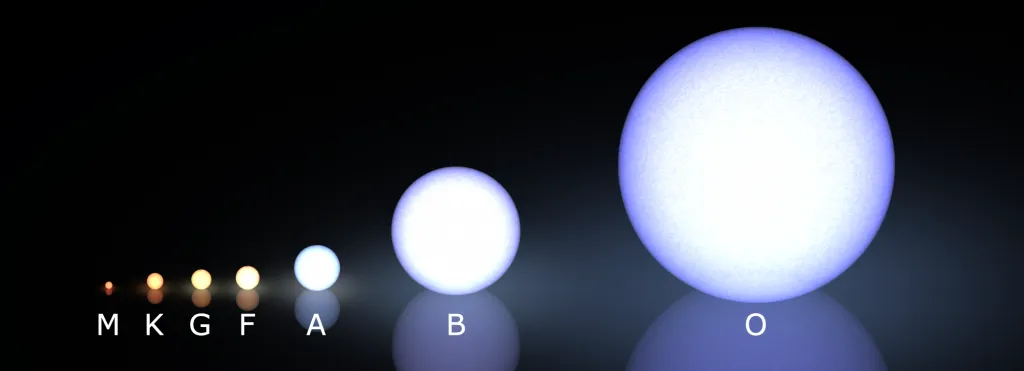
Our very own Sun must be a very happy little star… Not that it’s particularly little. More than one million planet Earths could fit inside our Sun, but compared to the monumental masses we find in the rest of the galaxy, our Sun is somewhere in the bottom half in terms of size. Its stellar classification puts it at a Type ‘G’, also known as a yellow dwarf, which is about 15 times smaller and 60 times less heavy than an average Type ‘O’, commonly called a blue supergiant.
Go Big Or Go Home
Stars produce heat and light by undergoing a process known as ‘nuclear fusion’, which is the same process used in modern nuclear weapons. However, when stars become really big – huge enough for their own gravity to destroy it – a spectacular cosmic explosion called a supernova occurs. This supernova can result in the formation of either neutron stars or black holes. Neutron stars are remnants of giant stars that have condensed into unimaginable densities, making them the densest and smallest stars in the universe, with around 1.4 times the mass of our Sun (sometimes more than 2) compressed into a radius of just 11 kilometers (7 miles). A teaspoon’s worth of a neutron star would weigh about 5.5 billion tons, roughly 900 times the mass of the Great Pyramid of Giza.

Denser neutron stars and giant supernovas form the leviathan of cosmic quandaries – the black hole. A black hole is an object so incredibly dense that even light cannot escape its gravitational field. The existence of black holes was actually doubted by scientists until the 1960s… even Einstein himself thought that it defied everything known about physics and astronomy. Eventually, however, they reached a consensus that black holes gobble up all incoming matter and do, in fact, exist.
Even Bigger?
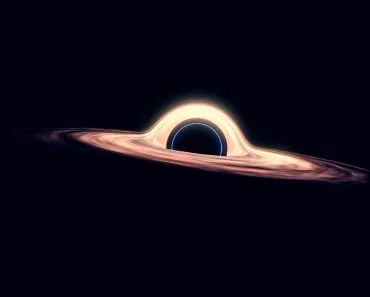
Alright. We know about black holes, we’ve seen them portrayed in science fiction and watched them in movies, such as ‘Interstellar’. A black hole is actually able to distort the fabric of space-time itself, causing objects to move closer until they are pulled into the ‘event horizon’ – the point of no return. To understand more about how black holes do this, take a look at this article.
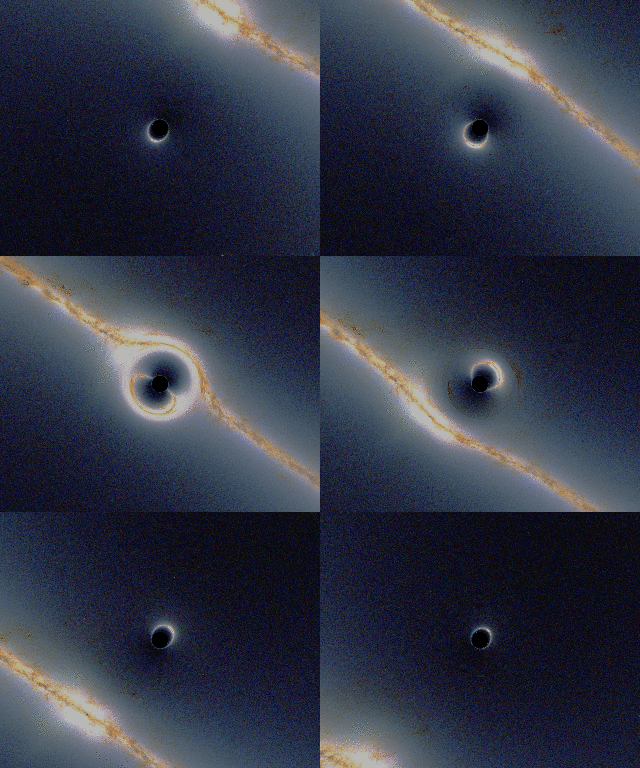
Black holes are usually quite small compared to the stars we saw earlier, but they have much, MUCH more mass than these stars, which is why their gravitational pull happens to be so enormous. This leads us to the aptly named supermassive black hole (one of my favorite things about astronomy is that extremely complex ideas have such simple names…).
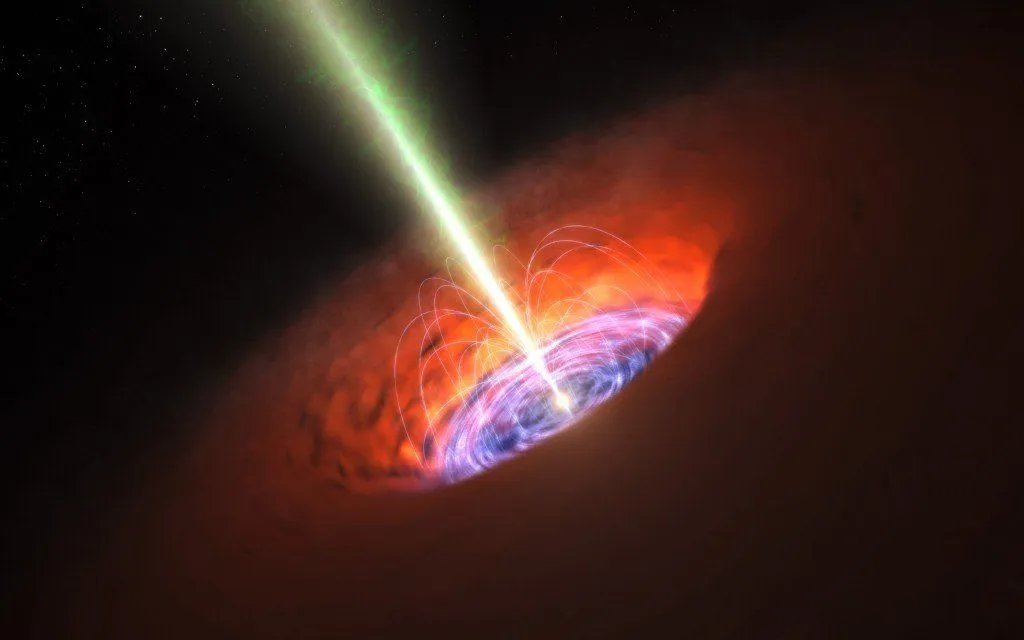
In 1971, two astrophysicists at the University of Cambridge, Donald Lynden-Bell and Martin Rees, hypothesized that the center of the Milky Way contains a black hole. A few years later, a bright radio source was discovered at the galactic center, about 27,000 light years away from our solar system. This object is known as Sagittarius A* (pronounced “Sagittarius A-star”). Compared to many other supermassive black holes, it’s quite small. If you dropped it into the center of our solar system, its event horizon would sit comfortably inside the orbit of Mercury. For decades, we couldn’t see it directly because it’s so small and far away that telescopes could only pick up its radio signals, but astronomers were confident it was a supermassive black hole because of its enormous mass: about 4.3 million times the mass of our Sun, inferred from watching nearby stars whip around it at staggering speeds.
Two milestones turned that confidence into certainty. In 2020, the Nobel Prize in Physics went to Reinhard Genzel and Andrea Ghez for tracking those stars over decades and proving that a supermassive compact object sits at the heart of our galaxy (Roger Penrose shared the prize for showing that black holes are an unavoidable prediction of Einstein’s general relativity). Then, in May 2022, the Event Horizon Telescope (a planet-wide network of radio observatories working together as one giant telescope) released the first direct image of Sagittarius A*: a glowing, donut-shaped ring of light wrapped around the black hole’s dark shadow. So it’s not a giant floating pizza slice after all, although the picture does look a little like one.
So, there you have it, the Milky Way galaxy most likely orbits around a powerful, seething black hole that warps space-time itself and gobbles down stars for breakfast. An entire galaxy revolves around it, but thankfully, it’s really far away… let’s just hope it stays that way!