Table of Contents (click to expand)
- What Is A Red Dwarf?
- What Is Barnard’s Star?
- How Bright, Hot And What Color Is Barnard’s Star?
- How Does Barnard’s Star Compare To The Sun And Proxima Centauri?
- Is There An Earth-like Planet Around Barnard’s Star?
- Is Barnard’s Star Moving Towards Us?
- Will Barnard’s Star Collide With The Sun?
- Will Barnard’s Star Explode?
Barnard’s Star is a red dwarf about 5.96 light-years away, the closest single star to the Sun and the second-closest star system after Alpha Centauri. It has the largest proper motion of any known star and is drifting toward us, but it will not collide with the Sun. Its closest approach, around 3.75 light-years, comes near 11,800 AD.
Have you ever watched the sky on a clear starry night and wondered about the countless other stars present in the universe? Have you ever wished to see them up close, to experience what our earthbound lives are hiding for us? Well, if you have ever made such a wish, apparently dreams are coming true these days. And while the approaching star will surely make for a mesmerizing view, the good news is that it will keep its distance and leave our solar system unscathed.
Astronomers discovered this star, one that falls under the category of Red Dwarfs, in the early 1900s. This star is undoubtedly the fastest we have ever seen. Its speed wouldn’t have been a problem if it were heading somewhere else, but unfortunately, it’s moving right towards our solar system. So… will it collide with us or not? We’ll come to that shortly, but first, let’s learn a bit more about Red Dwarfs.
What Is A Red Dwarf?
The Sun is a main-sequence star. This means that it generates its energy by fusing hydrogen atoms to helium. Most of the stars (about 90%) in the universe are of this type, and they are further classified into seven primary categories. Red Dwarf is one of these categories. A red dwarf is a relatively small star, with a mass roughly between 0.08 and 0.6 times that of our Sun. Because of their lower mass, the smaller red dwarfs are fully convective, meaning heat is carried from the core to the surface by churning currents of plasma rather than by radiation. This stirring keeps fresh hydrogen circulating into the core, where the fusion takes place, so the star can burn through almost all of its fuel instead of stalling once the core runs dry. As such, red dwarfs enjoy enormously long life spans, anywhere from tens of billions of years to trillions of years for the smallest of them, far longer than the Sun’s expected lifetime.
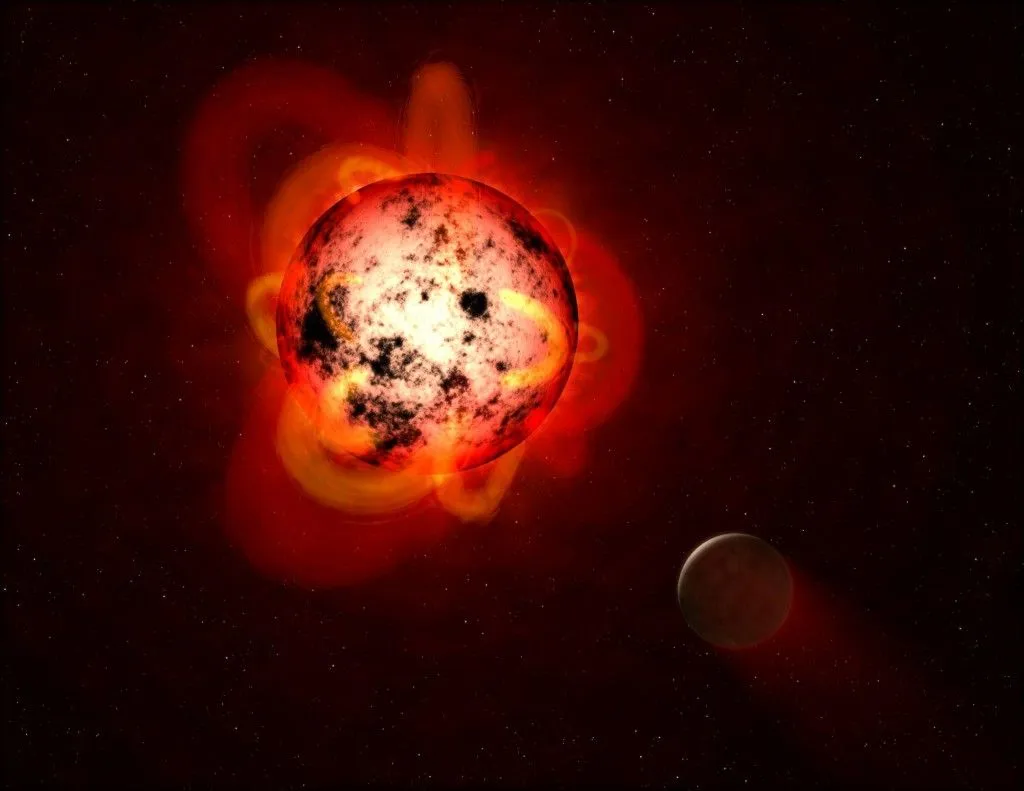
Red dwarfs have the lowest surface temperatures among all main-sequence stars, typically below about 4,000 K (compared with roughly 5,800 K for the Sun). Their luminosity is also very low, and the cool surface is responsible for the red color visible to us from here on Earth. Because of their low luminosities, planets can revolve very close to red dwarfs and still be habitable. About two-thirds of the stars in the Milky Way are red dwarfs. Estimates suggest that this proportion is even higher in the celestial world outside the Milky Way. Proxima Centauri, the star closest to Earth (other than the sun) is also a red dwarf.
What Is Barnard’s Star?
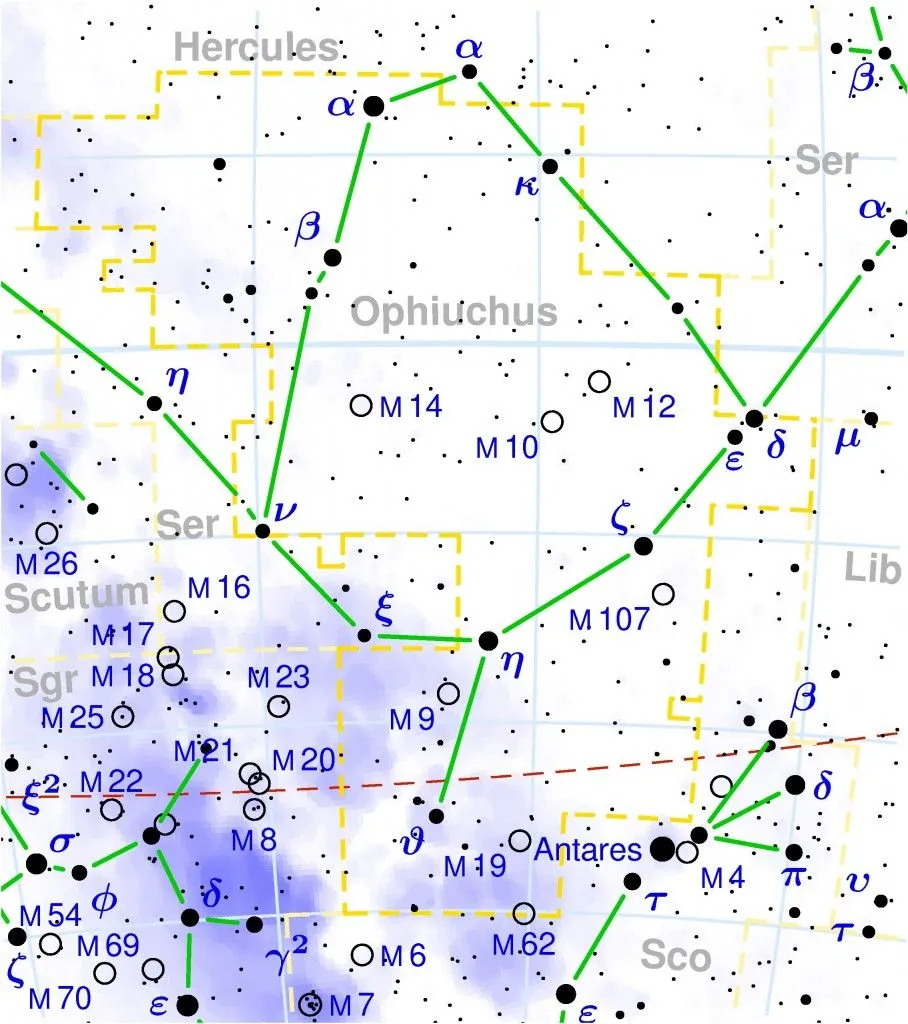
Ophiuchus is a pretty large constellation situated in the celestial equator and looks like a man holding a snake. Just like any other constellation, Ophiuchus has many stars, but it’s mainly famous for being the home of Barnard’s Star. Named after American astronomer E.E. Barnard, this star is a main-sequence red dwarf of spectral type M4, sitting about 5.96 light-years away. If you treat the three components of the Alpha Centauri system as a single system, Barnard’s Star is the second-closest star system to us; it is also the closest single (or isolated) star to the Sun, since the only thing nearer is the Alpha Centauri trio. Most of its physical characteristics match those of an average red dwarf, though its rotation is a little different.
Barnard’s star rotates once every 130 days because it has lost a significant portion of its rotational kinetic energy. As and when stars get old, they lose mass because of the continuous removal of gases and radiation; Barnard’s Star is about 8-12 billion years old, which is like the great-grandfather level in the hierarchy of stars. To put this in perspective, our sun is only about 4.5 billion years old and Barnard’s Star is about three times older, placing it amongst the oldest stars in the Milky Way.
How Bright, Hot And What Color Is Barnard’s Star?
For a star that sits almost in our cosmic backyard, Barnard’s Star is surprisingly hard to spot. Its apparent magnitude is only about 9.5, which means it is completely invisible to the naked eye; you need a decent telescope to pick it out at all. That faintness comes down to size. With a spectral type of M4.0V, Barnard’s Star is a genuine main-sequence dwarf, and a small one at that, carrying only about 0.16 times the mass of the Sun and roughly 0.19 times its radius.

The numbers behind its dimness are striking. Barnard’s Star radiates only about 0.0034 times the Sun’s total luminosity once you add up all wavelengths, and a mere 0.0004 times the Sun’s output in visible light. Put another way, to the human eye it is roughly 2,500 times fainter than our Sun. Most of its energy escapes as infrared rather than visible light, which is exactly what you would expect from such a cool surface.
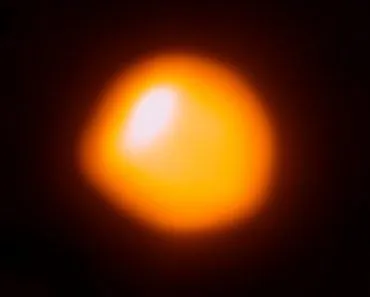
And its color? The surface temperature sits at around 3,195 K, far cooler than the Sun’s roughly 5,800 K. Cooler stars glow at longer, redder wavelengths, so Barnard’s Star shines a deep reddish-orange, the classic hue of a red dwarf. So if you are trying to place it on a star chart, it belongs right at the cool, dim, red end of the main sequence, keeping company with our other close neighbor, Proxima Centauri.
How Does Barnard’s Star Compare To The Sun And Proxima Centauri?
It is one thing to read Barnard’s Star’s numbers in isolation and quite another to see them lined up against familiar company. Two comparisons come up again and again: how the star measures against our own Sun, and how it stacks up against Proxima Centauri, the nearest star to the Sun of all. Both Barnard’s Star and Proxima are red dwarfs, so the gulf between them and the Sun is stark in every column.

| Property | Sun | Barnard’s Star | Proxima Centauri |
|---|---|---|---|
| Spectral type | G2V | M4.0V | M5.5Ve |
| Distance from the Sun | — | 5.96 light-years | 4.25 light-years |
| Mass (Sun = 1) | 1 | 0.16 | 0.12 |
| Radius (Sun = 1) | 1 | 0.19 | 0.15 |
| Luminosity (Sun = 1) | 1 | 0.0034 | 0.0016 |
| Surface temperature | ~5,770 K | 3,195 K | ~2,990 K |
So which is brighter, Barnard’s Star or the Sun? The Sun wins in a landslide. Barnard’s Star radiates only about 0.0034 times the Sun’s total energy, which is why a star practically in our cosmic backyard still needs a telescope to be seen at all. And faint as it is, Barnard’s Star is still roughly twice as luminous as Proxima Centauri, whose bolometric luminosity is only about 0.0016 times the Sun’s.
The distance labels can be confusing, so it is worth being precise. Proxima Centauri, at about 4.25 light-years, is the closest star to the Sun of any kind, but it is gravitationally bound to the two bright stars of the Alpha Centauri system. Barnard’s Star, at 5.96 light-years, is instead the closest solitary star to us and the nearest star in the northern half of the sky. Both neighbors are cooler and far smaller than the Sun, and both, remarkably, are now known to host at least one planet: the confirmed sub-Earth Barnard b, and Proxima b, which orbits within its star’s habitable zone.
Is There An Earth-like Planet Around Barnard’s Star?
Barnard’s Star might be the most studied star in the universe after the Sun, but not for being the second-closest to our planet. Its proximity has certainly made it easier to study, but the main reason astronomers have spent entire careers on this faint little star is the long-running hunt for planets around it, and the tantalizing hope of finding a world that might be able to host life. That hunt has had a dramatic, twisting history.

In 2018, Ignasi Ribas and his team published research on Barnard’s Star and claimed the existence of a candidate exoplanet, dubbed Barnard’s Star b. They reported it as a super-Earth, a planet outside our solar system more massive than Earth but lighter than Uranus or Neptune, weighing about 3.2 times as much as Earth with a 233-day orbit. The claim drew a great deal of attention. Here is the important update, though: that 2018 planet was never confirmed. In 2021, a careful re-analysis showed the signal was a false positive, produced by long-term magnetic activity on the star itself (essentially a wandering starspot) rather than an orbiting world. The frozen super-Earth, as exciting as it sounded, turned out not to exist.
The story did not end there, and it actually got better. In October 2024, a team using the ESPRESSO spectrograph on the European Southern Observatory’s Very Large Telescope confirmed a genuine planet, now called Barnard b. This one is a real sub-Earth, with at least about half the mass of Venus (roughly 0.3 to 0.4 times Earth’s mass), whipping around the star in just over three Earth days. By 2025, follow-up work combining ESPRESSO with the MAROON-X instrument confirmed a small family of up to four rocky planets, named Barnard b, c, d and e, each only about 20 to 30 percent the mass of Earth. So Barnard’s Star does host planets after all, just not the habitable super-Earth first announced. All four hug the star far too closely (their years last only a few Earth days) to sit in the temperate zone where liquid water could survive, so none of them is a promising home for life.
Is Barnard’s Star Moving Towards Us?
E.E. Barnard wasn’t the first person to observe Barnard’s Star, nor had he revealed any major characteristics of its interior or surface. Still, he remains the only astronomer in history to have his own research star named after him. The reason behind this is that in 1916 he measured the proper motion (the apparent drift of a star across the sky relative to the far more distant background stars) of this star, which came out to be about 10.3 arc-seconds per year. That is the largest proper motion of any known star, which is exactly why it earned the nickname “Barnard’s Runaway Star.” You see, every celestial body in this universe is moving with respect to every other. Even if we consider for a second that they’re not moving individually, the continually expanding universe will still change their relative position.
Will Barnard’s Star Collide With The Sun?
Barnard’s Star is approaching our solar system at great speed, as mentioned above, and over the next several thousand years it will keep closing in. However, we don’t need to worry about a collision. Stars do not move in straight lines toward one another; they sweep past on long, curving paths, which is exactly what that proper motion of 10.3 arc-seconds a year is hinting at. Barnard’s Star, sometimes melodramatically called a “Doomsday star,” will reach its point of minimum distance from the Sun, roughly 3.75 light-years, around 11,800 AD, and then begin pulling away again. In other words, there is no impending crash, and it never gets close enough to truly disturb our solar system. Even in the wildest what-if scenario, that is some 10,000 years away, and if humans are still around by then, let’s hope we will have a few more options than this one solar system!
Will Barnard’s Star Explode?
Given its melodramatic “Doomsday star” nickname, it is natural to wonder whether Barnard’s Star might one day go out with a bang. The reassuring answer is no. Stars end their lives explosively as supernovae only if they are far more massive than the Sun, and Barnard’s Star, at about 0.16 solar masses, falls nowhere near that threshold. Red dwarfs are the marathon runners of the cosmos: because they are fully convective and sip their hydrogen so frugally, Barnard’s Star could stay on the main sequence for something like two trillion years, after which it is expected to shrink into a faint blue dwarf and eventually a white dwarf, cooling quietly rather than detonating.

That does not mean this ancient star is entirely placid. Barnard’s Star is a flare star, capable of sudden outbursts. In 1998, astronomer William Cochran was measuring the star’s spectrum with the 2.7-meter telescope at McDonald Observatory when he caught it in the middle of an intense flare. A later analysis led by Diane Paulson estimated that the flaring region reached at least 8,000 K, more than double the star’s usual surface temperature, and two further ultraviolet flares were spotted in 2019. Such flashes are surprising for a star so old, but they are a world away from an explosion, and none of them poses any danger to us.
References (click to expand)
- Red Dwarf | COSMOS. The Centre for Astrophysics and Supercomputing
- Barnard’s Star - Wikipedia
- Scientists discover planet orbiting closest single star to our Sun - European Southern Observatory (ESO)
- Four Sub-Earth Planets Orbiting Barnard’s Star from MAROON-X and ESPRESSO - The Astrophysical Journal Letters (IOPscience)
- Stellar Activity Manifesting at a One Year Alias Explains Barnard b as a False Positive - arXiv
- The enduring mystique of Barnard’s Star | Astronomy Essentials - EarthSky
- Optical Spectroscopy of a Flare on Barnard’s Star - arXiv (Publications of the Astronomical Society of the Pacific)
- A flare for Barnard’s Star - Astronomy Magazine
- Proxima Centauri - Wikipedia
- Sun - Wikipedia