Light from the cosmic dawn of the universe has always been there, coming down towards us, carrying tales from the edge of time itself. Now, with the help of the JWST, we can finally meet.
At 07:20 am EST December 25, 2021, aboard the Ariane 5 rocket, the James Webb Space Telescope lifted off from the heart of a warm evergreen forest into the cold dark of space in search of the beginning of the universe.
The origin story of this project, deemed the Apollo mission of this generation, began in September of 1989 with a challenge. Riccardo Giacconi, then director of the Space Telescope Science Institute (STScI) challenged a group of brilliant scientists and engineers to think about the next major mission beyond the Hubble Telescope (even before it was launched!).
After 30 long years, on Christmas morning of 2021, the incredible feat of humankind’s genius left Earth’s atmosphere with plenty of unforeseen tricks up its sleeve. It reached its orbit around the second Lagrange point (L2) in late January 2022, and after six months of unfolding, cooling, and aligning its mirrors, it began full science operations in July 2022.
Would the James Webb Space Telescope discover new worlds? Fill the gaps in chemical evolution? Tell us how life began? Several years of observations later, it has already started answering some of those questions, and a few of its findings have surprised even the scientists who built it. Before we get to what it has seen, let’s rewind to the past of this GIANT TIME MACHINE!
Why Is It Named James Webb?
When the initial brainstorming for this telescope began in 1989, it was called the NGST or Next Generation Space Telescope. It wasn’t until August of 2002 that it received its current name, the James Webb Space Telescope (JWST).
NASA renamed it to honor their administrator during the Apollo moon missions. During the space race of the Cold War era, when landing on the moon was the sole mission, James Webb’s vision for NASA transcended that. He championed the belief that NASA should do in-house science research, along with human space flight research.
He wasn’t an engineer or a scientist, but actually a lawyer by profession, yet his contributions transformed the American space science research industry for years to come.
However, James Webb’s legacy isn’t devoid of some dark patches. Webb served in the State Department and then led NASA during the Cold War era, when federal policy actively pushed LGBTQ+ people out of government jobs in what became known as the “Lavender Scare.” Many in the scientific community argued the telescope shouldn’t carry his name. NASA commissioned a historical investigation, and in November 2022 it reported that it had found no evidence directly linking Webb to those firings; the agency decided to keep the name. The decision didn’t settle the debate, and some astronomers continue to refer to the observatory simply as “JWST” or “Webb.”
What’s So Special About This Telescope?
Well… everything! Just imagine a 6,200 kg (around 6.8 US tons) intricately designed piece of origami that can fit into a rocket and shoot up to space, then unfold in space and photograph pictures of baby galaxies taking shape from the darkness of the early universe. It is a successor to the Hubble Space Telescope with a field of view that is roughly 15 times larger. A light-collecting area about 6.25 times bigger makes it powerful enough to catch the faint luminous glow from the period immediately following the Big Bang.
The Golden Eye
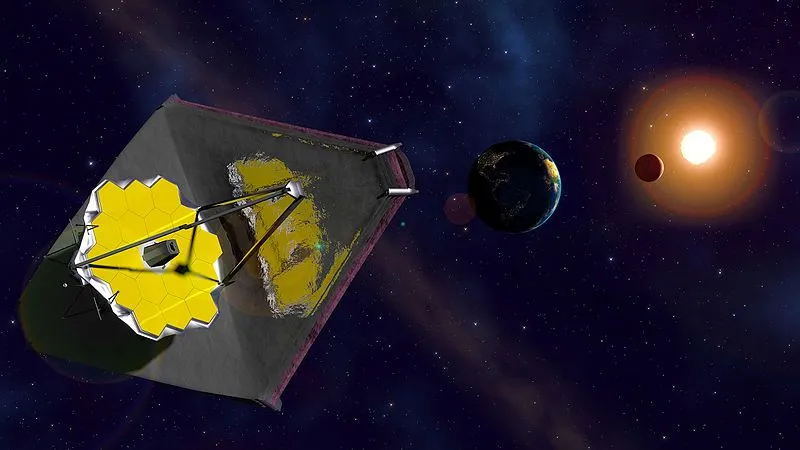
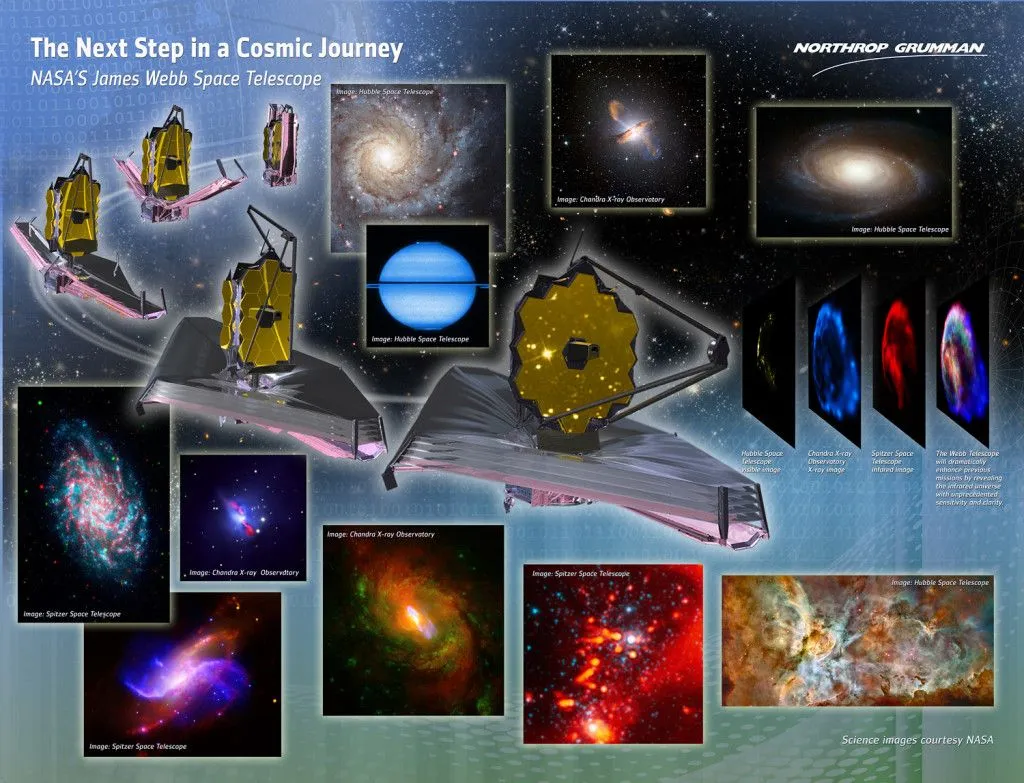
If you’ve ever looked up JWST or have accidentally stumbled upon its image while cruising the internet, you were likely bedazzled by the giant golden honeycomb-looking dish. That is the primary mirror of the telescope, consisting of 18 hexagonal Beryllium mirrors coated in gold. This huge network of mirrors spanning 6.5 meters (21 feet) lets the JWST collect infrared light from stars and galaxies far far away.
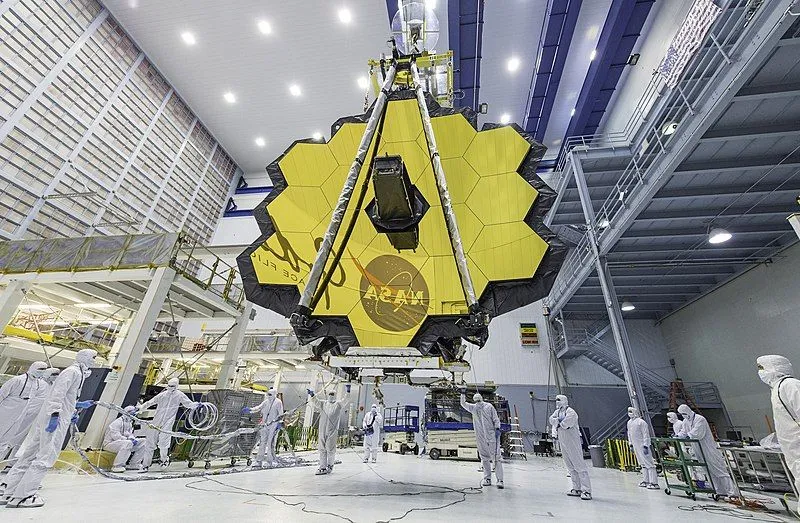
The telescope has a 3-mirror system. The primary mirror acts like a massive light collection pool, and from there the light bounces off to the secondary mirror, then the tertiary mirror, and finally the fine steering mirror for image stabilization. With each step, the light gets more focused, resulting in even sharper images when they ultimately hit the telescope’s camera.
Why Beryllium And Gold?
They couldn’t use an everyday mirror like those we have on Earth, which is made of glass, because it wouldn’t survive in space for long and the materials are usually quite heavy. The JWST team was looking for something that was lightweight, strong, and could withstand a wide range of temperatures. It also had to be a good conductor of heat and electricity, yet non-magnetic, to avoid interference with other components in the telescope.
After much searching, they settled on using beryllium (Be), a steel grey metal that sits 4th on the periodic table and possesses all the properties mentioned above. The mirrors began their journey in the beryllium mines of Utah. They made 13 more stops across the US, getting polished to a mirror finish, and finally being sent out for a gold coating.
Coating the entire span of the mirrors required only about 48 grams of gold (roughly the mass of a golf ball). A 100-nanometer layer of gold was deposited (about 1/1000th the thickness of a human hair) on the mirrors using a method called vapor deposition. The reason behind coating them with gold is to improve the infrared reflection of the mirrors. To read more about gold and its infrared properties, click here.
The Sunshields
For an infrared telescope to detect faint light from distant stars, it always has to stay cold. But how do you keep a giant mirror from catching sunlight and heating up? You build a tennis court-sized umbrella for it, obviously.
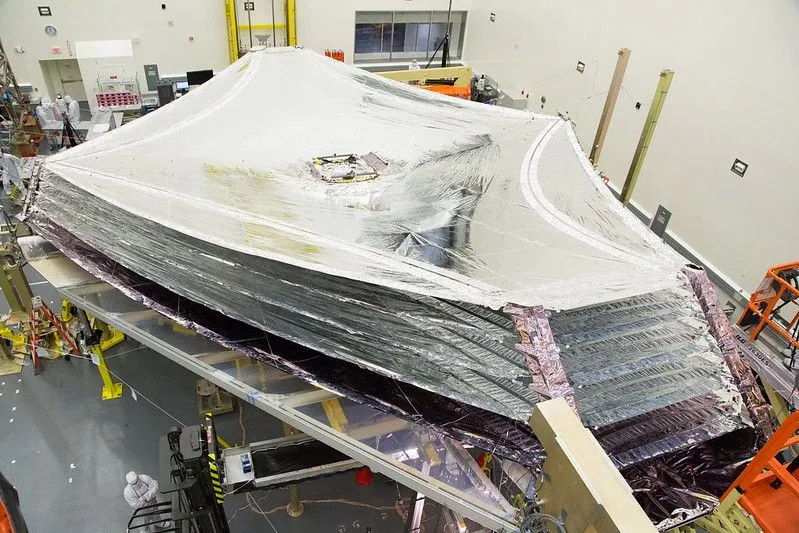
The sun shield on the JWST is a 5-layer structure located between the solar panels and the primary mirror, creating a barrier between components that seek the sun and those that need to hide from it. The sun shield not only provides SPF 1 million sun protection, but also cools down the mirror side of the telescope to below -223 °C (under 50 K, or about -370 °F). This is possible due to the 5-layered structure, specifically the gaps between each layer, which provide better heat insulation than a single thick membrane.
What Are The Sunshields Made Of?
Each layer is made of a hair-thin polyimide film called Kapton, which is further coated with doped-silicon and aluminum. The doped-silicon blocks any sunlight from reaching the infrared-sensitive instruments beneath the sunshield. It emits most of the light and heat received from the sun, while the remaining sunlight is bounced off by the highly reflective aluminum coating.
Also, these electrically conductive coatings keep the sunshield grounded and prevent the accumulation of static electricity.
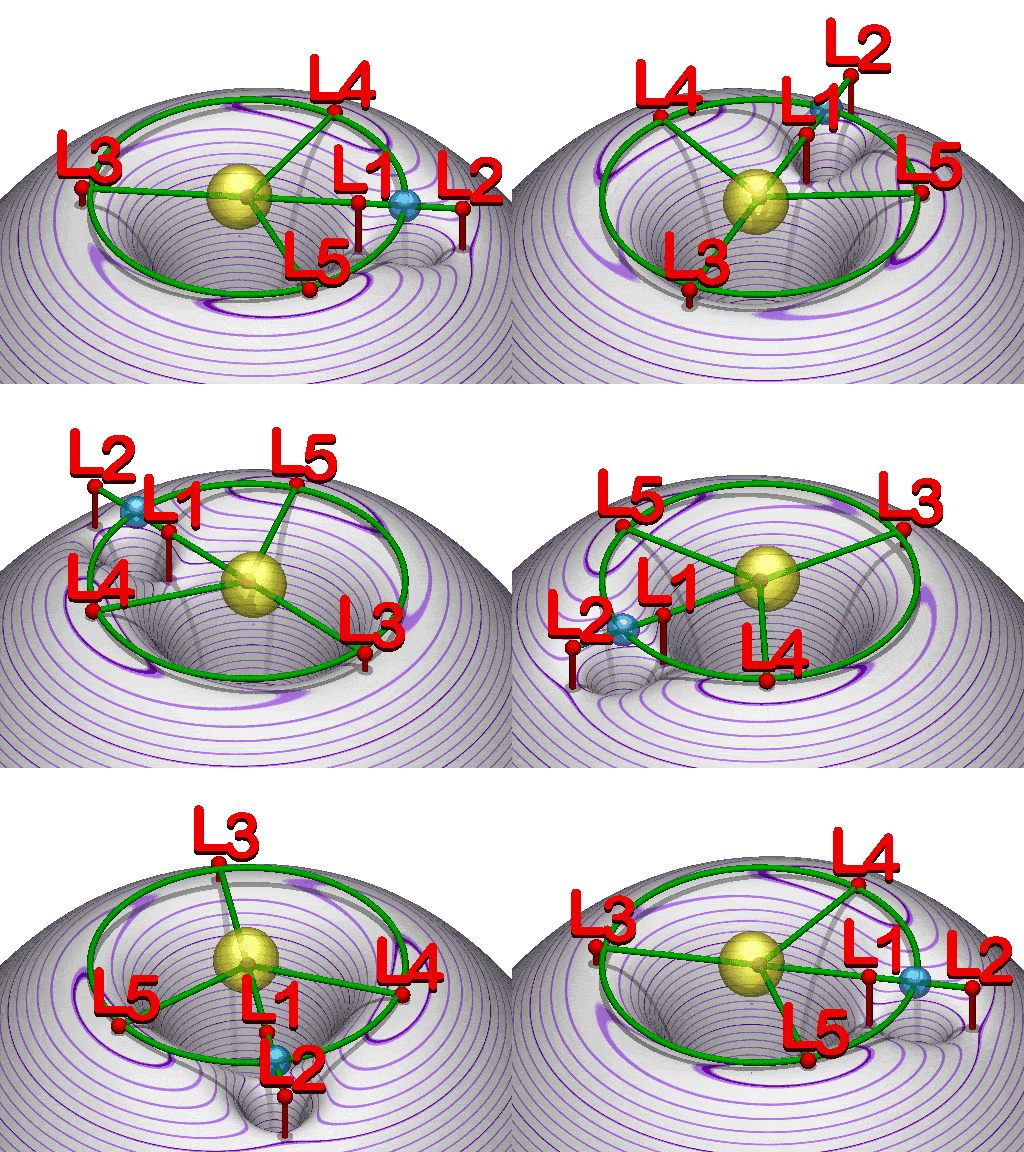
While cruising around its home L2 (a Lagrangian point 1.5 million km, or about 930,000 mi, away from us), the sunshield can encounter flying space rocks that could initiate a tear in the layers. To prevent a small tear from turning into a large hole, the Kapton layers have “rip stops” every 2 meters (about 6 feet), created by a process called Thermal Spot Bonding.
While that’s all very interesting, why go through all this rigamarole and send it to space, rather than simply mounting it on Earth? The answer to that all comes down to the JWST being an infrared telescope.
Why Is An Infrared Telescope Important In Space?
As we know, the universe is expanding; it is moving away even as you read this. Any form of an electromagnetic wave moving away from a point of reference (in this case, us) undergoes a redshift. Any light from the edge of time would have turned into infrared by now, due to the stretching.
Unlike visible light, due to its longer wavelengths, infrared doesn’t get bounced off easily and can easily penetrate through dust clouds, giving us a clear view of distant stellar nurseries. Infrared sensors also make it easier to spot young stars that are not hot or bright enough to emit visible light, but they do emit infrared light!

When it comes to glowing like a star, we have more in common with celestial bodies than you might think. All humans and most things around us glow bright enough with infrared to interfere with the telescope.
Thus, searching for celestial objects using a ground-based infrared telescope would be like looking for a glowworm on a bright sunny day.
To learn more about infrared light, click here.
Will The JWST Unravel More Cosmic Chemistry?
Scientists are now piecing together the jigsaw puzzle that is the chemical enrichment of the universe. The telescope can detect chemical signatures from galaxies that formed billions of years ago and compare them with newer systems.
This helps reveal the rate at which hydrogen and helium were forged into heavier elements that gradually built everything in the universe. To read more about chemical enrichment, click here.
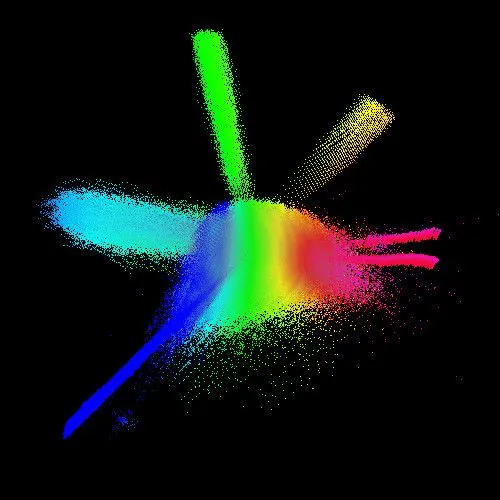
The JWST’s sensitivity to infrared light makes it an excellent tool to hunt for the key ingredients of life, namely water, carbon dioxide, and methane. The telescope’s powerful eye can measure the spectra of molecules in the atmospheres of distant worlds as they pass in front of their stars. Mapping that chemical makeup could tell us whether a planet can support life, or did so at some point in the past.
It didn’t take long for this promise to pay off. In August 2022, Webb made the first clear, unambiguous detection of carbon dioxide in the atmosphere of a planet beyond our solar system, the hot gas giant WASP-39 b, roughly 700 light-years away. Since then it has sniffed out water, sulfur dioxide, methane, and other molecules across dozens of exoplanets, and it continues to scrutinize small rocky worlds, such as those in the TRAPPIST-1 system, to test whether any of them hold onto an atmosphere at all.
The JWST’s chemical expeditions are slowly uncovering clues about our own origins on Earth and the potential for life elsewhere.
So, What Has The JWST Actually Shown Us?
On July 11, 2022, the world finally got to see what all the fuss was about. The very first full-color image, known as Webb’s First Deep Field, showed the galaxy cluster SMACS 0723 and, behind it, thousands of fainter galaxies bent and magnified by the cluster’s gravity. It was the deepest, sharpest infrared view of the universe ever taken, and it captured a patch of sky roughly the size of a grain of sand held at arm’s length.
From there, Webb went hunting for the cosmic dawn in earnest, and it kept breaking its own records. In 2024, astronomers confirmed JADES-GS-z14-0, the most distant galaxy known at the time, at a redshift of 14.32. We see it as it was roughly 290 million years after the Big Bang, when the universe was only about 2% of its current age. Surprisingly, it is bright and chunky, far more mature than the faint smudge our models predicted for such an early epoch.
That has been a recurring theme. The early galaxies Webb keeps finding are bigger, brighter, and more chemically enriched than the textbooks said they should be, forcing astronomers to rethink how quickly the first galaxies grew up. In other words, the telescope is doing exactly what its builders hoped: handing us answers and, in the same breath, a whole new pile of questions.
Conclusion
After 30 years of design, engineering, identifying worst-case scenarios, and coming up with solutions for them, the roughly $10 billion space telescope is up there at L2 and working beautifully. Thousands of people from 14 different countries came together to create a time machine that is now giving us an unimpeded view of the universe. We may not have teleportation yet, but we are going boldly (visually) where no human has ever gone before!
And the best part? We have barely scratched the surface. Dr. John Mather, the Nobel laureate who served as Webb’s senior project scientist for nearly three decades, always insisted that the greatest discoveries would be the ones nobody saw coming. Every time we build a new instrument, he liked to say, the universe finds a way to surprise us, and Webb has already kept that promise. The cosmic dawn is no longer just a story we tell. We are finally reading it firsthand.
References (click to expand)
- HISTORY - Space Telescope Science Institute. The Space Telescope Science Institute
- The Road to Launch and Beyond for NASA's James Webb .... The National Aeronautics and Space Administration
- SmarterEveryDay (2021). How Does The James Webb Space Telescope Work? - Smarter Every Day 262. Youtube
- Curiosity Stream (2021). The Epic First-Hand Story of Building the James Webb Space Telescope. Youtube
- Who Is James Webb - Webb/NASA. The National Aeronautics and Space Administration
- Witze, A. (2021, July 23). NASA investigates renaming James Webb telescope after anti-LGBT+ claims. Nature. Springer Science and Business Media LLC.
- Witze, A. (2022). NASA really, really won't rename Webb telescope despite community pushback. Nature.
- Mirrors Webb/NASA - James Webb Space Telescope. The National Aeronautics and Space Administration
- Sunshield Coatings Webb/NASA. The National Aeronautics and Space Administration
- James Webb Space Telescope will reveal new insights into astrochemistry - American Chemical Society - www.acs.org
- Other Worlds - James Webb Space Telescope. The National Aeronautics and Space Administration
- Webb's First Images - NASA Science. The National Aeronautics and Space Administration
- NASA's Webb Detects Carbon Dioxide in Exoplanet Atmosphere - NASA Science. The National Aeronautics and Space Administration
- NASA's James Webb Space Telescope Finds Most Distant Known Galaxy - NASA Science. The National Aeronautics and Space Administration
- Identification of carbon dioxide in an exoplanet atmosphere. Nature.