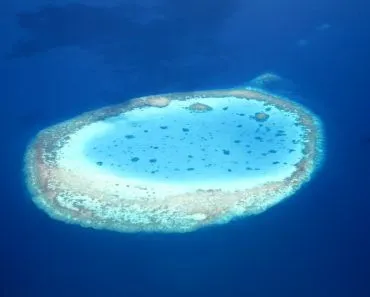
A blue hole is a circular, steep-walled marine sinkhole carved into carbonate bedrock and open to the surface. Most descend hundreds of meters (the Great Blue Hole in Belize is about 124 meters, or 407 feet, deep) and connect to flooded caves and tunnels formed when sea levels were lower during the last ice age.
Almost perfectly round stark blue holes are commonly called the “pupils of the sea”. For many years, they remained a mystery. People who tried and failed to understand this geological feature ended up creating quite a few stories around blue holes.
The Chinese believed these portals to be entrances to an underground palace ruled by dragons. The Mayans had an interesting idea that these blue holes were the gateways to the underworld. Finally, a 2018 expedition led by Aquatica Submarines (with Sir Richard Branson and Fabien Cousteau aboard) put an end to all those ideas and legends. This historic expedition took the plunge into the Great Blue Hole of Belize and explored the many mysteries that lie beneath. The dive was also streamed live on Discovery.
You can watch the incredible experience here
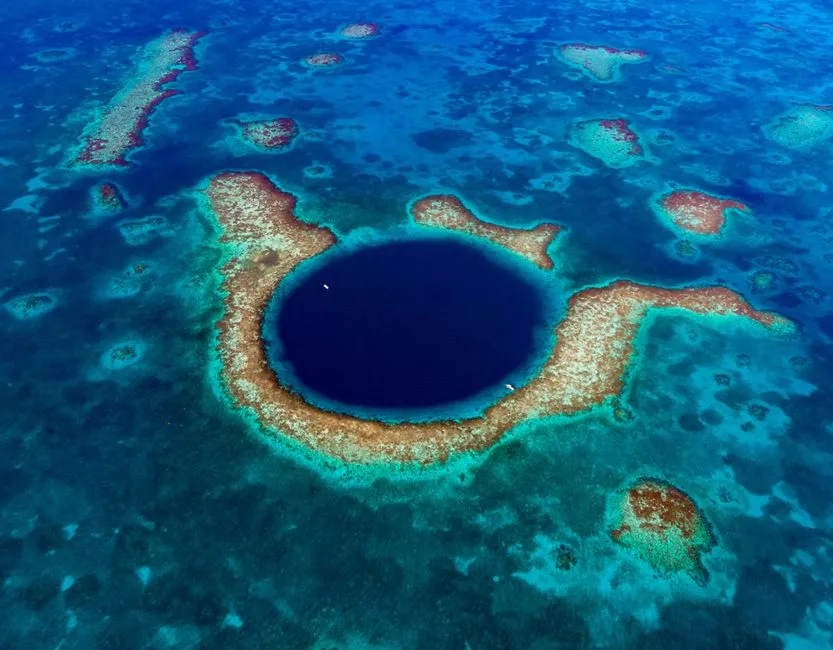
Aerial view of a blue hole in South Africa (Photo Credit : JamieB333/Shutterstock)
How Were Blue Holes Formed?
Most blue holes were formed from sinkholes that slowly developed over time. A sinkhole is a depression in the ground with no natural external drainage system. Any water entering a sinkhole remains inside. The rocks that are present at the bottom are easily soluble by the groundwater itself, and when water from rainfall moves down, the rocks begin to dissolve further, forming caverns and underground spaces.
The creation of blue holes began many thousands of years ago. Sea level was much lower in those times. Blue holes originally formed like limestone caves did in the last ice age. As the glacial runoff began, the limestone cave system collapsed, eventually resulting in the formation of vertical caves, otherwise called massive sinkholes.
These caves were later flooded with ocean water, thus forming these mighty blue holes. Within the walls of the blue holes, the water remains still, without any currents. Their dark blue appearance is due to the greater absorption of sunlight, which increases with the increasing depth.
How Are Blue Holes Different From Lakes And Ponds?
Ponds and lakes also have an appearance similar to blue holes, but they differ in numerous ways. Most lakes and ponds form as a result of glacial retreats that leave hollows behind and are later filled with water. They cover an area ranging from a few acres to several hectares, but blue holes are huge and far deeper. The Great Blue Hole in Belize, for instance, is about 318 meters (1,043 feet) across and roughly 124 meters (407 feet) deep. (Source)
Ponds and lakes are shallow enough for sunlight to penetrate through them. They support life forms, varying from primary producers to fishes and vertebrates. On the contrary, in blue holes, sunlight can hardly penetrate and they do not support much life.
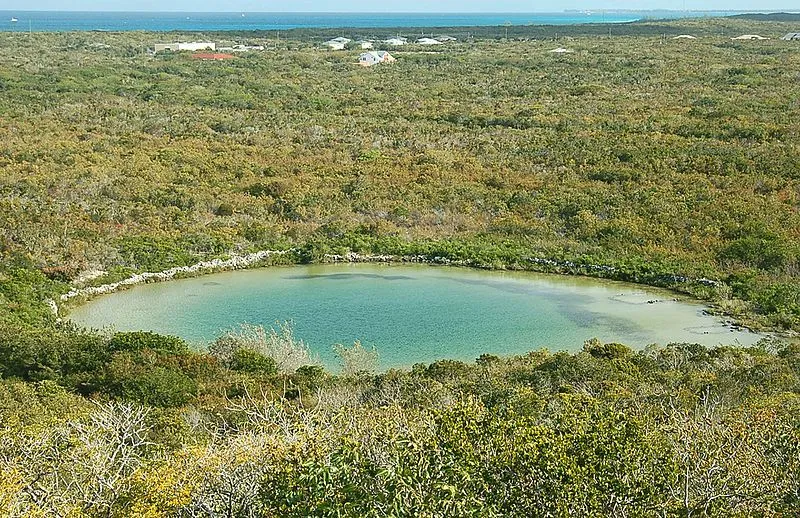
These blue holes can also form in inland regions, but these regions often have passages connecting to oceans. Seawater enters the holes through them, so they may have a mixture of freshwater, saltwater, and other chemical compositions.
What’s Inside A Blue Hole?
In the winter of 2018, a crew from Aquatica Submarines ventured to the bottom of the blue hole of Belize with a mission to create a 3D map of the Great Blue Hole. Along the way, they came across some common and rare sights. At the beginning of the expedition, the crew found the usual suspects, including corals, turtles, and reef sharks. As they moved deeper, life began to vanish. The area was entirely lifeless once the explorers moved beyond about 90 meters (300 feet) of depth. All they found down there was a layer of toxic hydrogen sulfide covering the entire width of the hole.
The condition inside is also anoxic, barren of both oxygen and life. Conch shells and hermit crabs had been found during archeological research, but they are believed to have been trapped down there and suffocated to death. As they moved further down, near the bottom at about 120 meters (390 feet), the researchers came across something that was not expected. Stalactites were found, which gave some clues to the hole’s past.
These are a type of formation that hang from the ceilings of caves as water drips. Also, stalactites form most effectively on land, with water dripping down the stone. Hence, their presence in the Great Blue Hole was strong evidence that these holes had been formed on land in the prolific era of the earth, and were later submerged at the end of the ice age.
Are Blue Holes Dangerous?
Blue holes that extend beneath the sea provide fascinating diving opportunities and are ideal for archeological research. The blue holes near the Bahamas have provided a great place for fossil discovery. Several extinct animals, archeological artifacts and human remains have been found near the Bahamas.
Almost all blue holes around the world, including the holes in Egypt and Belize, are popular dive sites. They are also a point of attraction to adventure seekers. However, don’t underestimate the danger that blue holes pose. The blue hole in Dahab, Egypt, in the Red Sea, is possibly the most deadly dive site of all. There is no official count, but estimates suggest that around 130 divers (and by some accounts as many as 200) have lost their lives there over the years, earning it the grim nickname "the Diver's Cemetery".
One major reason for this deadly dive is the notoriety of the site, which attracts adventure-seekers and presents a tempting challenge. Accessibility of the site is another such reason. In most places, blue holes are located right off the shore. Also, the warm, clear, and temperate water of blue holes make these dives look more benign.
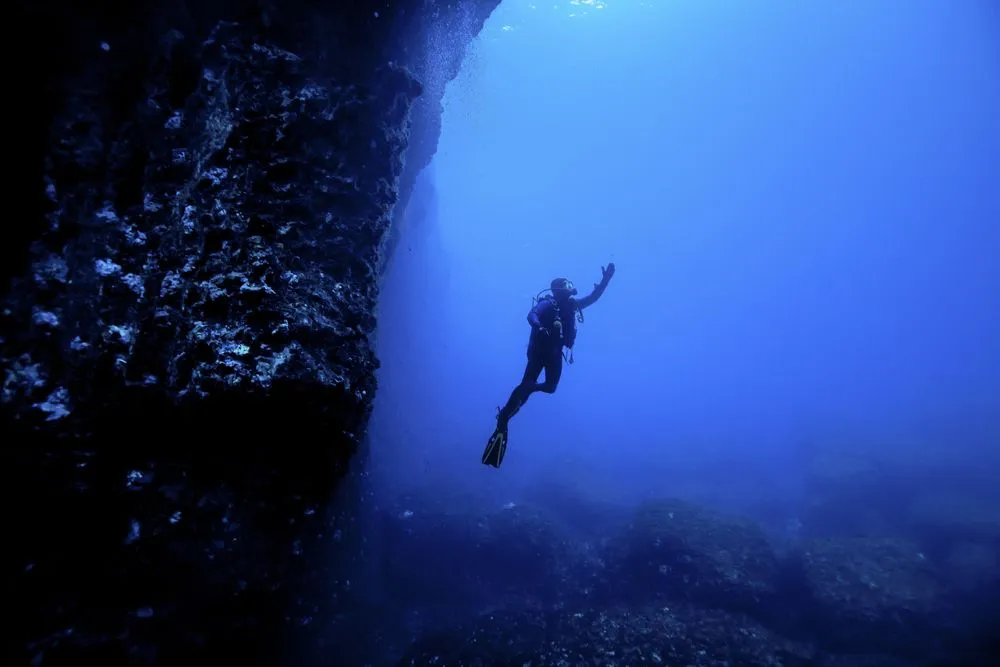
Can A Diver Survive Inside A Blue Hole?
A properly trained diver can get through the hole and admire the splendor inside. The bottom of most blue holes lies well over 100 meters (330 feet) down. In the blue hole of Dahab, at a depth of about 56 meters (184 feet), there is an archway through the reef wall that leads to open water. This is the arch that most divers come for.
With good buoyancy skills and preparation, one can experience the adventure inside, but there are a few hazards that lead to people getting hurt. One such problem is nitrogen narcosis. As one goes deeper and deeper into the hole, nitrogen narcosis takes hold. It impairs one’s ability to think clearly, and things can go horribly awry.
The deceptive part is that a diver may feel fine while their judgment is already slipping, and by the time they reach the arch at around 56 meters they are far beyond the roughly 30-to-40-meter (100-to-130-foot) limit for recreational diving on regular air. At those depths the partial pressure of oxygen is also climbing toward toxic levels. In other words, a blue hole isn’t inherently dangerous, so long as one dives with proper training, the right gas mix, and careful planning.
Conclusion
Apart from being a popular dive site and a site for archeological research, blue holes have also been identified as hotspots for microbial life. The microbes found here appear to feed on hydrogen sulfide, which is toxic to other lifeforms. Along with several other blue holes in the world, one of the blue holes in the Bahamas is known to have a mat of microbes completely covering the walls.
No submarines can be sent down, so one must physically get into the blue hole to completely discover what is down there. Obviously, that can be extremely dangerous. Proper training and certification are necessary to carry out research in a blue hole, which may be why these underwater caves are one of the least understood ecosystems on the planet!