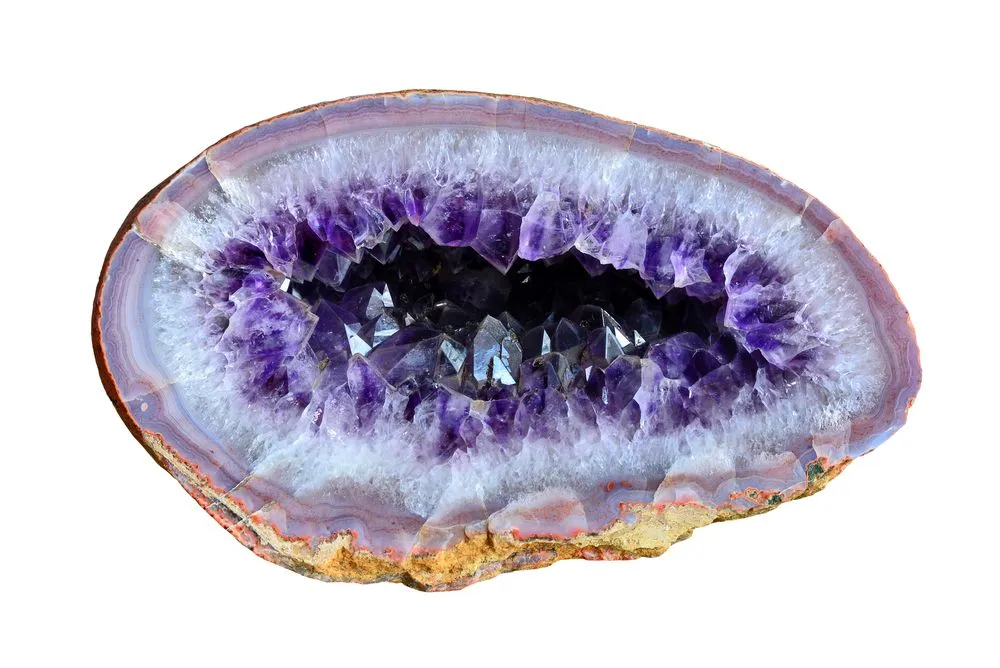
Hollow rocks lined with crystals on the inside are called geodes. They form inside pre-existing cavities (frozen gas bubbles in lava or voids in sediment left by dissolved fossils) when mineral-rich groundwater slowly seeps in and precipitates a tough silica rind followed by inward-growing crystals of quartz, amethyst or calcite. Geodes survive in the wild because their silica outer shell is harder than the host rock.
Plenty of rock-cutting videos on social media platforms feature stunning crystals that appear in incredibly intriguing places. I’m sure we’ve all have seen at least one of these videos.
But have you ever wondered why certain rocks are shaped in such unusual ways? What are these rocks known as?
Such eye-catching rocks are called Geodes. They contain a hollow space lined with crystals that can be round or egg-shaped. Geodes are found all over the world in a number of places. They can originate in sedimentary rocks (formed from the deposition of minerals) as well as igneous rocks (formed from the solidification of lava).
How Are Geodes Formed?
In the beginning, it was believed that geodes were only bubbles in volcanic rock. However, geodes can arise in locations that lie very far from volcanic activity. This also supported the notion of geodes being found among sedimentary rocks.
In sedimentary rocks like limestones, dolomites and shales, geodes form inside cavities left behind when fossil shells, evaporite nodules (like anhydrite or gypsum) or other organic material slowly dissolved away. Animal burrows, mudballs and root casts also leave behind voids that can become geodes, though these are less common.
The hollow shape itself comes first, before the geode does. A cavity, whether a frozen gas bubble in lava or a void left in sediment, sits inside the surrounding rock. Over many thousands or millions of years, mineral-rich groundwater seeps in and slowly precipitates a tough rind of silica (chalcedony) along the cavity wall, followed by crystals that grow inward into whatever empty space remains. So a geode is built from the inside out, not eroded from the outside in.
How Are Crystals Formed Inside The Rock?
Minerals are inevitably absorbed by water as it travels from the surface to the water table. This is because, as the water flows along the surface, it takes along the minerals present in the soil. The geography determines what minerals are washed off by the running water. Now that the water is abundantly rich with a particular mineral, it flows into the ground to the water table. To understand what the water table is, check out the diagram below.
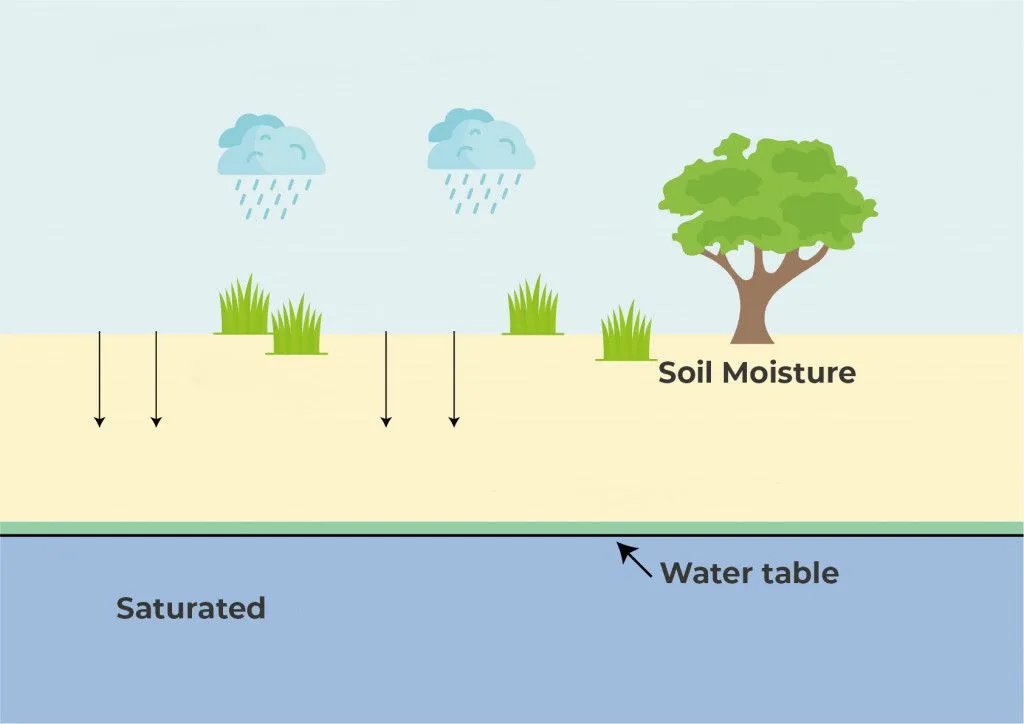
When water seeps into the ground, groundwater takes up space present in the soil. The water table is the boundary where this seeping water stops filling the spaces between soil particles.
Quartz (including its purple variety, amethyst) and calcite are the most common minerals that crystallize inside geodes. Strictly speaking, the minerals don’t flow in pre-formed: groundwater carries dissolved silica and carbonate ions, and these slowly precipitate out of solution onto the cavity wall as quartz, chalcedony or calcite over enormous spans of time.
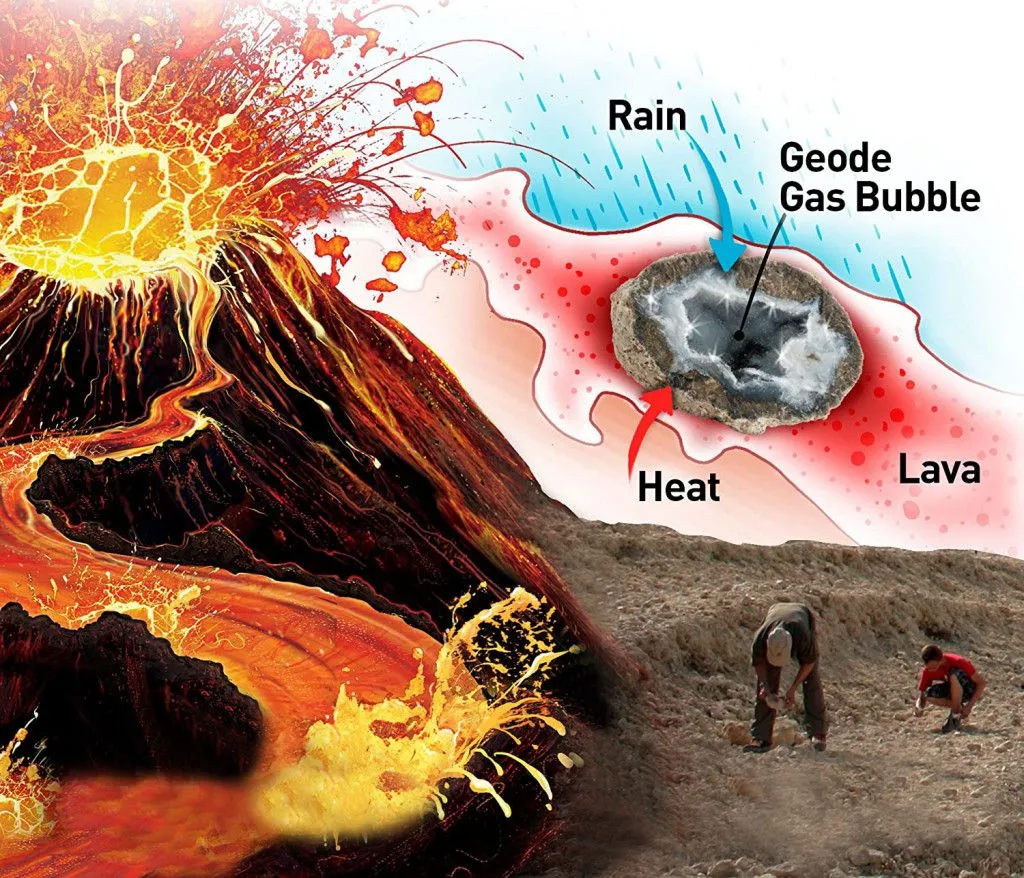
These minerals are present in the same water that flows through the rocks to make them hollow.
What is the outcome of water slowly seeping up through the ground for thousands or perhaps millions of years?
Crystals! If you cut open a geode and look inside, you might find crystal points or layers of banded crystals.
Because each geode is composed of a distinct combination of minerals, it possesses its own unique characteristics, much like a fingerprint. The only way to examine the contents of a geode is to cut it open with a rock saw or smash it with a rock hammer.
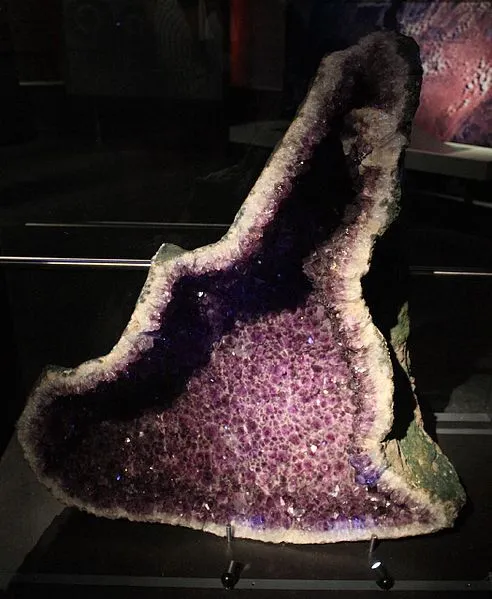
The material that lines the cavity is typically a druse of tiny quartz crystals that shine, and behind that are several bands of clear grey and white agate. Many of these geodes are packed with even more incredible minerals, colors and crystals.
Why Do Geodes Not Break Open, Despite Weathering Agents?
So one hammer is all it takes to break the rock open? So why do they remain intact despite being hollow? How do these rocks deflect the actions of natural weathering agents?
The exterior of a geode is tough and resistant to the effects of weathering to a greater degree than the bedrock that surrounds it. Because of this, the geode can remain intact, despite the erosion of the bedrock on all sides.
Though it would be amazing if all geodes had crystals in them, we aren’t that lucky. There are many rocks that are devoid of crystals. What causes this to happen? And what are these rocks?
These are either pre-mature geodes or chalcedony geodes. Let’s look at each of these separately.
What Is A Pre-mature Geode?
A geode is said to have been found prematurely if the required seepage of mineral-rich water did not occur, or if it didn’t have enough time to take place. It takes millions and millions of years to complete the procedure, and the discovered rock might be younger than expected.
What Are Chalcedony Geodes?
When someone cracks open a geode, the standard expectation is to discover brilliant, intricate crystals in geometric shapes. On the other hand, there are often more intriguing vistas contained inside. A geode lined with chalcedony, a microcrystalline variant of quartz, is one of the most typical findings when geometric crystals are not present.
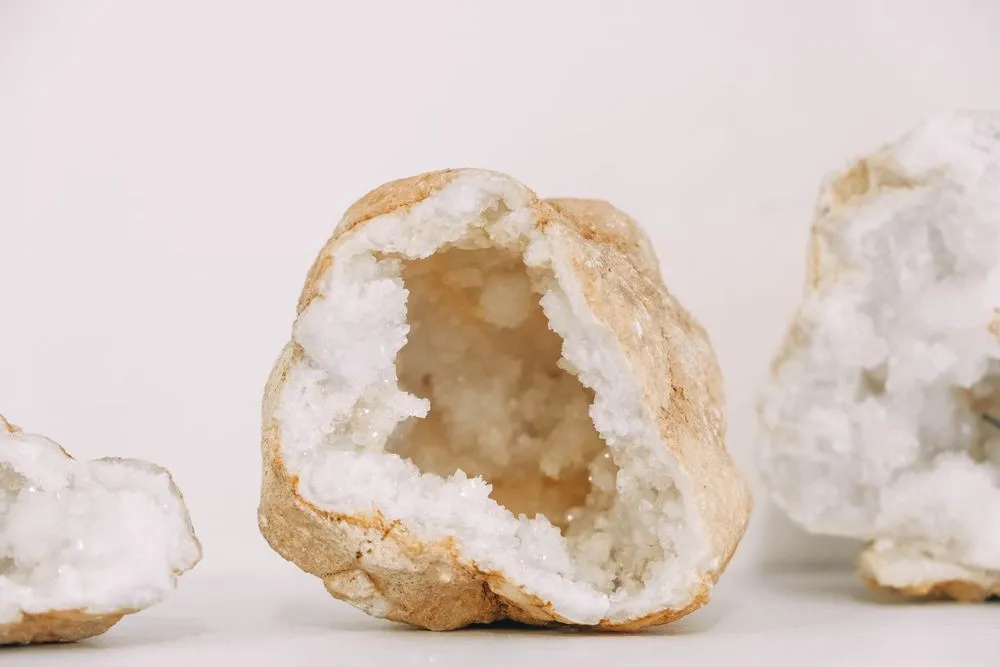
Basically, chalcedony geodes do have crystals in them, but they are too small to be distinguished by the unaided eye.
A tiny chalcedony crystal will connect to the wall of a geode and get covered with a layer of tiny crystals. These small crystals point away from the seed crystal (a tiny single crystal that facilitates further crystallization). As layers are added one after another, the first formation resembles a little hemisphere connected to the geode’s interior surface. As these little hemispheres start to grow into and on top of one another, the outcome is a landscape that resembles a bunch of grapes!
To understand chalcedony geodes a bit better, take a look at the image below.
When a beautiful treasure is concealed inside a rock that, from the outside, appears to be ordinary, you know that something extraordinary has taken place. The most spectacular example is probably the Pulpí Geode in Almería, Spain, a roughly 11-cubic-metre cavern lined with transparent gypsum crystals up to two meters long. A 2019 Geology study traced its formation to gentle, near-room-temperature crystal growth over a few hundred thousand years after the Mediterranean refilled at the end of the Messinian salinity crisis. And that, gentle readers, is yet another enchanting surprise from Mother Nature.
References (click to expand)
- Guide to Geodes - Maryville University Online. Maryville University of St. Louis
- Rocks and Minerals, Kentucky Geological Survey, University .... The University of Kentucky
- Amethyst Stone - GIA. The Gemological Institute of America
- Hewett, D. F., & Radtke, A. S. (1967, January 1). Silver-bearing black calcite in western mining districts. Economic Geology. Society of Economic Geologists.
- Geode. Encyclopaedia Britannica.
- García-Ruiz, J.M. et al. (2019). Formation of natural gypsum megacrystals in Naica and Pulpí. Geology.