Table of Contents (click to expand)
- How The Sun Gets Its Color
- Why Isn’t The Sun Green If Its Light Peaks In Green?
- How The Earth’s Atmosphere Distorts The Color Of Sunlight
- Color Of The Sun In Space
- What Color Does The Sun Look Like From Space Without An Atmosphere?
- Does The Color Of The Sun Really Matter?
- What Kind Of Star Is The Sun, And Why Is It Called A “Yellow Dwarf”?
The Sun’s true color, the one you’d see from space or the ISS, is white. It only looks yellow from the ground because Earth’s atmosphere scatters away more of the Sun’s shorter (blue and violet) wavelengths via Rayleigh scattering, leaving the longer yellow, orange and red wavelengths to reach your eye. Astronomers classify the Sun as a G2V “yellow dwarf” based on its spectrum, but its color temperature (~5,778 K) corresponds to white.
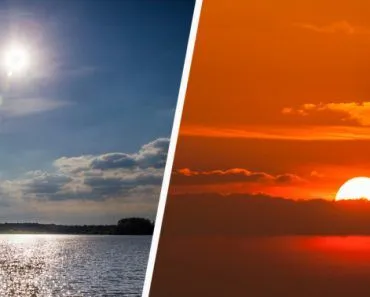
On the other hand, colors like yellow, orange, and red are less easily scattered, giving the sun a yellowish appearance throughout the day and an orange / reddish hue near the horizon.

There is a strange play of physics of light scattering that affects the color, and then the marginal effects of smoke, dust, and pollution contribute to making the sun appear yellow most of the time.
I was still sceptical even when I first realized that the sun wasn’t yellow. To the naked eye, the sun doesn’t appear as a white burning star.
However, to experience this white color of the sun, one would have to overcome the earth’s atmosphere – perhaps in the International Space Station (ISS)!
How The Sun Gets Its Color
The light emitted by the sun, which is visible to us, is only a tiny part of the huge electromagnetic spectrum. This electromagnetic spectrum consists of a wide range of different waves, ranging from gamma rays to radio waves.
Visible light in this electromagnetic spectrum lies somewhere in the middle and is only a tiny part of the entire spectrum.
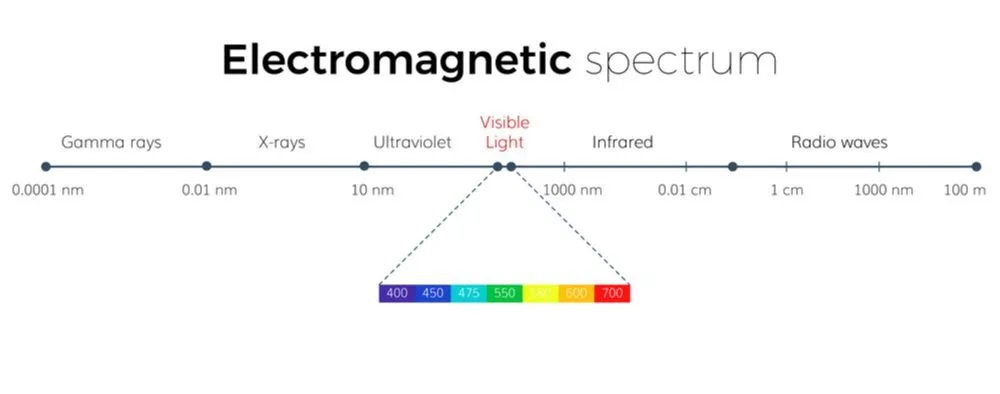
The entire spectrum of visible light emitted by the sun can best be seen through a prism. With a prism, sunlight can be broken down into its components – red, orange, yellow, green, blue, indigo and violet. These colors, from violet to red, are abbreviated as VIBGYOR.
Purple has the lowest wavelength, while red has the highest wavelength. If all these colors are combined, it forms a white color, which is the real color of the sun.
Another way to experience the individual components of the sunlight is when there is a rainbow. You can then see a beautiful spectrum of the VIBGYOR colors of visible light.

Why Isn’t The Sun Green If Its Light Peaks In Green?
Here is a fact that trips up a lot of people: if you measure how much energy the Sun pours out at each wavelength, the curve peaks at roughly 500 nanometers, which falls in the green part of the visible spectrum. So why don’t we see a green Sun in the sky? It feels like it should be the obvious answer, and yet it is wrong.

The catch is that the Sun does not emit only green light. It pours out a broad, continuous spectrum, with a hefty share of red, orange, yellow, blue and violet alongside that green peak. A single peak in a wide distribution simply does not decide the color we perceive. In fact, where the peak even lands depends on how you plot the data: physicists at West Texas A&M University note that when you graph the Sun’s output by wavelength the peak sits in the violet, but graph the very same sunlight by frequency and the peak slides all the way into the infrared. Since both plots describe the identical Sun, they argue that giving special significance to the peak of a broad spectrum is the wrong way to think about color in the first place.
What actually sets the color you see is your eye, not the graph. Your retina has three types of cone cells, and your brain blends their combined response into a single perceived hue. When light arrives carrying roughly equal helpings of every visible wavelength, that mixture reads as white. So even though the Sun’s spectrum technically peaks in green, the full mix of colors reaching your eyes averages out to white, which is exactly why no green Sun ever appears.
How The Earth’s Atmosphere Distorts The Color Of Sunlight
The reason why the sun appears yellow to us is the Earth’s atmosphere. When sunlight hits atmospheric particles, it causes electrons and protons to vibrate rapidly up and down, generating radiation at the same frequency as the incident light but emitting in all directions. This process of redirecting sunlight is called scattering.
The Earth’s atmosphere scatters away light in the blue, indigo, and violet wavelength region more prominently, while higher wavelength colors like red, orange and yellow are scattered sparsely. Due to this incongruous scattering, the Sun appears yellow. This is also why the sky appears blue during the day, as the blue wavelength is the most scattered color from the visible light spectrum.

Color Of The Sun In Space
If you are lucky enough to make it to the International Space Station one day, you can see the actual white color of the sun because it is not distorted by our atmosphere. From space, the sun will appear like a huge white glowing sphere.

What Color Does The Sun Look Like From Space Without An Atmosphere?
Strip away the atmosphere and the Sun finally shows its true color. To an astronaut on the International Space Station, on the Moon, or anywhere in the vacuum of space, the Sun is a blazing white sphere, not the friendly yellow disc we are used to drawing as kids. There is no air to scatter the blue end of the spectrum, so every wavelength arrives at the eye together and the brain reads the blend as white. NASA makes the same point about its own pictures: in photos the Sun shows up as a bright white glare precisely because it is throwing out every color we can see at once.

This is true even before you reach orbit. The Sun is white when seen from space and, on a clear day, white when seen from the ground too. The yellow tint we associate with it only really takes over near the horizon at sunrise and sunset, when sunlight travels through so much air that the shorter blue wavelengths are scattered out and warmer reds and oranges dominate (the same Rayleigh scattering covered above, and explored in detail in our companion piece on why the Sun is white at noon and red at sunrise and sunset). One quirk worth flagging: many familiar Sun images are captured in a single, narrow band of wavelengths (often invisible to our eyes) and then colorized afterward, which is why solar photos so often appear yellow or orange even though a true white disc looks oddly unfamiliar to most viewers.
Does The Color Of The Sun Really Matter?
Some of you may wonder if the color of the sun really makes a difference.
Well, the color of the Sun is actually significant for astrophysicists. A technique called spectroscopy is used to split the spectrum of light coming from a given star. This is done because splitting can give clues about the characteristics of the star from which the light is emitted. It can help astronomers estimate if a star is made of heavier elements or lighter elements, determining its age and behavior patterns.
Color also helps scientists estimate the temperature of a star. Contrary to intuition, cooler stars are actually colored red. Betelgeuse, a relatively cool star with about 3500 Degrees Kelvin, has a decidedly reddish color.
Hotter stars, such as Rigel, which lie above 10,000 Degree Kelvin, appear bluish. Our sun is estimated at 5800 Degree Kelvin, and when viewed from outside the Earth’s atmosphere, it appears white.
What Kind Of Star Is The Sun, And Why Is It Called A “Yellow Dwarf”?
Astronomers sort stars by the Morgan-Keenan system, a sequence that runs O, B, A, F, G, K, M from the hottest blue-white stars down to the coolest red ones. The Sun lands in the middle, with the official classification G2V. The letter G marks its surface temperature band, the 2 is its fine position within that band, and the V means it is a main-sequence star, still steadily fusing hydrogen into helium in its core.

NASA puts the Sun’s surface temperature at about 5,500 °C (roughly 9,900 °F), which works out to around 5,773 kelvin. To pin the figure down for everyone, the International Astronomical Union in 2015 fixed a standard “nominal” solar effective temperature of exactly 5,772 K. That value sits squarely in the range, about 5,300 to 6,000 K, that defines a G-type main-sequence star, which is why these stars are nicknamed yellow dwarfs.
The nickname is a bit of a misnomer, though. As we have seen, a star at this temperature actually glows white, not yellow, and it is hardly a dwarf in everyday terms. The “yellow” tag is a historical leftover from how the Sun looks through Earth’s atmosphere, and “dwarf” just distinguishes ordinary main-sequence stars from puffed-up giants and supergiants. So the most accurate one-line answer is this: the Sun is a white, G2V main-sequence star that we have long, and slightly inaccurately, called a yellow dwarf.
For eons, we lived with the idea that the color of the sun is yellow. In fact, we are so accustomed to the idea of a yellowish sun that astronomers often artificially alter the images of our white sun to make it appear more “natural”!
Now that you know all this, next time a teacher asks you to draw a picture of the Sun, draw it in white instead.
If you’re asked why your sun is not yellow, give a quick lesson about the atmosphere, the light, and the world around it!
References (click to expand)
- P Scherrer. What Color do YOU think the Sun is? - Stanford Solar Center. Stanford University
- The Science of Color - Smithsonian Libraries. Smithsonian Libraries and Archives
- The Physics of Light -- Color. The University of Kentucky
- What is the color of the sun? - West Texas A&M University
- Much of the sun’s light is green. Why does it look yellow? - Science News Explores
- Sun: Facts - NASA Science
- Nominal Values for Selected Solar and Planetary Quantities: IAU 2015 Resolution B3. The Astronomical Journal